EN
EN

Table of Contents
You have lost weight. You have tried facial exercises, lymphatic massage, radiofrequency devices, and maybe even double chin liposuction. Yet when you look at your profile photo, the area just under your jawline still looks heavy, rounded, and slightly “hanging.” Nothing seems to sharpen it.
For a significant number of patients, the reason is simple: the bulge is not fat at all. It is an enlarged submandibular salivary gland — a firm, glandular organ sitting beneath the jawbone that no diet, no massage, and no liposuction cannula can ever reduce.
This is where salivary gland reduction comes in. At MINE Plastic Surgery & Dermatology in Gangnam, Seoul, it is one of the procedures international patients most frequently fly in for, precisely because it addresses the one cause of a heavy lower face that most clinics abroad overlook entirely.
What Is Salivary Gland Reduction?
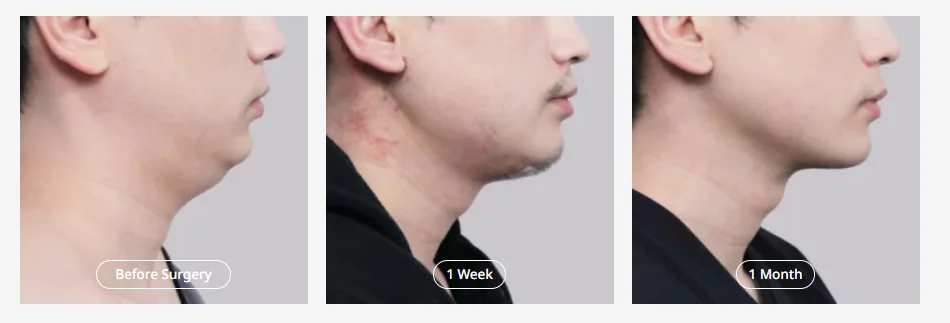
Salivary gland reduction is a surgical procedure that partially removes or reduces the volume of an enlarged salivary gland — most commonly the submandibular gland — in order to slim and define the contour of the jawline and upper neck.
You have three pairs of major salivary glands:
- Parotid glands — located in front of and below the ears; enlargement causes a wide, square lower cheek.
- Submandibular glands — located just beneath the jawbone on each side; enlargement causes the classic “double chin that isn’t fat” and a blunted jaw angle.
- Sublingual glands — beneath the tongue; rarely a cosmetic concern.
In aesthetic surgery, the submandibular gland is by far the most common target. When it is enlarged or sits low (ptotic), it pushes downward and outward against the skin, creating a soft, rounded fullness right where a sharp jawline should be.
Why Do Salivary Glands Become Enlarged?
There is rarely a single cause. In our international patient population, the most common contributors are:
- Genetics — some people are simply born with larger glands, and this often runs in families.
- Chewing habits and bruxism — habitual gum chewing, tough foods, or nighttime teeth grinding can stimulate glandular hypertrophy over years.
- Aging and ligament laxity — as the supporting fascia weakens, a normal-sized gland descends below the jaw margin and becomes visible.
- Post-liposuction unmasking — once the overlying fat layer is removed, a gland that was previously camouflaged suddenly becomes the most prominent structure in the neck.
- Significant weight loss — the same unmasking effect, achieved naturally.
If your “double chin” feels firm and slightly mobile rather than soft and pinchable, and if it did not improve after weight loss or liposuction, an enlarged submandibular gland is the most likely explanation. Only a physical examination combined with ultrasound imaging can confirm this.
Signs Your Jawline Problem Is Glandular, Not Fat
This is the single most important distinction to make before booking any surgery — and it is the reason so many patients arrive at MINE Clinic disappointed after a procedure performed elsewhere.
Question: How can I tell the difference at home?
Answer: Try a simple self-check. Stand in front of a mirror and tilt your chin slightly upward. Then press gently upward beneath the jawbone with two fingers.
- Fat feels soft, is easy to pinch between two fingers, and moves freely under the skin.
- A salivary gland feels firmer and more defined, like a small rubbery mass. It sits deeper, closer to the bone, and cannot be pinched away from the skin.
- A submandibular gland becomes more prominent when you tilt your head back or clench your jaw.
Question: Why did my double chin liposuction not fix this?
Answer: Because liposuction removes only the subcutaneous fat layer. The submandibular gland sits beneath the platysma muscle, in an entirely different anatomical plane. A cannula cannot and should not reach it. In fact, aggressive liposuction over an enlarged gland often makes the problem more visible by stripping away the fat that was softening its outline. If you are still weighing your options between the two, our page on double chin liposuction explains exactly what fat removal can and cannot achieve, and our blog covers the topic further in our double chin article collection.
How Salivary Gland Reduction Is Performed at MINE Clinic
Salivary gland reduction is a delicate procedure performed in an anatomically crowded region containing the facial nerve’s marginal mandibular branch, the facial artery and vein, and the lymphatic chain. Technique and surgeon experience matter enormously.
Here is what your surgical journey looks like at our Gangnam clinic:
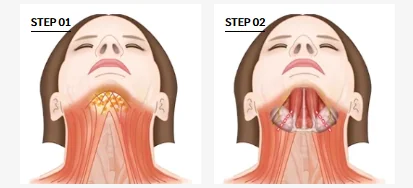
Step 1 — Consultation and Diagnostic Imaging
Your surgeon performs a manual palpation examination and reviews ultrasound imaging to confirm gland size, position, and symmetry. This step distinguishes glandular enlargement from fat, from a low-lying digastric muscle, from lymph node swelling, and from a masseter muscle issue. Each of these has a completely different treatment. We also screen for any pathological cause of enlargement — stones, infection, or a mass — which must be ruled out before any cosmetic procedure proceeds. International patients can begin this process remotely through our online consultation service by submitting photos from the front, 45-degree, and profile angles.
Step 2 — Surgical Planning
Your surgeon marks the target reduction volume. The goal is never total removal. We perform a partial, contour-driven resection that removes the portion of the gland responsible for the visible bulge while preserving functional glandular tissue and, critically, the ductal system.
Step 3 — Careful Dissection and Partial Resection
The surgeon dissects through the platysma layer, identifies and protects the marginal mandibular nerve, and isolates the gland capsule. The pre-planned portion is then resected. Meticulous hemostasis follows, and a closed suction drain is usually placed to prevent fluid collection.
Step 4 — Closure and Compression
Layered closure minimizes tension on the skin, and a compression garment is applied immediately to control swelling and support the new contour.
Typical operating time: approximately 1 to 1.5 hours for the gland reduction alone; longer if combined with liposuction, platysmaplasty, or lifting.
Why We Show Every Patient What Was Removed
Here is something that sets MINE Clinic apart, and it is deliberate.
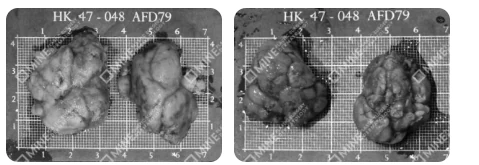
After surgery, we photograph the resected glandular tissue on a calibrated measuring grid and show it to the patient.
The images accompanying this article are real specimens from real salivary gland reduction procedures performed at our clinic. You can see the grid measurements, the size, and the distinctive lobulated texture of true glandular tissue — visibly different from the smooth, yellow appearance of fat.
Why do we do this?
- Proof of what was actually treated. Cosmetic surgery is one of the few fields where the patient cannot see the work. Showing the specimen closes that gap.
- It confirms the diagnosis was correct. The tissue removed is unmistakably glandular. Patients who spent years being told “just lose weight” finally get an answer.
- It sets realistic expectations for the result. When you can see the volume that was removed, the change in your contour over the following weeks makes intuitive sense.
- It builds trust across a language barrier. For international patients who cannot easily read a Korean operative report, a photograph communicates instantly.
Why Choose Korea and MINE Clinic
Question: Why do so many patients travel to Seoul specifically for this procedure?
Answer: Salivary gland reduction is not a routine offering at most clinics worldwide. Many surgeons outside Korea encounter enlarged submandibular glands primarily in an ENT or oncology context — for stones or tumours — not as an aesthetic contouring problem. Korean surgeons, working in a market where a defined jawline is a central aesthetic goal, have developed the procedure as a refined cosmetic operation with volume-based, contour-driven resection.
Here is what MINE Clinic adds:
1. Diagnostic Precision Before Anything Else
We routinely turn patients away from this surgery when imaging shows their fullness is caused by fat, muscle, or skin laxity instead. In those cases we redirect toward liposuction, a mini facelift, or non-surgical tightening such as Ulthera. The correct diagnosis is worth more than any surgical technique.
2. Function-Preserving Partial Resection
You have six major salivary glands. Partial reduction of one pair preserves normal salivary output. Our approach is conservative by design — we reduce the silhouette, not the function.
3. Combination Contouring in a Single Anesthesia Session
For patients traveling long distances, we can address multiple structures of the lower face in one session — glandular reduction, fat, platysma banding, and skin laxity — reducing both total recovery time and the number of trips to Korea.
4. Full International Patient Support
English-speaking coordinators, WhatsApp communication before and after surgery, airport and accommodation guidance, and remote follow-up once you return home. Details are on our International Service page.
5. Board-Certified Surgeons and Transparent Credentials
Every procedure is performed by a board-certified plastic surgeon. You can review our full team on the Medical Staff page and learn about our history on our clinic introduction page. Full procedure details are available on our dedicated Salivary Gland Reduction service page.
Important: Risks, Side Effects & Safety
No ethical discussion of surgery is complete without an honest account of what can go wrong. Salivary gland reduction is a safe procedure in experienced hands, but it is real surgery in a nerve-rich region, and you deserve to understand the risks before you decide.
Expected Side Effects (Normal, Temporary)
- Swelling — peaks around days 2 to 4, subsides substantially by week 2, with residual firmness resolving over 1 to 3 months.
- Bruising — common along the jawline and upper neck; typically fades within 10 to 14 days.
- Tightness and numbness — a sensation of tightness beneath the jaw and patchy skin numbness are normal and generally resolve over several weeks to months.
- Mild discomfort when opening the mouth wide — usually improves within the first week.
Potential Complications (Uncommon, Requiring Medical Attention)
- Marginal mandibular nerve neurapraxia — temporary weakness of the lower lip depressor muscles, causing asymmetry when smiling. Usually resolves within weeks to a few months. Permanent injury is rare but is the most important risk to understand.
- Sialocele or saliva collection — a fluid pocket that may form at the surgical site; managed with aspiration and compression.
- Hematoma or seroma — the reason a drain is placed and why the first post-operative check is critical.
- Infection — uncommon; managed with antibiotics.
- Contour irregularity or asymmetry — the two glands are rarely identical in size, and minor asymmetry can persist.
- Scarring — the incision is concealed, but individual healing varies; patients prone to keloids must disclose this during consultation.
- Xerostomia (dry mouth) — very unlikely with a partial, unilateral-preserving approach, but this is precisely why total gland removal for purely cosmetic reasons is not appropriate.
- Anesthesia-related risks — the reason a dedicated anesthesiologist is present for every case.
Who Should Not Have This Procedure
- Patients whose fullness is caused by fat or laxity rather than glandular tissue
- Patients with a history of salivary stones, chronic sialadenitis, or an undiagnosed mass — these require ENT evaluation first
- Patients with autoimmune conditions affecting salivary function, such as Sjögren’s syndrome
- Patients on anticoagulants that cannot be safely paused
- Patients with unrealistic expectations about the degree of jawline change achievable
Recovery in Korea: Your Day-by-Day Timeline
International patients always ask the same practical question first: how long do I need to stay in Seoul?
Our recommended minimum stay is 7 to 10 days.
| Timeline | What to Expect |
|---|---|
| Day 0 (Surgery day) | Procedure performed. Compression garment applied. Rest at your accommodation with head elevated. Soft, cool foods only. |
| Day 1–2 | Drain check and removal at the clinic. Swelling begins to peak. Continue cold compresses and garment wear. |
| Day 3–4 | Peak swelling and bruising. Gentle walking encouraged. Avoid chewing tough foods. |
| Day 5–6 | Noticeable reduction in swelling. Switch from cold to warm compresses per your surgeon’s instruction. |
| Day 7 | Suture removal. Most patients look presentable enough for casual outings, though some residual swelling and bruising remain. |
| Day 8–10 | Final in-person check. Clearance to fly home is typically given at this point. |
| Week 3–4 | Most visible swelling gone. Return to normal work and light exercise. |
| Month 2–3 | Deep swelling resolves. Jawline definition becomes clearly visible. |
| Month 6 | Final refined result. Scar maturation continues. |
When Can I Fly Home?
Most patients are cleared to fly 8 to 10 days after surgery, once sutures are removed and no fluid collection is present. Flying too early increases the risk of swelling and makes it difficult to manage any complication that arises mid-flight. On the plane, stay hydrated, keep your head elevated, and wear your compression garment.
Aftercare Essentials
- Sleep with your head elevated on two pillows for the first two weeks
- Wear your compression garment as directed — this genuinely affects the final contour
- Avoid vigorous chewing, gum, and hard foods for two weeks
- No alcohol, smoking, saunas, or jjimjilbang for at least three weeks
- No strenuous exercise for four weeks
- Attend all follow-up appointments, including remote check-ins after you fly home
Full instructions are provided in your discharge package and summarized on our post-operative care page.
Combining Procedures for a Complete Jawline
An enlarged salivary gland is often only one of several factors blurring the jawline. Depending on your anatomy, your surgeon may recommend combining:
- Submental liposuction — for a coexisting subcutaneous fat layer
- Mini neck lift — for skin laxity and platysmal banding
- V-line jaw reduction — when the bony jaw angle itself is wide
- Genioplasty or chin augmentation — a recessed chin dramatically worsens the appearance of a heavy neck
- Botox — for masseter hypertrophy contributing to lower face width
- Neck lift — for more advanced laxity in patients over 45
Browse more articles on jawline and anti-aging procedures in our Lifting & Anti-Aging blog collection.
Frequently Asked Questions
Will salivary gland reduction cause permanent dry mouth?
No. This is the most common concern we hear, and it is understandable. You have three pairs of major salivary glands plus hundreds of minor ones. Because we perform a partial reduction and preserve the ductal system, total salivary output remains within normal range. Some patients notice a mild, temporary change in saliva consistency during the first few weeks, which resolves. Permanent xerostomia is a risk associated with complete bilateral gland removal or radiation therapy — not with conservative aesthetic reduction.
How much does salivary gland reduction cost at MINE Clinic?
Pricing depends on gland size, surgical approach, whether the procedure is combined with liposuction or lifting, and the anesthesia plan required. For this reason, a consultation is required for personalized pricing. Submit photos through our online consultation form and our international coordinator will provide a tailored quotation via WhatsApp.
Is the result permanent?
The removed glandular tissue does not grow back, so the volume reduction is permanent. However, the jawline continues to age. Skin laxity, fat redistribution, and ligament descent will progress naturally over the decades, which may soften the definition over time. Patients who maintain a stable weight and address chronic teeth grinding tend to hold their result longest.
Will there be a visible scar?
The submental incision is placed in the natural crease beneath the chin, where it is hidden in shadow and invisible in a standard front-facing view. The retroauricular incision is concealed behind the ear. Most scars mature to a fine pale line within 6 to 12 months. Patients with a history of keloid or hypertrophic scarring should mention this at consultation so we can plan scar management from day one — see also our scar treatment options.
Can I have this procedure done during a two-week trip to Korea?
Yes, and this is the most common schedule for our international patients. A typical itinerary is: arrival and in-person consultation with imaging on day 1, surgery on day 2 or 3, suture removal on day 9 or 10, final check and flight clearance on day 11 or 12. Book early through our online reservation system so we can secure your consultation and surgery dates before you purchase flights.
Ready to Take the Next Step?
“Interested in this procedure? Contact Mine Clinic today for a personalized online consultation. We are ready to assist you on WhatsApp and guide you through your K-Beauty journey in Seoul.”
WhatsApp: +82 10 3476 1175 | Instagram: @mineps.eng
This content is for informational purposes only and does not substitute professional medical advice. Individual results vary. Please consult a qualified physician regarding your specific condition.
Reviewed by Dr. Lee Sung-wook, Board Certified Plastic Surgeon at Mine Clinic.