EN
EN

Chemical peel aftercare is the day-by-day routine you follow once the peel itself is over: no washing for the first 24 hours, no picking at flaking skin or scabs, light moisturizer applied often, and disciplined sun protection for at least three to four weeks. At MINE Plastic Surgery & Dermatology in Seoul we give this same handout to every patient who has an Aladdin Peeling or a Dot Peel, because what happens at home decides the result far more than the twenty minutes spent on the treatment bed.
I am Dr. Lee Sung-wook, board-certified plastic surgeon and director of MINE in Gangnam, Seoul. What follows is our own chemical peel aftercare sheet for facial peels, set out in the order your skin will raise the questions.
Table of Contents
- Aladdin Peeling and Dot Peel: Why the Aftercare Is Different
- Chemical Peel Aftercare in 10 Rules: The Handout We Give Patients
- The First 24 Hours: When Can You Wash Your Face After a Chemical Peel?
- Days 2 to 4: Flaking, Itching and Stinging Explained
- Moisturizing Without Adding Oil: The Aftercare Routine That Confuses Patients
- Days 7 to 10: Dot Peel Scabs and How to Protect Them
- Weeks 3 to 4: Sunscreen and Preventing Dark Marks
- Chemical Peel Aftercare Day by Day: The Recovery Timeline
- Everyday Habits Patients Forget After a Peel
- When to Call the Clinic — and Who Should Postpone a Peel
- Frequently Asked Questions About Chemical Peel Aftercare
- Planning a Korean Peel Treatment at MINE in Seoul
Aladdin Peeling and Dot Peel: Why the Aftercare Is Different
The two are often done in the same appointment, which is why patients mix them up. The skin reacts differently to each, so the instructions diverge the moment you leave.
What Aladdin Peeling does across the whole face
An Aladdin Peeling is applied over the entire face or a wide section of it, and fine flaking follows across that whole area. The skin also feels tighter and drier than usual while it renews. Here chemical peel aftercare is mostly about managing dryness and resisting the urge to help the flakes along.
What a Dot Peel scab is, and why it is left alone
A Dot Peel works point by point on specific marks. Each treated spot forms its own thin scab while the surrounding skin carries on as normal, so the question becomes narrower: how do you keep that scab in place until it is ready to come off?
If you had both in one visit, follow both sets of instructions. Readers still deciding what to book want a treatment guide rather than this one — our piece on the aqua peel facial in Seoul covers that side of a Korean peel treatment.
Face only: body treatments follow a different plan
All the chemical peel aftercare on this page is written for the face. Peels on the back and chest sit under thicker skin and stay covered by clothing, so their recovery rules differ. For that, read our guide to back and chest acne treatments instead.
Chemical Peel Aftercare in 10 Rules: The Handout We Give Patients
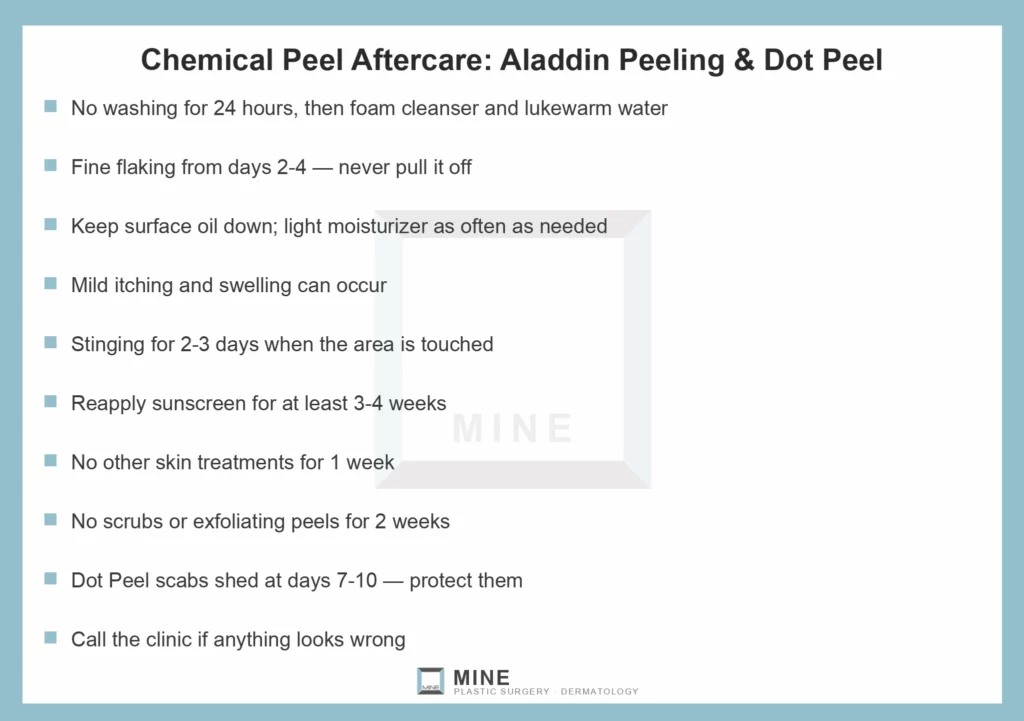
Below is the sheet our dermatology team hands over at the door, translated but otherwise unchanged. Keep these ten lines and you have covered most of chemical peel aftercare; the rest of this article explains the reasoning behind each one.
- Avoid washing your face for 24 hours. After that, cleanse gently morning and evening with a foam cleanser and lukewarm water; if your skin is oily, you may rinse briefly with plain water in between — no extra cleanser.
- Fine flaking starts 2 to 4 days after treatment and sheds on its own schedule, so never pull it off with your fingers.
- Keep surface oil down, and when the skin feels dry apply a light moisturizer or your recovery cream as often as you need it.
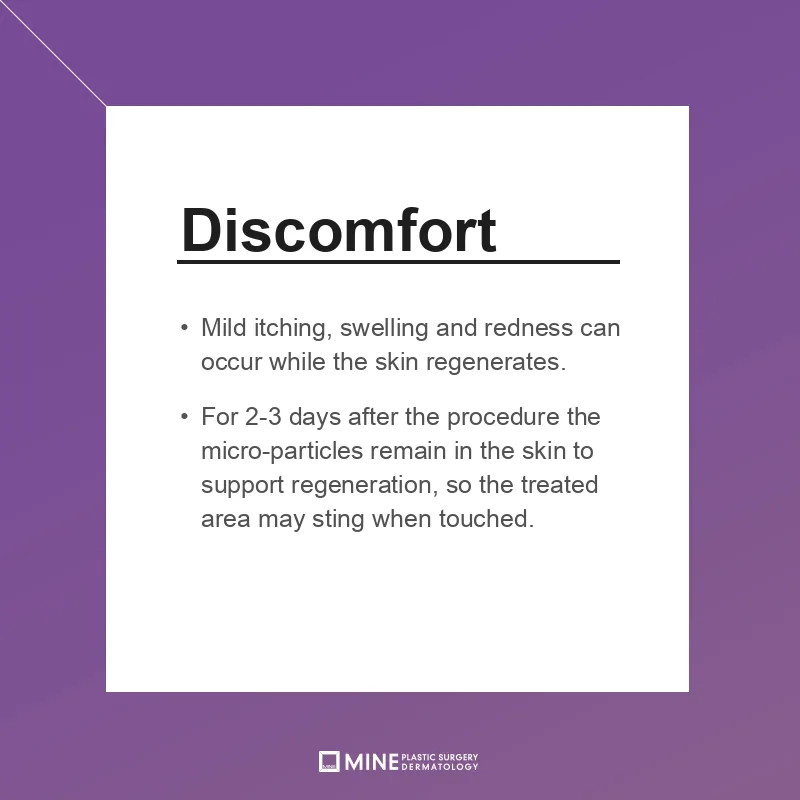
- Mild itching and slight swelling can occur while the skin regenerates.
- For 2 to 3 days the treated area may sting when touched, because the micro-particles left in the skin are still supporting regeneration.
- Reapply sunscreen throughout the regeneration period — at least 3 to 4 weeks.
- No scrubs, peeling gels or exfoliating pads for about 2 weeks.
- Avoid other facial treatments for about a week after the peel.
- Dot Peel spots look slightly darker on the day, scab over the next day and shed after 7 to 10 days. Protect them when you wash and when you remove makeup.
- Contact the clinic if a pustule forms, if a healed spot becomes raised, or if redness or pigment changes drag on.
The First 24 Hours: When Can You Wash Your Face After a Chemical Peel?
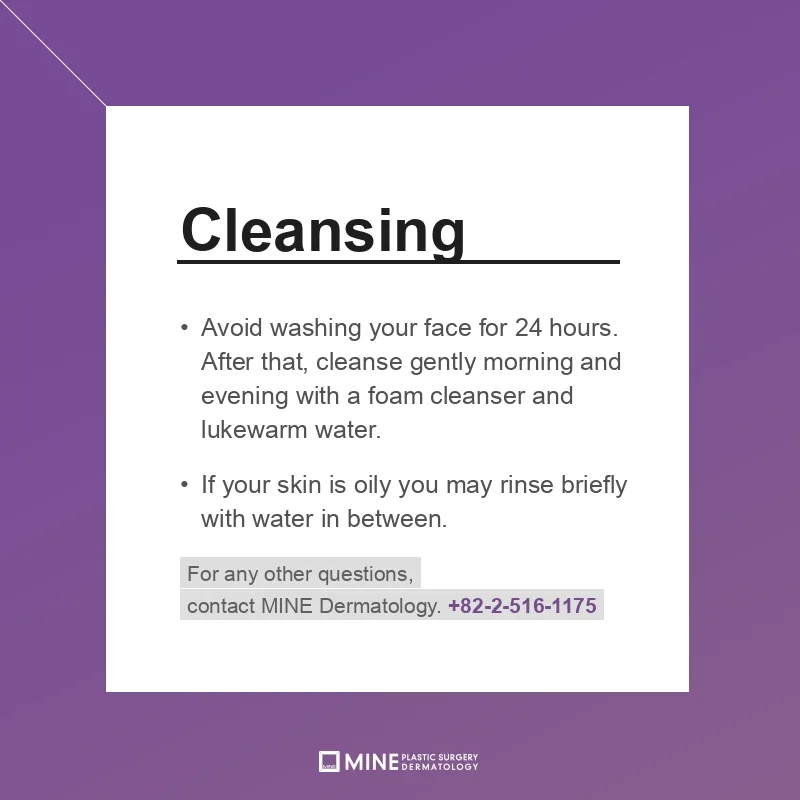
Do not wash your face for the first 24 hours after the peel; from day two, cleanse twice a day with a foam cleanser and lukewarm water. This is the question we field most often by phone.
The 24-hour no-wash window
Straight after a peel the surface reacts to water and cleansing agents far more sharply than usual. Washing in that window is an irritant in itself, and it rinses away material that is still doing useful work. Day one is the easiest part of chemical peel aftercare: you do nothing.
How to cleanse from day two: lukewarm water, foam cleanser, no rubbing
Two words matter: lukewarm and gentle. Hot water dries the skin further and keeps redness hanging around. Roll the foam over your face with your fingertips instead of scrubbing, then press a towel against the skin to blot rather than wiping it dry.
If your skin runs oily, a quick rinse with plain water between washes is fine — but do not add a second cleanser to it. Chemical peel aftercare in this first week is largely a matter of doing less than you normally would.
Heat, steam and water: sauna, long showers, pools
Heat and moisture both feed redness, and anything abrasive undoes the surface you are protecting. For the first week or two, chemical peel aftercare means keeping this list off the schedule:
- Sauna, jjimjilbang (the Korean dry sauna) and long hot showers
- Cleansing brushes and any tool with an exfoliating head
- Grainy scrubs, peeling gels and exfoliating pads
- High-strength acid products and strong resurfacing actives
- Rubbing your face dry with a towel
- Swimming pools, the sea and public bathhouses
Exercise is a question of sweat rather than movement. A walk is fine from the next day; hard training that leaves you dripping is worth postponing for a few days.
Days 2 to 4: Flaking, Itching and Stinging Explained
Fine flaking usually starts 2 to 4 days after an Aladdin Peeling and settles over the following one to two weeks, depending on how quickly the skin renews. Some patients are clear in three days; others shed lightly into week two.
Why you must not pull the flaking skin off
A flake lifting at one edge is still anchored at the other. Pull it and you tear away skin that has not finished forming underneath — which is how a straightforward recovery turns into weeks of redness or a patch of pigment that outlasts everything else.
Plan around it instead. If you have a wedding or a big presentation coming up, book the peel at least a week and a half earlier, since chemical peel aftercare is far easier when you are not trying to look polished in the middle of it.
Mild itching, slight puffiness and redness often arrive together now, and all three are an ordinary part of chemical peel aftercare in this window. For 2 to 3 days the area may sting when touched, because the micro-particles placed during treatment are still in the skin supporting regeneration. That fades day by day — but if itching keeps you awake, or swelling grows rather than shrinks, tell us rather than waiting it out.
Habits that make the flaking phase easier
- Press moisturizer onto a lifting flake instead of touching it with bare fingers
- Lay a cool damp towel on an itchy patch for a minute rather than scratching
- Hold off on makeup until the flaking has largely settled
- If you use a sheet mask, choose a bland one and keep it short
- Break the habit of resting your chin or cheek on your hand
The two-week ban on scrubs and exfoliating acids covers this whole phase. It feels counter-intuitive while your face is visibly flaking, but the flakes are the old surface leaving on schedule.
Moisturizing Without Adding Oil: The Aftercare Routine That Confuses Patients
One line of the chemical peel aftercare handout looks self-contradictory: keep oil off the skin, but apply moisturizer whenever it feels dry. The halves describe different things. The first means do not let sebum or heavy oils sit in a thick film on the surface; the second means keep the water content up, because regenerating skin loses it fast.
Light moisturizer, applied often — not one thick layer
Thin layers reapplied through the day are more comfortable than one heavy morning application, and they do not trap heat on skin that is already flushed. If you were sent home with a recovery cream, use it at the frequency you were given.
Indoor humidity matters more than people expect once heating or air conditioning is running. If you like a facial mist, seal it with cream immediately — mist left to evaporate takes moisture with it. Patients who want a gentler in-clinic option while the skin settles sometimes ask about an LDM facial, which is planned around a peel rather than layered onto it.
Actives to pause until the skin has re-sealed
Dermatology textbooks put re-epithelialization — the point at which the skin surface has sealed itself again — at 7 to 10 days after a superficial peel, and advise waiting until then before restarting AHA, hydroquinone or retinoid products. The same texts put daily moisturizer and strict sun avoidance alongside it as the core of chemical peel aftercare.
Until the surface has closed, park the following:
- Retinol and prescription retinoids
- AHA and BHA exfoliants
- High-concentration vitamin C serums
- Toners with a high alcohol content
- Heavily fragranced products, and anything you have never used before
When you restart depends on how your own skin has recovered, so confirm it at your follow-up. Reintroducing one product at a time makes it obvious which one your skin objects to if something flares.
Days 7 to 10: Dot Peel Scabs and How to Protect Them
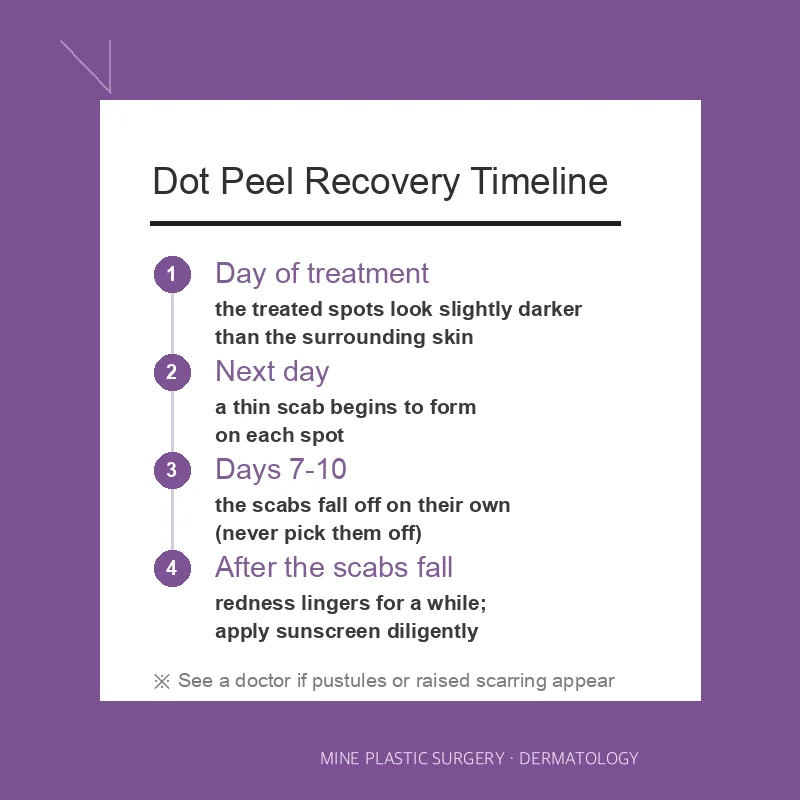
Dot Peel spots look slightly darker on the day of treatment, form a thin scab the next day, and shed on their own after 7 to 10 days. That scab is a temporary dressing the skin has made for itself, so chemical peel aftercare here has one objective: keep it there until it lets go.
A scab knocked off early exposes skin that has not finished healing, and the usual result is lingering redness or a visible mark. The two moments chemical peel aftercare most often goes wrong are predictable — washing your face, and taking off makeup.
Washing and removing makeup around a scab
Chemical peel aftercare around a scab is mechanical rather than chemical — almost all of it is about keeping friction away from that one point.
- Let water run over the scab rather than working your fingers across it
- Blot with a towel; never wipe
- Keep cleansing wipes and cotton pads away from the spot entirely
- Do not build layers of makeup on a scab and scrub them off each night
- Resist scratching it, however much it itches, and keep fingernails away
- Check that a mask strap or hat brim is not rubbing the same spot repeatedly
What to do if a scab comes off early
A half-lifted scab is the risky stage, because the snagging feeling makes people pick without thinking. A thin film of moisturizer keeps it supple and stops it catching, which usually buys the last day or two you need.
If one does come away early you cannot put it back, so treat that spot with extra care: keep friction off it, moisturize it, and be strict with sunscreen there. Get in touch if it weeps, swells or turns tender.
Weeks 3 to 4: Sunscreen and Preventing Dark Marks
Sunscreen is the longest-running rule in chemical peel aftercare: reapply it for at least 3 to 4 weeks, and every 2 to 3 hours while you are outdoors. It applies identically after an Aladdin Peeling and after a Dot Peel.
Skin that is still regenerating responds to ultraviolet light far more strongly than settled skin, and pigment laid down in that window can take months to fade. Prevention costs a tube of sunscreen; correction costs a course of treatment, which is why this is the one part of chemical peel aftercare we repeat at every follow-up.
Why re-applying matters more than the first application
One application at breakfast is not sun protection — it is the first of several. Clinical studies of superficial peels report that lasting pigment change is uncommon when the acid strength is raised slowly; in one published series of 25 patients with deeply pigmented skin, only 3 developed temporary darkening and none was left with permanent pigmentation. Darker skin tones tolerate superficial peels well, but sunscreen compliance has to be tighter.
- Reapply every 2 to 3 hours whenever you are outside
- Wear it on overcast days and beside windows indoors
- Use a hat, parasol or mask as physical cover when reapplying is awkward
- Avoid long stretches outdoors in the middle of the day
- Over a scab, pat sunscreen on gently rather than rubbing it in
If pigment has already appeared
Resist attacking a mark with strong brightening products bought on your own — irritated skin pigments more, not less. The textbook approach pairs a topical tyrosinase inhibitor (a cream that slows the enzyme your skin uses to make melanin) with reinforced sun protection. Our guide to acne scars and post-inflammatory pigmentation covers that in detail.
Chemical Peel Aftercare Day by Day: The Recovery Timeline
Here is the whole of chemical peel aftercare on one screen, from the treatment chair to the end of week four.
| Timing | Aladdin Peeling | Dot Peel | Both |
|---|---|---|---|
| Day of treatment | No washing | Spots look slightly darker | Hands off your face |
| After 24 hours | Lukewarm cleansing starts, morning and evening | Thin scabs begin to form | Light moisturizer, applied often |
| Days 2 to 4 | Fine flaking begins; stinging possible | Scabs stay put | Do not touch flakes or scabs |
| Days 7 to 10 | Flaking gradually settles | Scabs shed on their own | Keep sunscreen going |
| Up to 2 weeks | No scrubs or peeling products | Redness where scabs have shed | Irritating actives still on hold |
| Weeks 3 to 4 and beyond | Skin regeneration continues | Redness keeps fading | Reapply sunscreen through the day |
Recovery speed varies, so read the timings as a guide rather than a schedule. This general recovery guidance for chemical peels sets out the same phases, and your own chemical peel aftercare will depend on the depth of the peel and the area treated.
Everyday Habits Patients Forget After a Peel
Patients who follow the chemical peel aftercare handout closely still get caught out by ordinary daily life. These come up at follow-up appointments, and none of them are on the sheet.
Pillowcases and towels come first. Your face spends hours against them, so wash them more often through the recovery period, and if you sleep face-down try to change position for a couple of weeks. Dot Peel scabs are dislodged against a pillow more often than you would think.
Masks cut ultraviolet exposure, which helps, but the straps and inner surface rub in exactly the wrong places. If you wear one all day, take it off periodically and do not leave a damp mask against a healing area.
Alcohol dilates blood vessels, so redness and puffiness look worse the morning after. Dermatology literature also lists smoking as a factor that slows healing, which is why we ask patients to cut back for the 3 to 4 weeks of recovery — the stretch of chemical peel aftercare when the skin does the most repair work.
- Do not trial a brand-new product on your face during this window
- Postpone hair coloring and perms, where the solutions run down onto the face
- Schedule travel and outdoor plans for after the flaking and scabs have settled
One last worry we hear often: my skin feels thinner than it used to. As the outer layer reorganizes it can genuinely feel that way for a while, and it settles once moisturizing and sun protection are steady.
When to Call the Clinic — and Who Should Postpone a Peel
Most of what happens in the first two weeks is ordinary healing. A short list of changes is not, and those are worth a phone call rather than a search engine.
Warning signs that need a doctor
Call us at +82-2-516-1175 if any of the following appears. Early attention keeps a small problem small, which is the whole point of chemical peel aftercare.
- A pustule forms on a Dot Peel spot
- A healed spot becomes raised or firm compared with the skin around it
- Swelling and pain are still increasing after several days instead of easing
- The area feels hot and keeps weeping fluid
- Itching is bad enough to disrupt your day or your sleep
- Blister-like lesions keep appearing around the lips
- Redness or a change in pigment carries on for weeks
Do not reach for ointments or leftover medication on your own. Skin in recovery does not respond the way it normally does, and a product that has always suited you can behave unexpectedly on a freshly peeled surface.
Who should not have a superficial peel right now
A few situations mean a superficial peel is not performed until they have resolved. We check for these at consultation, and they are worth knowing if you are booking ahead:
- An active herpes simplex infection (a cold sore) anywhere on the face
- Active eczema on the area to be treated
- A fresh tan on the skin
- Isotretinoin taken within the past year
- Any skin cancer in the area
None of this should alarm anyone already recovering. Complications from superficial peels are generally minor and reversible — temporary pigment change, redness lasting under three months, small white bumps, an acne flare, a cold sore waking up, or a superficial bacterial infection — and all are manageable when reported early. Independent public health guidance on chemical peels covers the same ground for readers who want a second source.
Frequently Asked Questions About Chemical Peel Aftercare
What should you not do after a chemical peel?
The short version of chemical peel aftercare is to do less, not more. Do not wash for 24 hours, do not pull at flaking skin or pick scabs, and keep scrubs and exfoliating acids away for about two weeks. Skip the sauna and long hot showers, and never go out in strong sun without protection.
What is the worst day after a chemical peel?
Most patients find days 2 to 4 the most uncomfortable, because fine flaking, tightness and stinging peak together. Dot Peel scabs feel most fragile just before they shed at days 7 to 10.
What should you do in the first 24 hours after a chemical facial peel?
Leave your face alone: no cleanser, no water, no makeup, no touching. Once the 24 hours are up, cleanse gently with lukewarm water and a foam cleanser, then apply a light moisturizer.
What helps a chemical peel heal faster?
Keeping the skin moisturized, letting flakes and scabs fall on their own, staying out of strong sun, and pausing retinoids and acids until the surface has re-sealed at around 7 to 10 days. Cutting back on smoking helps too.
How many days does the flaking last after an Aladdin Peeling?
Fine flaking usually begins on days 2 to 4. Some people are clear within a few days, others shed gradually over one to two weeks. Either way it has to come off on its own.
When can I wear makeup again after a peel?
Once the flaking has largely settled. If you cannot wait, moisturize first, use the lightest coverage possible, and remove it without rubbing. Skip any spot that still has a scab.
What should I do if a Dot Peel scab came off early?
You cannot put it back, so treat that spot more carefully than the rest. Avoid friction, keep it moisturized, and be strict with sunscreen there. If it weeps or swells, contact the clinic.
When can I exercise or use a sauna after a chemical peel?
A gentle walk is fine straight away. Heavy sweating, sauna and jjimjilbang should wait until the flaking and scabs have settled, because heat and sweat make redness and irritation worse.
Can I have an Aladdin Peeling and a Dot Peel on the same day?
They are often combined, but whether that suits you depends on your skin and the area being treated, so it is decided at consultation. If you have both, follow both sets of chemical peel aftercare instructions.
Planning a Korean Peel Treatment at MINE in Seoul
Chemical peel aftercare comes down to three things: leave it alone, keep it moist, keep it out of the sun. Everything above is detail hung on those three lines.
If you are planning a Korean peel treatment while you are in Seoul, the aftercare is part of what we plan with you rather than a sheet handed over at the end. Depth, area and your own skin type all change how long each phase runs. You can see the full range of dermatology treatments at MINE in Seoul before you decide.
For an appointment, or a question about a peel you have already had, call +82-2-516-1175. Patients who have flown home are welcome to send photographs — remote follow-up is a normal part of how we look after international patients.
Written and medically reviewed by Dr. Lee Sung-wook, board-certified plastic surgeon, MINE Plastic Surgery & Dermatology, Seoul.
※ This content is for informational purposes only and does not replace professional medical advice, diagnosis, or treatment. Individual results may vary, and side effects may occur. Please consult with a board-certified plastic surgeon for personalized advice.