EN
EN

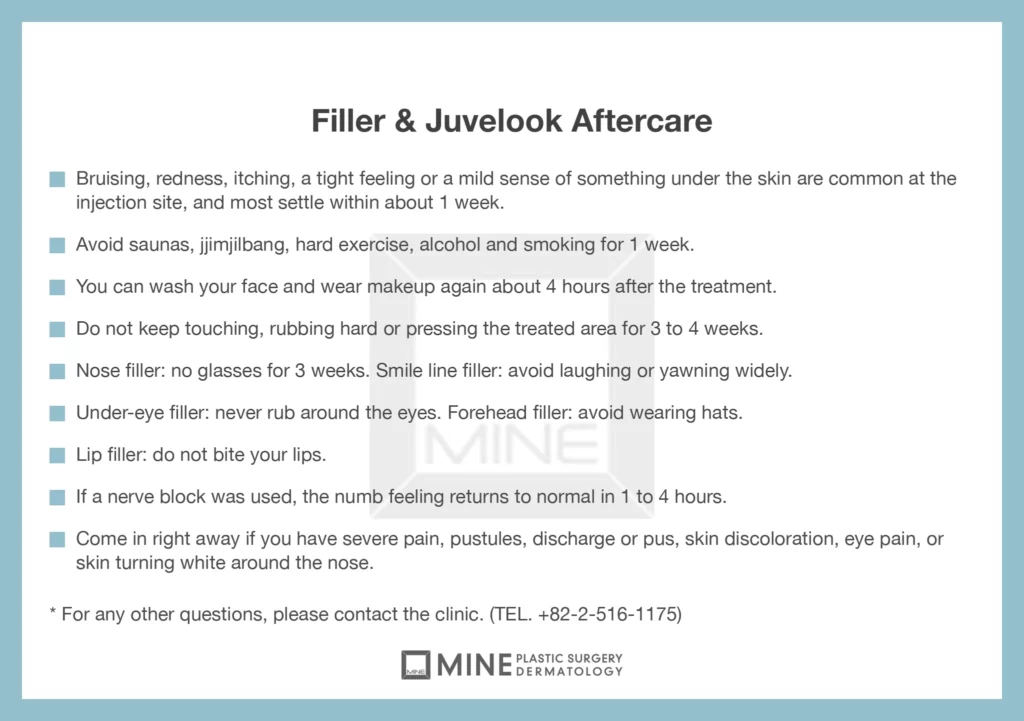
Filler aftercare is the short set of rules you follow in the hours, days and weeks after a dermal filler or collagen booster injection, so the product stays where your doctor placed it and the normal bruising and swelling fade on schedule.
One filler aftercare rule matters more than any other: the instructions are not the same for every injectable. Hyaluronic acid filler should be left alone. A collagen booster such as Juvelook may need gentle massage — but only in the way your clinic shows you.
And if the skin around the injection turns white or blotchy, stop reading and call the clinic. That single sign has its own section below, because it is the part of filler aftercare that cannot wait.
- What Filler Aftercare Is — and Why the Rules Change With the Product
- Hyaluronic Acid Filler vs. Juvelook: Opposite Rules on Touching and Massage
- The First 24 Hours: Washing, Makeup and the 4-Hour Mark
- How Long Filler Swelling and Bruising Last
- What Not to Do After Filler: Heat, Alcohol, Exercise and Smoking
- Area-by-Area Filler Aftercare: Nose, Smile Lines, Under-Eye, Forehead and Lips
- Red Flags: When to Call the Clinic the Same Day
- Filler Aftercare FAQ
- Aftercare Questions? Talk to MINE in Seoul
What Filler Aftercare Is — and Why the Rules Change With the Product
Nearly all dermal filler aftercare comes down to two ideas: leave the product where it was placed, and give the needle punctures time to close. Every rule below is one of those two ideas in a particular situation.
What counts as normal in the first week
Bruising, redness, itching, a tight or stiff feeling and a mild sense of something sitting under the skin are all common at the injection site, and most of them settle within about 1 week.
None of it means the treatment went wrong; the body answers a needle as it answers any small injury. What matters is the direction of travel — from one day to the next, quieter rather than louder.
Why a collagen booster can feel different from a dermal filler
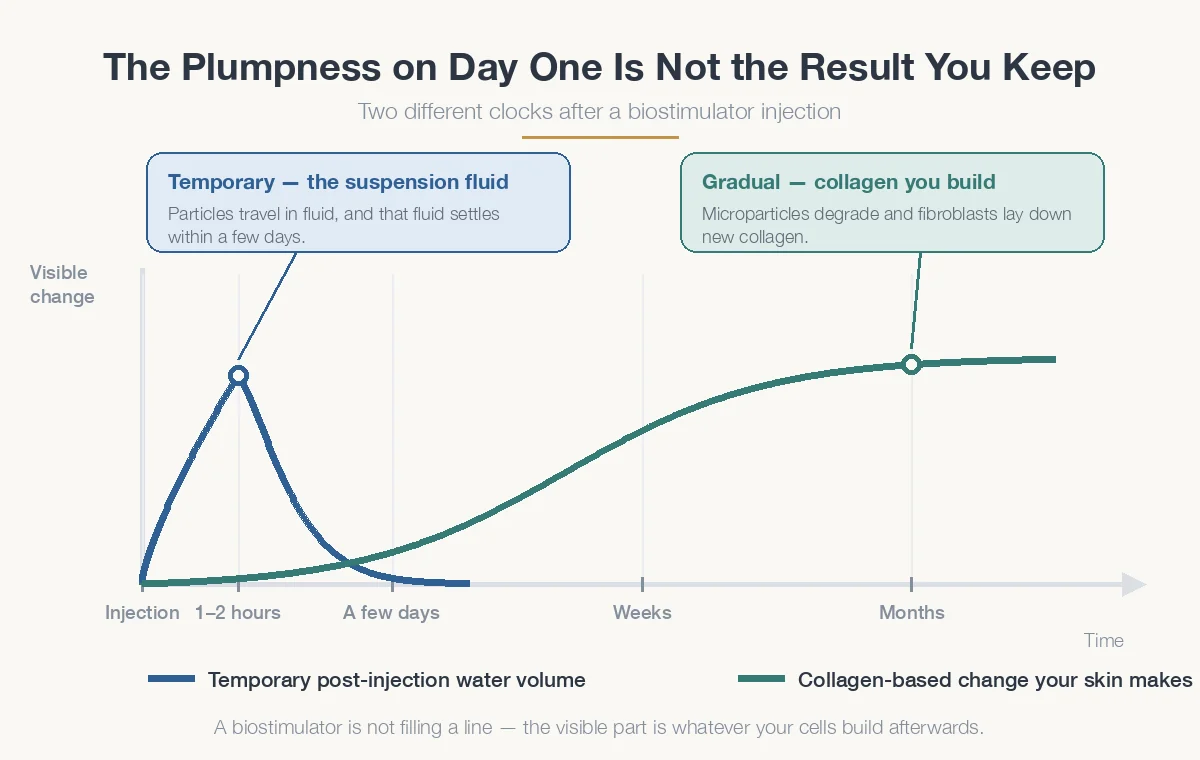
A dermal filler adds volume immediately: a gel sits in the tissue and holds a shape. A collagen booster works the other way around, prompting your own skin cells to build collagen over the following weeks.
Dermatology textbooks report that poly-lactic-acid collagen stimulators cause more injection-site pain, bruising and swelling than most other injectables, partly because a larger needle is used, and in practice those reactions still tend to quiet down within about 1 week.
Juvelook belongs to that broad family but is not the same product as the older poly-L-lactic acid injectables those textbooks describe. It combines PDLLA (polylactide) with hyaluronic acid, and that difference is exactly why its filler aftercare instructions are its own.
Who needs to follow this most closely
Be stricter than average if you smoke, bruise easily, or take aspirin, an anti-inflammatory painkiller or a blood thinner. The same goes for thin skin such as the under-eye, and for areas where vessels sit close together such as the nose. None of that makes treatment unsafe — it means your filler aftercare is worth following to the letter.
Hyaluronic Acid Filler vs. Juvelook: Opposite Rules on Touching and Massage
This is the part of filler aftercare people most often get wrong, and the one place where getting it wrong can change your result. Two injectables that both arrive by needle can carry instructions pointing in opposite directions.
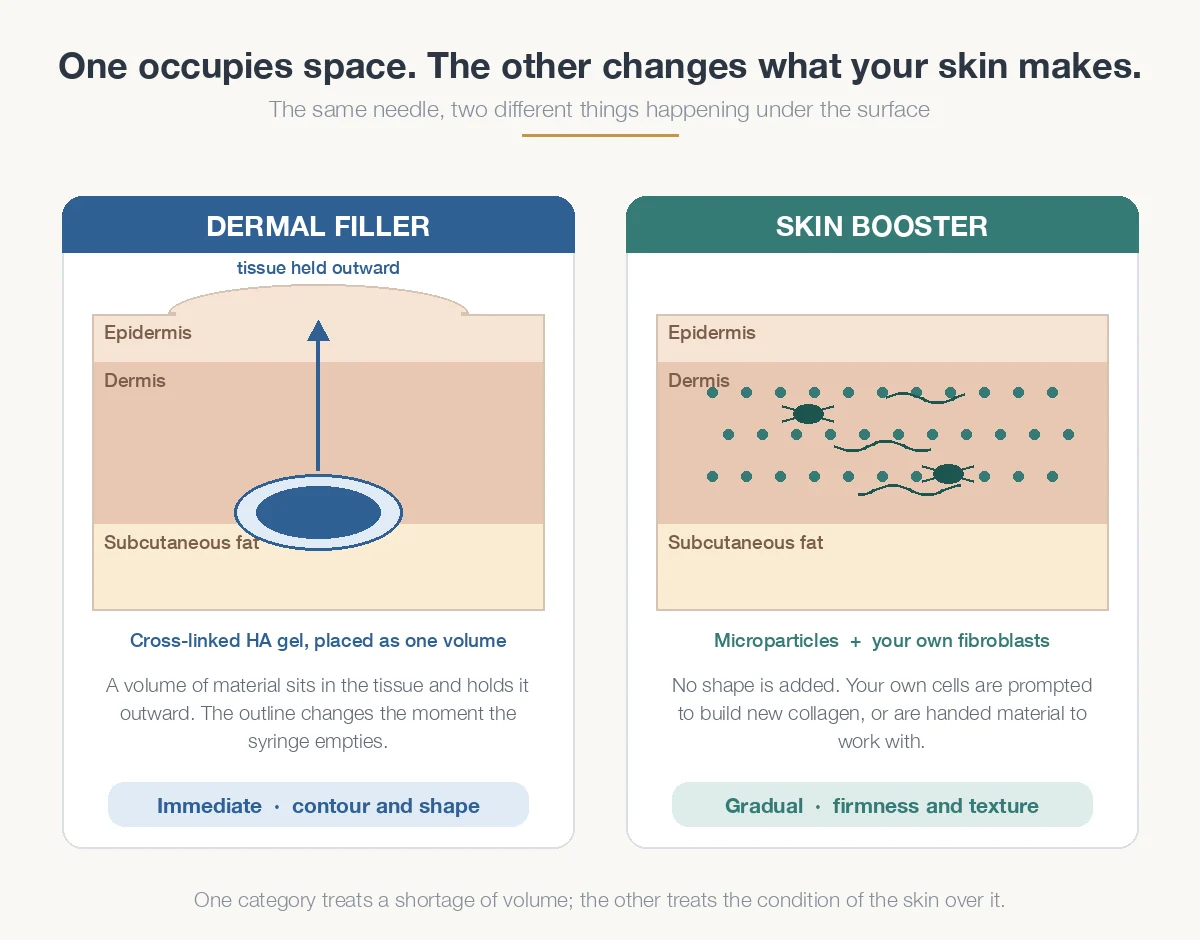
If you had hyaluronic acid filler: hands off for 3 to 4 weeks
Hyaluronic acid filler should not be rubbed, pressed or repeatedly touched for 3 to 4 weeks after treatment. The gel is settling into a pocket your doctor shaped for it, and steady pressure can move it before the surrounding tissue has held it in place.
It is the unthinking habits that matter: resting your chin on your hand at a desk, sleeping face-down, pulling a mask strap tight across the cheek. If you are not certain which product you were given, follow the instructions from the clinic that treated you.
If you had Juvelook or another collagen booster: massage only as your doctor instructs
Here the instruction can be the reverse. Cosmetic dermatology textbooks note that asymmetry and nodular lumps are largely avoided by careful injection technique combined with post-injection massage, which is why a collagen booster may come with a request to massage the area gently on a set schedule.
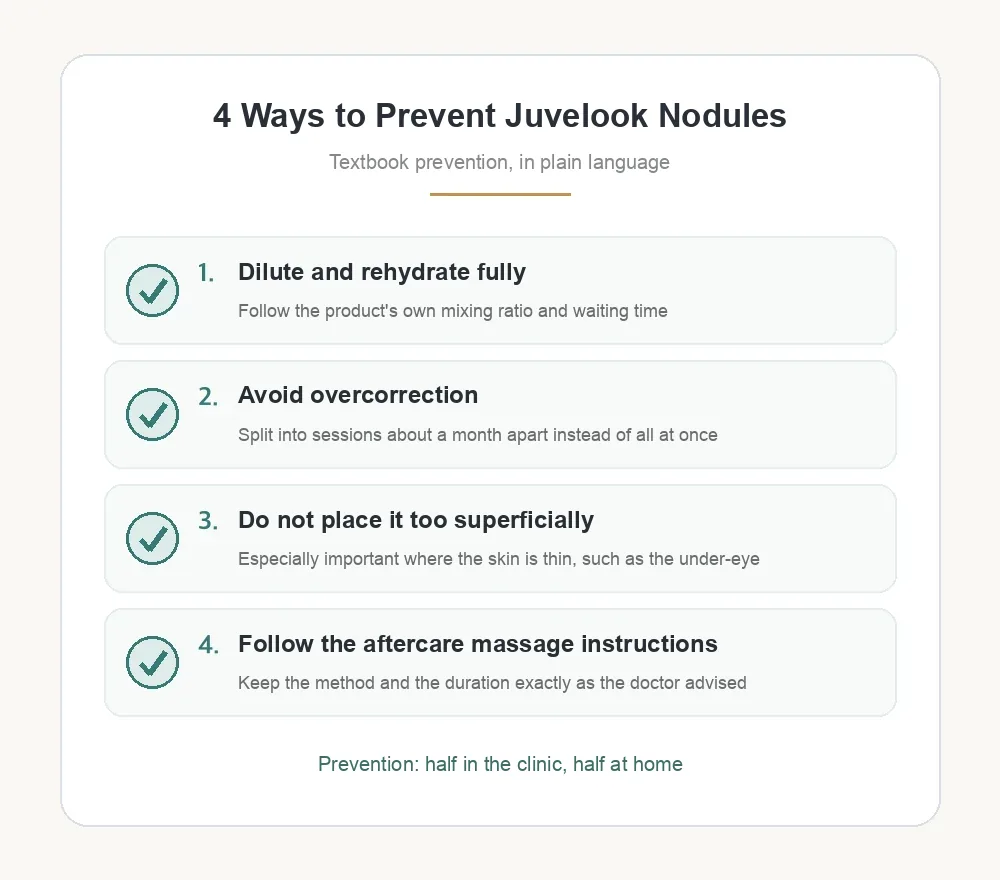
Read that carefully. The massage in question is the one your clinic prescribes, in the way and for as long as they demonstrate — not permission to knead the area whenever you think of it. And again: if you are not sure which product you had, follow your clinic’s filler aftercare instructions rather than a general rule from the internet.
MINE’s own Juvelook collagen booster page lists the downtime as none, and that is accurate — nothing forces you to hide at home. But no downtime is not the same as no filler aftercare: the four-hour rule still applies, so does the week without heat and alcohol, and so does whatever massage instruction you were given.
The side effects of collagen biostimulators as a group have never been gathered into a single comprehensive review — a 2026 review protocol in the Journal of Clinical Medicine confirms that one is still missing. That is one more reason your instructions should come from the clinic that chose your product, rather than from a general filler aftercare article.
Not sure which one you had? Here is how to tell
A rough guide: if the appointment was about adding volume or reshaping a contour — a nose bridge, a chin, deeper smile lines — it was most likely a hyaluronic acid filler. If the goal was skin quality or firmness across an area rather than a shape, a collagen booster is more likely.
That’s a guide, not a diagnosis; your treatment record has the answer and one phone call settles it. If you want the difference explained properly, we have written about how a skin booster differs from a dermal filler.
| Filler aftercare rule | Hyaluronic acid filler | Juvelook / collagen booster |
|---|---|---|
| Touching the area | Avoid for 3 to 4 weeks | Avoid, apart from the massage you were shown |
| Massage | No — not unless your doctor asks for it | Yes, but only as your clinic instructs |
| Why the rule exists | Pressure can move gel that has not settled | Even spreading helps prevent lumps |
| Washing and makeup | About 4 hours | About 4 hours |
| Heat, alcohol, hard exercise | Avoid for about 1 week | Avoid for about 1 week |
| If you are unsure which you had | Follow the instructions from the clinic that treated you | |
The First 24 Hours: Washing, Makeup and the 4-Hour Mark
Day one of filler aftercare turns on a single number — the one patients search for most.
The 4-hour mark: when you can wash your face and wear makeup
Yes — after about 4 hours. You can wash your face and wear makeup again roughly 4 hours after a filler appointment, and from that point most of normal daily life resumes.
The reason is plain: the tiny needle entry points need time to close before anything is pressed or smeared across them. Until then, skip the cleansing brush, the exfoliating pad and any foundation you have to rub in.
One distinction saves a lot of confusion. The 4-hour mark covers washing and makeup only: saunas, alcohol and hard exercise run on a 1-week clock, and pressing or massaging the area on a 3-to-4-week clock — three filler aftercare timelines, not one.
Cold packs — and why acetaminophen beats ibuprofen
A cold pack, applied on and off rather than held in place, eases both the swelling and the ache of the first evening. Wrap it in a cloth — no ice directly on skin.
Most of that tenderness passes within about 1 week, and for that soreness, cosmetic dermatology textbooks prefer acetaminophen over an NSAID such as ibuprofen, because NSAIDs can make bruising worse.
Acetaminophen is the drug sold as paracetamol or Tylenol; ibuprofen, naproxen and aspirin are NSAIDs, which thin the blood slightly and can deepen a bruise. If you take any of them regularly, ask your doctor before changing anything.
Numbness after a nerve block: 1 to 4 hours
If a nerve block was used, part of your face will feel dull or absent for a while. Normal sensation usually returns on its own within 1 to 4 hours.
Textbooks trace that dulled feeling to the needle or cannula irritating a nerve, or to the lidocaine mixed into many products, and they note that lasting nerve injury is rare. That’s why a return to normal within 1 to 4 hours is the expected pattern rather than a lucky one.
While the area is numb, be careful with hot drinks and with biting your cheek or lip — you cannot feel what you are doing to skin you cannot feel.
How Long Filler Swelling and Bruising Last
This is the most-searched filler aftercare question, and it has a short answer. Swelling and bruising after filler generally improve within about 1 week.
Swelling: what the first week usually looks like
Swelling is usually at its most obvious on the first morning, when fluid has had a night to settle, and it drifts down from there. Sleeping with your head slightly raised for the first two nights makes a visible difference.
Research on hyaluronic acid fillers describes temporary swelling, palpable lumps and acne-like bumps as the common early reactions, with the everyday ones easing within about 1 week.
What is not usual: swelling that keeps growing after the first 48 hours, one-sided swelling that worsens, or swelling with real pain behind it. Those belong in the red flags section below.
Bruising: why it happens and how to help it fade
A bruise means a small vessel was crossed on the way in. Nothing about it says the injection was done badly — some faces simply bruise, and the under-eye and lips bruise most readily.
Bruising is where good filler aftercare shows most visibly: cold packs early, acetaminophen rather than ibuprofen, no alcohol, and patience. Makeup can cover it from about 4 hours onward. If bruising would be a problem for an event, leave yourself a margin of a couple of weeks when you book.
Small lumps you can feel
A small lump you can feel under your fingertips isn’t unusual, and what it means depends on when it appeared and which product was used — a reason for a closer look rather than a guess. We cover it separately in what causes Juvelook nodules and how they are treated.
| Time after treatment | What is usual | What to do |
|---|---|---|
| 0 to 4 hours | Redness, small raised marks, tenderness | Cold pack on and off; no washing or makeup yet |
| 4 to 24 hours | Swelling becomes more obvious | Wash and wear makeup; sleep with your head raised |
| Day 2 to day 3 | Swelling and bruising at their peak | Acetaminophen if needed, not ibuprofen |
| Day 4 to 1 week | Bruising turns yellow and fades | Still no sauna, alcohol, smoking or hard exercise |
| Week 2 to week 4 | The area feels like your own tissue again | No pressing or rubbing; massage only if instructed |
What Not to Do After Filler: Heat, Alcohol, Exercise and Smoking
Saunas, hot baths, hard exercise, alcohol and smoking should all be avoided for about 1 week after filler. They share the mechanism behind much of filler aftercare: each opens blood vessels or raises blood pressure at the exact moment you want the opposite.
- Saunas, jjimjilbangs (Korean bathhouses) and hot baths — about 1 week
- Hard exercise and hot yoga — about 1 week
- Alcohol — about 1 week
- Smoking — about 1 week
- Pressing, rubbing or massaging the treated area — 3 to 4 weeks for hyaluronic acid filler; for a collagen booster, only the massage you were shown
For general background beyond our own filler aftercare guidance, the American Society of Plastic Surgeons’ patient guide to dermal fillers is a reasonable place to read further.
Saunas, jjimjilbangs and hot yoga: give it a week
Heat widens blood vessels, and wider vessels mean more fluid reaching tissue that is already swollen, so a session in a jjimjilbang (a Korean bathhouse sauna) tends to make swelling, bruising and redness more pronounced. A warm shower is not the problem; sustained, whole-body heat is — saunas, steam rooms, hot springs, hot yoga, a long bath.
Alcohol and smoking
Alcohol widens vessels too and makes bleeding into the tissue easier — which is to say, bigger bruises. Smoking works from the other end, narrowing the small vessels that carry oxygen to healing skin. Both sit on the 1-week filler aftercare list.
Exercise: when you can train again
Hard training raises your heart rate, blood pressure and body temperature at once — the sauna problem by another route, so the same 1-week pause applies. Ordinary movement is different: walking, stairs and going about your day are not usually restricted. After about a week most people return to their normal training, starting light.
Area-by-Area Filler Aftercare: Nose, Smile Lines, Under-Eye, Forehead and Lips
Beyond the general rules, filler aftercare has a handful of instructions that depend entirely on where the needle went. Each exists because that part of the face gets pressed, stretched or rubbed in a way the rest does not.
Nose filler aftercare: no glasses for 3 weeks
After nose filler, leave your glasses off for 3 weeks — and that includes sunglasses and any frame resting on the bridge.
The reason is pressure, not weight. A frame rests in one narrow line on the bridge for hours, and that steady pressure can flatten or shift filler that has not settled. Contact lenses are fine. If you cannot manage without glasses, say so before treatment rather than after.
Smile line (nasolabial) filler: no big laughs or wide yawns
After filler in the smile lines, don’t laugh hard or yawn widely for the first few days — both stretch the fold to its full range, repeatedly, while the product is still finding its position.
There is a reason this area gets its own filler aftercare rule. Textbooks note that regions with a lot of expressive movement are more prone to irregular papules with certain collagen-stimulating injectables, which is precisely why those products are not placed there. For hyaluronic acid filler the concern is simpler: large, repeated movement while the gel settles.
Under-eye filler aftercare: never rub your eyes
If you had filler for dark circles or the tear trough, never rub around the eyes. The skin there is the thinnest on the face — a rub you would not even notice on the cheek can move product and deepen a bruise here. Take the same care with what you do without thinking: removing eye makeup, pressing a towel into the socket, sleeping with your face pushed into the pillow.
Forehead filler: skip hats and headbands
After forehead filler, leave hats off. A cap, a beanie, a sports headband or anything with an elastic rim presses a line straight across the area that needs to be left alone, for as long as you wear it. The same goes for ski goggles, sleep masks and hair ties worn low on the brow — if something leaves a mark when you take it off, it was pressing hard enough to matter.
Lip filler: don’t bite your lips
After lip filler, don’t bite or chew your lips — an easy habit to fall into while they feel swollen and unfamiliar. If you want the fuller picture of what to expect there, read lip filler side effects and recovery.
| Area treated | The rule | How long |
|---|---|---|
| Nose | No glasses or sunglasses | 3 weeks |
| Smile lines (nasolabial) | No laughing hard or yawning widely | The first few days |
| Under-eye / dark circles | Never rub around the eyes | Always — most strictly for 3 to 4 weeks |
| Forehead | No hats, headbands or tight rims | 3 to 4 weeks |
| Lips | Do not bite or chew your lips | The first few days |
| Any area | No pressing, rubbing or massaging unless instructed | 3 to 4 weeks |
Red Flags: When to Call the Clinic the Same Day
Everything above describes a normal recovery. This is the one part of filler aftercare that is not about patience — a short list of signs where the right response is a phone call today.
Blanching — skin turning white or blotchy around the treated area
Skin that turns white or blotchy during or right after an injection needs a same-day call to the clinic. We tell patients to watch for blood vessels showing white around the nose, and the clinical literature reads the same sign as a possible warning that a vessel is compressed or blocked.
The clinical literature describes three measures a doctor reaches for when blanching appears after a hyaluronic acid injection: dissolving the product with hyaluronidase, applying nitroglycerin paste, and warming the area to limit damage to the skin.
Those are things your doctor does, not things you do — reversal of this kind has been documented, for instance in a 2019 report in the Journal of Cutaneous and Aesthetic Surgery. Your part is the phone call, and the sooner it comes the more options the clinic has.
Severe pain, pustules, discharge or a change in skin color
Severe pain at the treated area, pustules, weeping or pus, and a change in skin color all belong in one category: call the same day. Pain that worsens instead of easing after the first two days is the one people most often talk themselves out of.
Eye pain or any change in vision
Eye pain after facial filler, or any change in vision — blurring, a dark patch, double vision — means calling the clinic immediately. This is rare, and it’s why we ask you to keep our number somewhere you can find it in a hurry.
| Usual, and not a reason to worry | Call the clinic the same day |
|---|---|
| Bruising and redness settling over about 1 week | Skin turning white, pale or blotchy |
| Swelling that peaks early and then eases | Swelling that keeps increasing after 48 hours |
| Tenderness that improves from one day to the next | Severe or worsening pain |
| Itching and a tight feeling | Pustules, weeping or pus |
| Dulled sensation for 1 to 4 hours after a nerve block | Eye pain or any change in vision |
| A small lump that is settling down | Skin that changes color or feels cold and dusky |
- Stop what you are doing and look at the treated area in good light.
- Photograph it — a clear, well-lit photo helps us judge quickly.
- Call +82-2-516-1175, or the clinic that treated you if it was not MINE.
- Do not massage, heat or treat the area yourself while you wait for instructions.
- Come in the same day if you are asked to.
If you are unsure whether what you are seeing counts, call anyway. On this one axis of filler aftercare, contacting the clinic too readily is always the right error to make.
Filler Aftercare FAQ
The filler aftercare questions patients ask us most often, answered briefly.
What not to do after getting a filler?
Filler aftercare for the first week means no saunas, jjimjilbangs, hard exercise, alcohol or smoking, and no pressing, rubbing or repeatedly touching the area for 3 to 4 weeks if you had hyaluronic acid filler. A collagen booster is the exception: massage it only in the way your clinic instructed.
How long does it take fillers to settle in?
The early bruising and swelling usually ease within about 1 week, and filler aftercare asks you to keep pressure off the area for 3 to 4 weeks while the product settles. There is no single day on which the final shape is guaranteed to appear.
What is the best aftercare for fillers?
The best filler aftercare is short: wash your face and wear makeup after about 4 hours; skip heat, alcohol, smoking and hard exercise for 1 week; keep pressure off the area for 3 to 4 weeks; use acetaminophen and cold packs for soreness; and follow your clinic’s massage instruction for your particular product.
How long does filler swelling last?
Most filler swelling improves within about 1 week, and the most obvious day is usually the first morning after treatment. Swelling that keeps increasing after 48 hours, or comes with worsening pain, is a reason to call the clinic rather than wait it out.
How long does bruising after filler last?
Bruising also tends to fade within about 1 week, although the under-eye and the lips can take longer. Cold packs early and acetaminophen for soreness help; ibuprofen, naproxen and aspirin can make a bruise worse, so they are not the first choice in filler aftercare.
Can I wear makeup after filler?
Yes — from about 4 hours after treatment you can wash your face and wear makeup as usual; before that, the needle entry points are still closing. Go gently on the first day: fingertips rather than a brush, and no scrubbing to take it off at night.
Can I drink alcohol after filler?
Leave it for about 1 week. Alcohol widens blood vessels, which makes swelling and bruising more pronounced at exactly the point you want them settling. The same 1-week filler aftercare window covers smoking, saunas and hard exercise.
When can I exercise after filler?
Hard training can usually restart after about 1 week, building back up rather than picking up where you left off. Everyday activity — walking, stairs, normal movement around the house — is not usually restricted at any point.
Should I massage my filler?
This is the one filler aftercare question not to guess at, because the answer depends on the product. Hyaluronic acid filler should be left alone for 3 to 4 weeks. A collagen booster such as Juvelook may need gentle massage — but only exactly as the clinic that treated you instructed.
What is the most painful area for fillers?
Patients usually report the lips and the under-eye as the most painful areas, because the skin there is thin and the tissue is rich in nerve endings. The nose can feel sharp too. Numbing cream or a nerve block makes those areas far more comfortable, and they are also the two that bruise most readily — which is why filler aftercare is at its strictest around the eyes.
Aftercare Questions? Talk to MINE in Seoul
If something about your recovery doesn’t look right, or you want to check whether what you are seeing is normal, call us at +82-2-516-1175. A photograph sent ahead of the call usually shortens it considerably.
Patients who travel to Seoul keep that line after they fly home, which is often when filler aftercare questions actually arrive. If you are still deciding, a consultation with a board-certified plastic surgeon is the place to start — read about filler treatment at MINE first.
Written and medically reviewed by Dr. Lee Sung-wook, board-certified plastic surgeon (Korean Board of Plastic Surgery), MINE Plastic Surgery & Dermatology, Seoul. Published 23 September 2026. Last reviewed 23 September 2026.
※ This content is for informational purposes only and does not replace professional medical advice, diagnosis, or treatment. Individual results may vary, and side effects may occur. Please consult with a board-certified plastic surgeon for personalized advice.