EN
EN

Scar removal Korea is a range of medical and surgical treatments — surgical scar revision, laser resurfacing, injectables, and silicone therapy — that reduce and improve the appearance of a scar rather than erase it completely. The realistic goal is to trade a raised, widened, or discolored scar for one that is thinner, flatter, and far less noticeable.
If you have searched for scar removal Korea, you have probably seen bold promises of “invisible” skin. In my clinical experience, the patients who are happiest are the ones who understand the honest truth up front: a scar is permanent tissue, but a bad scar can very often be turned into a good one. That distinction is the heart of everything below.
This guide walks through what scar removal Korea can and cannot do, the scar types we treat, the six main treatment routes, why keloids are a special case, what drives cost, and what recovery honestly looks like — grounded in current dermatology and plastic-surgery literature and explained in plain language.
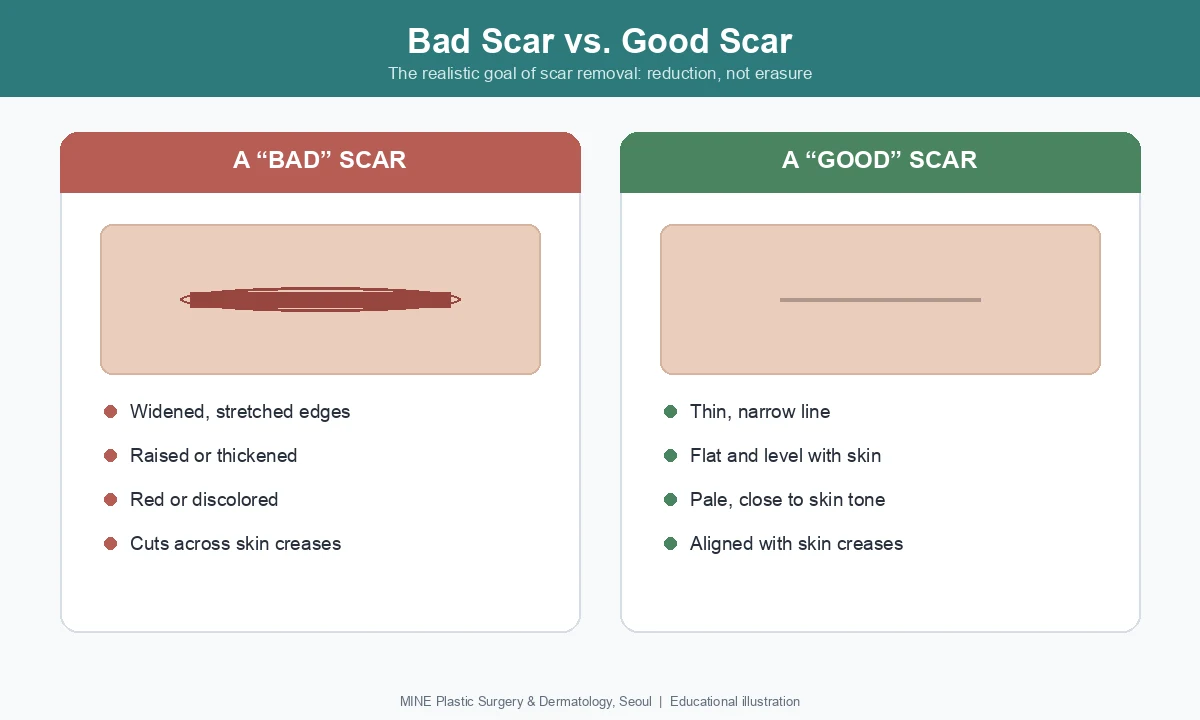
Table of Contents
- What Is Scar Removal? Setting Realistic Goals
- Types of Scars Treated at a Korean Clinic
- 6 Scar Removal Treatments in Korea
- Keloid Scar Removal Korea: Why It’s Different
- Scar Removal Korea: What It Costs
- Real Results & Recovery: What to Expect
- Aftercare & Choosing a Scar Specialist
- Frequently Asked Questions
What Is Scar Removal? Setting Realistic Goals
Reduction, not erasure — the honest goal
Let me be direct, because a scar affects your health, your appearance, and your budget, so honesty matters most: no treatment on earth makes a scar vanish. Once the deep layer of skin (the dermis) is injured, the body repairs it with scar tissue that will always be a little different from the surrounding skin. So the true purpose of scar removal Korea is improvement, not disappearance.
What we can realistically do is exchange a “bad” scar — one that is widened, raised, discolored, or pulling on the skin (contracted) — for a “good” one. Any clinic that promises a truly scar-free result is not being straight with you.
How Korean scar specialists think about a “good” scar
In practice, a “good scar” has four qualities: it is thin, flat, pale, and aligned with the skin’s natural creases (what surgeons call the relaxed skin tension lines). When a scar follows those lines instead of cutting across them, it catches far less light and shadow, so the eye simply glides past it. That is the target every plan for scar removal Korea is built around.
Types of Scars Treated at a Korean Clinic
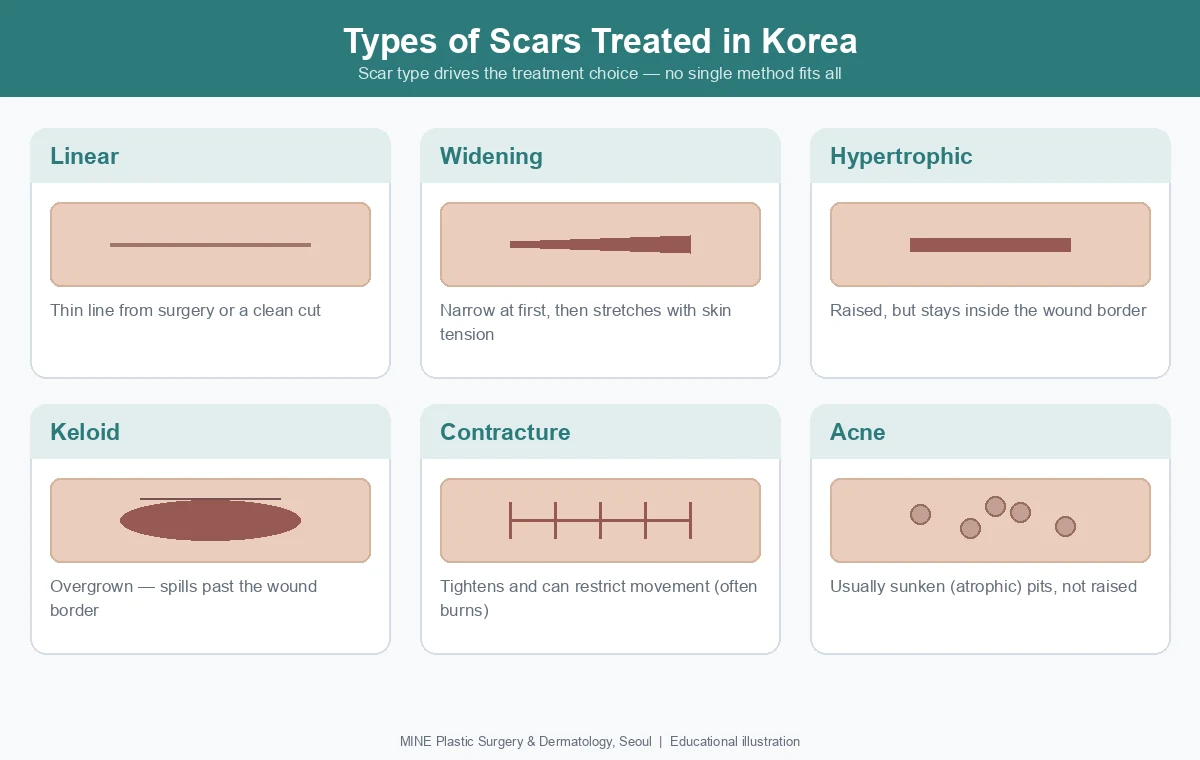
There is no single method that fixes every scar, because the scar type largely decides the treatment. In my clinical experience, matching the technique to the scar is where results are won or lost. At Mine, the scars we most commonly treat fall into a handful of groups.
Linear, widening & contracture scars
Linear scars are the thin lines left by surgery or a clean cut. Widening scars start narrow but stretch over months because skin tension keeps tugging the edges apart — common over joints, the chest, and the back. Contracture scars tighten as they heal and can restrict movement or pull nearby features out of place; these often follow burns.
Hypertrophic scars vs keloids (in plain English)
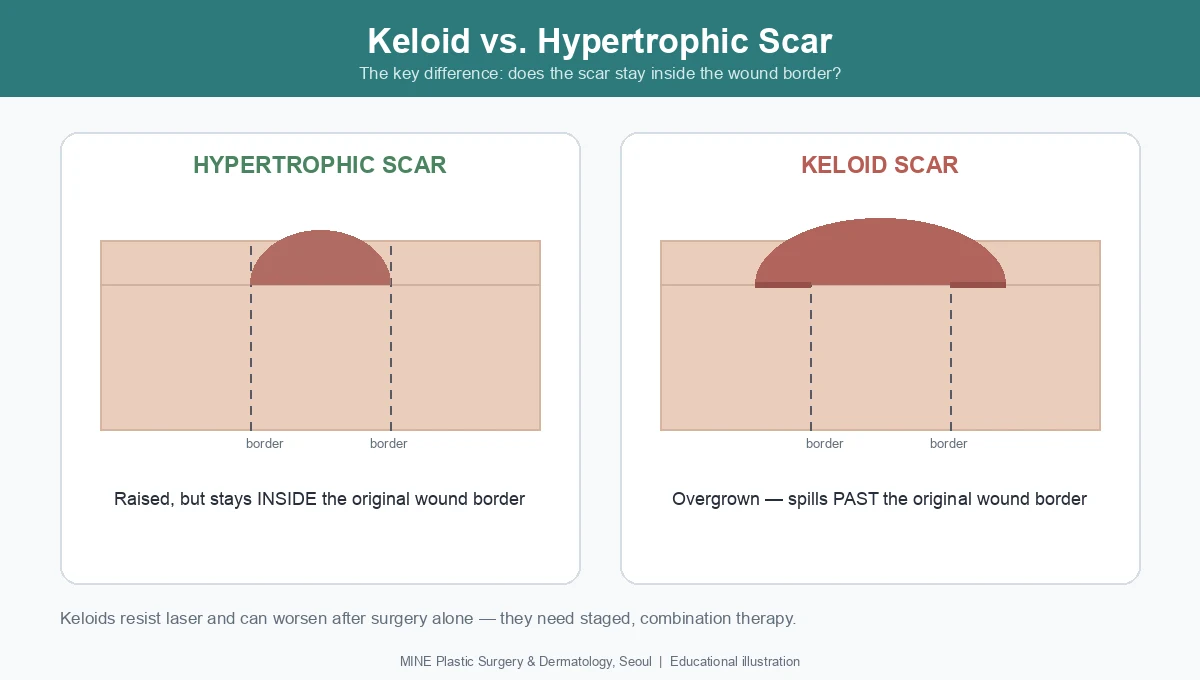
These two are constantly confused, so here is the simple version. A hypertrophic scar is a raised, thickened scar that stays inside the border of the original wound. A keloid is an overgrown scar that spills past the original wound border, invading healthy skin around it. That single difference — staying in bounds versus escaping them — changes the entire treatment strategy, which is why keloids get their own section later.
Here are the main differences at a glance, summarized from a comparison table that the textbook The Scar Book (2017) reprints from Gauglitz et al. (2011):
| Feature | Hypertrophic scar | Keloid |
|---|---|---|
| Border | Stays within the original wound | Grows beyond the original wound into healthy skin |
| When it appears | Usually within 4–8 weeks of the injury | Can appear years after a minor injury, or even with no known injury (for example, on the mid-chest) |
| How it behaves over time | Can grow quickly for up to 6 months, then often softens and flattens over a few years | Persists for long periods and does not regress on its own |
| Common locations | Shoulders, neck, front of the chest, knees, ankles | Front of the chest, shoulders, earlobes, upper arms, cheeks |
| What it means for treatment | Recurrence after excision is low; laser, injections, and silicone also help | Recurrence after excision is high, so combination therapy is needed |
Acne scars
Acne scars are their own category, usually sunken (atrophic) rather than raised, and they respond best to resurfacing lasers, microneedling, and collagen-stimulating treatments rather than surgery. If acne scarring is your main concern, our dedicated guide to acne scar types and how to match each one to the right treatment covers it in far more depth than this article can. Because hypertrophic scar treatment in Korea and acne-scar care use different tools, an accurate diagnosis comes first.
6 Scar Removal Treatments in Korea
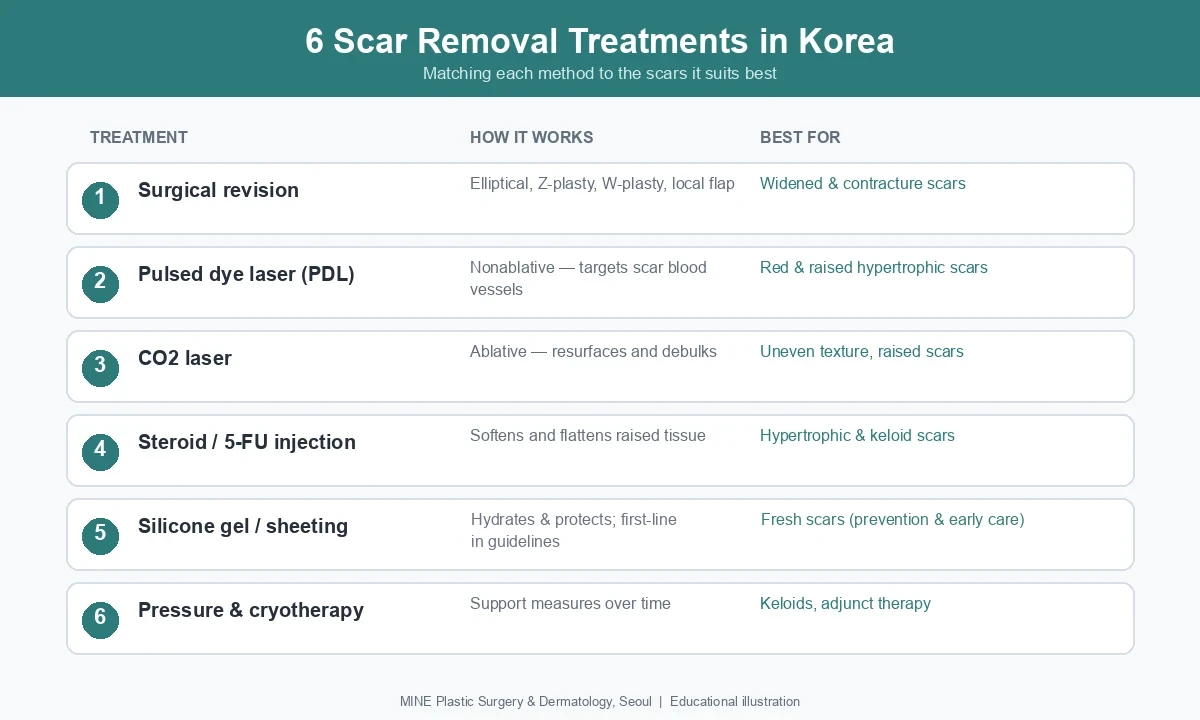
Here is the core menu — the six routes that most scar removal Korea programs actually use. Think of them as a toolkit; serious cases usually combine several rather than relying on one.
Surgical scar revision (elliptical, Z-plasty, W-plasty, local flap)
Surgical scar revision re-cuts and re-closes a poor scar so it heals better the second time. The main designs are:
- Elliptical (simple) excision — the scar is removed as a slim oval and closed in a clean straight line; the workhorse for narrow, well-behaved scars.
- Z-plasty — a zig-zag re-cut that breaks a long straight scar into a series of short segments hidden in natural skin creases, and can release a tight contracture so the skin moves freely again.
- W-plasty — a run of small triangles that makes a scar irregular so the eye cannot trace a single obvious line.
- Local flap — nearby healthy tissue is shifted to rebuild an area where a scar has caused distortion or a shortage of skin.
Medical textbooks stress that the surgical design matters less than the execution: incisions made perpendicular to the skin surface, gentle handling of tissue, and a genuinely tension-free closure are what separate an elegant result from a scar that simply comes back.
Laser resurfacing (PDL & CO2)
Two lasers do most of the heavy lifting for scars. The pulsed dye laser (PDL) is nonablative — it does not remove the skin surface. Instead it targets the tiny blood vessels feeding a red, raised scar, which calms redness and, over several sessions, prompts the scar’s collagen to remodel into a softer, flatter texture. The dermatology literature is encouraging here: The Scar Book (2017) reports that, in Asian patients, hypertrophic scars improved by more than 50% after three laser treatments.
The CO2 laser is ablative — it precisely vaporizes thin layers of tissue to resurface uneven scars and debulk raised ones. The two are often paired: PDL for color and thickness, CO2 for texture and height. For a deeper look at how we sequence these devices, see our breakdown of laser scar-management techniques (CO2, PDL, Nd:YAG, Er:YAG).
Injectables & non-surgical care (steroid, 5-FU, silicone, pressure)
For raised hypertrophic and keloid scars, the first-line, non-surgical toolkit includes intralesional corticosteroid injections (which soften and flatten the scar), 5-FU injections, cryotherapy (controlled freezing), pressure therapy, and silicone gel or sheeting. Injections are usually given every 4–6 weeks at first, then spaced out to every 2–3 months as the scar flattens. Rather than relying on one tool, textbook protocols often combine steroid with 5-FU and add pulsed dye laser sessions. An honest caveat from the literature: results with these measures can be inconsistent and recurrence is common, so expectations must be managed carefully.
Silicone gel sheeting is a first-line option in international scar-management guidelines, and it is inexpensive and low-risk. The evidence behind it, however, is modest: a Cochrane review on silicone gel sheeting (20 trials) found weak evidence that it helps prevent abnormal scarring in high-risk patients, plus some improvement in scar thickness and color, but judged most of the trials to be of poor quality.
In practice, silicone works best on fresh scars rather than mature ones. It is typically worn at least 12 hours a day for three to six months, starting about two weeks after the injury or surgery once the wound has fully closed — which is why it is worth the daily discipline it demands.
Keloid Scar Removal Korea: Why It’s Different
Keloid scar removal Korea deserves special attention because keloids behave unlike any other scar — and treating them the wrong way can make things worse.
Why keloids resist laser and one-shot surgery
Keloids are markedly more resistant to laser than hypertrophic scars, partly because they have a lower density of blood vessels for a laser like PDL to act on. The textbooks are blunt: keloids remain, in effect, an unsolved clinical problem. Even more importantly, surgery alone often makes a keloid worse — cutting it out can trigger an even larger keloid to grow back. A widely cited review in Molecular Medicine (Gauglitz et al., 2011) puts the recurrence rate after keloid excision alone at 45–100%. That regrowth risk is the single most important thing to understand before pursuing keloid scar removal Korea.
Multimodal, staged keloid therapy
Because of that, keloids are managed with multimodal, staged therapy: surgery is deliberately paired with steroid injections, pressure therapy, and/or radiotherapy to hold the keloid in check after removal. Ablative CO2 laser can flatten a large keloid, but here is the honest fine print — the tissue left behind is itself a hypertrophic scar. That is a real improvement over a bulky keloid, but it is not erasure. Recurrence is a genuine risk, so no responsible clinic offers a guarantee for keloids.
Scar Removal Korea: What It Costs
Everyone wants a number, but publishing a fixed price for scar removal Korea would be misleading, because no two scars — or treatment plans — are alike. What I can do is explain honestly what drives the cost so you can plan.
What drives the price (scar type, size, method)
The main cost drivers are straightforward: the scar type (a keloid needing combination therapy costs more to manage than a simple linear scar), the size and length of the scar, the method (surgical revision, laser, and injectables differ), and above all the number of sessions. Keloids and hypertrophic scars usually need several staged sessions, so it is wise to budget for a course of treatment rather than a single visit. A personalized quote only comes from an in-person assessment.
Korea vs. abroad & medical-tourism context
For international patients, part of Korea’s appeal is practical: a high concentration of surgical experience plus the ability to combine plastic surgery and dermatology under one roof, which matters a great deal for multimodal scar care. If you are planning a treatment trip and want to think through overall costs, our Seoul skincare-tourism price guide with tax-refund tips is a useful companion for budgeting.
One more honest word on value: the smartest way to think about scar removal Korea is not as a search for the lowest price, but as a search for the right match between your specific scar and the clinician’s experience. A cheaper single laser session that ignores the scar type can cost you more in the long run than a well-planned, combined approach done correctly the first time. When patients weigh scar removal Korea against options at home, the deciding factor is usually access to a surgeon and a dermatologist who plan the case together — not a headline figure.
Real Results & Recovery: What to Expect
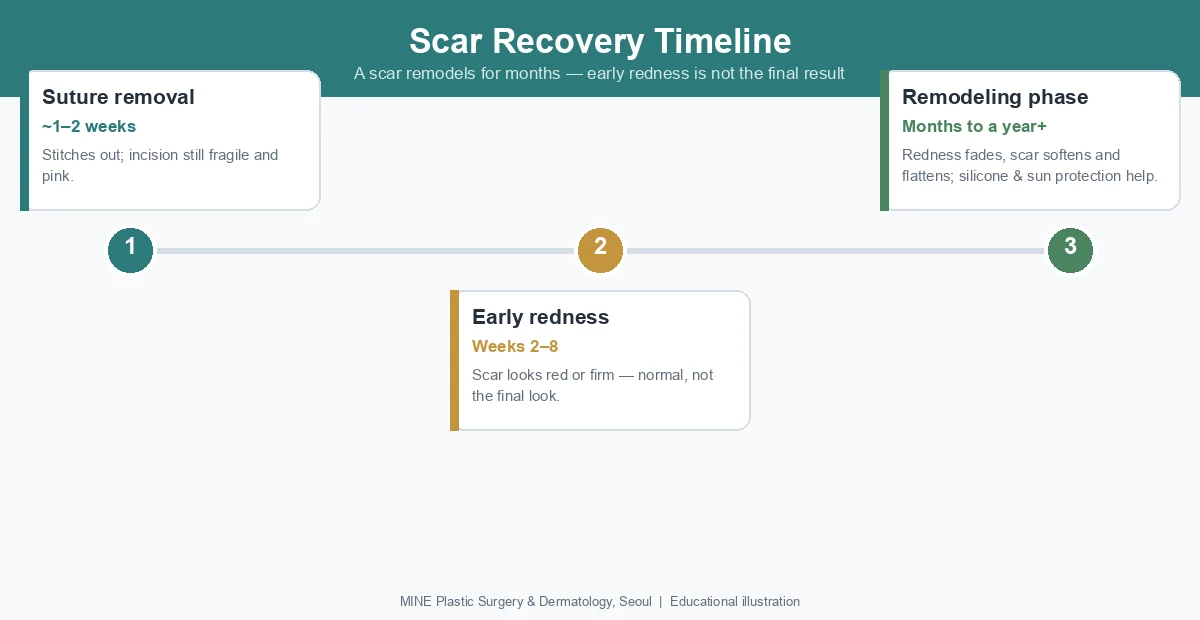
Recovery from scar treatment is a marathon, not a sprint. The most common disappointment I see comes from judging a scar too early — because a scar remodels for many months, the early redness is never the final result. Set expectations for scar removal Korea around this long timeline, not the first few weeks.
Healing and scar-remodeling timeline
| Stage | Rough timeframe | What happens |
|---|---|---|
| Suture removal | ~1–2 weeks | Stitches out; incision still fragile and pink. |
| Early redness | Weeks 2–8 | Scar looks red or firm — this is normal, not the final look. |
| Remodeling phase | Several months to a year+ | Redness fades and the scar softens and flattens; silicone and sun protection support this stage. |
Good surgical outcomes depend heavily on technique during that window: a tension-free, meticulous closure with internal dissolvable-suture reinforcement takes the pull off the surface, and consistent scar support (taping or silicone) during remodeling protects the investment.
Before/after expectations & individual variation
When you review any before-and-after gallery, keep two things in mind: images are shared with patient consent, and results vary from person to person — genetics, scar type, and aftercare all play a role, and keloids in particular may recur. For a fuller discussion of realistic surgical expectations, see our deep dive on whether scars can be fully removed before you decide.
Aftercare & Choosing a Scar Specialist in Korea
The treatment is only half the story; what you do during the months of remodeling strongly shapes the final scar.
Daily scar care: silicone, sun protection, nutrition
Three habits do most of the work. First, silicone gel or sheets worn daily support flatter, softer remodeling. Second, sun protection — a fresh scar burns and darkens easily, and UV exposure during healing is a leading cause of a scar staying discolored, so shield it and use sunscreen. Third, nutrition: adequate protein, vitamin C, and zinc give your skin the building blocks it needs to repair well. Scheduled scar-laser follow-ups round out the plan.
Questions to ask before you book
When choosing where to have scar removal Korea, look for a board-certified plastic surgeon working alongside in-house dermatology — that combination is what makes true multimodal care possible, which is essential for keloids. Just as important, a good specialist gives you realistic, honest counseling: if someone promises a flawless, invisible outcome, treat it as a red flag, not a selling point.
Before you book scar removal in Korea, it helps to bring these questions to your consultation:
- What type of scar is this? Ask whether it is linear, widened, contracted, hypertrophic, or a keloid — the diagnosis decides the whole plan.
- Which treatment or combination do you recommend, and why? A single method is rarely the full answer for raised or stubborn scars.
- How many sessions should I plan for, and how far apart? Injections and laser sessions are staged over weeks to months, which affects both your budget and your travel plans.
- What is the recurrence risk for my scar? This matters most for keloids, where excision alone often fails.
- What aftercare will I need at home? Silicone, sun protection, and follow-up timing should be explained before you fly back.
If you would like a personalized assessment, you can learn more about scar removal & revision surgery at MINE and book a free consultation with a board-certified plastic surgeon. Our standards follow international norms set by bodies such as ISAPS.
Frequently Asked Questions
Can scars be completely removed in Korea?
No. Scar removal Korea reduces and improves a scar rather than erasing it — the honest goal is to trade a raised, widened, or discolored scar for one that is thinner, flatter, and far less visible. Any promise of truly scar-free skin is misleading.
How much does scar removal cost in Korea?
There is no single fixed price. Cost depends on the scar type, its size, the method used (surgery, laser, or injectables), and the number of sessions needed. Because staged scars like keloids require several visits, a personalized quote comes from an in-person consultation.
What is the best treatment for a keloid scar?
Keloids need multimodal, staged therapy — surgery paired with steroid injections, pressure, and/or radiotherapy. Surgery alone often makes a keloid worse, and recurrence is common, so combination treatment under a specialist is the safest approach.
How long does it take for a revised scar to fade?
Early redness settles over a few weeks, but the scar-remodeling phase runs for many months and sometimes over a year. Daily silicone and diligent sun protection support the process, so early appearance is not the final result.
Which is better for scars, laser or surgery?
It depends on the scar. Laser (PDL and CO2) suits redness and raised or hypertrophic scars, while surgical revision reshapes widened or contracted scars. In practice they are often combined for a more complete overall improvement.
Talk to a Board-Certified Scar Specialist
Every scar — and every skin type — is different, so the most useful next step is a personalized assessment. At MINE, Dr. Lee Sung-wook and our combined plastic-surgery and dermatology team will look at your scar honestly, explain what is realistically achievable, and design a plan around it. Explore scar removal & revision surgery at MINE to book your free consultation.
Written and medically reviewed by Dr. Lee Sung-wook, Board-Certified Plastic Surgeon, MINE Plastic Surgery & Dermatology (Seoul, Korea).
※ This content is for informational purposes only and does not replace professional medical advice, diagnosis, or treatment. Individual results may vary, and side effects may occur. Please consult with a board-certified plastic surgeon for personalized advice.