EN
EN

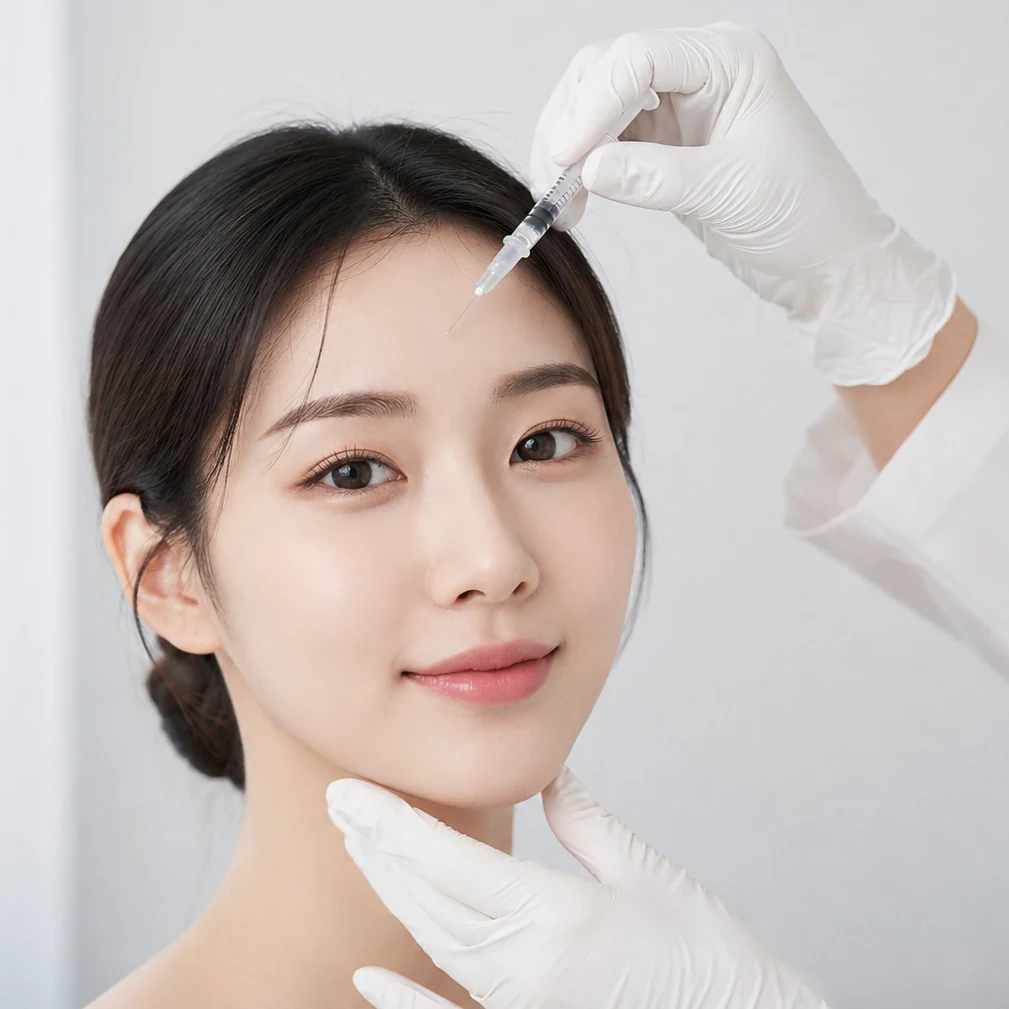
If the fine lines between your brows or across your forehead have ever caught your eye in the mirror, chances are your search for a solution eventually surfaced one particular name: Xeomin. In my consultation room, one of the questions I hear most often is, “How is Xeomin actually different from regular Botox?”
Xeomin (incobotulinumtoxinA) is a purified, “pure-toxin” botulinum toxin type A made by Merz Aesthetics of Germany, in which the accessory proteins surrounding the active neurotoxin are filtered away to leave only the roughly 150 kDa active molecule. In plain terms, think of it as a member of the broader Botox family whose formulation has simply been refined down to its essentials.
I’m Dr. Lee Sung-wook, a board-certified plastic surgeon. This article is designed to give you the whole picture of Xeomin in one place: what it is, how it works, its effects and how long they last, its approved treatment areas, and its safety profile. I’ll keep the big-picture overview here and link the deeper topics — the detailed comparison, resistance immunology, and area-by-area dosing — to their own dedicated articles. If you’d like to browse botulinum toxin treatments more broadly, you may also find all our Botox & filler articles helpful.
What Is Xeomin? The “Naked Toxin” Explained
IncobotulinumtoxinA and Merz of Germany
Xeomin is a botulinum toxin type A developed by Merz Aesthetics, a German pharmaceutical and aesthetics company. Its generic name is incobotulinumtoxinA, and it belongs to the very same botulinum toxin type A family as the product most people simply call “Botox.” So it’s more accurate to see Xeomin not as a rival to Botox, but as a family member — one household, one shared type A toxin.
The Naked-Toxin Difference (Complexing-Protein-Free)
Most botulinum toxin products contain two things together: the active neurotoxin protein that does the actual work, and a shell of surrounding “complexing proteins” (accessory proteins) that naturally accompany it. What sets Xeomin apart is that these complexing proteins are stripped out during manufacturing — through a purification process (double filtration, known as the XTRACT process) — leaving only the active neurotoxin (about 150 kDa) behind. That’s why it earns the nickname “pure toxin” or “naked toxin.”
Here, I’ll only sketch the big-picture concept: the complexing proteins have been removed. Exactly how that relates to resistance, and precisely how the ingredient makeup differs from conventional Botox component-for-component, is something I unpack in a separate, dedicated post. If you want the side-by-side breakdown, see Xeomin vs regular Botox: the differences.
In my clinical experience, patients understand Xeomin best when they picture it as a Botox-family toxin refined down to just the part that works — nothing more, nothing less.
How Xeomin Smooths Wrinkles: The Mechanism in Plain English
Briefly Blocking the Muscle Signal (SNAP-25)
Expression lines form when the same facial muscle contracts over and over with each expression, until the fold becomes a set crease. Relax that muscle’s movement for a while, and the wrinkle softens. Botulinum toxin type A works at the exact point where nerve meets muscle by cutting a protein called SNAP-25 — a protein the body needs in order to deliver the “contract” signal to the muscle.
Here is what the medical textbooks describe, in everyday language. Your body releases a signaling chemical called acetylcholine (the messenger that tells a muscle “move”) from the nerve ending. For that messenger to actually get out of the nerve, SNAP-25 has to act as a bridge. When Xeomin cuts SNAP-25, the bridge is broken, acetylcholine can’t be released, and as a result the muscle moves less and the expression line eases. The reason botulinum toxin type A barely touches other nerves and acts almost exclusively on the muscle signal is that this target is remarkably specific — it works selectively at the muscle-controlling (cholinergic) junctions.
Why the Effect Is Not Permanent (Recovery Mechanism)
The effect of Xeomin — and of any botulinum toxin — is not permanent. According to the medical literature, the nerve ending gradually grows small new branches (a process called axonal sprouting) and re-synthesizes the SNAP-25 it had lost, so that signaling to the muscle slowly returns. It’s your body’s natural way of restoring its own original function. That’s precisely why, to maintain the result, repeat treatment at regular intervals is needed. The wearing-off is a sign of a normal, recovering body — not a sign that the product was weak.
The deeper pharmacology and immunology of resistance go beyond the scope of this overview hub; I’ll pick up the finer detail of the mechanism and the immune meaning of resistance in the resistance section below and its dedicated article.
Key point: the effect isn’t permanent because the drug is weak, but because your body restores its own nerve function on its own.
Xeomin Effects and Duration: The Big Picture
Onset and How Long It Lasts
The question patients care about most is simply, “When does it start, and how long does it last?” Xeomin typically begins to take effect in about 3–5 days and lasts around 3–4 months, with individual variation (some Korean labeling cites a range of 3–6 months).
Because muscle strength, the treated area, and lifestyle habits all differ from person to person, the exact timing is best judged by watching how you respond after treatment rather than by a fixed formula.

How It Compares With Botox (Overview Only)
As a complexing-protein-free formulation, Xeomin has shown results equivalent to conventional Botox for glabellar (frown) lines — reported in studies as noninferiority (equivalence, not superiority) — and in clinical practice it is used interchangeably at a 1:1 dose. But I want to be clear about one thing: there is no basis to say Xeomin “works better” than Botox. What the comparative research demonstrates is equivalence, not superiority.
I’ll leave the detailed 1:1 comparison of effect, ingredients, and duration to the dedicated post rather than going deep here. If you need a more thorough comparison, you can find it in Xeomin vs regular Botox: the differences.
Key point: Xeomin isn’t a “replacement” for Botox — it’s an option that delivers a comparable effect in a slightly different formulation.
Resistance and the Pure-Toxin Idea: Why It Comes Up (Overview)
What a Lower Protein Load Means
The reason “resistance” comes up in almost every Xeomin conversation is protein load. Xeomin contains about 0.6 ng of protein per 100 units, versus about 5 ng for conventional Botox (onabotulinumtoxinA) — a lower amount, because the surrounding proteins that don’t contribute to the effect have been purified out. Our immune system can react to proteins introduced from outside the body, so the fact that a smaller quantity of protein enters in the first place is considered immunologically meaningful.
Understanding Resistance (Neutralizing Antibodies) Correctly
A lower protein load is reported to possibly lower the risk of forming neutralizing antibodies (the antibodies that inactivate the toxin’s effect — what people commonly mean by “resistance”) on repeat treatment. In fact, in a clinical pool of roughly 2,649 patients, the neutralizing-antibody positivity rate for Xeomin was reported at about 0.3%. It’s worth understanding that only neutralizing antibodies actually reduce a toxin’s effectiveness.
But there is a misconception I always want to correct. The claim “Xeomin doesn’t cause resistance” is not true. No botulinum toxin makes resistance impossible. The accurate way to put it is: “a formulation with a lower protein load may be an option that can lower the risk of resistance.” If you’d like to go deeper into antibody rates and the immune mechanism, I cover it in Xeomin resistance and the pure-toxin idea.
Key point: no drug can bring resistance risk to zero, but a low-protein-load formulation is one option worth considering for repeat treatment.
Which Areas Can Xeomin Treat? Approved Indications
FDA and Korea MFDS Approved Indications
In Korea, under Korea’s Ministry of Food and Drug Safety (MFDS), Xeomin is approved for glabellar lines, lateral canthal lines (crow’s feet), and forehead lines — that is, the upper-face expression wrinkles that stand out most when we make facial expressions.
The picture is similar abroad. The US FDA first approved Xeomin for glabellar lines in 2011, and in 2024 approved simultaneous treatment of the upper face (glabellar, forehead, and crow’s feet together). In effect, the approach of viewing the whole upper face in harmony — rather than treating each wrinkle in isolation — has been officially recognized.
A Korea-Only Edge: Room-Temperature Storage
Xeomin has one more feature that can be highlighted specifically in the Korean market: it is the only botulinum toxin approved in Korea for room-temperature storage (1–25°C), giving it stability during distribution and storage. For a global audience, it’s worth noting this is a Korea-specific regulatory point rather than a universal claim. That said, the appropriate dose for each area (for example, the number of units used at the glabella, forehead, or crow’s feet) and the injection depth and placement differ from person to person. To learn more about how Xeomin is applied area by area, continue with the Xeomin treatment areas guide.
Key point: even with the same Xeomin, dose and approach differ across the glabella, forehead, and crow’s feet — which is why a specialist’s in-person diagnosis shapes the outcome.
Xeomin Safety and Possible Side Effects
Common Side Effects and Recovery
A botulinum toxin session is relatively quick, but it is still a genuine medical procedure that depends on accurate anatomical understanding and an individual muscle assessment. No matter how simple a procedure looks, being honest about the possibility of side effects comes first.
Reactions that can occur after a Xeomin treatment include bruising, swelling, or pain at the injection site, a transient headache, and — rarely — eyelid drooping (ptosis) or facial asymmetry. Most are temporary and resolve with time, though there is individual variation.
Who Should Be Cautious
Patients who are pregnant or breastfeeding, and those with a neuromuscular disease, must consult a specialist before treatment. In my clinical experience, the same dose can produce different results from one person to the next, because muscle thickness and expression habits vary. On the understanding that both effect and safety carry significant individual variation, having an in-person evaluation first is the safest path. Ultimately, the injector’s accurate anatomical understanding and a person-by-person muscle assessment are the biggest keys to reducing side effects.
Key point: most reactions are temporary, but the injector’s precise anatomical understanding is the single biggest key to minimizing side effects.
Frequently Asked Questions (FAQ)
What is the difference between Xeomin and regular Botox?
The biggest difference is that Xeomin is a “pure-toxin” formulation with the complexing proteins around the active toxin removed, while its effect itself is reported to be equivalent to conventional Botox. For a detailed 1:1 comparison of ingredients, makeup, and duration, see Xeomin vs regular Botox: the differences.
How long does Xeomin last?
It usually begins to take effect about 3–5 days after treatment and lasts around 3–4 months (Korean sources sometimes cite 3–6 months), with individual variation. To maintain the result, repeat treatment at regular intervals is needed.
Does Xeomin avoid resistance if I repeat it?
A lower protein load is reported to possibly lower the risk of neutralizing antibodies (resistance), but no botulinum toxin makes resistance impossible. For more detail, see Xeomin resistance and the pure-toxin idea.
Which facial areas can Xeomin be injected into?
In Korea it is approved for glabellar, crow’s feet, and forehead lines. Because the appropriate dose and approach differ by area, I recommend the Xeomin treatment areas guide together with a specialist consultation.
What side effects can occur after Xeomin?
Bruising, swelling, or pain at the injection site, a transient headache, and rarely eyelid drooping can occur, but these are usually temporary. Patients who are pregnant or breastfeeding, or who have a neuromuscular disease, must consult a specialist before treatment.
A 1:1 Consultation With Dr. Lee at MINE
Even with the same Xeomin product, the appropriate dose and approach change depending on your muscle condition, your expression habits, and the area you want to treat. That’s why an individual, in-person diagnosis matters far more than any one-size-fits-all formula. Rather than deciding based on general information, it’s safer to have the muscles and wrinkles of your own face assessed directly.
If you’re wondering whether Xeomin is the right choice for you, I recommend a thorough consultation with Dr. Lee Sung-wook at MINE Plastic Surgery in Gangnam, Seoul, before you decide. You’re welcome to send an inquiry first through our online consultation whenever it suits you.
Book a 1:1 consultation with Dr. Lee Sung-wook at MINE Plastic Surgery ☎ +82-2-516-1175
Written and reviewed by Dr. Lee Sung-wook, Representative Director (board-certified plastic surgeon).
※ This content is for informational purposes only and does not replace professional medical advice, diagnosis, or treatment. Individual results may vary, and side effects may occur. Please consult with a board-certified plastic surgeon for personalized advice.