EN
EN


If a white dress shirt or a fitted gym top makes you check your chest before anything else, you are far from alone. Male nipple reduction is a procedure that reduces nipples that are too long or too thick so they no longer show through clothing. But not every nipple that shows through a shirt is enlarged, so the first step is identifying the cause.
This is one of the concerns men bring up most sheepishly in my consultation room. “I don’t want to wear T-shirts in summer.” “People keep glancing at my chest when I’m in gym clothes.” When I examine them, the cause usually falls into one of three groups. Depending on which one it is, you may not need surgery at all, you may only need the nipple reduced, or we may need to look at what sits underneath the nipple.
So this article starts with something you can do at home: a self-check to work out which of the three groups you are in. Then it walks through how the operation is chosen and ends with a decision table you can bring to a consultation.
- Why Your Nipples Show Through Shirts: 3 Causes, and Which One Male Nipple Reduction Treats
- Which Type Are You? A Mirror-and-Fingertip Self-Check Before Surgery
- How Male Nipple Reduction Works — and What It Must Preserve
- Nipple Only, or More? A Male Nipple Reduction Decision Table
- Male Nipple Reduction Risks and Recovery: What to Know Beforehand
- Male Nipple Reduction FAQ
- Bottom Line: Find the Cause Before Male Nipple Reduction
Why Your Nipples Show Through Shirts: 3 Causes, and Which One Male Nipple Reduction Treats
Nipples that show through men’s clothing fall into three types: temporary protrusion, persistent enlargement, and nipple-areola complex protrusion. Of these, only persistent enlargement is what male nipple reduction on its own is designed to fix. From the outside all three simply “stick out,” but a different cause needs a different solution.
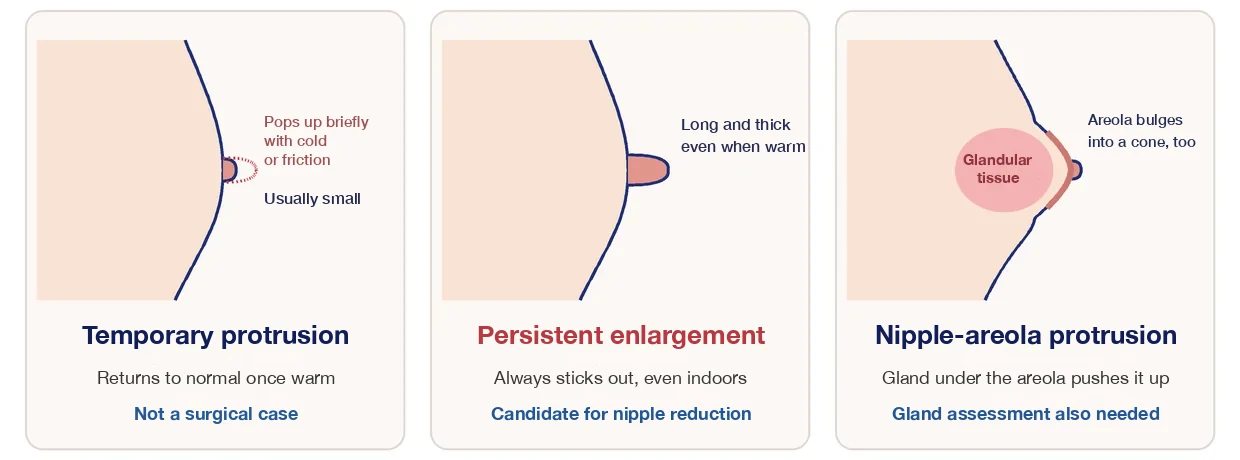
Temporary Protrusion: Cold or Friction Makes Nipples Stand Up
Step outside on a cold day, or let a shirt rub against your chest, and the nipples firm up and rise. Plastic surgery textbooks explain why: just beneath the nipple and areola lies a thin layer of smooth muscle (small muscle fibers you can’t control at will), arranged in rings and spokes. When those fibers contract, the nipple stands up.
This is a normal body reaction, not a reason for surgery. The tell-tale sign is that the nipple settles back to its usual size soon after you warm up.
Persistent Enlargement: Long or Thick Even in a Warm Room
Here the nipple itself is too long (its height) or too thick (its width, or diameter), whatever the temperature. If it shows through a white shirt, a compression or gym top, and a thin knit alike, this is the likely group. Persistent enlargement is exactly what male nipple reduction targets.
Nipple-Areola Protrusion (Puffy Nipples in Men): Something Underneath Pushes Up
In this group it is not just the nipple. The areola (the darker ring of skin around the nipple) also bulges forward in a cone shape together with it. Often what is pushing it out is glandular tissue (breast gland tissue) sitting just beneath the areola. That is why trimming the nipple alone leaves the bulge behind.
In my clinical experience, missing this distinction is one of the most common reasons a man tells me, “I had my nipples reduced, but they still show.” Puffy nipples in men need the area under the areola assessed before any plan is made.
- Shows only when cold or rubbed → temporary protrusion (normal reaction)
- Shows even in a warm room → persistent enlargement (candidate for nipple reduction)
- Nipple and areola bulge as one mound → nipple-areola protrusion (check under the areola)
Dr. Lee Sung-wook’s Key Point: Two questions decide whether surgery makes sense: when it shows (only in the cold, or all the time) and what sticks out (just the nipple, or the areola too).
Which Type Are You? A Mirror-and-Fingertip Self-Check Before Surgery
Before you book a consultation for male nipple reduction, a mirror and your fingertips can already point you in the right direction. This does not replace an examination, but it helps you know what to ask during a consultation.
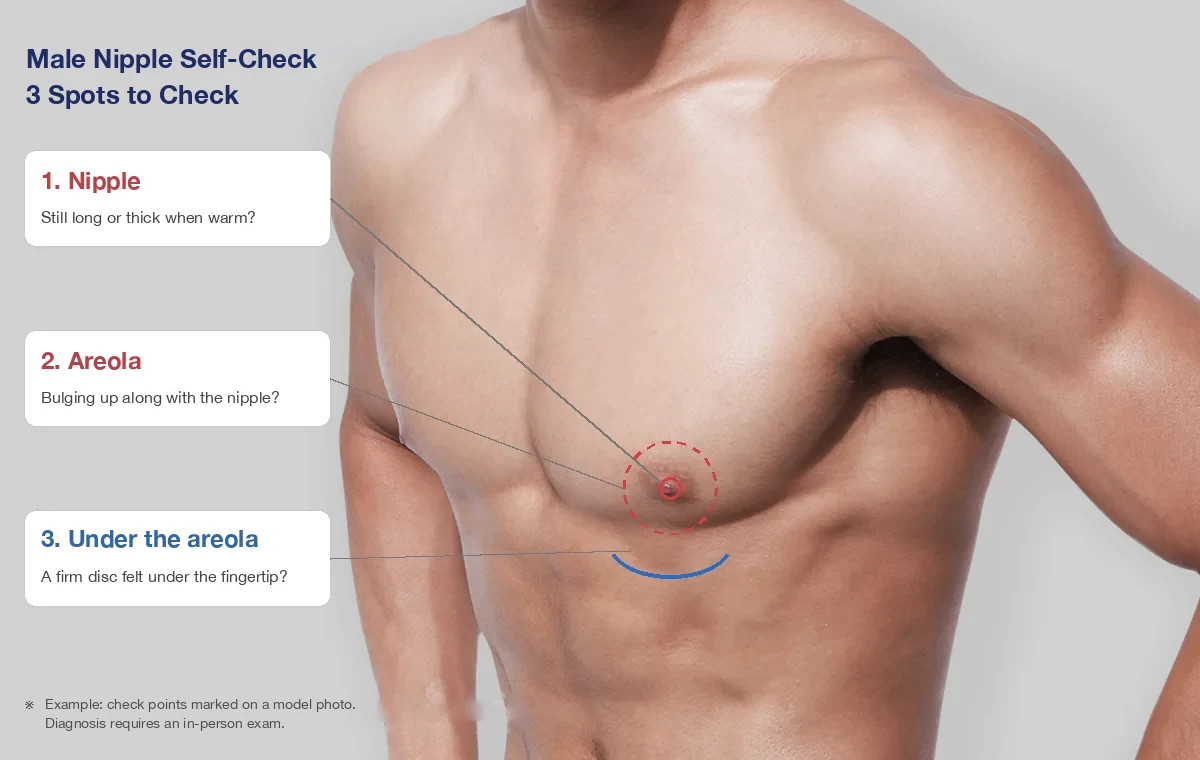
Check Nipple Length and Width in the Mirror While You’re Warm
Look at your chest from the side when your body is warm and relaxed, for example right after a shower. If the nipple still projects forward or looks thick, you are probably in the enlargement group, the one male nipple reduction is meant for. Checking in a cold room mixes in temporary protrusion and blurs the picture.
There is no single “normal” nipple size, because people vary a great deal. Rather than comparing to a number, judge the nipple in proportion to your build and to the size of your areola.
Press Just Under the Areola: Is There a Firm Disc?
Press gently just under the areola with your fingertips. If you feel a firm, coin-like disc, gland tissue may be involved, and male nipple reduction alone may not be enough. If the area feels soft and the fullness is mostly fat or loose areolar skin, that is sometimes described as puffy nipples without gynecomastia. Textbooks call fat-only enlargement pseudogynecomastia (fat build-up without any growth of gland tissue). The two can feel similar, so only an examination can tell them apart.
When the areola itself looks wide, reducing it may be part of the plan as well. You can read how we approach this on our page for nipple and areola reduction at MINE.
Red Flags: When to See a Doctor Before a Cosmetic Consultation
If you notice any of the following, getting checked for a male breast condition comes before any question about male nipple reduction:
- Only one side has clearly grown larger
- You feel a hard lump that does not move when you push it
- Fluid comes out of the nipple without squeezing
- The nipple is pulling inward, or the skin has changed
Medical textbooks note that breast cancer accounts for less than 1% of cancers in men in the UK and US, so it is uncommon. It usually appears on one side only, as a hard lump outside the nipple-areola area, which is different from the even, two-sided gland growth of gynecomastia. For general information, see the National Cancer Institute (NCI): male breast cancer patient information.
If puberty, a medication you take, or a hormone problem could be behind the change, that cause should be looked at first (MedlinePlus: breast enlargement in males).
Dr. Lee Sung-wook’s Key Point: Always self-check when you are warm. In the cold, temporary protrusion and true enlargement look the same.
How Male Nipple Reduction Works — and What It Must Preserve
Male nipple reduction is planned as height reduction, width reduction, or a combination of the two, chosen after an examination. Two nipples that both look “big” can need very different work, depending on whether they stick out because they are long or look blunt because they are thick.
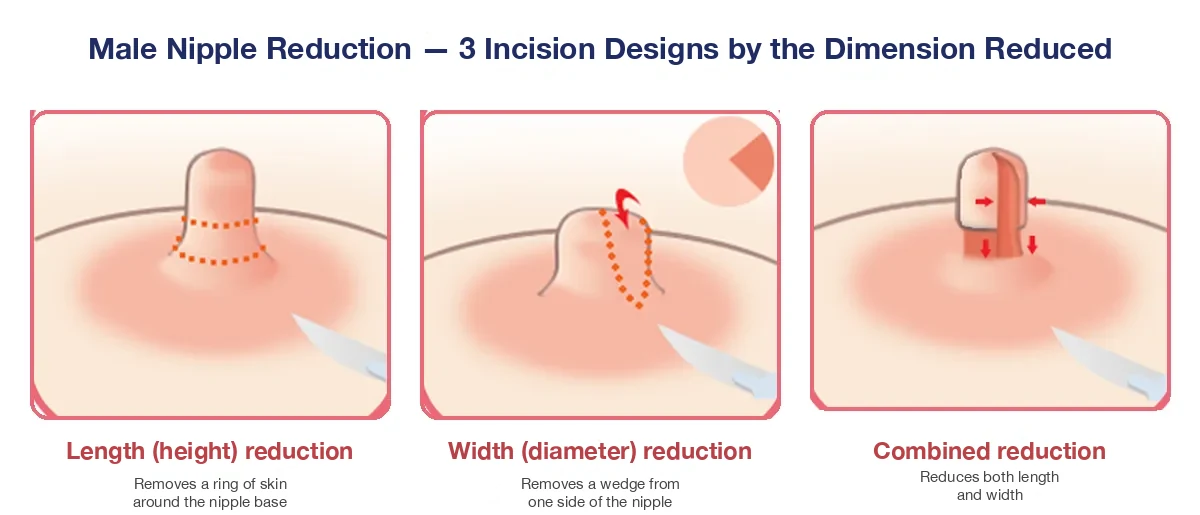
Too Long or Too Thick? Choosing Height, Width, or Combined Reduction
Height reduction suits a nipple that projects forward and pushes against fabric. The principle is to remove tissue so the nipple keeps its shape, rather than simply cutting the tip off.
Width reduction suits a nipple that is wide and blunt more than long. The height is left largely alone while the circumference is narrowed.
Combined reduction is used when the nipple is both thick and long. Being male does not decide which dimension needs work, so the exam decides which one stands out. The incision shapes and steps for each approach are covered in nipple reduction techniques compared.
One more thing is worth knowing. Plastic surgery textbooks describe four incision routes for male chest surgery: below the areola, around the areola, through the areola, and around the nipple. Two of those, around the areola and around the nipple, overlap with where a nipple reduction is done. In plain terms, nipple reduction and gland removal can be done through the same small openings, so when both are needed they can often be planned within the same incision.
Dr. Lee Sung-wook’s Key Point: Before you worry about the name of the technique, figure out whether your nipple shows because it is too long or too thick.
No Breastfeeding Constraint — but Sensation and Blood Supply Still Matter
In women, preserving the milk ducts (the tiny channels milk flows through) is a key factor in choosing a nipple technique. Men don’t need to preserve milk ducts, so a male nipple reduction can focus fully on correcting length and width, and the choice of technique is somewhat wider.
That does not mean the nipple can be trimmed freely. When I operate on gynecomastia (enlarged gland tissue in the male chest), I hold to three principles: keep the scars small, keep the chest contour masculine, and keep blood flowing to the nipple-areola complex (the nipple and areola as one unit). I apply the same principles to a nipple-only operation.
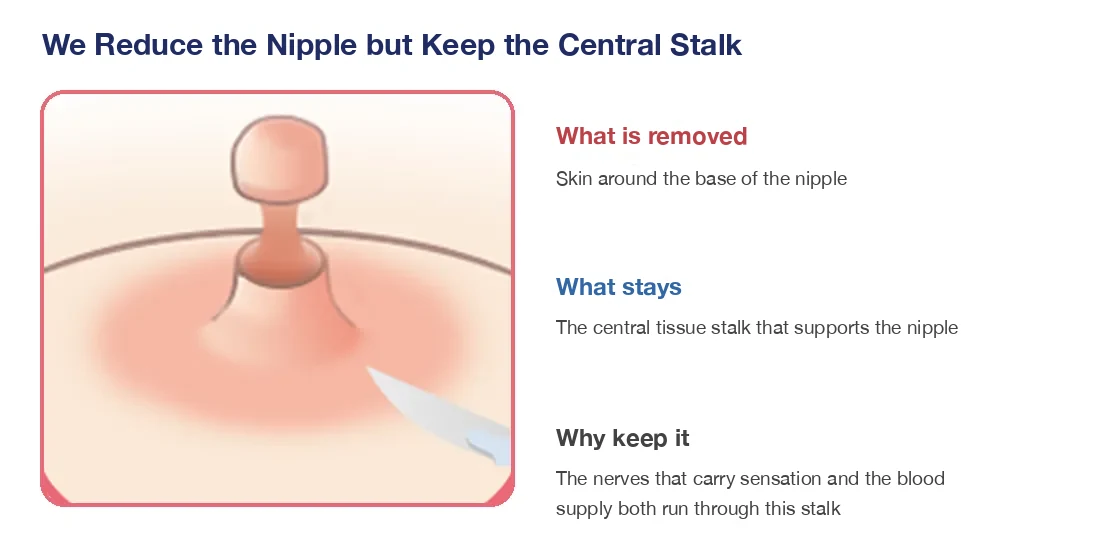
Textbooks describe the nipple’s blood supply as generous and doubled up. Blood arrives through a fine network of vessels just beneath the skin and also through vessels running up from the deeper breast tissue. The practical takeaway is simple: we keep the central stalk of tissue that supports the nipple, because the nerves that carry sensation and much of the blood supply travel through it.
Studies in breast reduction surgery suggest that loss of sensation depends more on how the nipple’s supporting tissue is handled than on how much tissue is removed. Those studies were done in women, so I don’t apply their numbers to men, but the principle is the same. Sensation depends less on how much is taken away and more on how intact the tissue carrying the nerves and vessels is left.
Why We Leave a Little: Avoiding a Flat or Sunken Nipple
In male nipple reduction, one of the most disappointing outcomes is a nipple that ends up sunken or pulled inward, and over-reduction is usually the cause. Even in men, leaving too little can make the nipple look flat and unnatural. That is why our approach is to leave a little rather than chase the smallest possible result.
Dr. Lee Sung-wook’s Key Point: Having no breastfeeding to protect doesn’t mean giving up sensation and natural shape.
Nipple Only, or More? A Male Nipple Reduction Decision Table
The table covers five common situations men raise when considering male nipple reduction. It follows the order I actually work through in a consultation: find what you see in the left column, then read across.
| How it shows through clothing | What the exam checks | Option usually considered | Why nipple reduction alone falls short |
|---|---|---|---|
| Only rises when cold or rubbed | Whether it returns to normal size when warm | No surgery; clothing or patches | A normal reaction, so there is nothing to reduce |
| Only the nipple always sticks out | Nipple length and width | Nipple reduction alone | — |
| Large nipple and wide areola | Nipple size plus areola diameter | Nipple and areola reduced together | With a wide areola, a smaller nipple alone can look out of balance |
| Nipple and areola bulge together | A firm disc under the areola (gland) | Gland removal considered as well | The tissue pushing it out lies beneath the nipple |
| Whole chest is full and sagging | Fat, skin laxity, nipple position | Assessed as gynecomastia surgery | The issue is the whole chest, not the nipple |
When Nipple Reduction Alone Is Enough
If only the nipple sticks out, even when you are warm, and nothing can be felt under the areola, we plan male nipple reduction on its own.
When the Nipple and Areola Are Reduced Together
If the nipple is large and the areola is also wide, reducing only one can leave the proportions looking off, so both are considered together. The incisions sit close to each other, so they are often planned as one operation, though the decision depends on your individual anatomy.
When Gland Removal (Gynecomastia Surgery) Should Be Considered
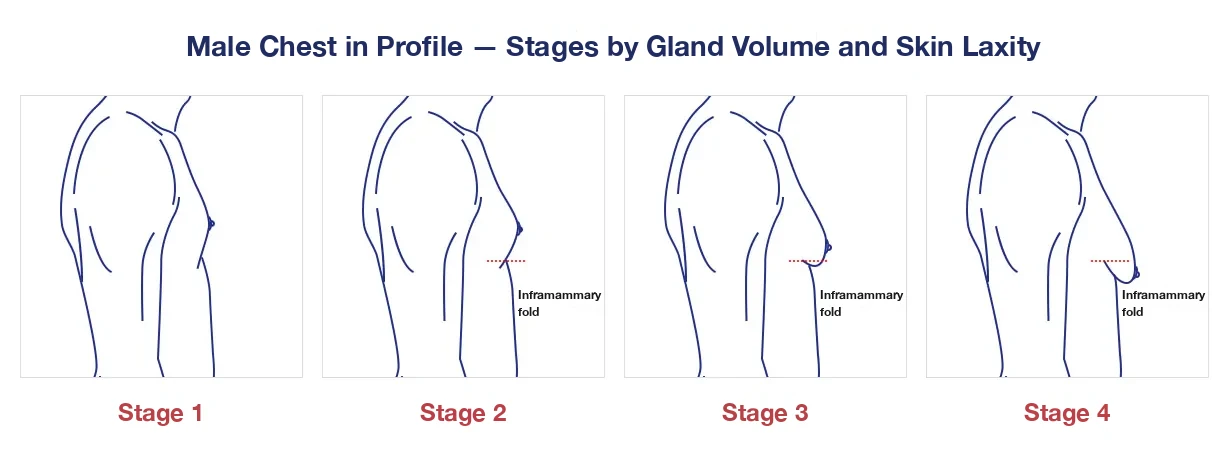
Gynecomastia is graded by severity. In the medical literature, the mildest stage, stage 1, means a small amount of gland, no loose skin, and a nipple-areola complex that sits above the inframammary fold (the crease under the chest). At that stage an incision around the areola alone is usually considered. As gland volume increases and the skin loosens, the stage rises and we look at whether a larger incision is needed.
Recovery changes too. When gland removal is added, plastic surgery textbooks advise a compression garment for 4–6 weeks and limiting strenuous exercise for 6–8 weeks, which is not the same as recovery from male nipple reduction alone. For more on that, see our gynecomastia surgery recovery precautions. If gland removal looks likely, I suggest reading about gynecomastia surgery at MINE first.
Dr. Lee Sung-wook’s Key Point: If you feel a firm disc under the areola, put the nipple-only plan on hold and have the gland checked first.
If you are unsure which row describes you, an in-person exam at MINE Plastic Surgery & Dermatology will settle it in one visit.
Male Nipple Reduction Risks and Recovery: What to Know Beforehand
Male nipple reduction is a small operation, but the side effects we go over in consultation are much the same as for larger chest surgery. Go through this list before you decide.
Possible Side Effects
The side effects below are the nipple-related items from the complication list for gynecomastia surgery, put in plain language:
- Bleeding, or a collection of blood under the skin (hematoma)
- Infection
- Changes in sensation: duller, or more sensitive than before (see numbness after plastic surgery)
- Shape changes, such as a sunken or inverted nipple
- Asymmetry between the two sides
- Scars that widen, become raised, or change color
- Over- or under-correction, with a possible need for revision
What to Do During Recovery
After male nipple reduction, keep the dressing on, and restart showering and workouts only when your surgeon tells you to. In the early days, wear a soft undershirt so fabric doesn’t rub the wound. If the area turns red and swollen, starts to ooze, or bleeds more, contact the clinic right away.
Covering Up Before Surgery: What Patches and Undershirts Can and Can’t Do
Nipple patches, compression undershirts and slightly thicker fabrics help hide show-through. They do not change nipple size. For temporary protrusion, that may be all you need. For persistent enlargement, it comes down to whether covering up or male nipple reduction fits your life better.
Dr. Lee Sung-wook’s Key Point: Don’t brush off changes in sensation or shape as “rare.” Ask about them directly in your consultation.
Male Nipple Reduction FAQ
When does a man need nipple reduction?
Consider it when your nipples stick out and show through clothing all the time, even in a warm room and without cold or friction. Nipples that rise only briefly in the cold are reacting normally and don’t need surgery.
Can nipples showing through a shirt be caused by gynecomastia?
Yes. If the nipple and areola bulge together and you can feel a firm disc under the areola, gland tissue may be the cause. Reducing only the nipple can leave the bulge in place, so an examination should come first.
Does male nipple reduction affect nipple sensation?
A change in sensation is one of the possible side effects. Men don’t need to protect breastfeeding function, but the operation is still designed to preserve sensation and blood supply. Results vary from person to person, so ask about it in your consultation.
Can nipple and areola reduction be done at the same time?
If an enlarged nipple and a wide areola occur together, both are considered at once. Because the incisions are close together, they can often be planned as one operation, depending on your individual anatomy.
How can I stop my nipples from showing through my shirt without surgery?
Nipple patches or a compression undershirt can hide show-through, but they don’t change nipple size. If your nipples only protrude temporarily, these measures may be all you need.
Bottom Line: Find the Cause Before Male Nipple Reduction
Nipples that show through a man’s shirt fall into three groups: temporary protrusion, persistent enlargement, and nipple-areola protrusion. If only the nipple always sticks out, male nipple reduction is the fitting option. If the areola or the gland beneath it is involved, the scope of treatment is decided first. Whatever the method, the plan should keep sensation, blood supply and a natural shape.
Nipple length and width, and whether gland tissue sits under the areola, are hard to judge from photos alone and need an in-person exam before male nipple reduction is planned. I recommend deciding after a face-to-face consultation. You can learn more on our page for nipple and areola reduction at MINE. To book a consultation with Dr. Lee Sung-wook in Seoul, call +82-2-516-1175 or use the online consultation form at mineclinic.com. Pricing is provided after an individual consultation.
Written and medically reviewed by Dr. Lee Sung-wook, Board-certified Plastic Surgeon (Korea), MINE Plastic Surgery & Dermatology, Seoul. Published October 5, 2026. Last reviewed October 5, 2026.
※ This content is for informational purposes only and does not replace professional medical advice, diagnosis, or treatment. Individual results may vary, and side effects may occur. Please consult with a board-certified plastic surgeon for personalized advice.