EN
EN


If you have ever felt self-conscious about the size, shape, or position of your nipples, you are far from alone. These concerns are some of the most common reasons patients quietly research breast aesthetics, yet they are rarely talked about openly. The good news is that both oversized nipples and inverted nipples can be corrected with a short, well-established outpatient procedure.
Nipple reduction surgery is a minor outpatient procedure that corrects nipples that are abnormally wide or that protrude too far, while inverted nipple correction releases the tight band of tissue pulling the nipple inward. At MINE Plastic Surgery in Seoul, both are typically performed under local anesthesia in under an hour. This guide walks you through everything an international patient needs to know about nipple reduction surgery Korea patients ask about most — from grading and techniques to recovery, risks, and how to plan your trip.
Throughout this article I will share what I explain to patients in my own consultations as a board-certified plastic surgeon, grounded in the surgical literature so you can make a calm, informed decision.
Table of Contents
What Is Nipple Reduction Surgery? (Definitions & Who It’s For)
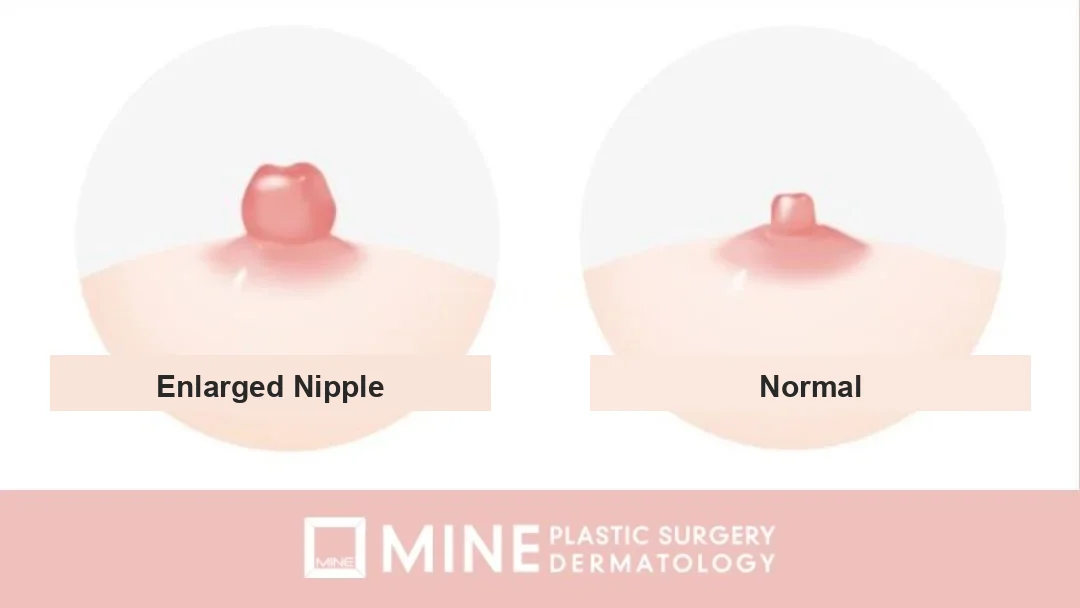
Nipple reduction surgery in Korea is a procedure that reshapes nipples that are wider than roughly 1 cm in diameter or taller than about 0.9 cm in height, bringing them back into natural proportion with the breast. Because the nipple sits at the center of the nipple-areolar complex (NAC) — the nipple plus the darker circle of skin around it — even small changes here have a big effect on how balanced the breast looks.
Inverted nipple correction is a separate but closely related procedure. Here, the nipple is pulled inward by tight cords of fibrous tissue and shortened milk ducts beneath the skin, so it sits flat or sinks into the breast instead of pointing outward. The two procedures are often discussed together because many patients have one or both concerns, and both can be addressed in a single visit.
Overly Large Nipples: Causes and Candidates
Nipples can become enlarged for several reasons: some people are simply born with larger nipples, while others notice changes after pregnancy and breastfeeding, which can stretch and lengthen the nipple. Aging and significant weight changes play a role too. Good candidates are usually those who feel the nipple looks out of proportion, who notice a marked difference between the two sides, or whose nipple size causes discomfort under clothing.
In my clinical experience, what many patients don’t realize is that nipple reduction is one of the more subtle procedures in breast aesthetics — the goal is a result that looks like nothing was “done” at all, just a naturally proportioned nipple.
Inverted Nipples: Why They Form and Who Is Affected
Inverted nipples are surprisingly common. According to the American Society of Plastic Surgeons (ASPS), an estimated 10–20% of people have some degree of nipple inversion. Most cases are congenital, meaning they have been present since puberty, but inversion can also develop after breastfeeding or with aging as the supporting tissue changes.
One important safety point: if a nipple that was always normal suddenly turns inward, this is different from lifelong inversion and should be checked by a doctor first. A newly inverted nipple needs a medical evaluation to rule out an underlying breast condition before any elective cosmetic surgery is considered. This is a non-negotiable step.
Can Both Procedures Be Done at the Same Time?
Yes. When it is clinically appropriate, nipple reduction and inverted nipple correction can be combined in a single outpatient session. During your consultation, both conditions are assessed together so that the surgical plan addresses size, shape and position in one coordinated approach. To see how nipple correction fits within the wider range of breast procedures, you can explore Mine Clinic’s breast surgery program.
Dr. Lee’s Key Point: Nipple reduction reshapes a nipple that is too large; inverted nipple correction frees a nipple that is pulled inward. Many patients benefit from both, often in one short procedure.
Grading Nipple Inversion: Grade 1, 2, and 3 Explained
Not all inverted nipples are the same, and the grade matters a great deal because it decides which surgical technique is right for you and how likely you are to keep the ability to breastfeed. Surgeons use a simple three-grade system based on how easily the nipple can be drawn out by hand and whether it stays out.

Grade 1 — Mild Inversion (Manually Reducible)
In Grade 1, the nipple can be gently pulled out by hand and tends to stay out on its own afterward. The milk ducts underneath are largely intact, and the fibrous tissue pulling the nipple in is minimal. Because the ducts are preserved, breastfeeding is usually still possible after surgery. This is the mildest and most straightforward grade to correct.
Grade 2 — Moderate Inversion (Immediate Retraction)
In Grade 2, the nipple can be pulled out manually but snaps back inward almost immediately once released. This happens because there are firmer fibrous bands and some shortening of the milk ducts. Breastfeeding can be more challenging here, but it can often still be preserved when a duct-sparing technique is used. For a deeper look at how this affects nursing, see our dedicated guide on nipple surgery and breastfeeding.
Grade 3 — Severe Inversion (Cannot Be Everted)
In Grade 3, the nipple cannot be drawn out at all, even with effort. There is significant fibrous tissue and the ducts are tightly shortened. Correcting a Grade 3 nipple usually requires fully releasing these tight ducts, which means breastfeeding is unlikely to be preserved after surgery. This trade-off is discussed openly during consultation so you can decide what matters most to you. For a closer look at this category specifically, our existing article on inverted nipple correction covers it in more detail.
Choosing the right technique for the grade is essential — using an approach designed for a milder grade on a more severe one increases the chance the nipple will turn back inward over time.
Dr. Lee’s Key Point: Your grade — 1, 2 or 3 — is the single most useful piece of information. It tells us which technique to use and gives you a realistic picture of your breastfeeding outlook.
Surgical Techniques at MINE Clinic: Which Method Is Right for You?
The right method depends on your grade and your priorities, especially whether preserving the ability to breastfeed is important to you. At MINE Clinic, duct preservation is a standard part of our surgical philosophy wherever the anatomy allows it. Here are the main approaches.

Purse-String Suture — For Grade 1–2 Inverted Nipple
The purse-string suture technique works by releasing the tight fibrous bands beneath the nipple while carefully protecting the milk ducts. A small stitch is placed in a circular, drawstring-like pattern at the base of the nipple to hold it in its new outward position. Because the ducts are spared, this approach is well suited to Grade 1 and Grade 2 patients who want to keep their breastfeeding potential.
Triangular Flap Technique — For Grade 2–3
For more stubborn Grade 2 and Grade 3 cases, the triangular flap technique is often used. This method borrows a small flap of skin tissue (a dermal flap) from the edge of the areola and tucks it underneath the nipple to fill the gap left when the tight tissue is released. This added support helps hold the nipple out and reduces the chance of it sinking back in. Whether the milk ducts can be preserved depends on how much fibrous tissue is present.
Nipple Reduction: Width, Height, or Combined Correction
Nipple reduction itself can be tailored to your specific concern. Surgeons can reduce the width only, the height only, or both together. The general targets are a diameter of about 1 cm or less and a height of roughly 0.7–0.9 cm, though the right proportions are always judged against your individual breast. A key part of the MINE approach is preserving the milk ducts and nerves during reduction, which helps protect both nipple sensation and future breastfeeding.
Milk Duct Preservation: What It Means for Breastfeeding
Milk duct preservation is one of the most important — and most overlooked — aspects of nipple surgery. The surgical literature is clear on why careful technique matters: the nipple-areolar complex receives its blood supply from a delicate network of vessels (the areolar plexus), and protecting this network is critical to keeping the nipple healthy and viable during surgery. This is described in standard plastic surgery references such as Plastic Surgery (Neligan). It is precisely this attention to the underlying anatomy that makes a duct- and vessel-preserving approach so meaningful, both for breastfeeding and for the long-term health of the nipple.
Dr. Lee’s Key Point: The technique is chosen to match your anatomy, not the other way around. Preserving the ducts and the nipple’s blood supply protects sensation, breastfeeding, and the lasting quality of the result.
The Procedure: What to Expect Before, During & After Surgery
One of the reasons patients find nipple surgery reassuring is how short and low-key the actual procedure is. Here is what the journey looks like from start to finish.

Pre-Operative Consultation and Assessment
Everything begins with a thorough consultation. Your nipple grade is assessed, your goals are discussed, and your medical history is reviewed. If you have a newly inverted nipple, this is when the appropriate medical evaluation is arranged before anything else. For international patients, pre-operative lab work and care instructions are coordinated in advance so your time in Korea is used efficiently.
On the Day of Surgery: Step by Step
The procedure is performed as an outpatient surgery under local anesthesia and typically takes 30 to 60 minutes. You remain awake and comfortable throughout. A detail many patients appreciate is that, during surgery, symmetry is confirmed with the patient assessed in a partially seated position before the wound is closed — a careful checkpoint also described in plastic surgery literature to make sure both sides match. After the procedure, you return to your accommodation the same day; there is no overnight hospital stay.
Immediate Post-Operative Care (Days 1–7)
For the first 5–7 days, light compression dressings are worn to support healing and reduce swelling. Light daily activities are fine right away. Stitches are typically removed at a follow-up visit on Day 5 to 7. For most international patients, this means you are cleared to fly home roughly 7 to 10 days after surgery.
Dr. Lee’s Key Point: This is a short outpatient procedure — local anesthesia, 30 to 60 minutes, home the same day, stitches out within a week.
Risks, Complications & Realistic Expectations
Every surgery, no matter how minor, carries some risk, and honest counseling is part of good care. The aim here is not to alarm you but to give you a clear, evidence-based picture so your expectations are realistic.
Common Risks: What the Medical Evidence Shows
In one published series of 88 consecutive patients who underwent nipple-areolar complex surgery, the overall complication rate was reported at 6.8%, with issues including hematoma (a collection of blood), partial nipple necrosis (loss of a small area of tissue), wound separation, and fat necrosis (firm lumps from healing fat). Beyond these, the recognized risks of nipple surgery include — but are not limited to — bleeding, infection, scarring, altered nipple sensation, delayed healing, and, rarely, partial or complete loss of the nipple-areolar complex. These figures come from the surgical literature and help set realistic expectations.
Nipple Sensation Changes After Surgery
It is common to notice some temporary change in nipple sensation after surgery. For most patients, normal feeling returns within 3 to 6 months, although a permanent change in sensation is possible. The duct- and nerve-preserving techniques used at MINE are designed in part to minimize this disruption. If sensation changes are a particular worry for you, our article on numbness after plastic surgery explains the typical timeline in more depth.
Recurrence Risk by Grade
The chance that an inverted nipple turns back inward over time is highest in Grade 3 cases, where the fibrous tissue is most extensive. This is one reason matching the technique to the grade is so important. In Grade 3 corrections that require fully dividing the milk ducts, the result is more stable, but the trade-off is a lasting effect on breastfeeding.
Breastfeeding After Nipple Correction: The Full Picture
Breastfeeding outcomes depend heavily on grade and technique. With Grade 1–2 corrections using duct-preserving methods, breastfeeding is typically preserved. With Grade 3 corrections that fully divide the ducts, breastfeeding is likely to be permanently affected, and this is disclosed clearly before you decide. We never overstate what is possible — full transparency is the standard. For the complete picture, see our guide to nipple surgery and breastfeeding.
Dr. Lee’s Key Point: Published data shows a roughly 6.8% complication rate in a series of 88 NAC surgery patients. Most risks are uncommon and manageable, but you deserve to know them all before deciding.
Recovery Timeline for International Patients: Planning Your Korea Trip
Many international patients researching nipple reduction surgery Korea offers are traveling from abroad, so building your stay around the recovery milestones makes the whole experience smoother. Here is a realistic timeline to build your trip around.
Week 1: Surgery and Immediate Recovery
On Day 0 to 1, you have your surgery and rest at your accommodation, with light activities permitted the same day. By Day 5 to 7, you return to MINE Clinic for your suture-removal consultation. After this, you are generally cleared for light travel.
Weeks 2–4: Healing and Activity Restrictions
Most international patients are cleared to fly home around Day 7 to 10. For about four weeks, it is advisable to avoid heavy exercise and underwire or tight-fitting bras so the area can heal without pressure. Gentle daily routines are perfectly fine during this period.
When Is It Safe to Return to Normal Life?
Full healing is generally complete by 4 to 6 weeks. The final aesthetic result becomes visible at around 3 months, once any residual swelling has fully settled. Patience in these final weeks is rewarded with a more natural, settled outcome.
Dr. Lee’s Key Point: Plan for at least 7 to 10 days in Korea so your stitches are removed and you are cleared to fly before you head home.
Why Choose Korea for Nipple Surgery? MINE Clinic’s Approach
Korea has earned its reputation in breast and body aesthetics through rigorous training standards rather than low prices alone. Choosing where to have surgery is about trust, technique and aftercare.
Korea’s Medical Excellence in Breast Aesthetics
Korean plastic surgeons complete some of the most demanding training programs in the world, and board certification through the Korean Society of Plastic and Reconstructive Surgeons is a genuinely high bar. International bodies such as ISAPS recognize Korea as a leading destination for aesthetic surgery — a reflection of clinical standards, not just accessibility.
Dr. Lee Sung-wook: Board-Certified Expertise
At MINE Clinic, duct- and nerve-preserving techniques are used as standard practice, because protecting breastfeeding potential and nipple sensation is a core part of the surgical philosophy rather than an afterthought. As a board-certified plastic surgeon, I assess both inverted nipple and reduction concerns together and build a plan around your individual anatomy and goals.
How to Book a Consultation
International patients receive English-language consultation, coordination of any pre-operative lab work, and clear post-operative care instructions before departure. You can learn more about the procedure on our dedicated page for nipple surgery at MINE Clinic.
Dr. Lee’s Key Point: The value of having surgery in Korea lies in surgical training, duct-preserving technique and structured international aftercare — not in price.
Frequently Asked Questions About Nipple Surgery in Korea
What are the grades of nipple inversion and which grade am I?
There are three grades. Grade 1 nipples can be drawn out by hand and stay out; Grade 2 can be drawn out but retract immediately; Grade 3 cannot be drawn out at all. Your exact grade is determined during consultation, and it directly shapes both the technique used and your breastfeeding outlook.
Can I still breastfeed after inverted nipple correction surgery?
It depends on your grade. With Grade 1–2 corrections using duct-preserving techniques, breastfeeding is typically preserved. With Grade 3 corrections that fully divide the milk ducts, breastfeeding is likely to be permanently affected. This is fully disclosed during your consultation so you can decide with complete information.
How long does recovery take after nipple reduction surgery in Korea?
Stitches are removed on Day 5 to 7, and most international patients are cleared to fly home around Day 7 to 10. Light daily activities are fine the same day as surgery. Full healing usually takes 4 to 6 weeks, with the final result visible at around 3 months.
Can nipple reduction and inverted nipple correction be done together?
Yes, when it is clinically appropriate, both can be combined in a single outpatient session. During consultation, both conditions are assessed together and the surgical plan is built to address size, shape and position in one coordinated procedure.
Will nipple surgery change my nipple sensation?
Temporary changes in sensation are common after surgery, and most patients regain normal feeling within 3 to 6 months. A permanent change is possible and is disclosed before surgery. The duct- and nerve-preserving techniques used at MINE are designed to minimize nerve disruption.
Ready to Explore Your Options?
Concerns about nipple size, shape or inversion are common, treatable, and nothing to feel embarrassed about. If you would like a clear, honest assessment of which approach fits you, book a free consultation with Dr. Lee Sung-wook at MINE Plastic Surgery in Seoul. Our international patient team will guide you through every step, from your first questions to your post-operative care.
Call us at +82-2-516-1175 or send a consultation inquiry through our nipple surgery page to get started.
※ This content is for informational purposes only and does not replace professional medical advice, diagnosis, or treatment. Individual results may vary, and side effects may occur. Please consult with a board-certified plastic surgeon for personalized advice.
Written and medically reviewed by Dr. Lee Sung-wook, Board-Certified Plastic Surgeon, MINE Plastic Surgery & Dermatology, Seoul.