EN
EN


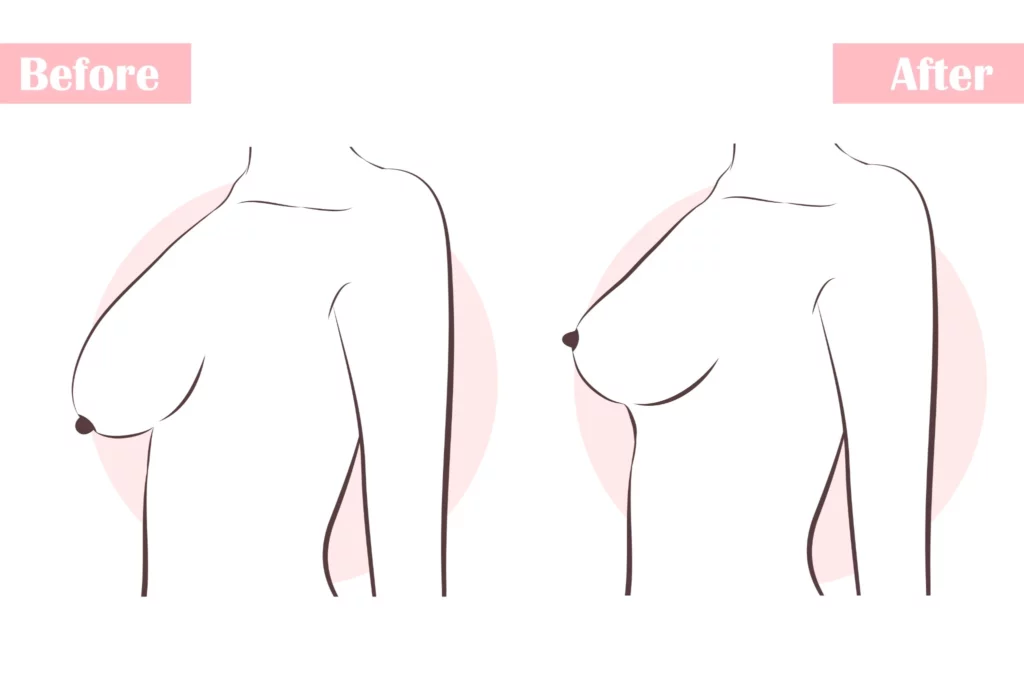
Breast implant revision after surgery abroad is a second operation in Korea to correct or replace implants first placed in another country, and planning it depends on records from that first surgery. If your first breast augmentation took place in Thailand, Turkey, Mexico, the US or anywhere else, the details of that operation now matter as much as how your breasts look and feel today.
What many international patients don’t realize is that the hardest part of a revision is often not the surgery itself. It is the missing information. The operative note may be written in another language, the implant card may never have been handed over, and the original surgeon may be difficult to reach across time zones.
This guide explains which five records to gather before you fly, why each one changes the revision plan, what a remote review in Korea can and cannot do, and what happens once you arrive in Seoul. It is written from the perspective of a board-certified plastic surgeon who regularly reviews files from patients who had their first operation overseas.
Table of contents
What Is Breast Implant Revision After Surgery Abroad?
Breast implant revision is any operation that changes the result of an earlier breast augmentation. Surgeons sometimes call it secondary surgery (the second operation) or tertiary surgery (the third). When the first operation took place in another country, the medical goals are the same, but the planning has an extra step: rebuilding the story of that first surgery from documents.
Plastic surgery textbooks describe revision as more complex and less predictable than a first augmentation. The breast tissue may have thinned over the years, the implant already sits in a pocket that was created for it, and a capsule (the layer of scar tissue your body naturally forms around any implant) has developed. Each of these factors shapes what a revision can safely achieve.
The Four Common Reasons Women Seek Revision
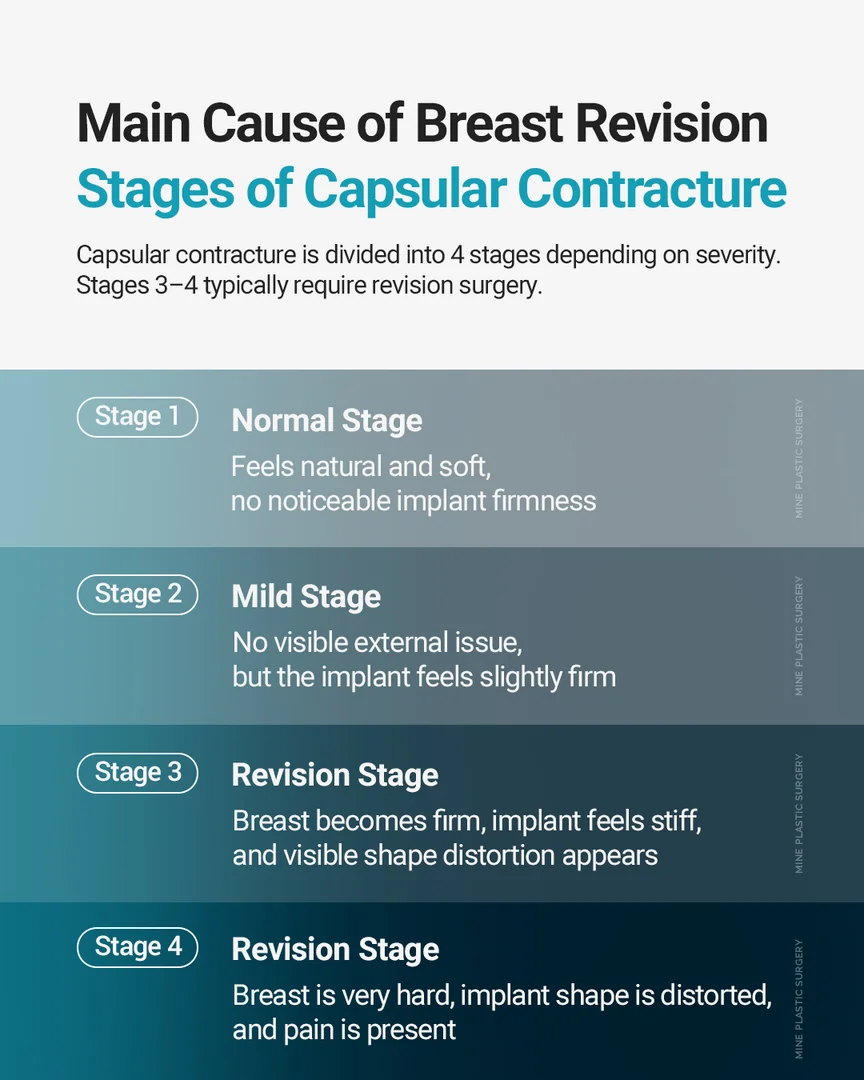
Breast surgery textbooks list 4 main drivers of revision surgery, and they often overlap in the same patient:
- Capsular contracture – the scar capsule tightens and squeezes the implant, making the breast feel firm, look round or high, and sometimes ache.
- Implant malposition – the implant has shifted too low, too far to the side, or toward the center of the chest.
- Ptosis – the breast tissue sags over or below the implant, sometimes creating a “double bubble” look.
- Visibility or palpability – the edges of the implant can be seen or felt, including rippling (visible wrinkles under thin skin).
Interestingly, the same texts note that patients with capsular contracture often come in complaining of something else, such as a high implant or uneven shape, without realizing the capsule is the underlying cause. That is one reason a careful examination matters more than a single photo.
Other reasons include implant rupture, a wish to change size, or simply wanting to remove the implants. For an overview of the techniques used to correct each problem, see our complete guide to breast revision surgery techniques. The American Society of Plastic Surgeons patient information on breast implant revision is also a useful general background read.
Why Surgery Abroad Adds a Records Problem
When revision is done by the original surgeon, most of the planning information already sits in the clinic’s chart. When you travel to a new country for a second operation, that chart does not travel with you unless you bring it.
In our international consultations, the most common gaps are an operative report written only in the local language, an implant card that was never received, and no imaging since the first surgery. None of these gaps reflects badly on the original clinic. Record formats simply differ from country to country, and many patients were never told to keep them.
Why Your First Surgery’s Details Change the Revision Plan
A revision is not a fresh start. Your surgeon has to work with the incision, pocket and implant that are already there, and with whatever happened to your body after the first operation. That is why planning a revision after surgery abroad starts with the paperwork from that first trip.
Incision, Pocket and Implant Surface
Three technical details from the first surgery matter most:
- Incision – under the breast fold, around the areola, or through the armpit. This affects where a revision incision can go and how the old scar is handled.
- Pocket – whether the implant sits above the chest muscle (subglandular), under it (submuscular), or in a combined “dual plane” position.
- Implant surface – smooth or textured, which influences both capsule behavior and how the old capsule may be managed.
According to plastic surgery textbooks, revision repairs are generally built from a combination of 3 moves: modifying the capsule, changing the pocket, and exchanging the implant. Some repairs also add a support material, such as an acellular dermal matrix (a processed tissue sheet that reinforces thin areas). If your surgeon knows the original pocket in advance, they can already judge whether a pocket change is likely to be part of your plan.
Complications You Had After the First Surgery
Your history after the first operation is just as important as the operation itself. A leading breast surgery textbook lists 6 factors linked to capsular contracture: infection or bacterial contamination, a subglandular pocket, a periareolar incision (around the areola), smooth implants, hematoma (a collection of blood after surgery), and the use of drains.
Several of those factors are recorded only in your discharge notes or remembered only by you. If you had an infection treated with antibiotics, a bleed that needed draining, or an early return to the operating room, your new surgeon needs to know. You can read more about capsular contracture symptoms and prevention in our dedicated guide.
Malposition follows the same principle. The surgical literature on aesthetic breast complications stresses that treatment begins with a thorough evaluation to find the underlying cause, because one displaced implant can have more than one cause. Your records help narrow down those causes before the examination even starts.
The textbooks are also clear that repeat operations carry more risk than first ones. A 3-year review of 166 patients, described in a major plastic surgery textbook, found that secondary augmentation-mastopexy (a repeat breast lift combined with implants) had higher revision and complication rates than primary procedures. Good records do not remove that risk, but they help your surgeon plan around it.
Records 1 and 2: Your Operative Report and Breast Implant Card
These two documents answer the most basic planning questions: what was done, and exactly what is inside your body.
What the Operative Report Should Show
The operative report (sometimes called the operation note or surgical record) is written by the surgeon on the day of surgery. A useful report usually shows:
- The date of surgery and the name of the clinic and surgeon
- The incision site
- The pocket: subglandular, submuscular or dual plane
- Implant volume in cc and the implant profile (how far it projects forward)
- Any unusual findings, extra procedures such as a lift, and whether drains were used
If the report is not in English, bring the original and a translation together. A translation alone can lose medical meaning, while the original lets a reviewer check numbers and terms directly.
What Is on a Breast Implant Card
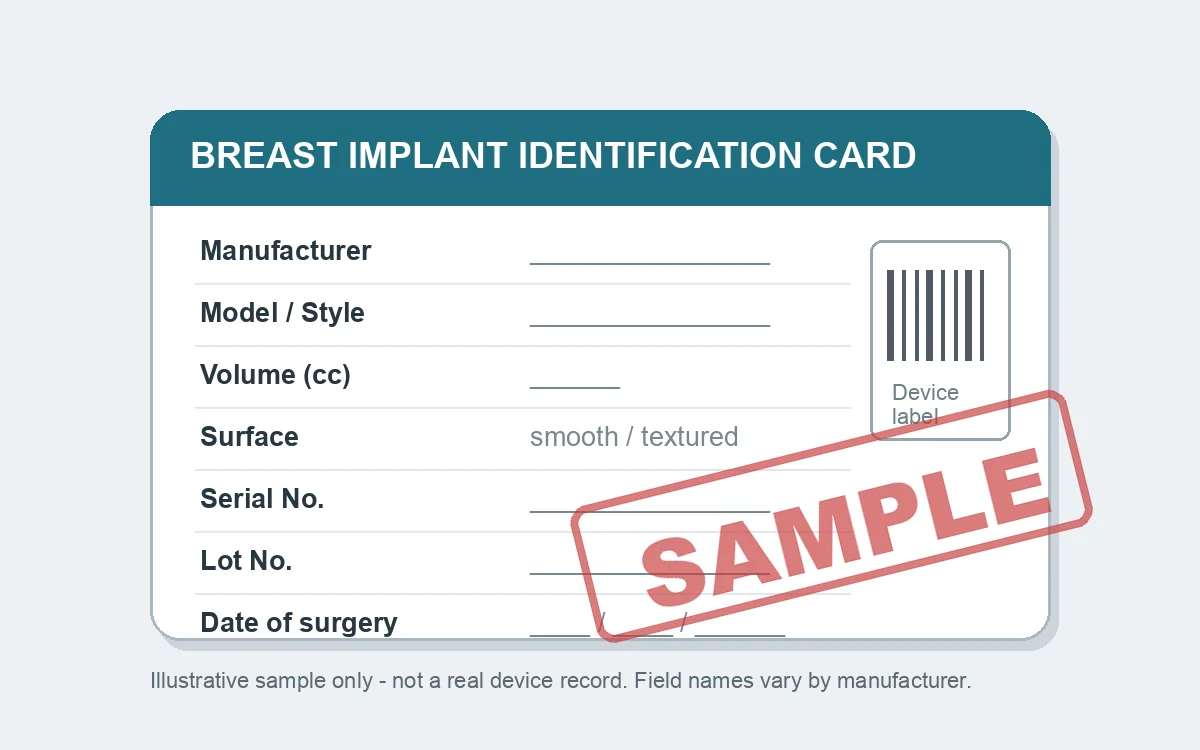
A breast implant card, also called an implant identification card, is a small card or sticker sheet that records the device placed in your body. It typically lists:
- The manufacturer
- The model or style name
- The volume in cc
- The surface type: smooth or textured
- The serial number and lot number for each side
These details are not just paperwork. Breast surgery literature reports that rupture rates differ between implant models and generations, and that failures increase as an implant ages. Knowing the exact model and its age helps your surgeon interpret your imaging and decide what to replace it with, if replacement is part of the plan.
If You Never Received an Implant Card
Many patients who traveled for their first surgery never received a card, or lost it years ago. This is common, and it does not stop you from having a revision.
Start by writing to the original clinic and asking for a copy of your operative report and the implant details. An email is fine, but keep a written record of the request. In some cases, the implant manufacturer’s warranty or device registration system can also help, although procedures differ by country and by manufacturer, so it is worth asking rather than assuming.
If no records can be found, your surgeon can still plan from an examination and imaging. Ultrasound or MRI can show the implant’s shape, approximate size and whether the shell is intact. They cannot, however, guarantee identification of the exact brand or model. That uncertainty is simply factored into the plan.
Record 3: Recent Breast Implant Ultrasound or MRI
Imaging shows what cannot be felt from the outside: whether the implant shell is intact, how the capsule looks, and whether silicone has moved outside the implant. For silicone implants in particular, a rupture can be silent, with no change in shape or feel.
Breast surgery textbooks explain the difference simply. A saline implant that ruptures deflates quickly, and the salt water is absorbed by the body harmlessly. A silicone implant can tear inside the capsule (intracapsular rupture) or allow gel to escape beyond it (extracapsular rupture), and both can go unnoticed. For a detailed look at symptoms and diagnosis, read our guide to the signs and treatment of breast implant rupture.
Ultrasound vs MRI: What Each One Shows
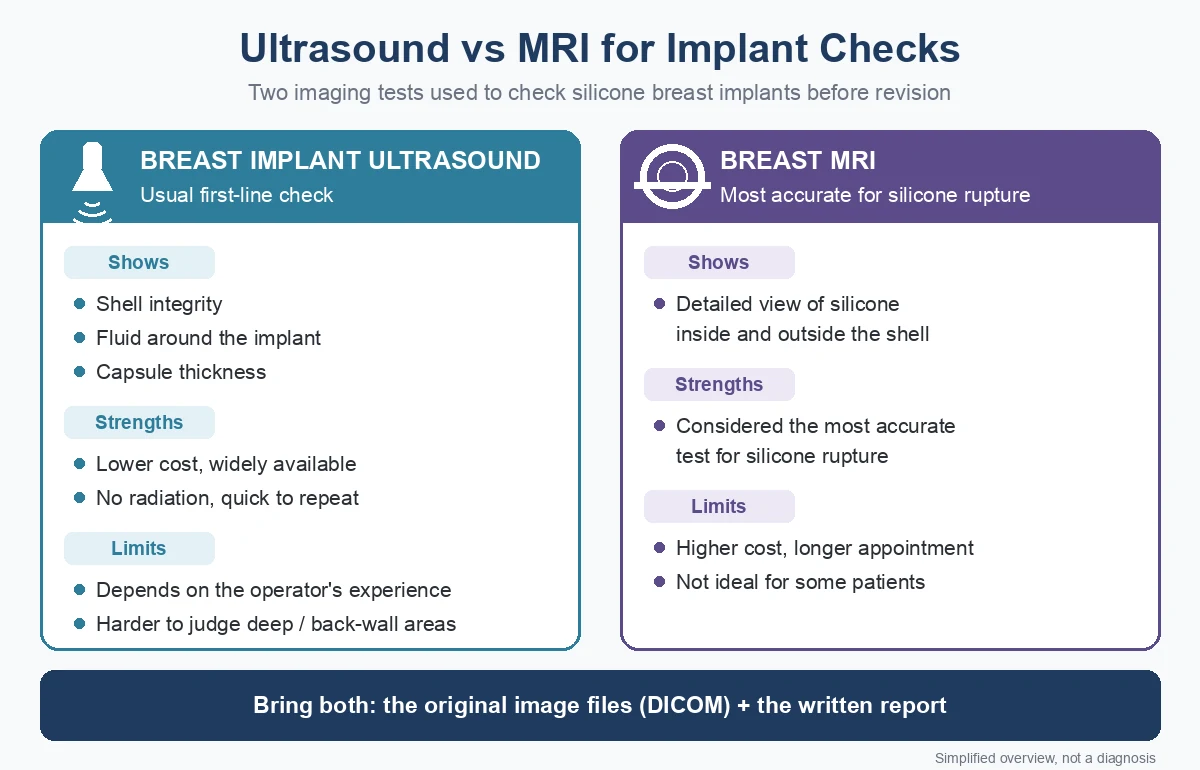
Both tests are used to check silicone implants. The surgical literature describes high-resolution breast implant ultrasound as the usual first-line check, mainly because it costs less and is widely available, while MRI is considered the most accurate test. Studies show high agreement between ultrasound and MRI for detecting silicone implant rupture, so a rupture already confirmed on ultrasound may not need an MRI as well.
| Test | What it shows | Strengths | Limits |
|---|---|---|---|
| Breast implant ultrasound | Shell integrity, fluid around the implant, capsule thickness | Lower cost, widely available, no radiation, quick to repeat | Depends on the operator’s experience; harder to judge deep or back-wall areas |
| Breast MRI | Detailed view of silicone inside and outside the shell | Considered the most accurate test for silicone rupture | Higher cost, longer appointment, not ideal for some patients |
In the US, the FDA recommends periodic imaging for silicone implants even when there are no symptoms. These are U.S. recommendations, and screening advice differs between countries, so do not worry if your country follows a different schedule.
How to Bring Imaging: Original Files Plus the Report
When you request your imaging, ask for two things:
- The original image files, usually in a format called DICOM, on a CD, a USB drive or a secure download link.
- The written report from the radiologist or the doctor who performed the scan.
A report alone gives someone else’s conclusion. A screenshot or a phone photo of the screen loses most of the detail a surgeon needs. The original files allow your surgeon in Korea to look at the images directly.
Recent imaging is more useful than old imaging, because implants and capsules change over time. How recent is “recent” depends on your symptoms and history, so our consultation team will tell you whether your existing scans are enough or whether a new scan would help.
Records 4 and 5: Photos, Symptom Notes and Medical History
The last two records are the easiest to prepare at home, and they often tell your surgeon the most about when and how things changed.
Photos From Before and After Your First Surgery
Collect three sets of photos if you can:
- Photos taken before your first surgery
- Photos from the early months after it
- Current photos taken now
For the current set, take a front view, two 45-degree views and two side views, standing in the same even light with your arms relaxed at your sides. Consistent photos make it much easier to compare shape, height and symmetry over time.
A Simple Symptom Timeline
Write a short list with dates. When did one side start to feel firmer? When did you first notice a change in shape, height or symmetry? When did any pain, tightness or rippling begin? Even approximate dates such as “spring 2023” are helpful.
Add any problems you had after the first surgery: infection, bleeding, wound healing issues, antibiotic treatment, or any additional operation. As the textbook risk factors above show, these events can directly influence the revision plan.
Medications, Allergies and Health Conditions
Finally, list your general health information:
- All regular medications, including blood thinners and herbal or vitamin supplements
- Allergies to medicines, latex or dressings
- Smoking or vaping habits
- Ongoing conditions such as diabetes, thyroid disease or high blood pressure
One important safety note: if, years after surgery, one breast suddenly swells or fills with fluid, see a doctor in your home country before you plan any travel. This kind of late fluid build-up (late seroma) needs to be evaluated promptly, partly to rule out rare implant-associated conditions such as BIA-ALCL, a rare lymphoma linked mainly to textured implants. It is a sign to get checked, not a reason to panic.
Here is the full checklist in one place:
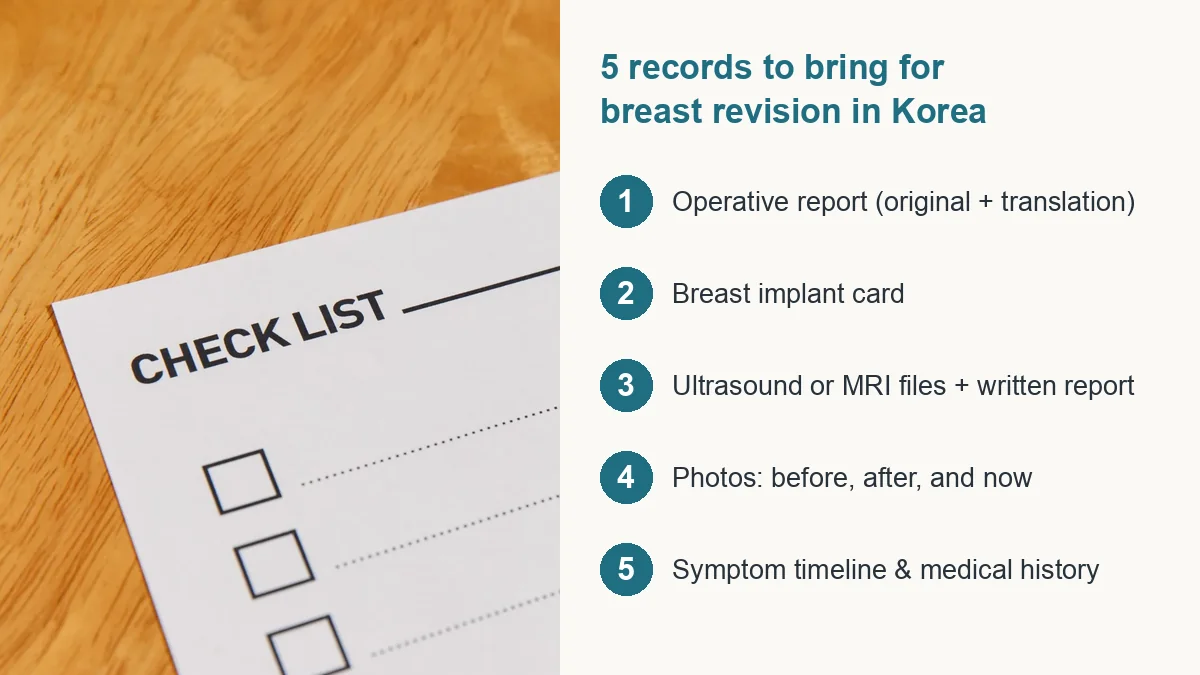
- Operative report – original plus translation if it is not in English
- Breast implant card – manufacturer, model, volume, surface, serial and lot numbers
- Recent ultrasound or MRI – original image files plus the written report
- Photos – before the first surgery, after it, and now
- Medical history – symptom timeline, past complications, medications, allergies and conditions
Sending Your Records to Korea: What a Remote Review Can and Can’t Do
Once your records are ready, a remote review lets a surgeon in Korea look at your case before you book flights. It is a helpful first step, but it has clear limits.
How to Package and Send Your Files
- Put all five records into one folder.
- Start each file name with the date, for example “2021-03-operative-report”.
- Keep originals and translations side by side.
- Use a secure method for health information, such as the clinic’s consultation channel or a password-protected link, rather than public file-sharing.
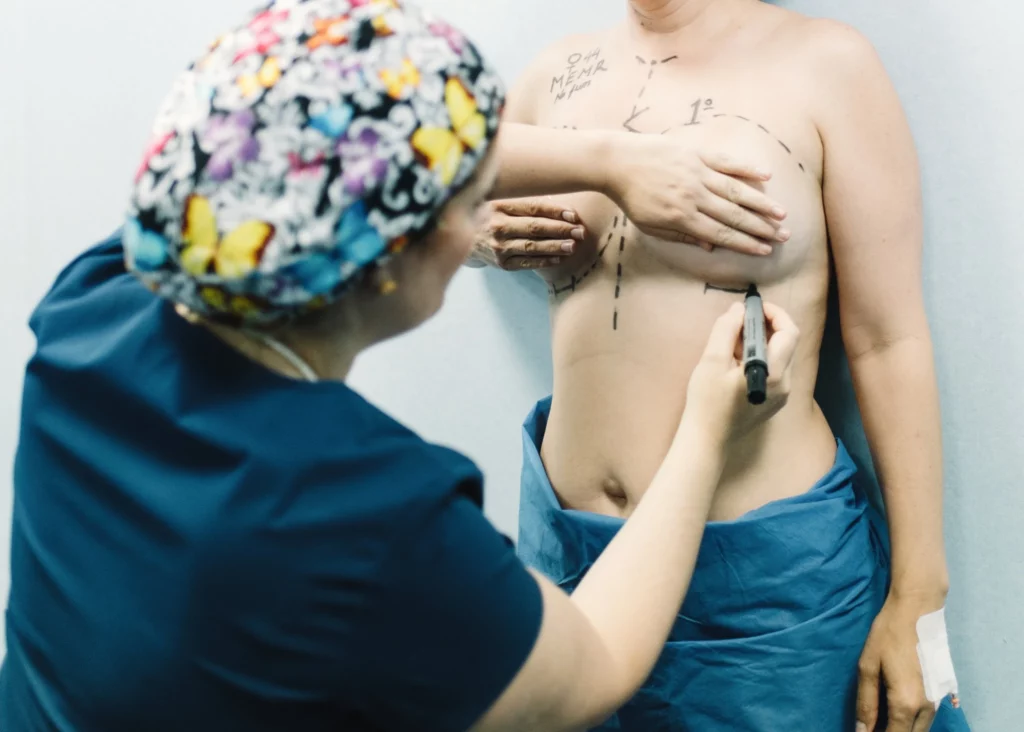
A remote review can give you a general direction, tell you which additional tests may be needed, and help you estimate how long to plan your stay. What it cannot do is confirm the final surgical plan. Tissue thickness, capsule firmness and skin quality must be felt and examined in person.
What Happens After You Arrive in Seoul
After you arrive, the process usually follows four steps:
- An in-person examination with your surgeon
- Repeat imaging if your existing scans are old or unclear
- A discussion of the options for the capsule, the pocket and the implant
- Confirmation of the plan, with time to ask questions
Revision recovery and safe travel timing depend on what is done. To plan the length of your stay, read what breast revision recovery looks like. To learn how revision is approached at our clinic, visit our page on breast revision surgery at MINE.
Frequently Asked Questions About Breast Implant Revision After Surgery Abroad
What should I bring for breast implant revision after surgery abroad?
Bring five records: your operative report, your breast implant card, a recent ultrasound or MRI with the original files and written report, photos from before, after and now, and your medical history. If any document is not in English, bring the original and a translation together.
How do I get my breast implant card if I lost it?
Ask the original clinic in writing for your operative report and implant details. The manufacturer’s warranty or registration system may also help, though procedures vary by country and company. If nothing is found, a revision can still be planned from examination and imaging, but the exact model may not be identifiable.
Do I need an MRI before breast implant revision?
Not always. Ultrasound is commonly used as the first check, and studies show that when ultrasound already confirms a rupture, an MRI may not be needed. MRI is the more detailed test. After reviewing your records, your surgeon will tell you which scan, if any, is still required.
Should you go back to the same surgeon for a revision?
Your original surgeon knows your first operation best, so returning is reasonable when it is practical. After surgery abroad, that is often difficult because of distance or language. If you see a new surgeon, the key is filling the information gap with the five records in this guide.
Can a surgeon in Korea plan my revision from photos alone?
No. Photos and imaging allow a preliminary opinion, but tissue thickness, capsule firmness and skin quality need a hands-on examination. A responsible surgeon will confirm the final plan only after seeing you in person in Seoul, sometimes with repeat imaging.
Breast implant revision after surgery abroad goes most smoothly when your surgeon in Korea can see the full story of your first operation. Gather the five records, send them for an initial review, and let the in-person examination confirm the plan.
Ready to have your records reviewed? Once you have gathered your files, you can request a preliminary review through our consultation team by WhatsApp or email. Learn more about breast revision surgery at MINE and how our board-certified plastic surgeons approach each case.
Medically reviewed by Dr. Lee Sung-wook, board-certified plastic surgeon, MINE Plastic Surgery, Seoul.
※ This content is for informational purposes only and does not replace professional medical advice, diagnosis, or treatment. Individual results may vary, and side effects may occur. Please consult with a board-certified plastic surgeon for personalized advice.