EN


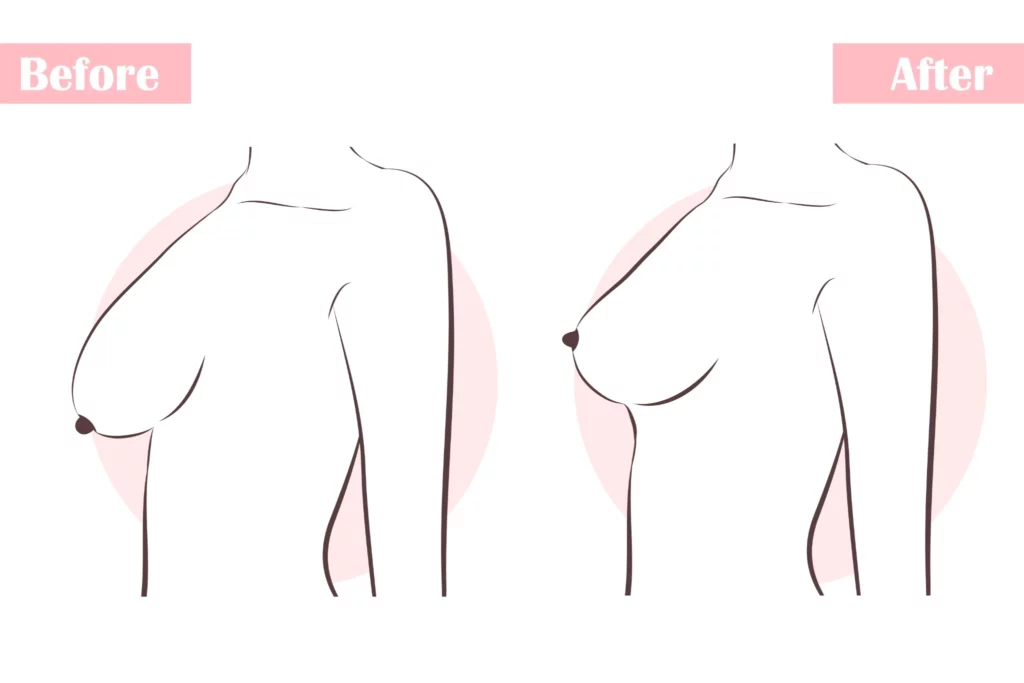
A breast lift scar timeline is the predictable sequence a mastopexy scar follows: red and firm in the first weeks, gradually lighter and flatter over the following months, and ready for a final assessment after about one year. Where the scar sits depends on which of three incisions is used.
In my consultations, scars are almost always the first worry patients raise. “I want the lift, but I don’t know where the scars will be or how much they will show” is something I hear nearly every week. The honest answer is that the incision decides the shape of the scar, and time decides how it looks.
So this guide answers three questions: where each incision leaves a scar and roughly how far it extends, what your breast lift scar timeline looks like over the first 12 months, and why the scar around the areola can widen — and what limits that. Day-to-day scar care, such as silicone and laser options, is covered in a separate guide that I link to in the timeline section.
Table of Contents
What Determines Where a Breast Lift Scar Ends Up?
A breast lift (mastopexy) removes stretched skin and moves the nipple and areola back up to a higher position, reshaping the breast. Wherever skin is removed, the edges have to be stitched together, and every stitched line heals as a line scar. That is why the first chapter of any breast lift scar timeline is written before surgery, with one question: how much skin has to go?
How Much Skin Has to Go: Sagging Grade Comes First
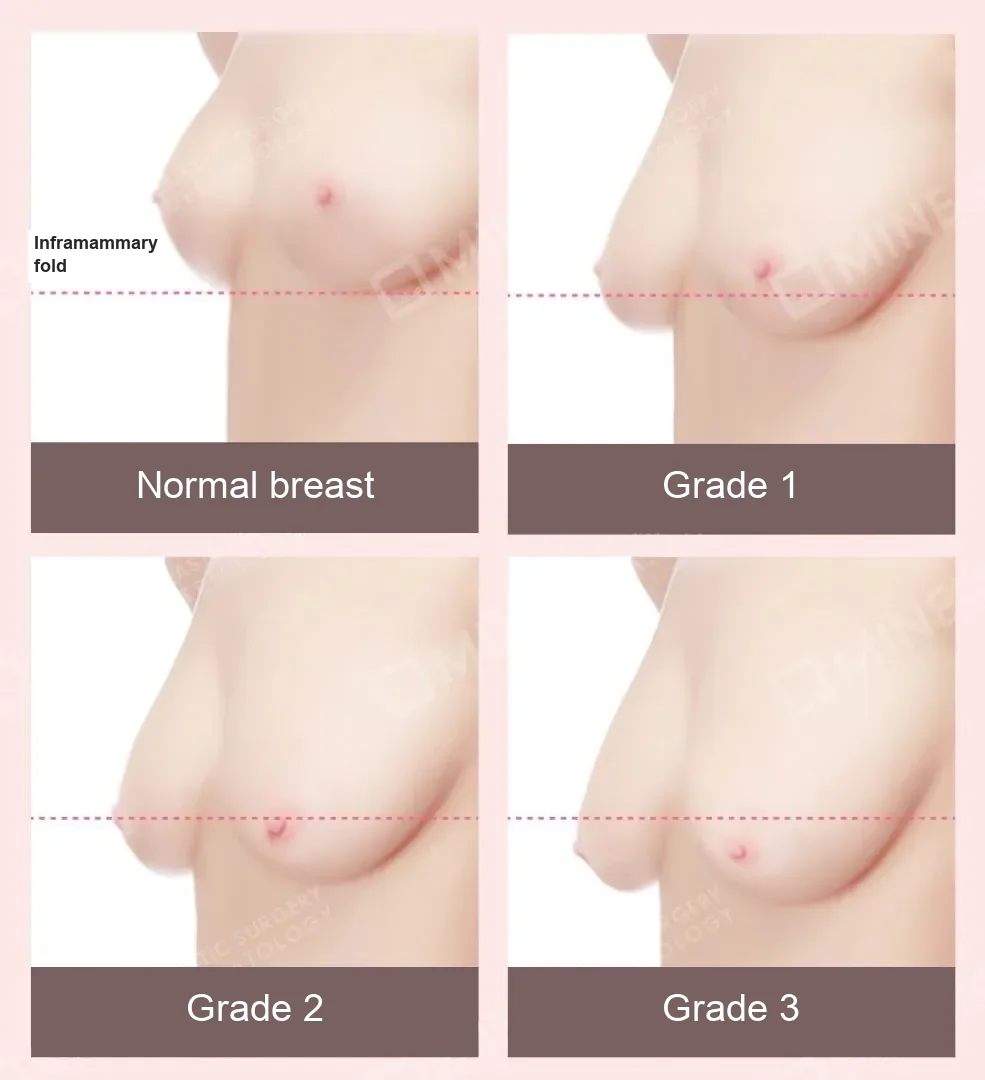
Standard plastic surgery references begin the discussion of a breast lift with how far the breast has dropped. With mild sagging (ptosis), only a small amount of skin needs to be removed, and a circle around the areola may be enough. The further the breast has dropped, the more skin has to come away, and the longer the incision lines become. Surgeons grade this in a fairly standard way, which I explain in our article on the stages of breast sagging.
Think of taking in a loose garment. If it has stretched a little, one tuck is enough; if it has stretched a lot, you need several. This is why women whose sagging became more pronounced after pregnancy, breastfeeding or major weight loss usually end up with longer scar lines.
Three Incision Shapes to Remember: Donut, Vertical, Anchor
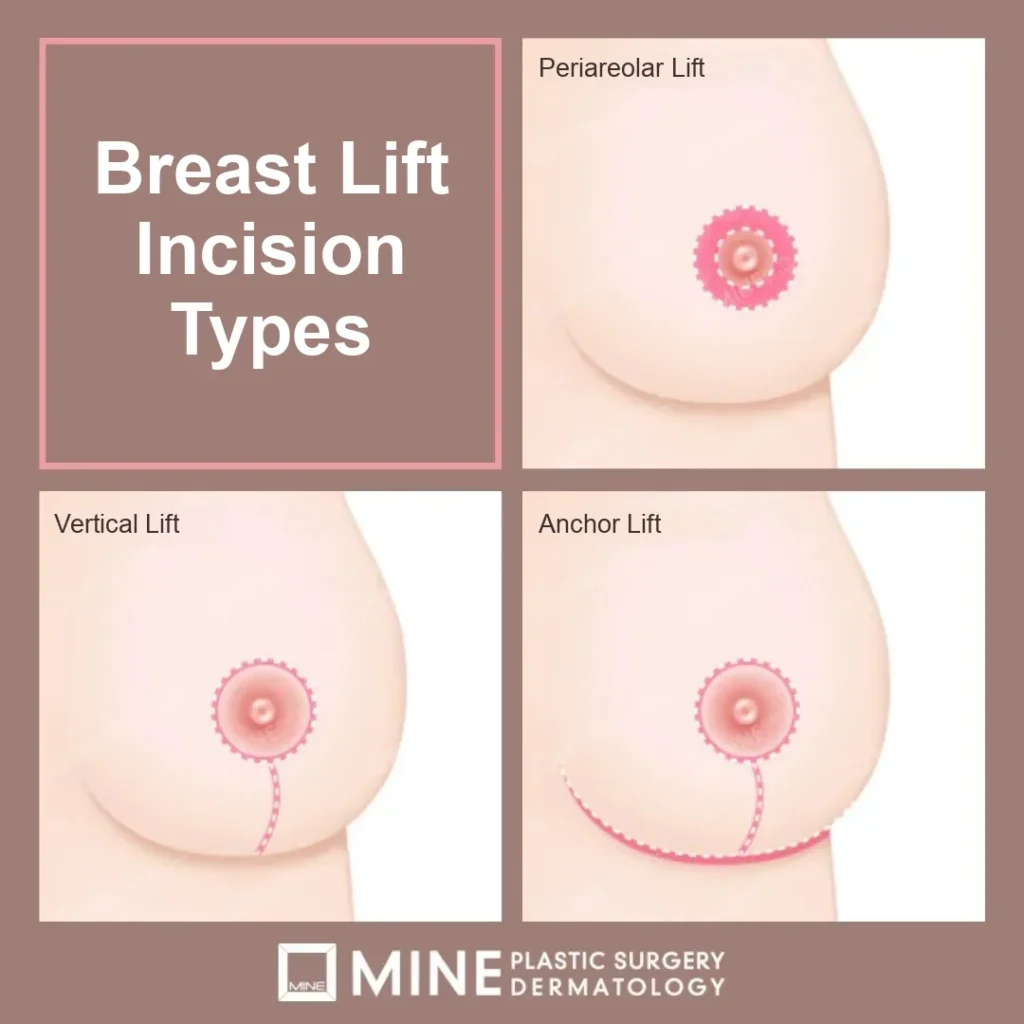
- Periareolar (donut) incision — a single circle around the edge of the areola.
- Periareolar plus vertical incision — the areola circle plus a vertical line running down from the areola to the crease under the breast. This pattern is often called a lollipop lift.
- Anchor (inverted-T) incision — the circle, the vertical line, and a horizontal line along the crease under the breast (the inframammary fold).
Which incision suits your body, and the pros and cons of each, are covered in our article on how to choose between breast lift incision methods. Here, I stay with the next question: once an incision has been chosen, what scar does it leave, and how does that scar change over time?
Dr. Lee’s Key Point: Scar length is not something the surgeon picks freely — your degree of sagging decides it first.
Breast Lift Scars by Incision: Location and Length Compared
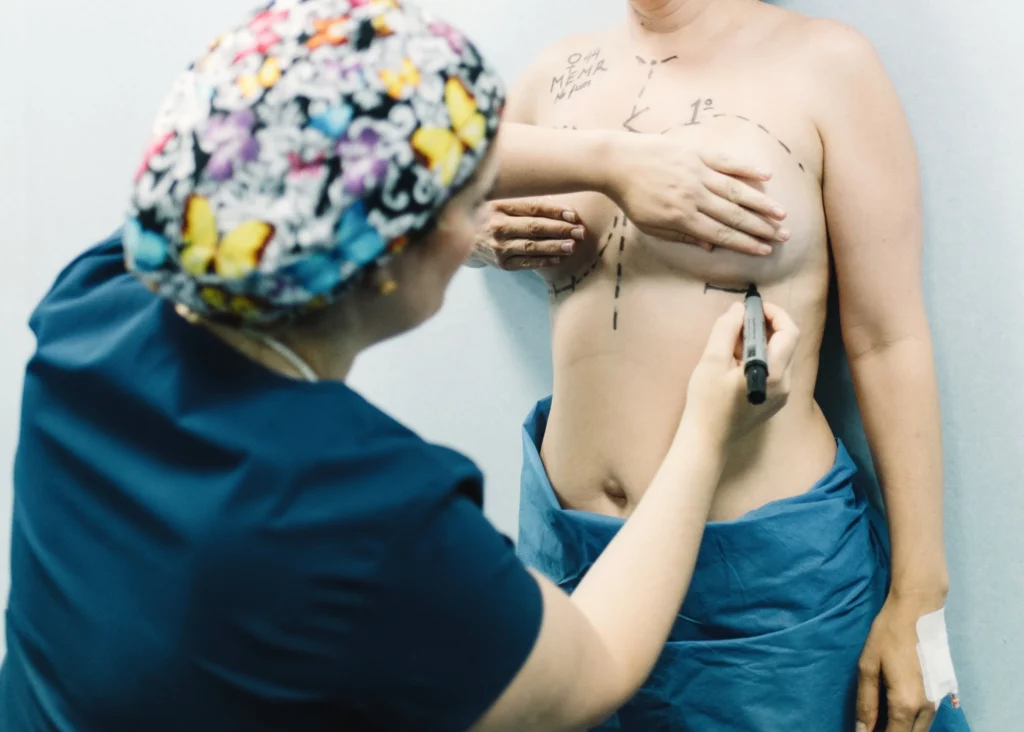
The same operation can place its scars in quite different places depending on the pattern. Picturing the lines in advance turns a vague fear into specific questions you can bring to your consultation, and it is the first step in understanding how your own scars will heal.
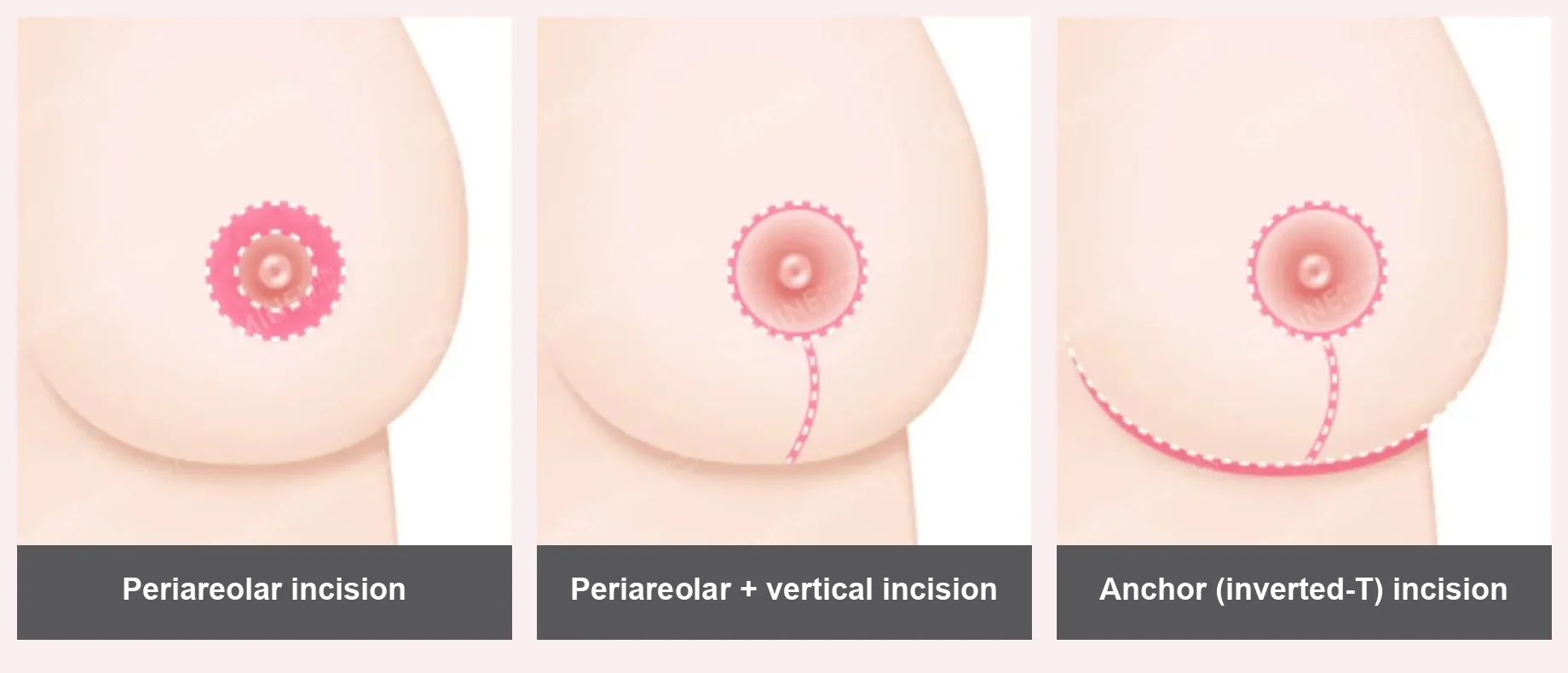
| Incision | Where the scar sits | Relative extent | Where tension concentrates / what to watch |
|---|---|---|---|
| Periareolar (donut) | Around the areola border, on the line where the color changes | Shortest — one circle | The whole circle (drawstring-style closure) → scar widening, areola stretching |
| Periareolar + vertical | Areola circle + vertical line from the areola to the crease under the breast | Medium | Lower end of the vertical line; small horizontal pleats |
| Anchor / inverted-T | Circle + vertical line + horizontal line in the crease under the breast | Longest | The T-junction; inner and outer ends of the fold scar (dog-ears, thickening) |
Scar length varies with the degree of sagging and how much loose skin there is, so it cannot be promised as one number.
Periareolar Incision: A Circle on the Areola Border
The scar sits as a circle on the border where the darker areola meets the surrounding skin. Because it follows a natural color change, it tends to be relatively discreet.
The catch is that this line is also the most exposed to closure tension, which can widen the scar or let the areola stretch again. I explain why in the section on periareolar scar widening below.
Periareolar Plus Vertical Incision: A Line Down to the Fold
Here, a vertical scar runs from the bottom of the areola toward the crease under the breast, in addition to the circle. The vertical line lets the surgeon remove more skin from the lower half of the breast, which makes it easier to raise the nipple to the right height.
To keep the vertical line short, surgeons often gather the skin along the closure, a little like gathering fabric on a thread. According to the surgical literature, these gathered vertical wrinkles usually smooth out within about 6 months.
Anchor (Inverted-T) Incision: The Fold Scar and the T-Junction
When sagging is severe or the breasts are large, a vertical line alone may not be enough to deal with all the excess skin. Adding a horizontal line in the crease under the breast creates the anchor pattern. Breast surgery textbooks describe it as the most aggressive option for removing skin, best suited to more advanced (grade 2–3) sagging.
Some surgeons push vertical techniques further. A 2016 study by Swanson in Plastic and Reconstructive Surgery – Global Open reported 252 consecutive vertical augmentation-mastopexies (a lift combined with breast implants) performed without converting any of them to an anchor pattern. Even so, when there is a lot of excess skin, adding a horizontal line can still be the better choice, so the pattern is decided after looking at your degree of sagging and the quality of your skin.
The horizontal line lies inside the fold, so when you stand it is often tucked under the breast. The spot that needs the most attention is the T-junction, where the vertical and horizontal lines meet.
Anatomically, the areola circle, the lower vertical line and the fold line mostly fall within the area a bra cup covers. How much shows in practice, though, depends on the cut of your lingerie or swimwear and on your body shape, so no surgeon can honestly call these scars invisible.
Dr. Lee’s Key Point: The goal is not simply “the shorter the scar, the better” but a line that fully corrects the sagging with as little tension as possible.
Breast Lift Scar Timeline: What Changes Over the First Year
A scar does not set on the day of surgery. It matures slowly over many months, and knowing the stages of the breast lift scar timeline in advance saves a lot of unnecessary worry at month two or three, when many scars look their least attractive.
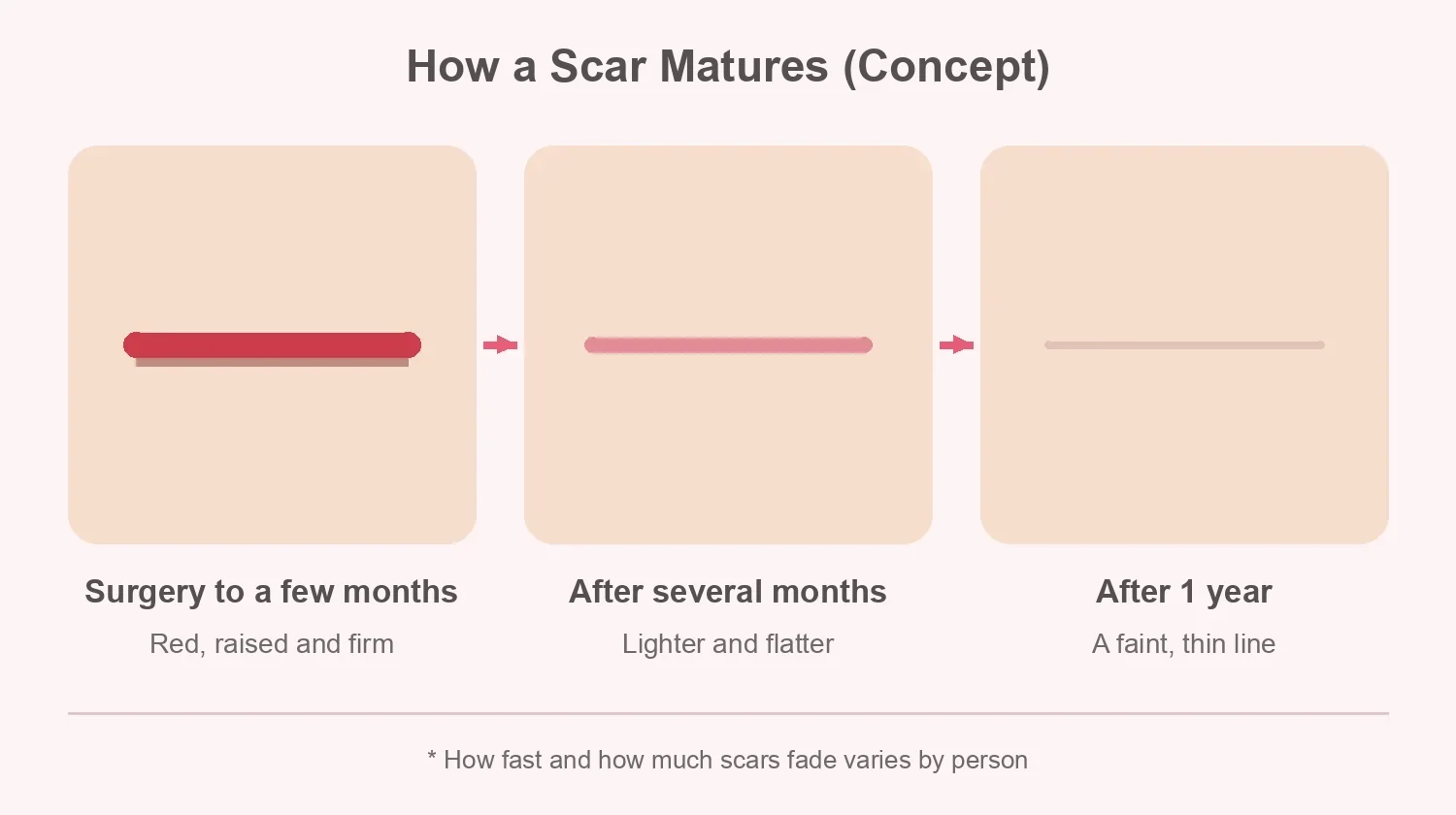
| Stage | Typical timing | What you usually see |
|---|---|---|
| Early | First weeks to a few months | Red or pink, slightly raised, firm to the touch |
| Middle | The following several months | Redness fading; the scar flattening and softening |
| Mature | Around 12 months and beyond | A thin, pale line; time for the final assessment |
These timings are a general guide only — your own breast lift scar timeline may run faster or slower.
Weeks to Early Months: Red, Raised and Firm
In the first weeks to months after surgery, the body builds many tiny new blood vessels inside the healing wound to supply the repair work. That is why a young scar looks red or pink, sits slightly raised and feels firm. At this stage of the breast lift scar timeline, redness is usually a sign of normal healing, not a problem.
The Following Months: Lighter, Flatter, Softer
As the months pass, those extra blood vessels regress and the redness gradually fades. Raised areas flatten and the scar softens. Standard references on wound healing explain that as a normal scar matures, its blood supply comes closer to that of the surrounding skin, which is exactly why the color settles.
How you look after the scar during this window matters too. Silicone products and vascular laser options for early red scars are covered in our guide to managing breast lift scars, so I won’t repeat them here.
Breast Lift Scars After 1 Year: When to Judge the Final Result
According to scar textbooks, even thick, raised (hypertrophic) scars can keep maturing for a year or more and flatten considerably without any treatment. That is why the final look of a mastopexy scar is usually judged after about one year, not at three or six months.
It also helps to keep expectations realistic. A mature scar never becomes identical to normal skin: it heals as a thin, pale line without hair follicles or sweat glands. The scar literature also describes maturation as a process that can continue for years in some people.
How quickly your own scars mature depends on your genetics and how your skin tends to heal, whether you smoke, how much tension the wound is under, and your skin tone. Two patients who had the same operation can be at very different points in the same month.
Dr. Lee’s Key Point: Don’t judge your result by how the scar looks a few months in — on the breast lift scar timeline, one year is the benchmark.
Why a Periareolar Incision Scar Can Widen
The periareolar approach leaves the shortest scar, yet it is also the one where some patients later notice that the scar around the areola has widened, or that the areola has stretched larger again. Understanding why is the most useful thing to know about this incision.
The Tension of Fitting a Large Circle to a Small Areola
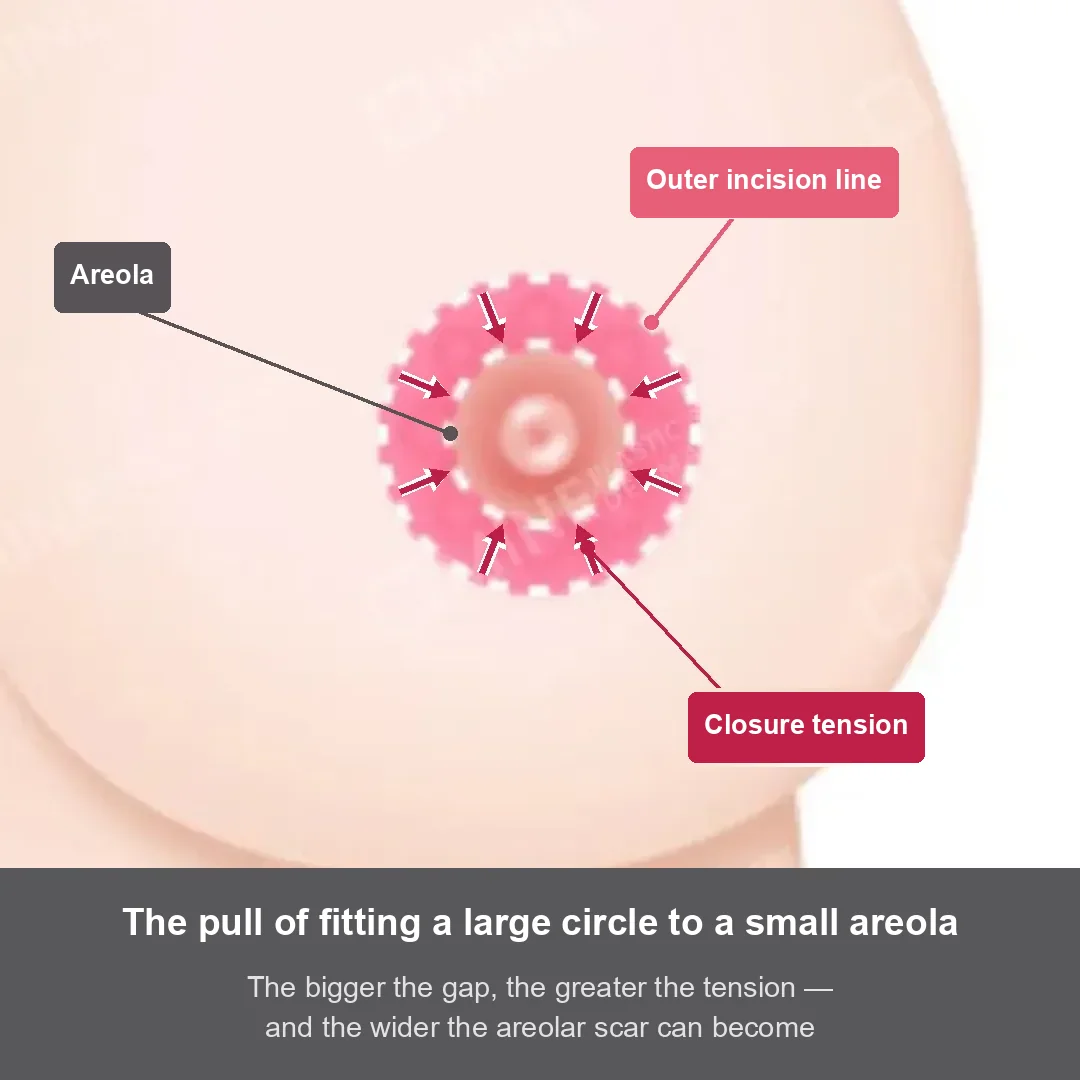
In a periareolar lift, the surgeon draws a larger circle outside the areola, removes the ring of skin in between, and then cinches the large outer circle down to fit the smaller areola — a drawstring-style closure, much like pulling the cord on a pouch.
The bigger the difference between the two circles, the greater the pull on the stitched edge. Plastic surgery textbooks identify this excessive drawstring tension as the main cause of unsightly periareolar scars and of the areola spreading again after surgery. In other words, a widening scar is usually a tension problem rather than a sign of weak stitches.
Who a Periareolar-Only Lift Suits
Plastic surgery textbooks recommend limiting a periareolar-only breast lift to women with large areolas and mild nipple sagging of no more than 2 cm. When the technique is stretched to correct more severe sagging, deformity around the areola becomes more likely and satisfaction drops.
If the nipple needs to move up by more than about 2 cm, adding a vertical line usually gives better control of nipple position than forcing the circle to do all the work. Surgery to reduce areola size on its own is a different topic, so I won’t cover it here.
Tension-Sharing Sutures Described in the Literature
The medical literature describes several stitching methods designed to keep the areola’s diameter stable. One is a permanent (non-dissolving) stitch placed in the deeper skin layer around the areola, acting as a supporting ring. Another is an interlocking stitch that weaves between the edge of the areola and the surrounding skin like the spokes of a wheel, reported by Hammond and colleagues in Plastic and Reconstructive Surgery (2007).
The shared principle is to spread the tension around the whole circle instead of letting it build up in one place. Which suture suits you depends on your skin and how much sagging there is, so it is worth asking about directly at your consultation.
Dr. Lee’s Key Point: Areolar scar widening is more about tension than thread. The first decision is not to push the periareolar approach beyond what it can do.
Vertical Scar Pleats and the T-Junction: Where Problems Concentrate
The longer the incision, the more points there are to watch. It is better to know them honestly before you decide than to discover them afterward.
Small Horizontal Pleats Inside the Vertical Scar
The vertical wrinkles created by gathering the skin usually settle on their own. There is an important exception, though: horizontal pleats do not smooth out by themselves and can leave small crosswise scars inside the vertical scar, so they need to be corrected during surgery rather than left to time.
T-Junction Separation and Widening in Anchor Lift Scars
In an anchor lift, the T-junction is where the pull from the vertical line and the pull from the horizontal line meet. Because these forces converge on one small point, this is where the wound is most prone to separating slightly and where the scar most often widens.
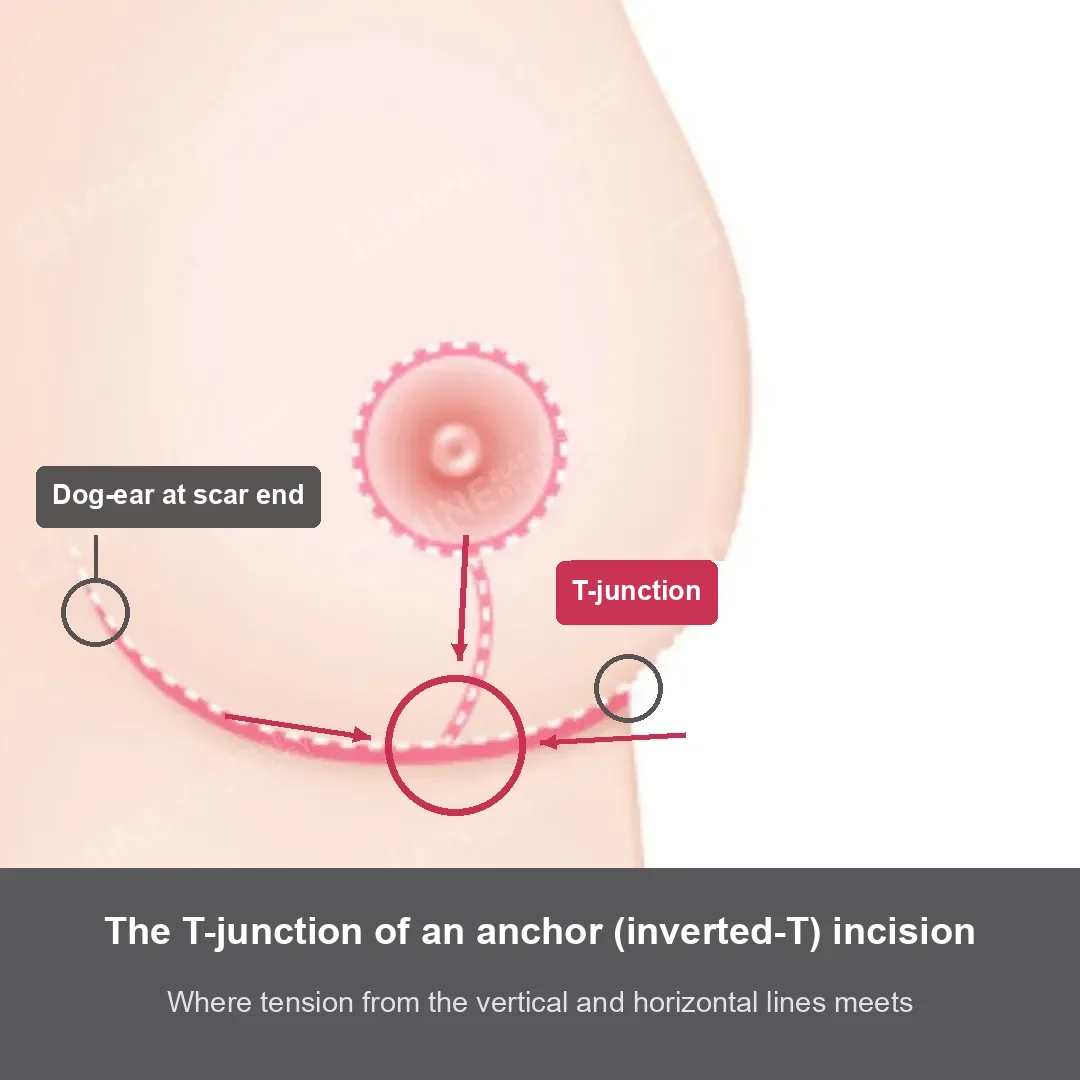
At the ends of the fold scar, skin can bunch up into small puckers known as dog-ears. Surgical references also note that the inner and outer ends of the fold scar are more prone to thickening than its middle. Both issues are best minimized at the planning stage, through how the incision lines are designed, rather than fixed afterward. They are also the areas most worth photographing as your scars mature.
Risk Factors for Thick or Dark Mastopexy Scars
Some factors make a scar more likely to thicken or darken. If any of these apply to you, please tell your surgeon at consultation:
- A tendency to form keloids or thick scars, or a family history of them
- Smoking, which slows wound healing
- Diabetes or other conditions that affect healing
- A large change in weight after surgery
- A darker skin tone that is prone to pigmentation (darkening) after injury
The scar literature also notes that adolescents tend to form more pronounced scars than older adults, which is one more reason scar healing differs from person to person.
Beyond scarring, a breast lift carries the general risks of any operation, including infection or inflammation, bleeding, changes in nipple or areola sensation, and asymmetry between the two sides.
Dr. Lee’s Key Point: Many scar problems start at the T-junction and in how pleats are handled. Please don’t hide a keloid tendency or smoking — it changes the plan.
When to Consider Breast Lift Scar Revision
If a scar disappoints you a few months after surgery, I don’t recommend rushing back to the operating room. At that point you are still in the middle of the breast lift scar timeline, and much of what bothers you may still improve.
Plastic surgery textbooks advise delaying mastopexy scar revision for at least 6 to 12 months, until the scar has matured and the surrounding tissue can be closed again without tension. In practice, the decision is usually made around the one-year mark.
Until then, the usual approach is to keep up your scar care and let the breast lift scar timeline play out. If you are flying home after surgery, photos taken in the same lighting at regular intervals make it much easier to tell whether a scar is still improving.
Dr. Lee’s Key Point: Know where your scars will be before surgery, and wait a year before judging them afterward.
Questions to Ask Before Your Breast Lift: Draw Your Incision Lines
In my clinical experience, dissatisfaction with scars often starts not with the scar itself but with the feeling “I didn’t know it would look like this.” Plastic surgery references make the same point: even when the breast shape is good, failing to explain in advance how scars mature can turn a good result into a disappointment.
Ask your surgeon to draw your actual incision lines on your body, and check these points:
- Which incision does my degree of sagging need?
- Exactly where will each scar sit, and roughly how far will it extend?
- Do I have factors, such as a family history of keloids or smoking, that could affect scarring?
- What should my breast lift scar timeline look like over the first year?
- What is the plan if a scar widens or thickens?
- If I am traveling for surgery, how will scar checks at around 3, 6 and 12 months be handled once I am home?
The general recovery schedule — pain, compression bra, and when you can return to work and exercise — is set out in our breast lift recovery timeline.
Frequently Asked Questions About the Breast Lift Scar Timeline
Where exactly will my breast lift scars be?
Every breast lift leaves a scar around the areola. For moderate sagging, a vertical line from the areola down to the crease under the breast is added; for more severe sagging, a horizontal line along that crease is added as well. Which pattern you need depends mainly on how far the breast has dropped.
What do breast lift scars look like after 1 year?
By around one year, most scars have become thin, pale lines that are flatter and softer than they were at three to six months. Scar textbooks describe maturation continuing for a year or more, so this is when the breast lift scar timeline reaches its final assessment. A mature scar is never identical to normal skin, and the pace varies between individuals.
Why does the scar around my areola look wider than expected?
The main cause is tension from drawing a large outer circle in to fit a smaller areola. That is why plastic surgery textbooks recommend limiting a periareolar-only lift to mild nipple sagging of no more than 2 cm. Tension-sharing stitching methods have also been described in the literature.
Are anchor lift scars more visible than vertical scars?
Anchor lift scars are longer in total because a horizontal line is added, but that line sits in the crease under the breast. The point to watch most closely is the T-junction, where the vertical and horizontal lines meet. Whether you need an anchor or a vertical pattern depends on your degree of sagging.
Can the areola stretch again after a periareolar lift?
Yes. When the closure is under high tension, the areola can gradually enlarge again and the scar can widen. Keeping the periareolar approach within its limits and using tension-sharing stitches are the main ways to reduce this risk, so it is worth discussing both at consultation.
When can a breast lift scar be revised?
Revision is considered once the scar has matured and the surrounding tissue can be closed again without tension. That usually means waiting at least 6 to 12 months, with the decision typically made around one year after surgery, once the normal scar healing timeline has run its course.
Plan Your Scar Before Surgery with Dr. Lee Sung-wook
To sum up: as sagging increases, breast lift scars grow from a circle around the areola to a vertical line and then a fold line, and over a year or more they fade and flatten. Areolar scar widening is mainly a matter of closure tension, while the T-junction, your genetics and smoking all shape how your breast lift scar timeline unfolds.
Because the incision you need and the way your scars mature depend on your degree of sagging, your skin thickness and how your skin heals, the right plan differs from person to person. If you would like to know exactly where your scars would sit and how they are likely to change, I recommend a one-on-one consultation with MINE Plastic Surgery — through our online consultation form, or by phone at +82-2-516-1175. You can read more about our approach on the Korean breast lift at MINE page.
Written and medically reviewed by Dr. Lee Sung-wook, Board-certified Plastic Surgeon, MINE Plastic Surgery.
MINE Plastic Surgery | 813 Nonhyeon-ro, Gangnam-gu, Seoul, Korea | +82-2-516-1175
※ This content is for informational purposes only and does not replace professional medical advice, diagnosis, or treatment. Individual results may vary, and side effects may occur. Please consult with a board-certified plastic surgeon for personalized advice.