EN


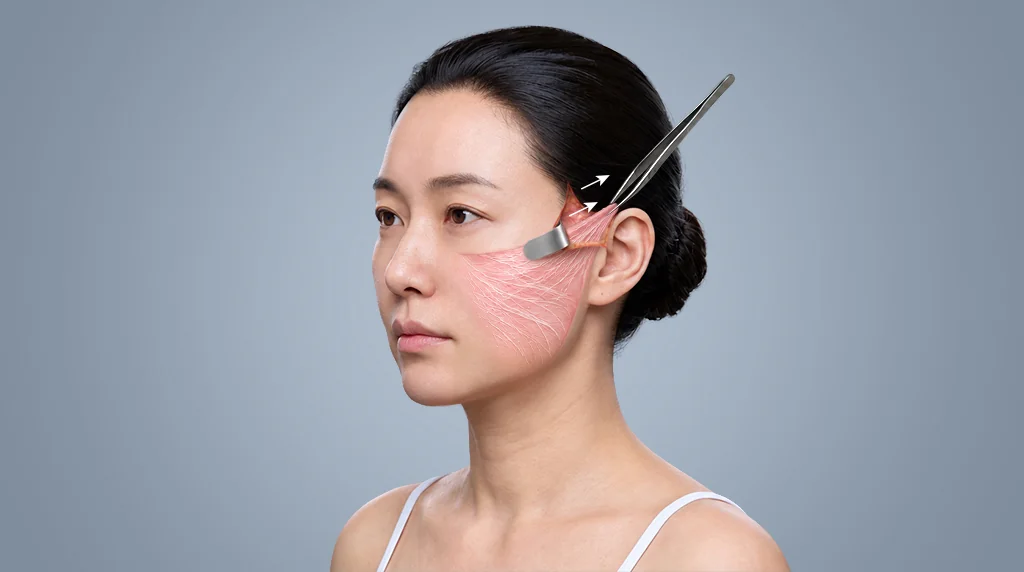
Thread lift or mini facelift: the choice is really between two different depths of correction. A thread lift suspends the soft tissue under the skin with absorbable barbed threads, while a mini facelift releases and repositions the deeper SMAS layer (the supportive tissue sheet under the skin and fat) through a short incision and removes excess skin. Both promise a cleaner jawline, but they work on different layers, and that difference decides how well each one treats a jowl.
The short answer: for mild, early jowling with little loose skin, threads can give a modest lift that fades within about 1–2 years. Once there is loose skin, heavy jowl fat, or a jowl that has dropped to or below the jawline, threads are usually the wrong tool, and a mini facelift addresses the cause rather than the surface.
This guide looks at the thread lift or mini facelift question for jowls specifically: why jowls form, what each procedure actually lifts, how long each holds, and the situations where threads are the wrong choice. If you want the bigger picture on durability across every lift type, see our guide on how long each type of facelift lasts.
Why Jowls Form: The Layer You Treat Decides the Result
A jowl is not simply “extra fat” along the jaw. It is soft tissue (fat, a loosened support layer and the skin over it) that has slid down and forward until it bulges just behind a firm anchor point on the jawbone. Because several layers are involved, whether a thread lift or mini facelift is the better fit depends on which layer has actually let go.
The Mandibular Ligament: The Anchor the Jowl Drops Behind
Along the jaw there is a tough tether called the mandibular ligament (a band of tissue that ties the skin to the jawbone roughly one-third of the way back from the chin). In front of it, the tissues stay fixed. Behind it, the attachment is much weaker, so tissue there can slide.
Anatomical research published in 2022 found that the jowl sits in the fatty layer just behind the mandibular ligament, which is why the jawline breaks into a notch rather than sagging evenly. You can read the study, The Surgical Anatomy of the Jowl and the Mandibular Ligament Reassessed (Aesthetic Plastic Surgery, 2022), for the full anatomical detail.
Plastic surgery textbooks describe the same pattern from another angle: the platysma (the thin muscle sheet that runs from the jaw down the neck) is only loosely attached behind that ligament, and as fat descends into this weak spot, the jowl forms right behind the strong anchor point.
Skin, Fat and SMAS Sag at Different Rates
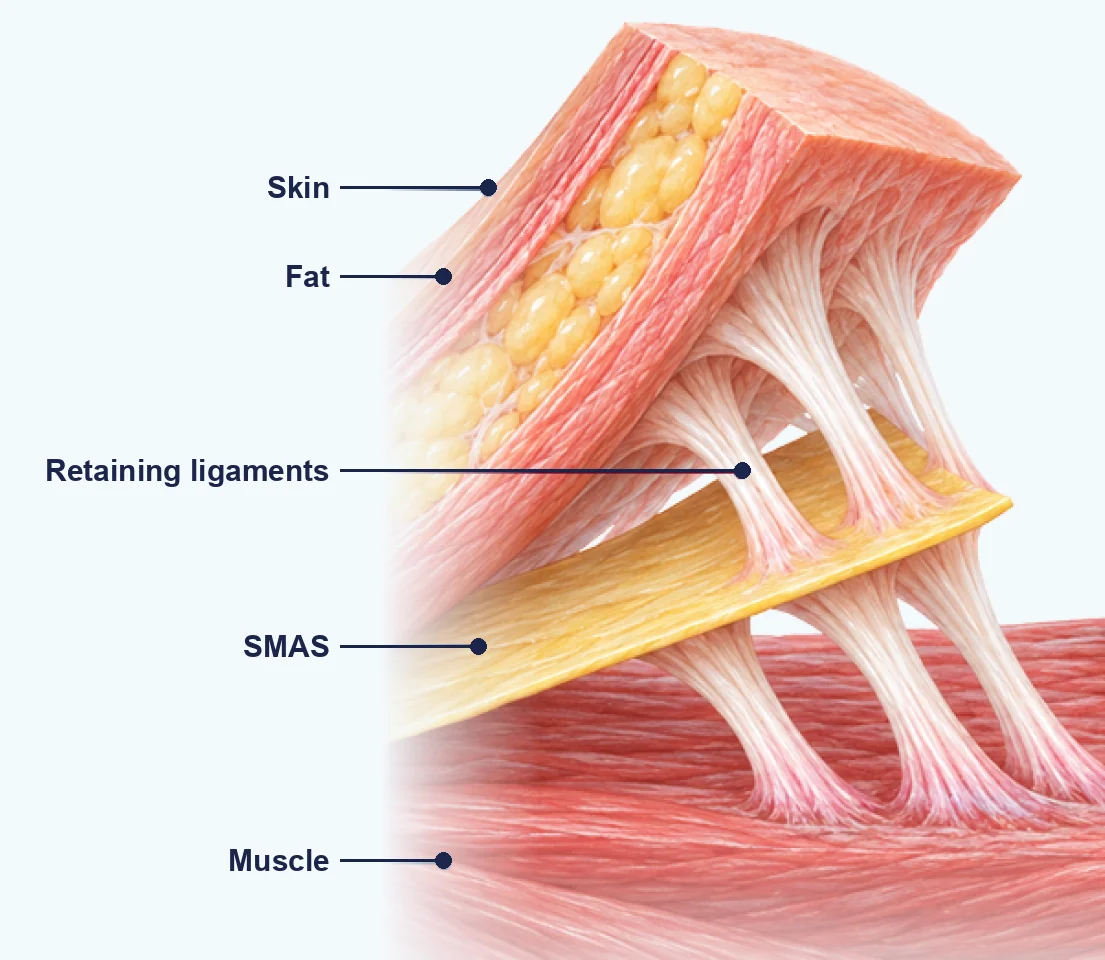
The SMAS (the thin fibrous-muscular sheet under the fat that holds the cheek and jaw tissues up) is the main support layer of the lower face. Over time it stretches, the fat above it drifts downward, and the skin loses elasticity. Textbooks note that skin and SMAS age at different rates and in different directions, which is why they often need to be handled separately.
So a jowl can be made of three things: loose skin, descended fat and a stretched SMAS. Most people have a mix. The treatment has to reach the layer that is actually loose. If the neck is also part of the problem, that changes the picture again, which we cover in the section on when threads are the wrong choice.
Thread Lift or Mini Facelift: What Each One Actually Lifts
When people weigh a thread lift or mini facelift, they often picture two versions of the same thing, one with a needle and one with a scalpel. In reality they work at different depths and do different jobs.
Thread Lift: Suspension in the Fat Layer, No Skin Removed
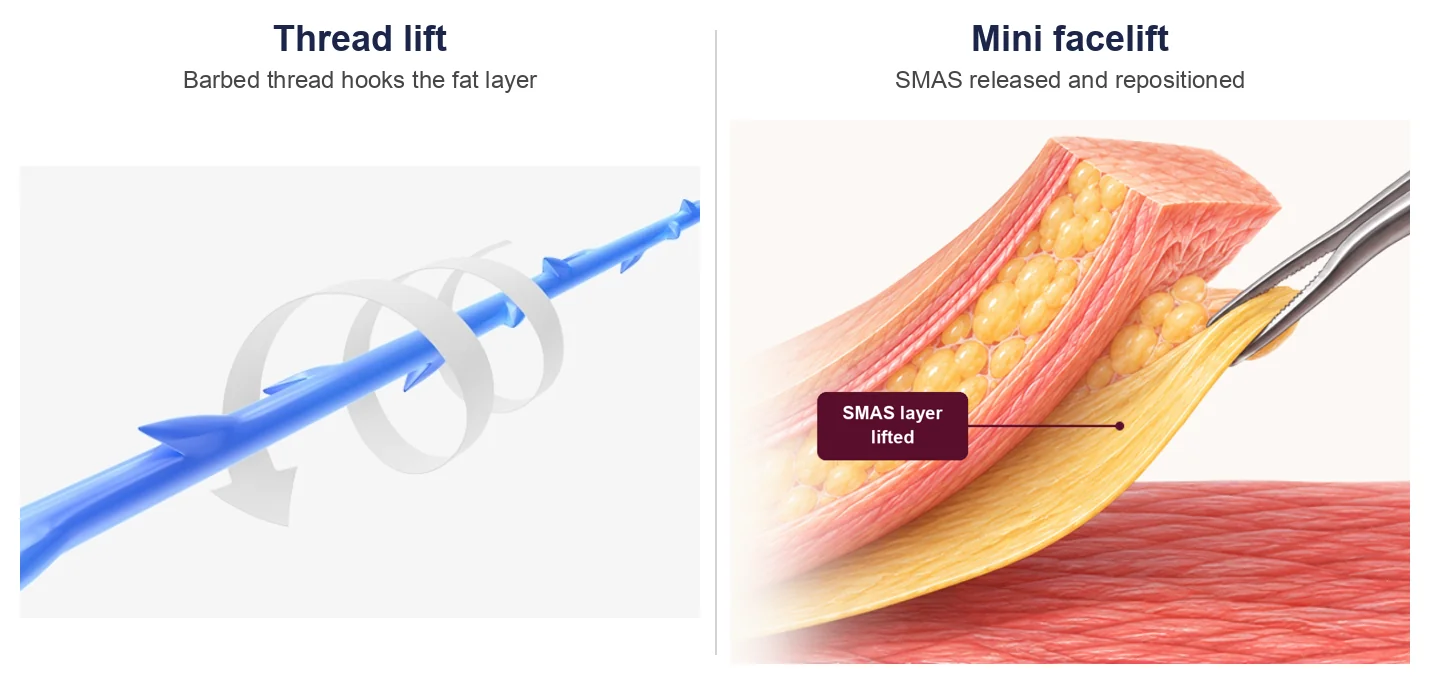
In a thread lift, absorbable threads with tiny barbs or cogs (for example, PDO threads) are passed through small entry points, usually near the temple or hairline, into the fatty layer under the skin. The barbs catch the tissue, and the threads are drawn upward to suspend it.
Nothing is cut free. The SMAS is not released or repositioned, and no skin is removed. The body forms some new collagen around the threads as they dissolve, but that is a secondary, minor effect rather than the main lift. In plain terms, a thread is a temporary hook placed in a soft layer.
MINE Mini Facelift: A Small Incision, but the SMAS Work Is Not Cut Back
A mini facelift uses a shorter incision than a full facelift. At MINE, the incision runs along the temple hairline, in front of the ear, and around the earlobe to behind the ear. Through it, the SMAS over the cheek, jowl and jawline is released and lifted layer by layer, then fixed to firm tissue in front of the ear.
The skin is then redraped separately, without tension, and the excess is trimmed. The key point is this: the incision is smaller, but the SMAS work over the cheek, jowl and jawline is not cut back. “Mini” describes the scar, not a shallow operation. The neck and the platysma bands are outside the scope of a mini facelift.
The direction of the lift matters too. The SMAS is moved up and back, roughly along the line of the main cheek muscle, not straight up. The surgical literature explains why: pulling skin straight upward tends to bunch it near the ear and shift the hairline, so skin and support layer are best moved along their own natural directions.
A thread lift moves tissue without removing any skin; a mini facelift repositions the SMAS and trims the excess skin that a thread can only bunch up.
A Barbed Suture Inside a Facelift Is Not the Same as a Thread Lift
Some patients read that barbed threads are “also used in facelifts” and conclude the two must be similar. Some surgeons do use barbed sutures inside an open facelift as a fixation aid, after the tissue has already been freed through an incision. That is different from a thread lift done through needle punctures, where the threads have to do the whole job on their own, in tissue that has not been released.
How Long a Thread Lift Holds vs a Mini Facelift
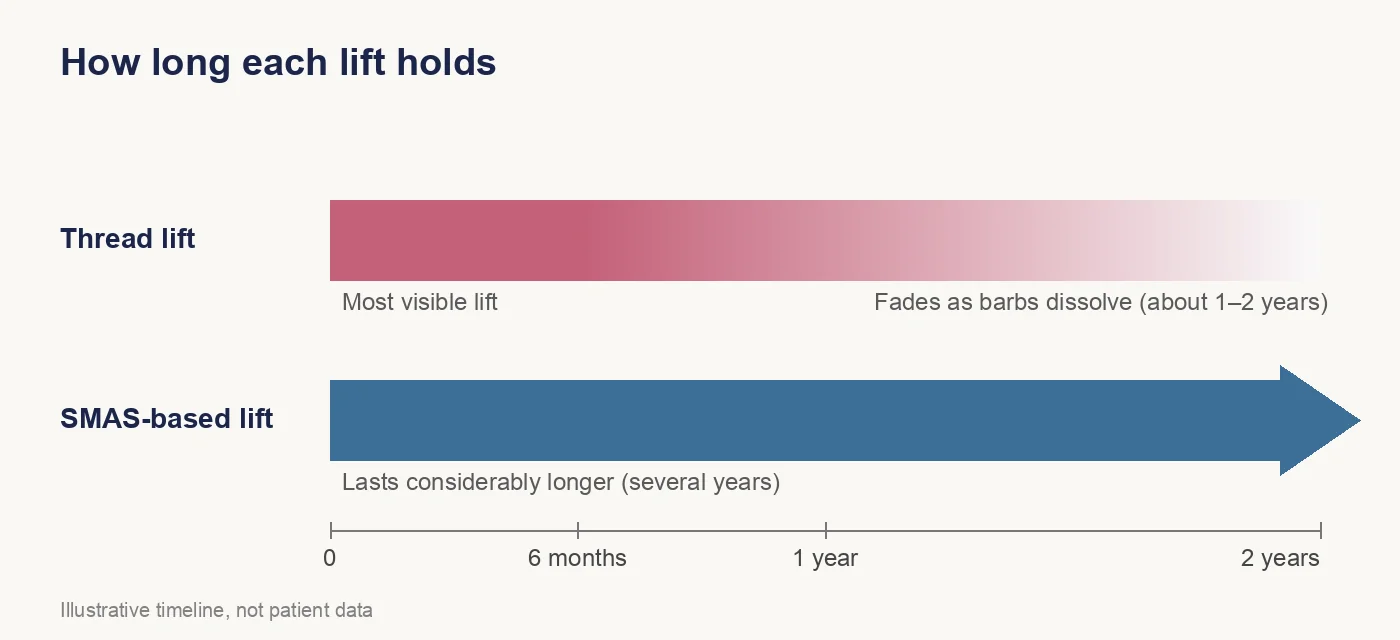
Durability is often where the thread lift or mini facelift decision becomes clear. Thread lift results typically last about 1–2 years, with the most visible lift in the first 6 months. A lift that frees and re-anchors the support layer lasts considerably longer.
Why Thread Results Fade as the Barbs Dissolve
Medical textbooks on thread lifting state that the effect lasts no more than about 2 years and is most visible in the first 6 months or so, because the tissue drifts back as the barbs dissolve and lose their grip. Those same texts stress that patients should be told the effect is temporary before treatment.
Why a Repositioned SMAS Holds Longer Than a Suspension
A thread holds tissue on a temporary hook. A lift that releases the SMAS, moves it, fixes it to firm tissue and removes the extra skin leaves less loose material to slide back. Textbooks on facial biomechanics also note that simply tightening a stretched layer in place can loosen again over time, which is one reason releasing and repositioning the support layer is favored for durability.
For reference, our longevity guide lists SMAS-based lifts in the range of several years, compared with about 1–2 years for threads. For the mini facelift’s own timeline, read how long a mini facelift lasts.
One honest caveat applies to both: no lift stops aging. The face keeps aging from its new starting point.
When Threads Are the Wrong Choice for Jowls
Threads are often marketed as a “facelift without surgery.” For some faces that is a fair description of a short-term improvement. For many jowls, it is not. Below are the situations where a thread is likely to disappoint, and what addresses each one instead. If one or more of them describes your jowl, the thread lift or mini facelift question usually tips toward surgery.
Loose, Crepey Skin That Needs to Be Removed
A thread can lift tissue, but it cannot remove skin. When there is real excess skin, pushing it upward simply moves the surplus somewhere else, often bunching near the entry points. That is why textbooks recommend a surgical facelift rather than threads in this situation.
Heavy Jowl Fat or a Jowl That Hangs Below the Jawline
When the jowl is mostly fat, a thread is trying to hold a heavy load in a soft layer. The literature advises liposuction when there is excess fat in the lower face. A 2019 clinical study by Bae and colleagues, published in Archives of Aesthetic Plastic Surgery, compared thread lifting combined with lower-face liposuction against thread lifting alone, and the combination came out ahead.
The practical takeaway: for a heavy, fatty jowl, threads alone are a weak plan. A jowl that already sits at or below the jawline usually needs the support layer repositioned, sometimes with fat reduction as well.
Hollow Cheeks or Volume Loss
Sometimes the jowl looks worse because the cheek above it has hollowed out, so the lower face appears heavier by contrast. Lifting alone will not refill that space. In these cases, textbooks point to fat grafting or filler to restore volume, either on their own or alongside a lift.
Neck Bands and a Blurred Neck–Jaw Angle
If the problem continues below the jaw, with visible platysma bands or fullness under the chin, neither a thread nor a mini facelift is the right single answer. The neck needs its own assessment. Our article on which jawline surgery fits a neck-driven jawline explains how that decision is made.
When You Want Results Measured in Years, Not Months
If you would be unhappy repeating treatment every 1–2 years, threads are a poor match for your goals. Repeated threads add up in cost, time and appointments, and the lift still returns toward where it started.
Risks to Know for Each Option
Thread lift risks reported in the thread lifting literature:
- Relapse, meaning the lift simply does not hold, is the most common problem.
- Infection is rare but possible.
- Threads can occasionally be felt or seen under the skin, or work their way out.
- The face can be left uneven.
- Skin dimpling can also occur after threads.
A mini facelift carries surgical risks:
- A scar along the hairline and ear
- Swelling and bruising
- Hematoma (a collection of blood under the skin)
- Temporary numbness
- Rarely, injury to a facial nerve branch
Both procedures should be discussed in detail with your surgeon before you decide.
What if you have had threads before and later want surgery? Texts on secondary facelifts note that a satisfactory SMAS dissection is usually still possible in a repeat procedure. Some surgeons find that previous threads can make the dissection more tedious, so it helps to tell your surgeon about any threads you have had.
When a Thread Lift Is a Reasonable Choice
None of this means threads are useless. In the right face, with the right expectations, they are a reasonable option.
Early, Mild Jowling With Good Skin Quality
Threads make the most sense for mild, early softening of the jawline, often in people in their 30s or 40s whose skin is still elastic and whose jowl contains little fat. They can also suit someone who wants a small touch-up years after a surgical lift.
Expect a modest lift that fades over about 1–2 years and may be repeated. If that trade-off suits you, you can read how MINE plans a thread lift.
When Downtime or an Incision Is Not an Option Right Now
Some people cannot take time off at the moment, or are not ready for surgery. For them, a thread can be a short-term bridge, as long as they understand it is temporary.
For many, the real worry is the scar. It is worth knowing that a mini facelift incision is placed along the temple hairline and the natural contour of the ear, where it tends to be well hidden as it matures. Fear of a scar alone is not always a good reason to choose a weaker tool for a jowl that needs more.
Thread Lift or Mini Facelift? 5 Deciding Factors at a Glance
Five factors decide between a thread lift and a mini facelift: loose skin, jowl position, jowl fat, desired longevity and downtime tolerance.

| Factor | Points toward a thread lift | Points toward a mini facelift |
|---|---|---|
| 1. Loose skin on the pinch test | Little or none | Visible excess skin or folds |
| 2. Where the jowl sits | Slight softening above the jawline | A bulge at or below the jawline, with a notch in front of it |
| 3. Fat content of the jowl | Thin | Heavy (often combined with liposuction) |
| 4. How long you want it to last | About 1–2 years, repeats acceptable | Several years from one procedure |
| 5. Downtime and incision tolerance | Only days of minor swelling are acceptable now | A short-scar surgical recovery is acceptable |
As a practical rule of thumb from clinical experience, if two or more of your answers fall in the right-hand column, threads are unlikely to satisfy you. That is not a study statistic, just a useful way to frame the thread lift or mini facelift conversation with your surgeon.
If the right-hand column describes you, learn more about MINE’s SMAS-based mini facelift. Whether a mini or a full facelift fits better is a separate question that depends mainly on how much of the neck is involved.
How Dr. Lee Sung-wook Assesses Jowls Before Recommending Either
Deciding between a thread lift and a mini facelift should start with an examination, not a menu. In my clinical experience, patients who arrive set on one option often change their minds once they see which layer is actually loose.
What We Check in the Consultation
- Pinch test: how much skin gathers when the jowl skin is gently pinched.
- Upright vs lying down: how far the jowl moves with gravity, which shows how loose the support layer is.
- Smile and expression: how the cheek and jowl move together.
- Jawline profile: whether the line breaks into a notch in front of the jowl.
- Neck check: bands, fullness under the chin and the neck–jaw angle.
- Fat versus laxity: whether the jowl is mainly fat, mainly loose tissue, or both.
- Prior treatments: threads, fillers, energy devices or earlier surgery.
If surgery fits, our mini facelift releases the SMAS over the cheek, jowl and jawline and lifts it up and back, with the skin redraped without tension. If the problem is mild, I may advise a thread or a non-surgical option instead. If the neck is driving the problem, we discuss a neck-focused procedure.
If You Have Had Threads Before
Previous threads do not usually rule out a later mini facelift. As textbooks on secondary lifts note, the SMAS can usually still be dissected well. Bring whatever details you have about past threads, such as the type and the date, so the surgeon can plan for any scar tissue they might encounter.
Frequently Asked Questions
Is a thread lift or mini facelift better for jowls?
It depends on which layer is loose. For a mild, early jowl with little loose skin, a thread lift can help temporarily. When there is loose skin, heavy fat, or a jowl at or below the jawline, a mini facelift addresses the cause by repositioning the SMAS and removing excess skin.
How long does a thread lift last on the jowls?
Usually about 1–2 years. The lift is most visible in the first 6 months, and textbooks state the effect does not exceed about 2 years, because the tissue drifts back as the barbs dissolve.
Can a thread lift get rid of jowls completely?
Usually not. A thread can soften a jowl, but it cannot remove skin or reduce fat. Heavy jowls generally need surgery, liposuction, or both.
Can I have a mini facelift after a thread lift?
Yes, in general. A satisfactory SMAS dissection is usually still possible after earlier treatments. Tell your surgeon about any previous threads, since some surgeons find that scar tissue can make the dissection slower.
When should I choose a mini facelift instead of threads?
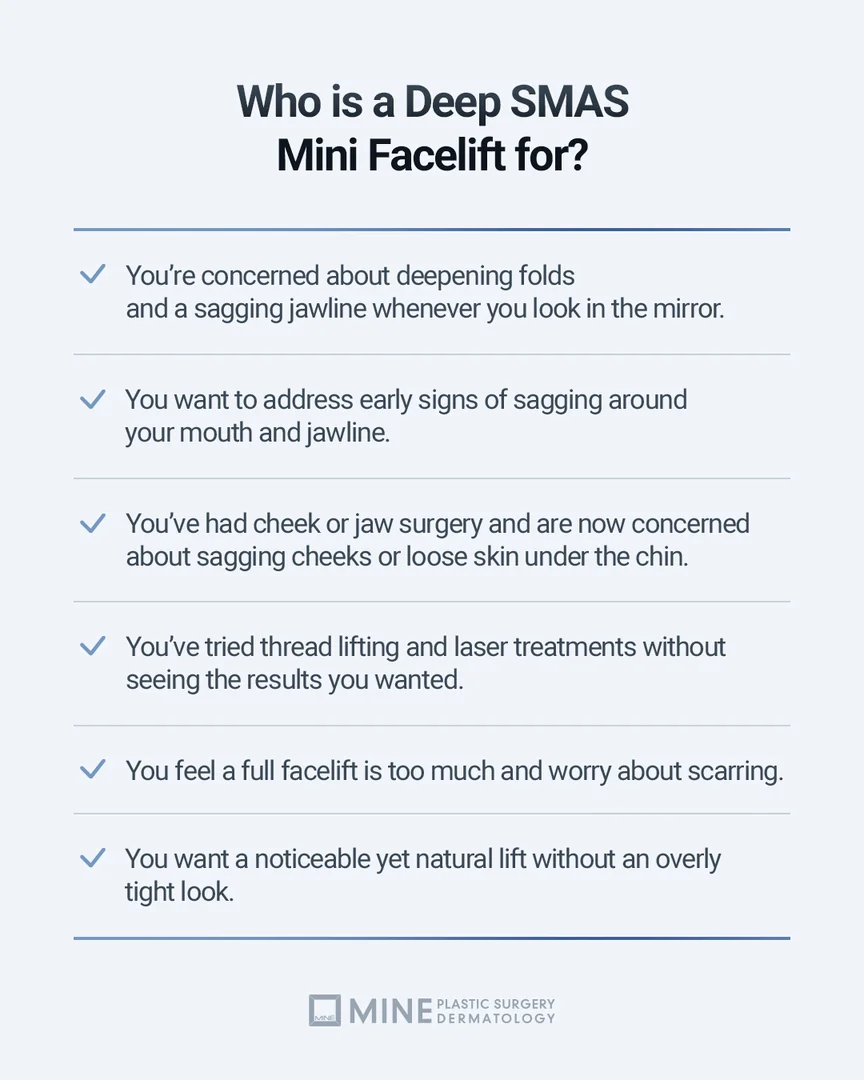
Consider a mini facelift when the pinch test shows excess skin, the jowl breaks the jawline, you want a result measured in years, or repeated threads have stopped giving you a result you are happy with.
Choosing a thread lift or mini facelift comes down to matching the tool to the layer. Threads can soften an early jowl for a while; a mini facelift repositions the support layer and removes the skin a thread cannot.
Not sure which layer is causing your jowl? Dr. Lee Sung-wook, board-certified plastic surgeon, can review your photos before your trip or assess you in person in Seoul and explain whether a thread lift or mini facelift, or another approach, suits your face. Call +82-2-516-1175 to arrange a consultation.
Written and medically reviewed by Dr. Lee Sung-wook, board-certified plastic surgeon, MINE, Seoul.
※ This content is for informational purposes only and does not replace professional medical advice, diagnosis, or treatment. Individual results may vary, and side effects may occur. Please consult with a board-certified plastic surgeon for personalized advice.