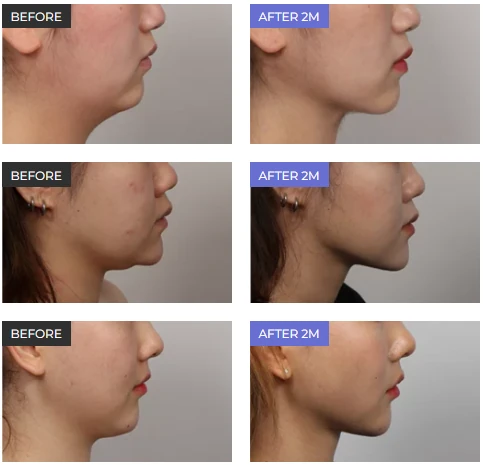
EN


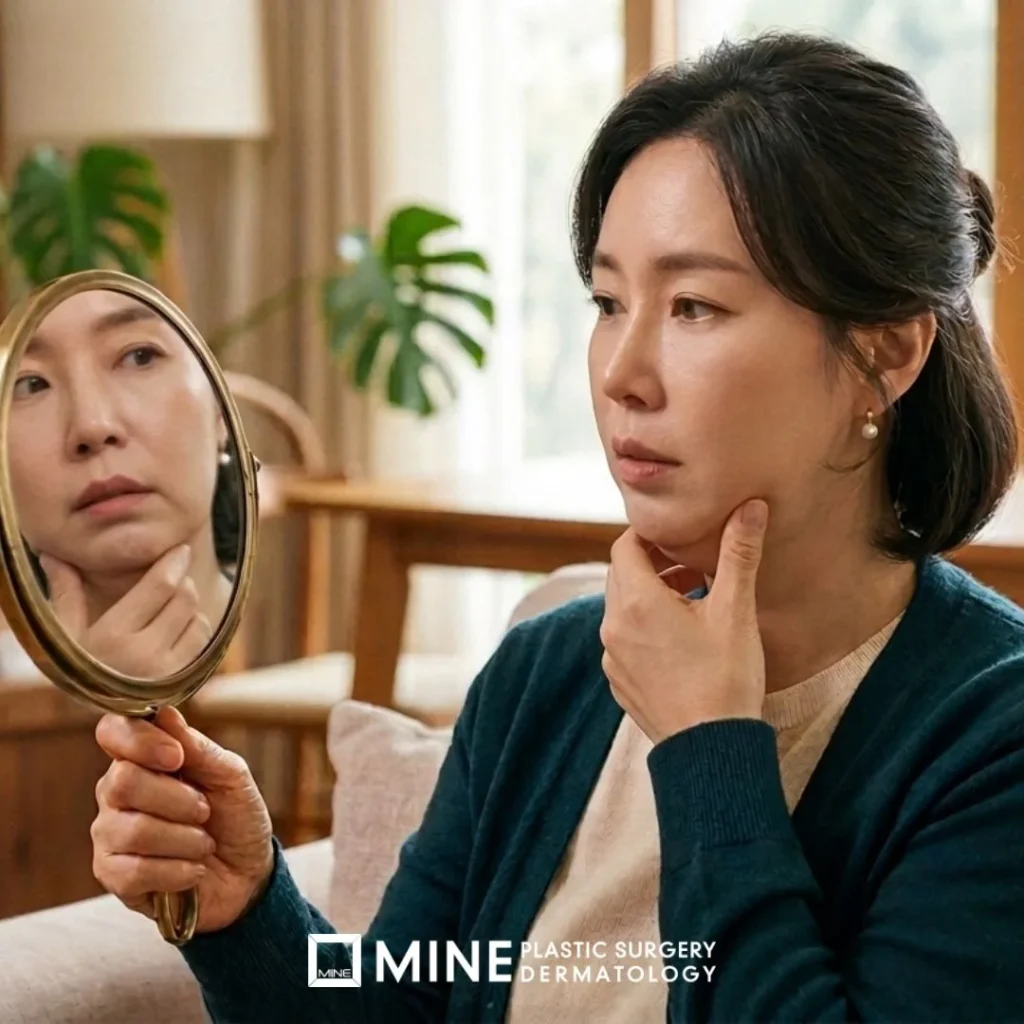
Do you catch yourself checking the soft fullness under your chin every time you pass a mirror, or untagging side-angle photos because your jaw seems to melt into your neck? It is one of the concerns I hear most often in my consultation room in Seoul.
A chin liposuction candidate is someone whose fullness under the chin comes mainly from fat — not an enlarged salivary gland or a loose platysma muscle — and whose skin is firm enough to tighten once that fat is removed. Chin liposuction itself removes both the fat just under the skin and the deeper fat beneath the platysma (the thin muscle covering the front of the neck) to bring back a clear line between the jaw and the neck.
I am Dr. Lee Sung-wook, a board-certified plastic surgeon and the founder of MINE Plastic Surgery in Gangnam. A double chin is rarely just a matter of “losing a bit of weight” — fat, muscle and salivary glands are often tangled together. In this guide I will walk you through three things based on my clinical experience: a checklist to see whether you are a chin liposuction candidate, the 4–5 layer method we use at MINE, and what recovery looks like week by week. If you want the wider picture first, read about what double chin liposuction can and can’t fix.
In this article
What Is Chin Liposuction? The Two Fat Layers Under Your Chin
If you have decided to deal with your double chin, the first step is knowing what is actually sitting under your chin. Submental fat (the fat below the chin) is not one single lump — it is arranged in two separate layers, and a good plan has to account for both.
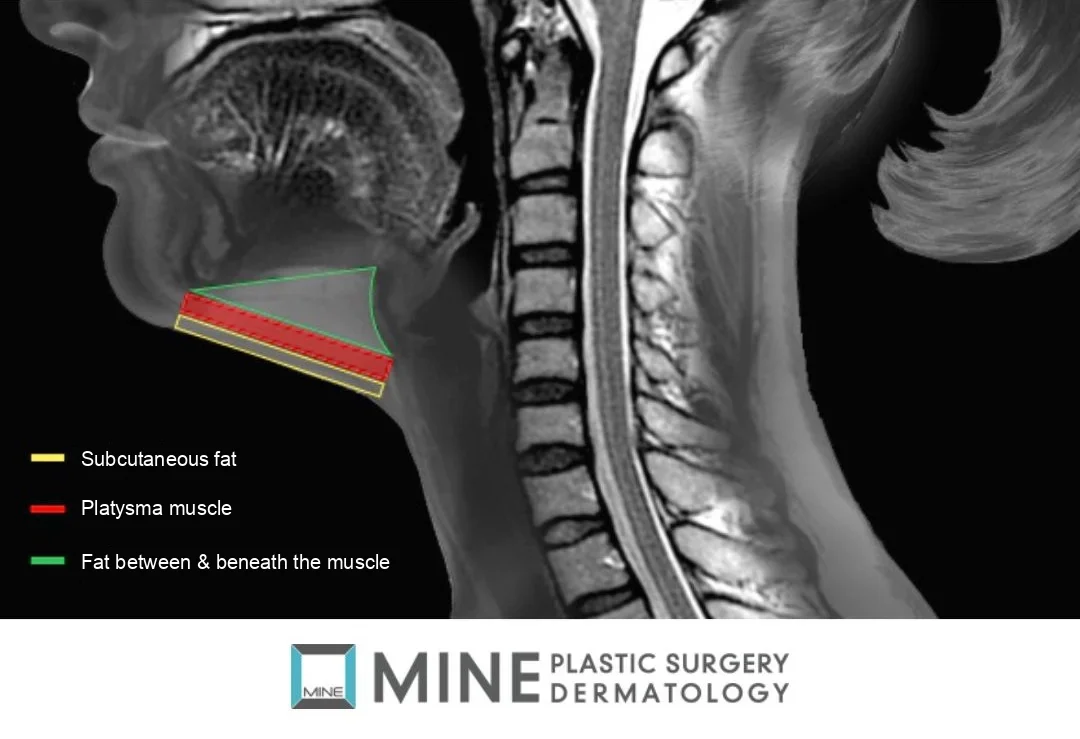
Subcutaneous Fat vs. Subplatysmal Fat
The first layer is subcutaneous fat — the soft fat directly under the skin that most people picture when they think of a double chin. The second layer is subplatysmal fat, a deeper pad that sits underneath the platysma, the thin, sheet-like muscle that covers the front of your neck. Think of the platysma as a thin curtain: one layer of fat lies in front of it, and another lies behind it.
Measurements cited in plastic surgery textbooks show that fat above the platysma accounts for about 44% of the soft-tissue volume behind neck fullness, fat beneath it about 31%, and the submandibular (salivary) glands about 25%. In other words, close to a third of the bulk can sit behind the muscle. If only the fat under the skin is removed, the improvement may stop halfway, so both layers are assessed before deciding whether you are a chin liposuction candidate.
Three Causes of a Double Chin: Fat, Muscle, and Salivary Glands
In my clinical experience, three things make the area under the jaw look heavy, and I check all of them in every chin liposuction candidate: subcutaneous and subplatysmal fat, a stretched platysma muscle, and — the one many people miss — enlarged salivary glands. In some people the fullness is not fat at all but a submandibular gland that has grown larger. If this is not identified with ultrasound beforehand, liposuction may not deliver the result you were hoping for. To learn more about that situation, see our guide on how to tell a double chin from an enlarged salivary gland.
Dr. Lee’s Key Point: If the real cause of a double chin is not identified, surgery may only deliver half the improvement. That is why I check fat, muscle and salivary glands with ultrasound at the very first consultation.
Are You a Chin Liposuction Candidate? A 7-Point Checklist
“Would I be a candidate for this?” It is the question I am asked more than any other. Before you book a consultation, you can do a quick self-check with the list below. If you are still unsure what is causing your fullness in the first place, our double chin self test focuses on identifying the cause, while this checklist focuses on whether surgery is likely to suit you.
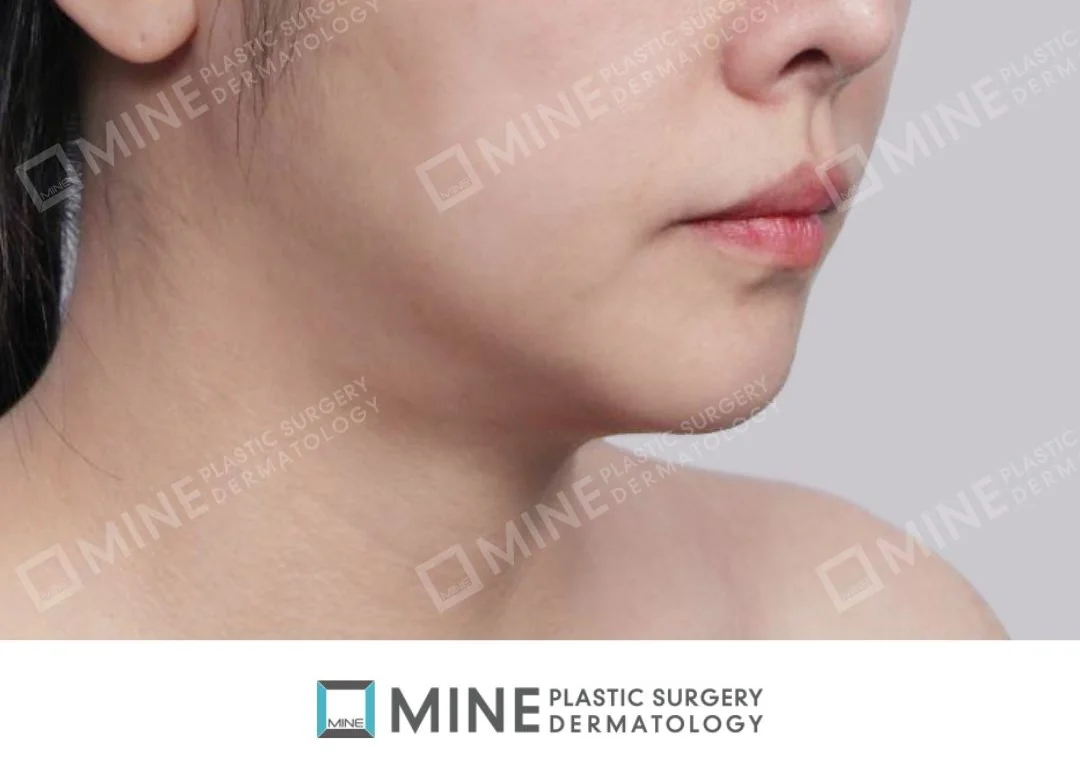
The 7 Signs Chin Liposuction May Work for You
The more of these signs apply to you, the closer you are to being a good chin liposuction candidate:
- Fat under the chin makes your whole face look larger. Excess subcutaneous fat can make the lower face look wider and rounder than it really is.
- The border between your face and neck has disappeared. This is the classic “double chin” look, where the jawline blends into the neck.
- The skin under your chin has started to sag with age. Fat removal can help here, but if the platysma has stretched noticeably, the muscle needs to be tightened at the same time, and if the sagging is significant, combining liposuction with a mini neck lift gives a more complete result.
- Your jawline looks uneven or lumpy rather than smooth.
- Your skin has loosened after facial contouring surgery. As with sign 3, the amount of looseness decides whether liposuction alone is enough or whether muscle tightening or a mini neck lift should be added.
- Laser or radiofrequency treatments have not worked for you. Energy-based devices can only do so much when the volume is in the fat layers.
- A short chin makes your neck look fuller than it is. Plastic surgery textbooks note that when the chin bone is underdeveloped, adding a chin augmentation to liposuction can improve the result further.
In my experience, if three or more of these apply to you, liposuction alone is often enough to make a meaningful improvement. That is my clinical rule of thumb, not a universal standard — and the caveat matters: if your platysma has become very loose, liposuction alone has limits, and the muscle needs to be addressed during the same operation.
Liposuction Alone vs. When You Also Need Muscle or Skin Work
Why do signs 3 and 5 come with a condition attached? Plastic surgery textbooks identify skin laxity (how loose the skin is) as the best guide to choosing the right patients, and they sort necks into four grades: no laxity, mild, moderate and severe. For a neck with no laxity, liposuction alone is usually enough. As the laxity grade rises, the plan shifts toward tightening the muscle and, eventually, lifting the skin.
The textbook “ideal” chin liposuction candidate is a relatively young person with good skin elasticity and fat concentrated under the chin and jaw. Once the fat is removed, firm skin shrinks back neatly onto the new contour. The looser the skin, the more a patient benefits from added muscle work.
| Your situation | What usually fits |
|---|---|
| Fat under the chin, firm skin, no visible sagging | Chin liposuction alone |
| Fat plus a loosened platysma muscle or mild sagging | Liposuction + platysmaplasty (muscle tightening) |
| Fat plus clearly sagging skin (aging or after contouring surgery) | Liposuction + mini neck lift |
| Fullness from an enlarged salivary gland | Salivary gland reduction, alone or combined |
| Short or receding chin bone | Liposuction, possibly with chin augmentation |
Why an Ultrasound Comes Before the Surgical Plan
Before every surgery, I use a detailed ultrasound examination to look at the fat layers, the muscle and the salivary glands, and only then build a customized surgical plan. Two people can both say “I have a double chin” and have completely different causes underneath. Going into surgery without seeing those layers means leaving the outcome to chance. For a chin liposuction candidate, the ultrasound is what turns a good guess into an accurate plan.
Dr. Lee’s Key Point: “Do I qualify?” is the question I hear most. If three or more items on the checklist apply to you, liposuction often brings a meaningful improvement on its own — but first we need to confirm it is not an enlarged salivary gland.
How MINE Performs Chin Liposuction: The 4–5 Layer Method
Once we confirm you are a chin liposuction candidate, the operation itself begins. At MINE, chin liposuction is not a single pass of suction. It is a staged operation that works through the area layer by layer, in four or five steps depending on how thick the fat is.
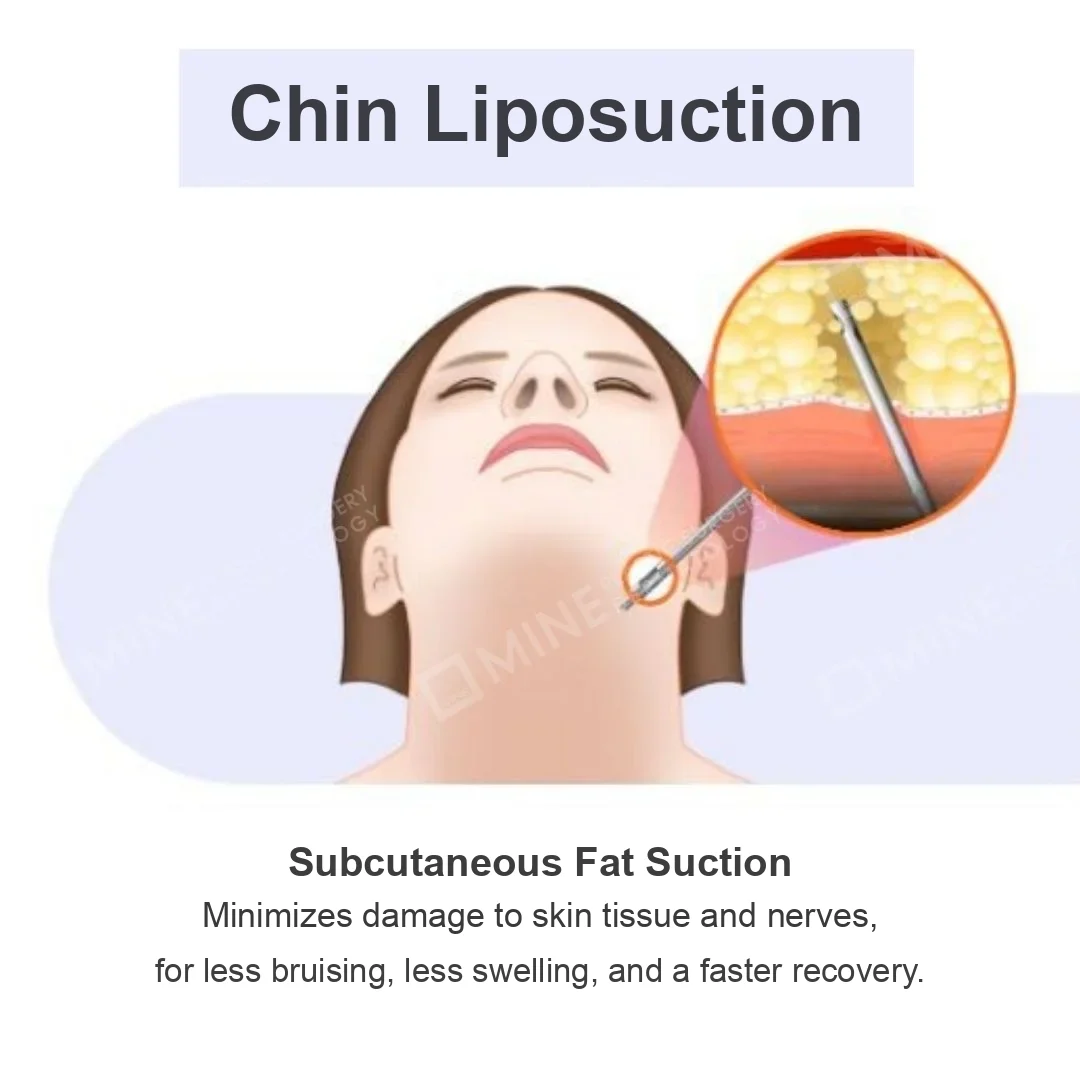
Steps 1–3: Subcutaneous, Surface, and Fibrous Fat
- Subcutaneous fat: fat under the skin is suctioned through a fine tube called a cannula.
- Surface fat: small clusters of fat that cling to the bone and muscle surface like bunches of grapes are released and removed directly.
- Fibrous fat: firmer, fibrous fat in the area where the neck muscles overlap is removed through a minimal incision.
Plastic surgery textbooks caution that liposuction under the chin, when done on its own, can leave the skin there looser over the long term, and that fat under the skin should be removed conservatively. A thin layer of fat left beneath the skin hides the structures underneath and keeps the surface smooth. That is the reason we refine the layers carefully instead of simply suctioning as much as possible.
Steps 4–5: Subplatysmal Fat Removal and Platysmaplasty
- Subplatysmal fat pad: the fat pad between and beneath the platysma muscle is removed.
- Subplatysmal fat block: when the fat is very thick, an additional deeper block of fat beneath the muscle is removed.
The key point is that we do not stop at removing fat. Once the fat is out, the loose platysma is drawn toward the midline and stitched together — a step called platysmaplasty (gathering and suturing the neck muscle). This tightens the neck from inside, so chin liposuction and a lifting effect happen in the same operation.
Plastic surgery textbooks describe this exact sequence — approaching through a small incision under the chin, contouring the neck with liposuction, then tightening the loose platysma bands — as a standard technique for rejuvenating the neck and jawline, either on its own or as part of a facial rejuvenation plan. The same textbooks note that in roughly 75% of necks, the left and right platysma muscles overlap and interlace under the chin. In short, treating the muscle together with the fat tends to give a more natural, longer-lasting result than fat removal alone. If you are comparing surgeons, the American Society of Plastic Surgeons offers useful background on liposuction and on choosing a board-certified plastic surgeon.
Chin Liposuction Scar: Where the Incisions Go and Why You Won’t See Them
The incisions are about 1.8–2 cm long, hidden in the first crease under the chin and a small groove below each ear. Both sit where they cannot be seen when you hold your head level and face forward, so the chin liposuction scar does not show in everyday life. For the full journey from consultation to final check-up, see our step-by-step double chin liposuction procedure.
Dr. Lee’s Key Point: Removing fat alone can leave the skin sagging. That is exactly why I tighten the platysma at the same time as removing the fat.
Chin Liposuction Recovery Week by Week
People are often as curious about recovery as about the surgery itself. Knowing what to expect at each stage removes a great deal of unnecessary worry. Here is the recovery timeline to expect before you commit to surgery.

Days 1–7: Peak Swelling and Starting the Compression Garment
Swelling and bruising are at their most noticeable right after surgery. This is when you start wearing a compression garment (a snug elastic band that supports the chin and neck). The garment directly affects how well the skin shrinks back and how quickly swelling settles, so wearing it consistently for about 12 days is one of the most important things you can do.
Chin Liposuction After 1 Week: About 70% of the Swelling Settles by Week 2
Looking at how my own patients progress, most see roughly 70% of their swelling and bruising settle within the first two weeks, and many return to daily life around this point. Please remember, though, that what you see at this stage is not your final result. The tissue is still remodeling underneath.
Week 4 Onward: The Final Jawline Takes 4–6 Months
The final shape of the jawline takes about 4–6 months to settle. How you look at one or two months is not the finished result. Knowing this in advance helps you recover without feeling rushed or disappointed too early.
| Timeframe | What to expect | What to do |
|---|---|---|
| Days 1–7 | Peak swelling and bruising | Start the compression garment |
| Weeks 2–3 | About 70% of swelling settles; many return to daily life | Finish about 12 days of compression |
| Week 4 to 4–6 months | Jawline gradually refines | Keep your weight stable; attend check-ups |
Dr. Lee’s Key Point: The most common worry I hear is “It’s been two weeks and I’m still swollen.” The final result comes at 4–6 months — and wearing the compression garment properly for about 12 days makes a real difference to that result.
Chin Liposuction Risks and Precautions: What to Know Before You Book
I believe a doctor’s duty is to share the downsides as well as the benefits. Here is what you should honestly know before deciding.
Three Things to Confirm Before Surgery
Every chin liposuction candidate should confirm these three points first:
- Is the cause really fat? If your double chin comes from enlarged salivary glands rather than fat, liposuction alone will do little. An ultrasound to tell the two apart is essential.
- Who will remove the deep fat? Removing the subplatysmal fat block is a demanding procedure because blood vessels and nerves lie close by, so it should only be done by an experienced plastic surgeon.
- Can you keep your weight stable? Liposuction removes fat cells, but the cells that remain can store fat again if you gain weight after surgery.
Possible Side Effects and How They Are Prevented
As with any surgery, chin liposuction can cause side effects such as inflammation, bleeding and temporary changes in sensation. Removing too much fat just under the skin can also leave the surface uneven, which is why a protective layer of fat is deliberately left in place. To reduce these risks, we rely on a careful diagnosis before surgery, precise dissection during it, and compression and regular check-ups afterward.
Dr. Lee’s Key Point: More important than any side effect is avoiding liposuction on someone who never needed it. Checking for salivary gland enlargement at the first consultation matters most.
Chin Liposuction vs. Other Options: Matching the Treatment to the Cause
There is no single right answer for a double chin. The best option depends on what is causing it — which is also why being a chin liposuction candidate does not automatically mean liposuction is the only step you need.
Chin Liposuction vs. Salivary Gland Reduction
Someone can look like a chin liposuction candidate from the outside and still have enlarged salivary glands underneath. In that case, salivary gland reduction is more suitable than liposuction. Research on aesthetic neck surgery also shows that part of the volume under the jaw belongs to the submandibular glands, which fat removal does not change. Whether to combine the two is decided based on your ultrasound findings.
Liposuction Alone vs. Combining It With a Mini Neck Lift
If aging has caused significant skin sagging, combining liposuction with a mini neck lift can give a more refined, complete result. If the sagging is mild, liposuction alone, often with platysmaplasty, is usually enough.
Dr. Lee’s Key Point: There is no one-size-fits-all answer for a double chin. Depending on the cause, I plan liposuction, salivary gland reduction or a mini neck lift — on their own or in combination.
Chin Liposuction Candidate FAQ
How long does chin lipo take to heal?
In my patients, swelling and bruising are about 70% better within the first two weeks, and most return to daily life around then. The compression garment is worn for about 12 days, and the final jawline takes 4–6 months to settle.
How long do chin liposuction results last?
Because the fat cells themselves are removed, the result can last a long time for a chin liposuction candidate whose weight stays stable. If you gain weight, the remaining fat cells can grow larger, so weight management is the key to keeping your result.
Could my double chin be a salivary gland problem instead of fat?
Yes. In some people, the fullness under the jaw is caused by enlarged salivary glands. Fat and glands can be told apart on ultrasound, so this should be checked at the first consultation — it is one of the most important steps in deciding whether you are a chin liposuction candidate.
Where are the chin liposuction scars?
The incisions are small: about 1.8–2 cm in the first crease under the chin, plus a small groove below each ear. Both are positioned where they are not visible when you look straight ahead.
How is MINE’s method different from standard chin liposuction?
Standard chin liposuction usually removes only the subcutaneous fat layer. At MINE, we work through 4–5 steps, from the fat under the skin down to the subplatysmal fat, and add platysmaplasty — drawing the loose neck muscle together — for a lifting effect.
An Accurate Diagnosis Changes the Result
Without an ultrasound, it is hard to know exactly what is causing your double chin — fat, salivary glands or muscle. The same-looking fullness can call for a completely different operation depending on its cause, and finding out whether you are a chin liposuction candidate is exactly what a face-to-face consultation is for.
At MINE Plastic Surgery in Gangnam, Seoul, I assess each layer one-on-one before recommending a plan. International patients can start with an online consultation, or reach us by WhatsApp or phone at +82-2-516-1175. To learn more about the procedure itself, visit our page on double chin liposuction at MINE.
※ This content is for informational purposes only and does not replace professional medical advice, diagnosis, or treatment. Individual results may vary, and side effects may occur. Please consult with a board-certified plastic surgeon for personalized advice.
Written and medically reviewed by Dr. Lee Sung-wook, Board-Certified Plastic Surgeon, MINE Plastic Surgery