EN


Every time you look in the mirror your eyes seem heavier, and you are not sure whether the fix is in the eyelid or higher up in the forehead. Brow lift vs blepharoplasty comes down to what is being lifted: blepharoplasty removes loose upper-eyelid skin, while a brow lift raises a brow that has dropped.
Many patients come to my clinic asking for eyelid surgery. Yet when I gently lift their brow with a fingertip, the heaviness almost disappears. The reverse happens too: someone asks about a forehead lift, but the brow sits exactly where it should and only the eyelid skin has loosened. The two problems look alike from the outside, but a different cause calls for a different surgery.
In this guide I explain how to tell the causes apart, then compare three operations by what each one actually changes: upper blepharoplasty, the sub-brow lift and the forehead (brow) lift. Seen this way, the brow lift vs blepharoplasty question becomes much easier to answer.
3 Reasons Your Upper Eyelids Look Heavy
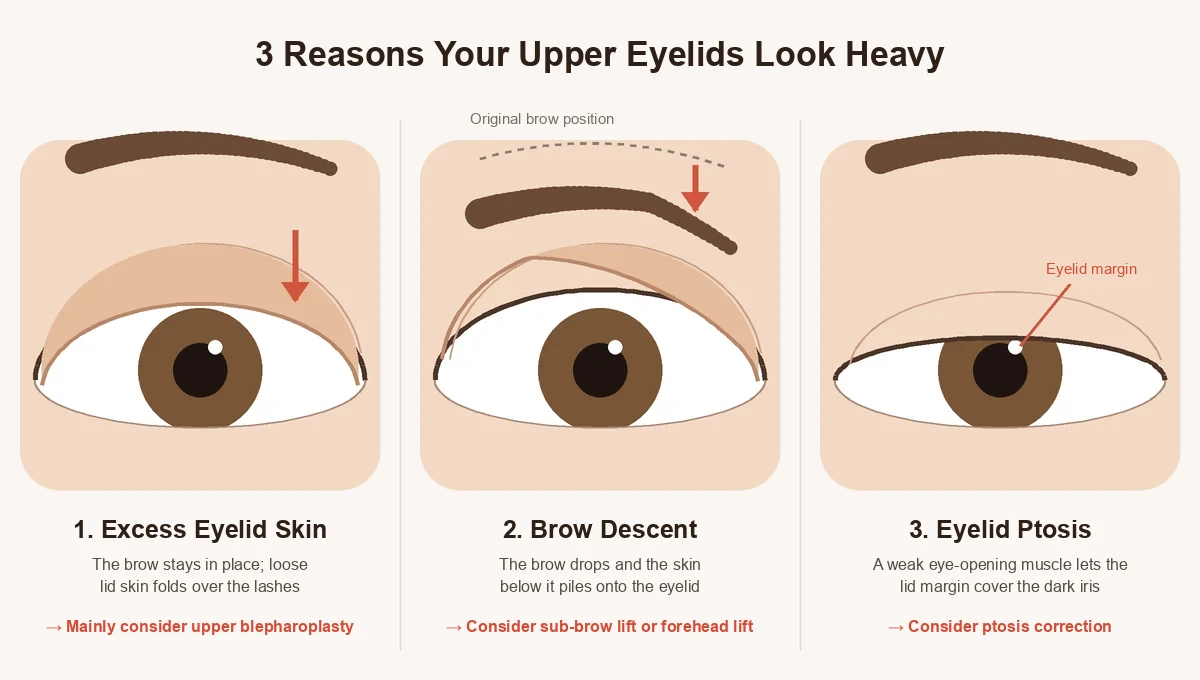
“My eyes look droopy” is one feeling, but there are 3 common reasons upper eyelids look heavy: excess skin, a dropped brow and a weak eyelid-opening muscle. Each one is corrected by a different operation, so sorting out which applies to you is the first step in any brow lift vs blepharoplasty decision.
Excess upper eyelid skin (dermatochalasis)
With age, upper-eyelid skin becomes thinner, loses its spring and starts to fold down over itself. Doctors call this dermatochalasis (loose, overhanging upper-lid skin). Medical textbooks describe it as the most common reason people have upper blepharoplasty. The loose fold can rest on the lashes and press them down, and in stronger cases the top of your field of vision can feel crowded. The key detail: the brow is still where it belongs. Only the eyelid skin has stretched.
A brow that has dropped (brow ptosis)
Brow height is set by more muscles than most people realize. Textbooks describe it as a tug-of-war. The frontalis (the broad forehead muscle) pulls the brow up, while the muscles between the brows and around the eyes pull it down. With time the balance tips downward, and the tissue that supports the brow loosens. The brow then settles below its natural position, which is called brow ptosis.
When the brow drops, the skin beneath it is pushed down and piles up on the eyelid. In the mirror it looks like “extra eyelid skin,” but the real cause sits above the lid. This is especially common when the outer corner of the eye is hooded in a triangle shape.
Weak eyelid-opening muscle (eyelid ptosis)
The third cause is neither the skin nor the brow but the muscle that raises the eyelid. If you lift the loose skin away and the edge of the eyelid still covers part of the colored iris, a weak lifting muscle is the likely reason. In that case, neither blepharoplasty nor a brow lift will solve it on its own; ptosis correction, which works on the muscle itself, may be needed.
Dr. Lee Sung-wook’s Key Point: The same “droopy eyes” can come from three different places — the skin, the brow or the muscle — and each needs a different surgery.
The Brow-Position Self-Check: Brow Lift vs Blepharoplasty
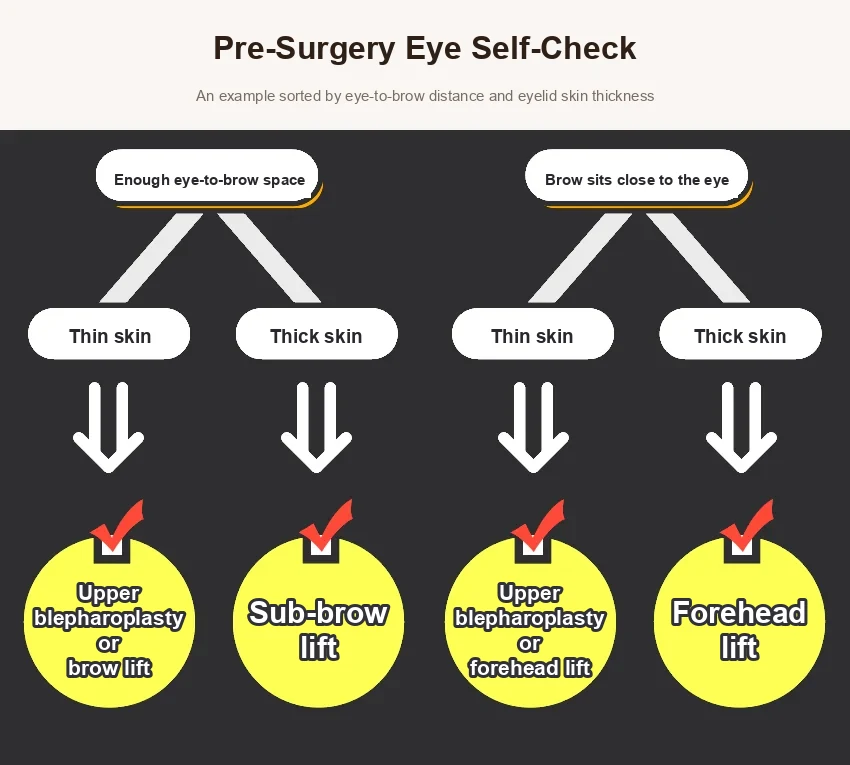
The first thing that separates brow lift vs blepharoplasty is where your brow sits. If the brow is in its natural position, I look first at the eyelid. If the brow has come down, I look first at a forehead lift or a sub-brow lift.
Lift your brow gently in the mirror
You can get a first sense of direction at home. Plastic surgery textbooks describe gently lifting the brow or the overhanging skin to see the true eyelid height as a basic way to tell the causes apart. Look straight into a mirror, relax your face, and try this:
- The hooding almost disappears when you lift the brow back to its natural spot with a fingertip → a dropped brow is the likely cause.
- Loose eyelid skin is still left over even with the brow lifted → excess skin is the likely cause, which points toward blepharoplasty.
- The eyelid edge still covers the iris after the skin is lifted away → eyelid ptosis should be checked as well.
Mixed cases are common. If lifting your brow makes the heaviness lighter but does not remove it completely, you may have both a dropped brow and extra eyelid skin.
Deep forehead lines can hide a dropped brow
When the eyelids start to block your view, your body quietly tightens the forehead muscle to hoist the brows up. The brow then looks normal, but only because the forehead is working all day to hold it there. Textbooks call this compensated brow ptosis: a brow drop that stays hidden because the forehead muscle keeps lifting it.
Clues include unusually deep horizontal forehead lines, a forehead that feels tired by the afternoon, and brows that look lower later in the day. For a more honest check, close your eyes, let your forehead relax completely, then open your eyes slowly and look at where your brows settle. Missing this hidden drop is the most common trap in brow lift vs blepharoplasty planning.
Brow measurements: textbook reference values and their limits
Published plastic surgery literature, based on Western patients, treats a mid-pupil-to-brow distance under about 2.5 cm as a sign of brow ptosis. The same literature puts the distance from the eyelid crease to the upper edge of the brow at about 15 mm.
These are Western reference values, not a ruler test for deciding on surgery at home. The same literature also notes that many young women today prefer a lower inner brow and a flatter arch. Ideal brow height and shape vary with ethnicity, sex and personal taste, so in clinic I make the brow lift vs blepharoplasty decision from photos and measurements together.
Dr. Lee Sung-wook’s Key Point: If lifting your brow makes your eyelid feel lighter, trimming eyelid skin alone is unlikely to solve the problem.
Upper Blepharoplasty, Sub-Brow Lift and Forehead Lift Compared
These three surgeries change three different places: the eyelid, the area just below the brow, and the brow position itself. That is why, in the brow lift vs blepharoplasty debate, “Which surgery is better?” matters far less than “Where is my cause?” The sub-brow lift sits between the two, so the brow lift vs blepharoplasty comparison below includes it as a third option.
| Upper blepharoplasty | Sub-brow lift | Forehead (brow) lift | |
|---|---|---|---|
| Main cause it treats | Excess eyelid skin and fat | Hooding just below the brow and at the outer corner | The brow itself has dropped |
| Area it changes | Upper eyelid | Skin below the brow and the muscle around the eye | Forehead and overall brow position |
| Eyelid crease | Creates or changes a crease | Keeps your current eye shape | Does not change it directly |
| Incision site | Along the eyelid crease | Along the lower edge of the brow | Hairline (or small incisions inside the scalp) |
| Good fit when | Brow position is fine, only the lid skin is loose | You want to keep your current eye shape | Brow descent plus forehead lines |
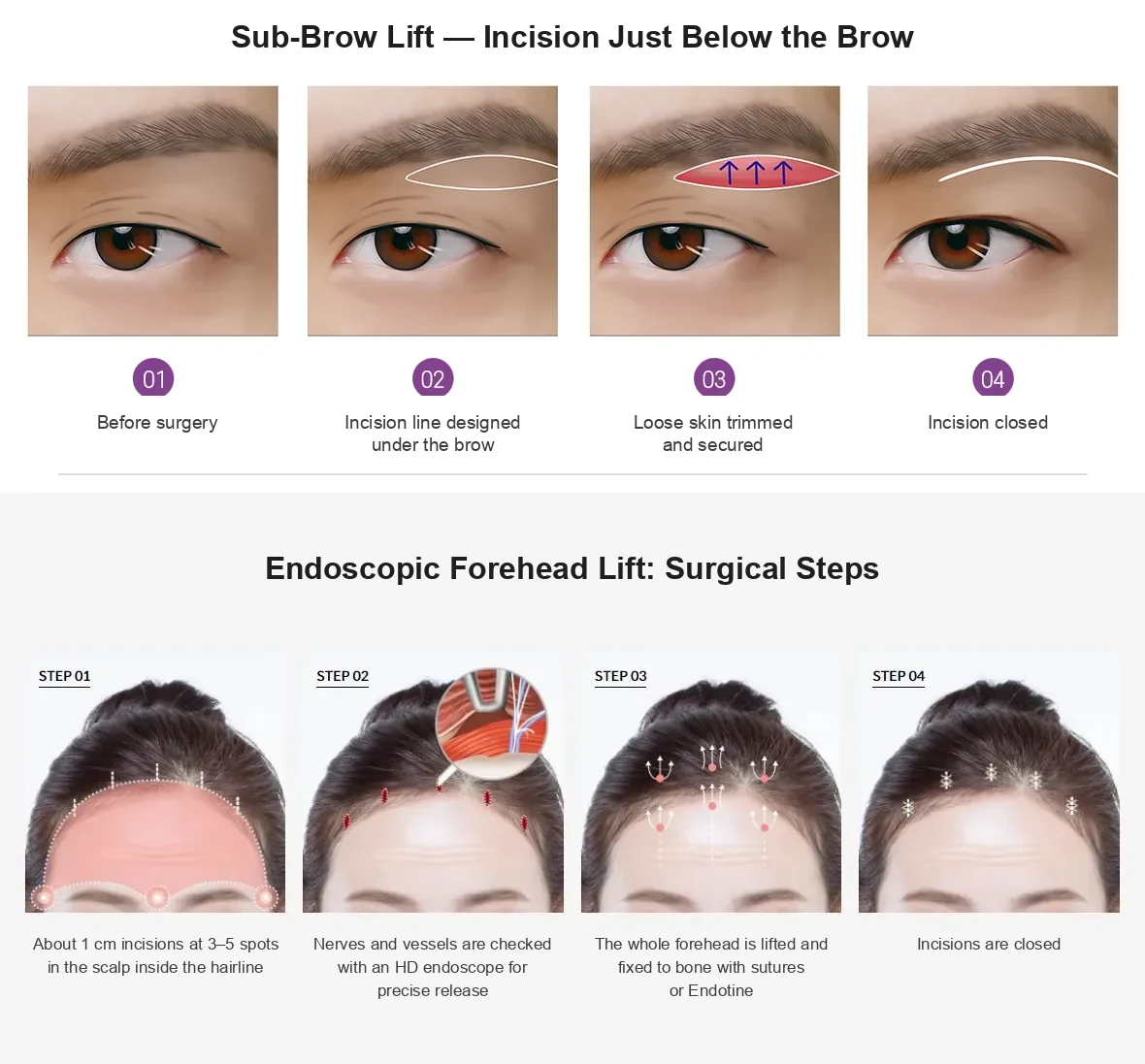
Upper blepharoplasty: lid skin, fat and the eyelid crease
Upper blepharoplasty removes as much loose eyelid skin and fat as needed and forms an eyelid crease (the fold Koreans call a “double eyelid”). At MINE, we also tighten and secure the loosened orbicularis oculi (the thin muscle that closes the eye) during the same operation. When the weight of the eyelid itself is the problem, blepharoplasty is the most direct solution in any brow lift vs blepharoplasty comparison. Keep in mind, though, that the crease is new or changed, so the overall look of your eyes can change too.
Sub-brow lift: keep your current eye shape, reduce hooding below the brow
A sub-brow lift leaves the eyelid crease alone. Through a minimal incision just below the brow line, the loose skin and the muscle around the eye are lifted and fixed to the periosteum (the thin membrane that covers bone). In Korea it is a popular choice for people who do not want a double eyelid and simply want the heaviness gone, including many men.
Because the incision sits at the lower edge of the brow, the scar tends to be less noticeable, but this is not a scarless surgery. And if the brow itself has dropped a lot, a sub-brow lift may not be enough, which is when a forehead lift comes into the conversation. You can see how each method works on MINE’s upper blepharoplasty and sub-brow lift page.
Forehead (brow) lift: raising the brow itself
A forehead lift reaches the forehead through the hairline or the scalp and lifts the forehead skin and the tissue beneath it. Textbooks describe the endoscopic version (done through small openings with a thin camera) as releasing the tissue that holds the brow down, fixing the brow higher, and weakening the corrugator (the frown muscle between the brows). As a result, brow position, forehead lines and eyelid hooding can improve together.
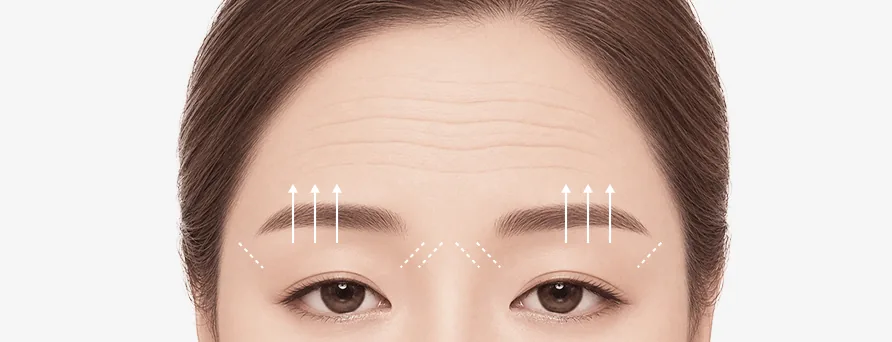
Open and endoscopic approaches leave the scar in different places and recover differently, so I have covered how to choose between an open and an endoscopic forehead lift in a separate guide. One more point that often causes confusion: a forehead lift raises the brow, while forehead reduction (hairline lowering) brings the hairline down. The names sound similar, but they work in opposite directions.
Dr. Lee Sung-wook’s Key Point: Blepharoplasty changes the eyelid, a sub-brow lift changes the area just below the brow, and a forehead lift changes the brow position itself.
When Blepharoplasty Alone Isn’t Enough — and When to Combine
This is the part I explain most carefully in consultation. If a hidden brow drop is missed and only the eyelid is treated, the result can be quite different from what the patient expected. Getting brow lift vs blepharoplasty right before surgery prevents that.
Why the brow can look lower after eyelid surgery
Textbooks explain that after blepharoplasty alone, the forehead muscle can finally relax, and a brow drop that was hidden until then shows itself. Before surgery, the heavy eyelid gave the forehead a reason to keep lifting. Once the eyelid is lighter, that reason is gone, the brow settles lower, and patients may notice “less space between my eyes and brows” or a heavier, more tired look.
The opposite is also true. Simply returning the brow to its proper position often makes much of the apparent extra skin shrink away. Eyelid skin is hard to replace once it has been removed, so sparing it matters. And when some skin still needs to be removed, the incision can stay shorter.
Men with heavy, low brows need extra care
Men often have thicker brows that naturally sit lower. Plastic surgery textbooks caution that in men with heavy brows, removing only upper-eyelid skin can leave the brows looking much lower, so brow surgery should be considered at the same time. That does not mean every man needs a large operation; quite often, a conservative skin removal is all that is required. What matters is assessing brow position before surgery, which makes brow lift vs blepharoplasty a question every male patient should ask.
Combining a brow lift with blepharoplasty
When a dropped brow and excess eyelid skin occur together, the two surgeries are not competitors; they are often planned together. Plastic surgery textbooks include cases in which an endoscopic brow lift combined with upper blepharoplasty increased the distance between brow and lashes and improved hooding at the outer corner of the eye. In other words, the honest answer to brow lift vs blepharoplasty is sometimes “both.” Whether to combine them, and in what order, depends on the individual and is decided with you at consultation; our forehead lift page explains the options we offer. For the step-by-step procedure and recovery, see our endoscopic forehead lift procedure and recovery guide.
On the other hand, if your brow position is normal, you do not need a forehead lift. Not adding an unnecessary operation is part of planning a good result.
Dr. Lee Sung-wook’s Key Point: If you have deep forehead lines and often raise your brows without thinking, have your brow position checked before eyelid surgery.
Side Effects and Recovery for Each Surgery
Because each surgery works on a different area, side effects and recovery also differ in brow lift vs blepharoplasty. Any surgery carries some risk, and knowing what to expect ahead of time makes the recovery period far less stressful.

What to expect after blepharoplasty or a sub-brow lift
Right after surgery, bruising, swelling and a temporary feeling of tightness are normal. The skin around the eyes is thin, so swelling shows easily. The two sides can settle at different speeds and look uneven for a while. Rarely, a difference between the sides remains and needs a small revision. Recovery speed varies a great deal from person to person, so I give each patient an individual estimate of when they can return to work during the consultation.
Uncommon complications of a forehead lift
Plastic surgery textbooks report infection after a brow lift at consistently below 1%, and a hematoma (a collection of blood under the skin) is also uncommon. Other reported issues include contour irregularity where muscle was removed, hair loss along the scar with the wide-open scalp (coronal) approach, and temporary weakness of brow movement when a nerve is briefly irritated. Numbness of the scalp is common at first and mostly recovers over time. Most of these problems are rare or temporary.
The limits of a Botox brow lift
Botox can relax the muscles that pull the brow down and raise the brow slightly. However, dermatology literature notes that if the toxin spreads to the muscle that lifts the eyelid, it can cause a droopy eyelid instead. The effect is also temporary, so it is not a substitute for surgery when the skin is very loose or the brow has clearly dropped.
Dr. Lee Sung-wook’s Key Point: No surgery has zero risk. Matching the surgery to the cause is the first step toward avoiding a revision.
4 Things to Check Before Your Consultation
To pin down brow lift vs blepharoplasty for your own eyes, it helps to look at four things before you come in. The more you notice in advance, the more specific our conversation can be.
- What changes when you lift your brow — does the hooding disappear, or does it stay?
- Horizontal forehead lines and a brow-raising habit — are you tensing your forehead without realizing it?
- The eye shape you want — would you like an eyelid crease, or do you want to keep your current look?
- Eye-opening strength — if people often say you look sleepy, or you tilt your chin up to see comfortably, eyelid ptosis should be checked as well.
Compare old photos with recent ones
Place photos from ten or twenty years ago next to a recent one, and you can often see when, and how much, your brows have come down. This shows whether only the eyelids have become heavier with the brows unchanged, or whether the brows themselves have dropped. Bringing these photos to your consultation is genuinely useful for a brow lift vs blepharoplasty assessment.
Decide on the eye shape you want first
Even with the same cause, the right choice can change with your goal. If you are happy to have a crease, blepharoplasty becomes a wider option. If you want to keep your current eye shape at all costs, a sub-brow lift or a forehead lift deserves a closer look. Satisfaction is highest when the face the patient imagines and the face the surgeon plans are the same. You can confirm whether a surgeon is a board-certified plastic surgeon through the Korean Society of Plastic and Reconstructive Surgeons.
Dr. Lee Sung-wook’s Key Point: Before choosing a procedure name, find out why your eyelid feels heavy.
Brow Lift or Blepharoplasty? Frequently Asked Questions
How do I know if I need a brow lift or blepharoplasty?
Gently lift your brow to its natural position with a fingertip. If the hooding mostly disappears, a dropped brow is likely, pointing to a brow lift or sub-brow lift. If loose skin remains, excess eyelid skin is likely, pointing to blepharoplasty. The final decision is made in clinic, after checking brow position and eye-opening strength together.
Which is better for hooded eyes, a blepharoplasty or a brow lift?
In blepharoplasty vs brow lift, neither is better in general; it depends on where the hooding comes from. Hooding caused by loose eyelid skin responds to blepharoplasty, while hooding caused by a dropped brow responds to a brow lift. Triangle-shaped hooding at the outer corner is often brow-related, and many people have both causes and benefit from planning the two together.
Why can my brows look lower after eyelid surgery?
Because a hidden brow drop is revealed. While the eyelid was heavy, the forehead muscle kept lifting the brow to clear your view. Once the eyelid is lighter, the forehead relaxes and the brow settles to its true, lower position. This is why brow position should be assessed before any blepharoplasty.
When is a sub-brow lift a better choice than blepharoplasty?
A sub-brow lift suits people who want to keep their current eye shape without a crease while reducing the hooding just below the brow, especially at the outer corner. It does leave a scar along the lower edge of the brow. If the brow itself has dropped a lot, a forehead lift may be discussed instead or as well.
Can a brow lift and blepharoplasty be done together?
Yes. When a dropped brow and excess eyelid skin exist together, the two are often planned as one treatment, and plastic surgery textbooks describe combined cases. Whether to combine them and how much to do in each area are decided at consultation, based on your own anatomy and goals.
What are the downsides of a brow lift?
Textbooks report infection after a brow lift at below 1%, and bleeding under the skin is uncommon. Other possible issues are contour irregularity, hair loss along the scar with the coronal approach, temporary weakness of brow movement and scalp numbness that mostly recovers. And if your brow position is normal, you do not need a brow lift at all.
Can Botox lift droopy brows instead of surgery?
Botox can give a slight, temporary brow lift by relaxing the muscles that pull the brow down. If it spreads to the eyelid-lifting muscle, it can cause a droopy eyelid. It is not a substitute for surgery when the skin is clearly loose or the brow has clearly dropped.
The Bottom Line: Find the Cause Before Choosing the Surgery
Heavy upper eyelids come from three main causes: loose skin, a dropped brow and weak eye-opening strength. Lifting your brow in the mirror gives you a first direction, and the three surgeries each change a different area. Brow lift vs blepharoplasty is not about which operation is superior; it is about where your cause lies.
At MINE Plastic Surgery in Seoul, I assess brow position, eyelid skin and eye-opening strength together in an in-person consultation before recommending any surgery, so your brow lift vs blepharoplasty decision rests on a clear diagnosis. To book a consultation, call +82-2-516-1175 or visit us at 813 Nonhyeon-ro, Gangnam-gu, Seoul.
Written and reviewed by Dr. Lee Sung-wook, Board-Certified Plastic Surgeon
※ This content is for informational purposes only and does not replace professional medical advice, diagnosis, or treatment. Individual results may vary, and side effects may occur. Please consult with a board-certified plastic surgeon for personalized advice.