 EN


You slept eight hours, yet someone still asks if you’re tired. If that sounds familiar, the problem is rarely sleep. The most common under eye bags causes are structural: the thin membrane that holds the fat cushioning your eyeball loosens, so that fat bulges forward and the tear trough beneath it deepens into a shadow. No concealer can fully hide a shadow, because it is made by shape, not color.
I’m Dr. Lee Sung-wook, a board-certified plastic surgeon and the representative director of MINE Plastic Surgery & Dermatology in Seoul. In consultations, the question I hear most is not “Which surgery should I get?” but “Why do I have these bags at all?” That question deserves an answer first, because the cause decides the fix.
In this article, I’ll walk you through the under eye bags causes in four steps:
- The four structural reasons under-eye fat pushes forward, including why it happens in your 20s and 30s
- How to tell a shadow-type dark circle from a pigment or blood-vessel type
- Which fix matches which cause: fat repositioning, lower blepharoplasty or filler
- The real risks, ranked by how often they happen, and a short recovery outline
- Under Eye Bags Causes: Why the Fat Pushes Forward
- Shadow, Pigment or Blood Vessels? Find Your Dark Circle Type First
- How Tear Trough Fat Repositioning Fixes the Shadow-Type Cause
- Fat Repositioning vs Lower Blepharoplasty vs Filler: Which Fix Fits Your Cause
- Risks Ranked by How Often They Happen
- Recovery at a Glance
- Frequently Asked Questions
- Find the Cause Before You Choose the Fix
Under Eye Bags Causes: Why the Fat Pushes Forward
Most under-eye concerns are two problems stacked on top of each other. The first is a soft bulge of fat just below the lashes. The second is the groove right beneath it, called the tear trough. Where the bulge meets the groove, a small step forms. Under overhead light, that step casts a shadow, and this shadow is what most people call a “dark circle.”
So what pushes the fat forward in the first place? In one sentence: the structures that hold the fat around your eyeball (orbital fat) in place lose their grip, and the fat slides forward. The under eye bags causes below explain why that happens, and why it happens earlier for some people than for others.
Weakened support with age (orbital septum and orbicularis muscle)
Orbital fat sits behind a thin sheet of tissue called the orbital septum (a membrane that works like a curtain holding the fat back). In front of it lies the orbicularis oculi, the ring-shaped muscle that closes the eye. With age, both slowly loosen. Once the curtain and the muscle give way, fat that used to sit further back bulges forward into the lower lid.
Plastic surgery textbooks describe how both the internal and external support of the eye weaken with age. That is also why a lasting correction has to deal with support, not only with the visible bulge.
Inherited orbital anatomy: why bags appear in your 20s and 30s
Under-eye bags can appear as early as the 20s and 30s when inherited orbital anatomy lets fat push forward. In my clinical experience, younger patients who come in asking “I’m still young, so why do I already look like this?” are not rare at all. For them, the cause is usually built in, not a matter of late nights or too much salt. In younger patients, inherited anatomy is usually the leading one among the under eye bags causes.
Some bone and soft-tissue shapes simply give the fat less room. Surgical textbooks single out a few of these features, such as a “negative vector” (when the cheekbone sits behind the front surface of the eyeball), a flatter cheekbone and a smaller eye socket. Among under eye bags causes, these are the ones you cannot change with lifestyle, and they also matter when a surgeon plans lower-lid surgery.
The tear trough ligament that sharpens the groove
A ligament runs across the area below the under-eye fat and holds the skin down firmly against the bone. The fat above it can bulge, but the skin over the ligament stays tethered. The more the fat pushes forward, the deeper and sharper that boundary line, the tear trough, becomes.
Midface volume loss that deepens the step-off
Over time, the cheek loses some of its fat and firmness and descends slightly. As the cheek drops, the hollow between the lower eyelid and the cheek deepens, and the step-off becomes more obvious. If you also notice flatter cheeks or deeper smile lines, you may want to read about other signs of midface ageing.
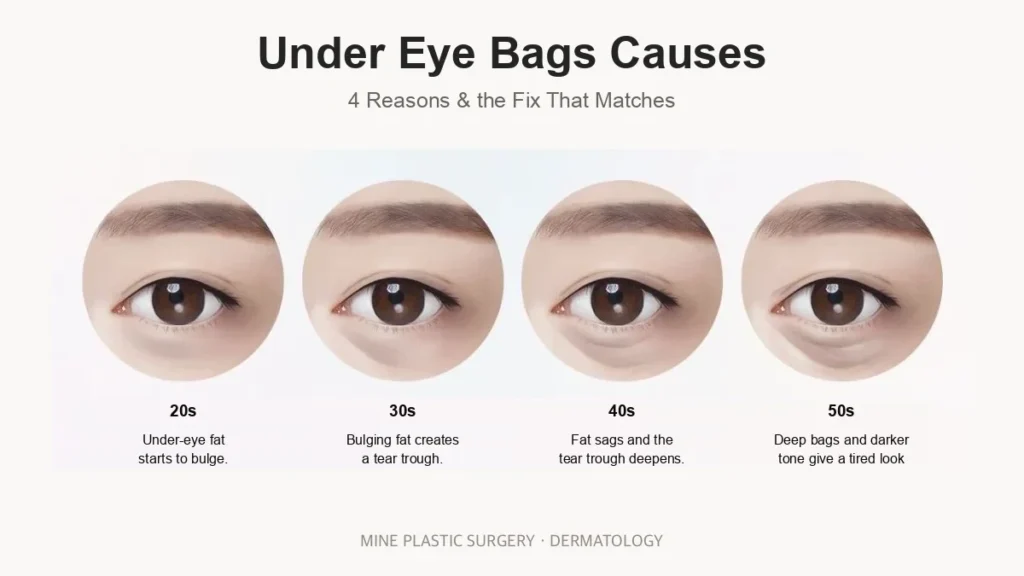
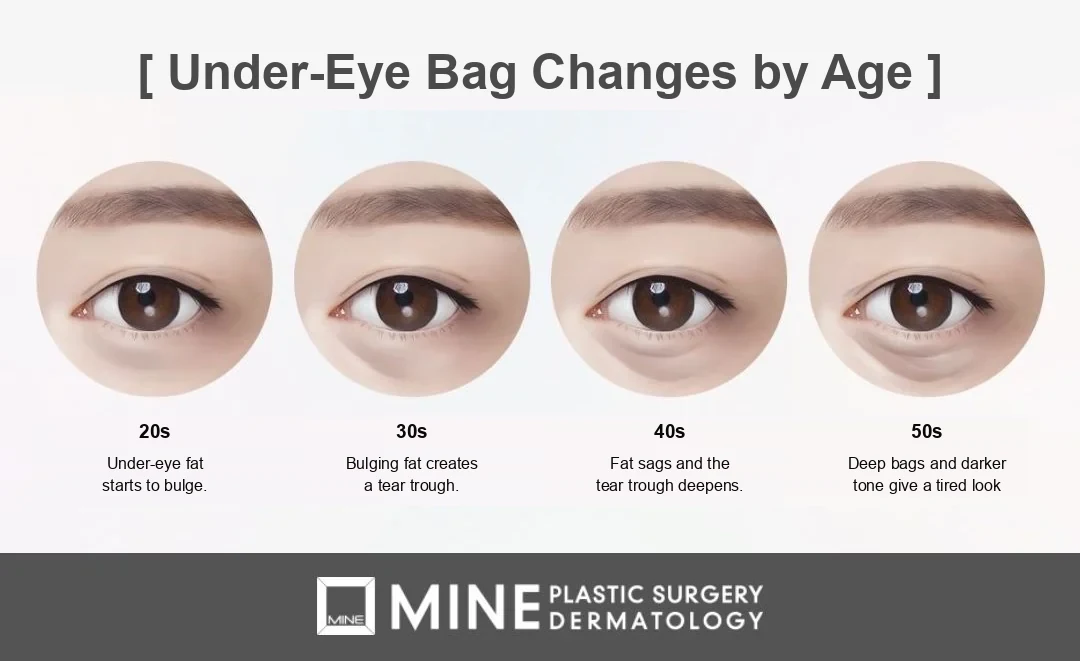
These changes tend to show up in stages. In the 20s, the fat starts to bulge. In the 30s, the bulge creates a visible tear trough. In the 40s, the fat sags and the groove deepens. By the 50s, deeper bags and a darker tone add up to a constantly tired look. The pace varies from person to person, and so does the mix of under eye bags causes, but the order is usually the same.
Shadow, Pigment or Blood Vessels? Find Your Dark Circle Type First
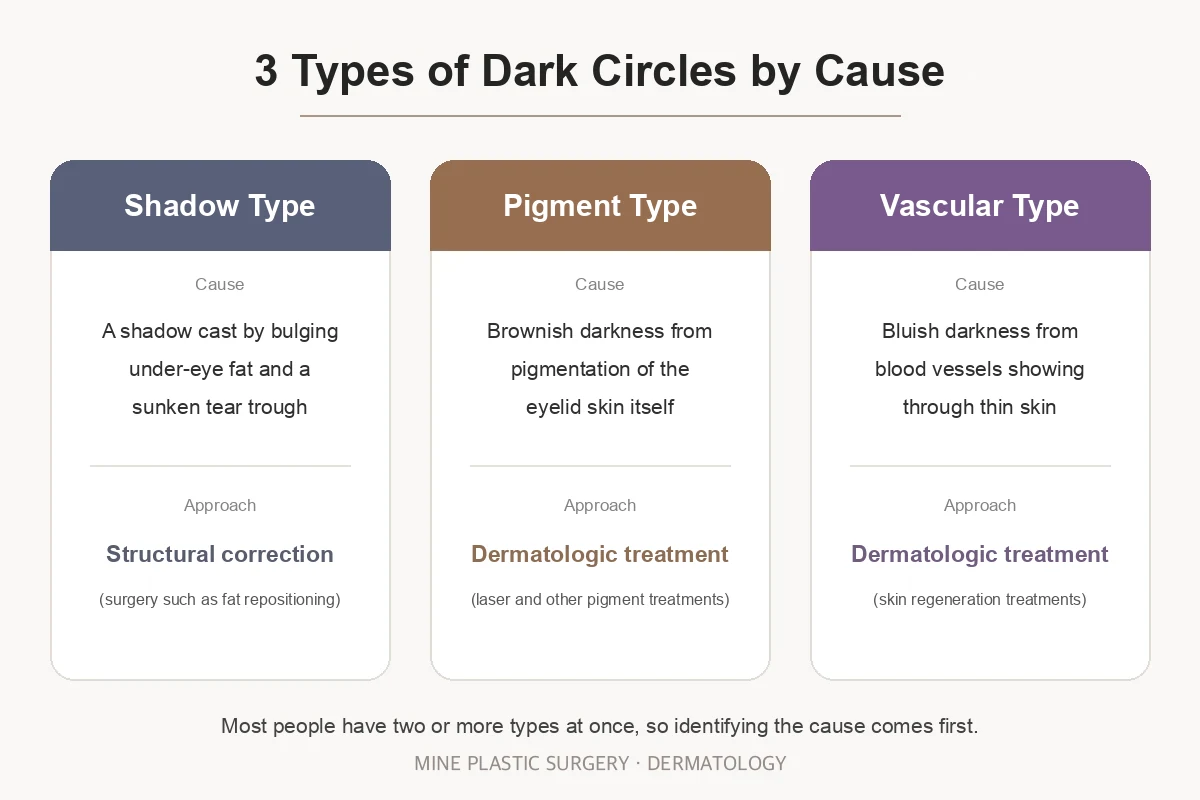
Dark circles come in three broad types: shadow, pigment and vascular (blood vessel). Only the shadow type is created by the structural under eye bags causes described above, so only the shadow type is a target for surgery. In practice, most people have two or more types mixed together, which is why sorting them out comes before choosing any treatment.
Shadow type: a structural problem
A shadow-type dark circle is the darkness cast by bulging fat and the groove below it. It sits right under a visible bulge, and it changes as the light changes. This is the type that the four under eye bags causes above produce. A classification of dark circles published in the plastic surgery literature groups this as a “problem of shape.” For bulging orbital fat, that classification lists moving the fat through the inside of the lower lid (transconjunctival fat repositioning) or removing it through the same route as the treatment of choice.
Pigment and vascular types: a skin problem
The same classification groups the other types as a “problem of color.” Pigment-type darkness is brownish and comes from extra pigment in the eyelid skin. Vascular-type darkness looks bluish or purplish because thin, almost see-through skin lets the blood vessels underneath show. Here the literature points to skin treatments, such as laser toning, laser resurfacing, chemical peels and, for thin skin, small fat grafts. Surgery that moves fat does not change skin color.
A quick mirror check you can do at home
Stand under a ceiling light, then face a window or a lamp straight on. If the darkness fades when the light comes from the front, a shadow is likely involved, which points to the structural under eye bags causes. Next, look at the color: brown suggests pigment, while blue or purple suggests vessels. Finally, gently lift the skin toward your temple; pigment stays the same color when stretched. Treat this as a hint, not a diagnosis.
Dr. Lee’s key point: The first fork in the road is whether your darkness comes from structure (fat and the step it creates) or from the skin itself (pigment and vessels). Getting that right is the first step toward a result you are happy with.
How Tear Trough Fat Repositioning Fixes the Shadow-Type Cause
Tear trough fat repositioning is surgery that keeps the bulging under-eye fat instead of throwing it away, and moves it down into the hollow tear trough. The bulge goes down and the groove fills in at the same time, so the step that casts the shadow disappears. In other words, it targets the shape problem behind the most common under eye bags causes rather than the skin.
Move, don’t remove: why removing fat can age the eye later
Many patients ask, “If the fat is sticking out, why not just take it out?” In my clinical experience, removing too much fat can look smooth at first, but a few years later the area under the eye can turn hollow and actually look older. That is why I treat under-eye fat not as waste but as volume that can fill the hollow next to it.
This principle is not my own invention. Goldberg (2000), Plastic and Reconstructive Surgery described transconjunctival orbital fat repositioning, in which fat is moved into the groove through the inside of the lower lid and secured there. Plastic surgery textbooks now list fat repositioning as a standard approach for a lower lid that combines a bulge with a sunken tear trough.
What happens during the procedure (4 steps)
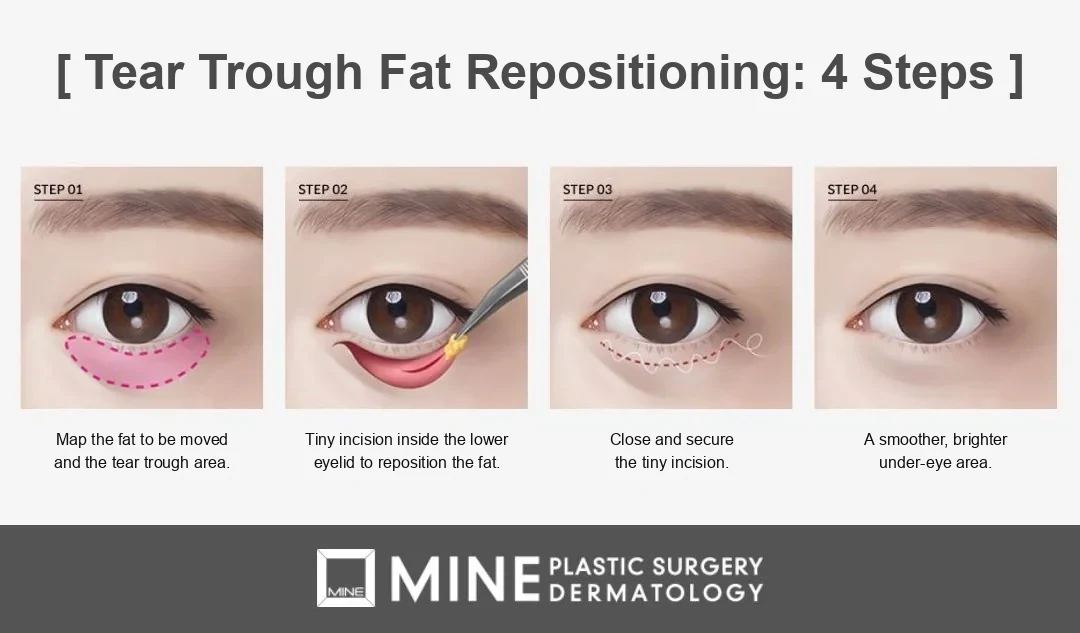
Fat repositioning is usually done through an incision inside the lower eyelid in about 30 to 60 minutes, with same-day discharge. It is performed under local anesthesia combined with sedation.
- Diagnosis and design. The surgeon measures how much the fat bulges, how deep the tear trough is, how firm the skin is and how the two sides differ, then plans how much fat to move and where.
- Incision inside the eyelid. Access is through the conjunctiva (the moist pink lining inside the lower lid), so there is no cut on the outer skin.
- Repositioning and fixation. The bulging fat is spread thinly and evenly into the tear trough and secured. Fat is trimmed only where truly needed. If the hollow is unusually deep, adding a micro fat graft is discussed at the diagnosis stage.
- Closing and going home. The small inner incision is closed with minimal stitches and left to heal naturally. After a check in the recovery room, you go home the same day.
Textbooks also note the trade-offs of this route. The inside approach gives the surgeon a narrower view than a skin incision, and fat in the outer corner can be harder to reach. That is one more reason why the design step matters so much. You can read how we perform transconjunctival fat repositioning at MINE on our procedure page.
Fat Repositioning vs Lower Blepharoplasty vs Filler: Which Fix Fits Your Cause
Once you know which under eye bags causes apply to you, the choice between the three main fixes becomes much clearer. If your skin is still firm, fat repositioning is usually the fit. If the skin is loose and finely wrinkled, lower blepharoplasty, which also removes the extra skin, may suit you better. If there is a mild hollow with no bulging fat, filler can be an option.
Comparison table
| Fat repositioning | Lower blepharoplasty | Under-eye filler | |
|---|---|---|---|
| Main candidate | Bulging fat with good skin firmness, mostly 20s to 40s | Bulging fat with sagging skin and fine wrinkles, usually middle age and older | Mild hollow without bulging fat |
| Approach | Incision inside the lower lid (no skin scar) | Skin incision just below the lashes | Injection, no incision |
| Corrects sagging skin | Limited | Yes | No |
| Recovery | Bruising and swelling for about 1 to 2 weeks | About 1 to 2 weeks or more, including stitch removal | Same day to a few days |
| How long it lasts | Expected to last a long time (varies by person) | Expected to last a long time (ageing continues) | Usually about 6 to 12 months |
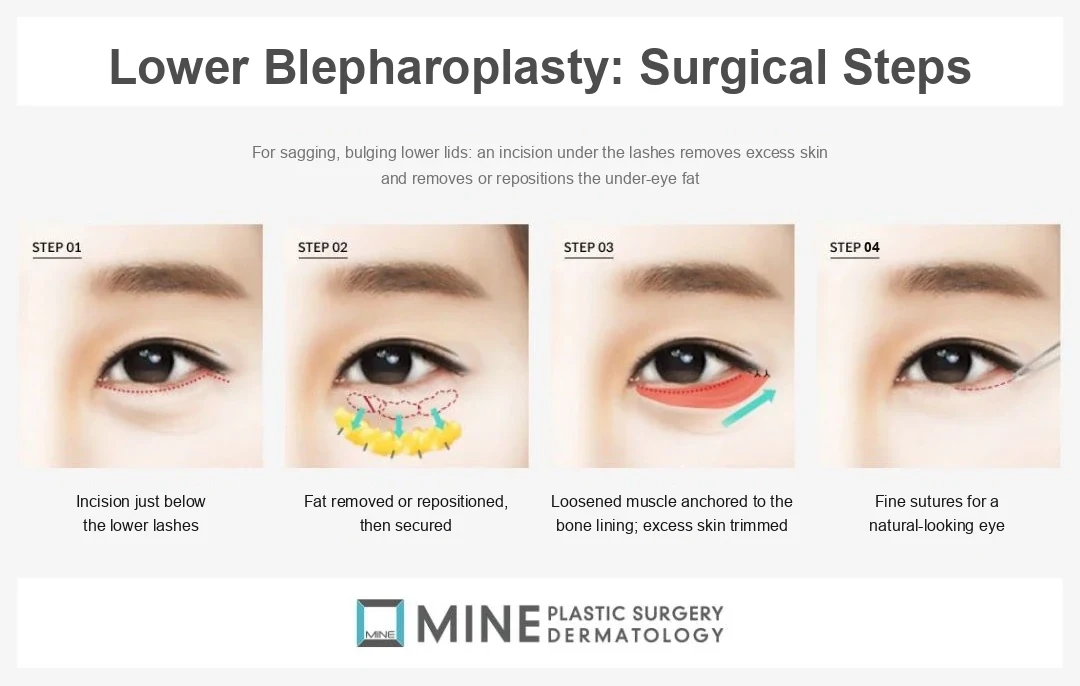
When skin laxity points to lower blepharoplasty
The deciding factor is skin firmness and how much the skin sags, not your age. Lower blepharoplasty uses an incision just below the lashes, so the surgeon can reposition or remove fat, support the loosened muscle and trim the excess skin. That skin trim is exactly where it differs from fat repositioning, which never touches the outer skin. If loose skin is part of your picture, see our page on lower eyelid surgery with skin removal.
Textbooks describe a balance between the two routes. A skin incision can give an excellent contour, but a pulled-down lower lid (lid retraction) or an outward-turned lid (ectropion) are the complications surgeons watch for most closely. The inside route is more conservative, yet it does not completely remove the risk of lid position problems either. Choosing the route is therefore a matter of matching it to your skin and anatomy.
When filler is enough, and its limit
Under-eye filler typically lasts about 6 to 12 months and does not remove the bulging fat itself. The aesthetic surgery literature describes filler as a way to camouflage the under-eye bulge and the tear trough without surgery, which suits people who are not candidates for an operation or who have a mild hollow. It hides the step by filling the groove, while the fat that causes the bulge stays where it is. You can compare dermal filler options if this sounds like your situation.
Dr. Lee’s key point: I choose the method by skin firmness and how much the skin sags, not by age. Pick the operation that matches your own under eye bags causes and skin condition, not the one that is currently popular.
Risks Ranked by How Often They Happen
Like any surgery, under-eye surgery does not carry zero risk. Most side effects are temporary, and accurate diagnosis, careful technique and good follow-up lower the risk considerably. I believe honest information builds trust, so here are the possible problems sorted by how often they occur.
Common and temporary
Bruising, swelling, redness of the white of the eye, a gritty feeling, temporary stinging or dryness and watery eyes are common. Most of these settle gradually over a few days to two weeks.
Uncommon: needs follow-up
Less often, patients may notice asymmetry, over-correction (a hollow look), under-correction (some remaining bulge), small irregularities where the fat was placed, or infection. These are monitored, and a touch-up is considered if needed.
Surgical textbooks list a few complications specific to the inside approach: injury to the inferior oblique (a small muscle that helps move the eye), persistent chemosis (swelling of the clear membrane over the eye) and lower-lid retraction. Retraction can follow when inflammation from handling the fat leads to scarring in the middle layer of the lower lid, which then pulls the lid down. Loose outer-corner tendons and a descending cheek are also listed as contributing factors.
Very rare emergency: orbital hemorrhage
The most serious complication is bleeding behind the eye (orbital hemorrhage). A study of about 270,000 blepharoplasties by Hass et al. (2004) reported orbital hemorrhage in about 0.055% and permanent vision loss in about 0.0045% of cases. These figures cover eyelid surgery overall, not fat repositioning alone.
Rare is not the same as never. That is why bleeding risk factors such as blood-thinning medications and high blood pressure are checked before surgery. If you notice sudden severe pain, a feeling that the eye is being pushed forward, or any change in vision after surgery, contact the clinic immediately.
Recovery at a Glance
Bruising and swelling mostly settle within 1 to 2 weeks, and most patients return to daily life in 3 to 7 days. Swelling peaks over the first three days, and by the end of the first week most of it has gone down. After one to two weeks, remaining bruising can usually be covered with makeup. The final, natural contour settles over 1 to 3 months as the last subtle swelling fades.
Everyone heals at a different pace, so use this as a general guide. For cold compresses, sleeping position, contact lenses, exercise and other day-by-day precautions after surgery, see our separate aftercare article.
Frequently Asked Questions
Why do I have under-eye bags in my 20s?
Usually because of inherited orbital anatomy. Some people are born with bone and soft-tissue shapes that give the fat less room, so it pushes forward early. Sleep and diet can make puffiness worse from day to day, but they rarely explain a bulge that is there every morning. A consultation can confirm whether fat is actually involved.
How can I tell if my dark circles are caused by fat or pigment?
A shadow from fat sits directly under a bulge and changes as the light angle changes. Pigment looks brownish and stays the same under any light, while vascular darkness looks bluish or purplish. Many people have a mix, so an in-person assessment is the reliable way to sort out which under eye bags causes and skin factors apply to you.
Does tear trough fat repositioning leave a scar?
No visible scar on the skin. The incision is made inside the lower eyelid, through the conjunctiva, so the outer skin is not cut. This inner lining is a mucous membrane and tends to heal quickly.
How long do the results of fat repositioning last?
Fat that has been moved and secured tends to stay in place for a long time. The surgery does not stop ageing, though, so the eye area will keep changing naturally over the years. Rarely, leftover fat becomes noticeable again, and a touch-up may be considered. Results vary from person to person.
What is the difference between under-eye filler and fat repositioning?
Filler adds volume to the hollow tear trough without surgery and usually lasts about 6 to 12 months, but it leaves the bulging fat where it is. Fat repositioning moves that bulging fat itself into the groove, which removes the step that casts the shadow.
Find the Cause Before You Choose the Fix
The same under-eye concern can have a different answer for each person. Depending on how much fat bulges, how deep the tear trough is, how firm the skin is and how your bones are shaped, the right choice may be fat repositioning, lower blepharoplasty, filler or a skin treatment. That is why the under eye bags causes have to be sorted out before any treatment is chosen.
If the shadow under your eyes has bothered you for a while, start by finding out what is really causing it. You can reach MINE Plastic Surgery & Dermatology through our online consultation form, on WhatsApp, or by calling +82-2-516-1175 to book a visit. When you come in, I will examine your under-eyes myself and help you find the approach that fits.
Written and reviewed by Dr. Lee Sung-wook, Board-Certified Plastic Surgeon, MINE Plastic Surgery & Dermatology | 813 Nonhyeon-ro, Gangnam-gu, Seoul | +82-2-516-1175
Sources: Plastic surgery textbooks and reviews on lower blepharoplasty (eyelid anatomy, transconjunctival technique and complications); a published classification of infraorbital dark circles and their treatment of choice; Goldberg (2000); Hass et al. (2004).
※ This content is for informational purposes only and does not replace professional medical advice, diagnosis, or treatment. Individual results may vary, and side effects may occur. Please consult with a board-certified plastic surgeon for personalized advice.
