EN


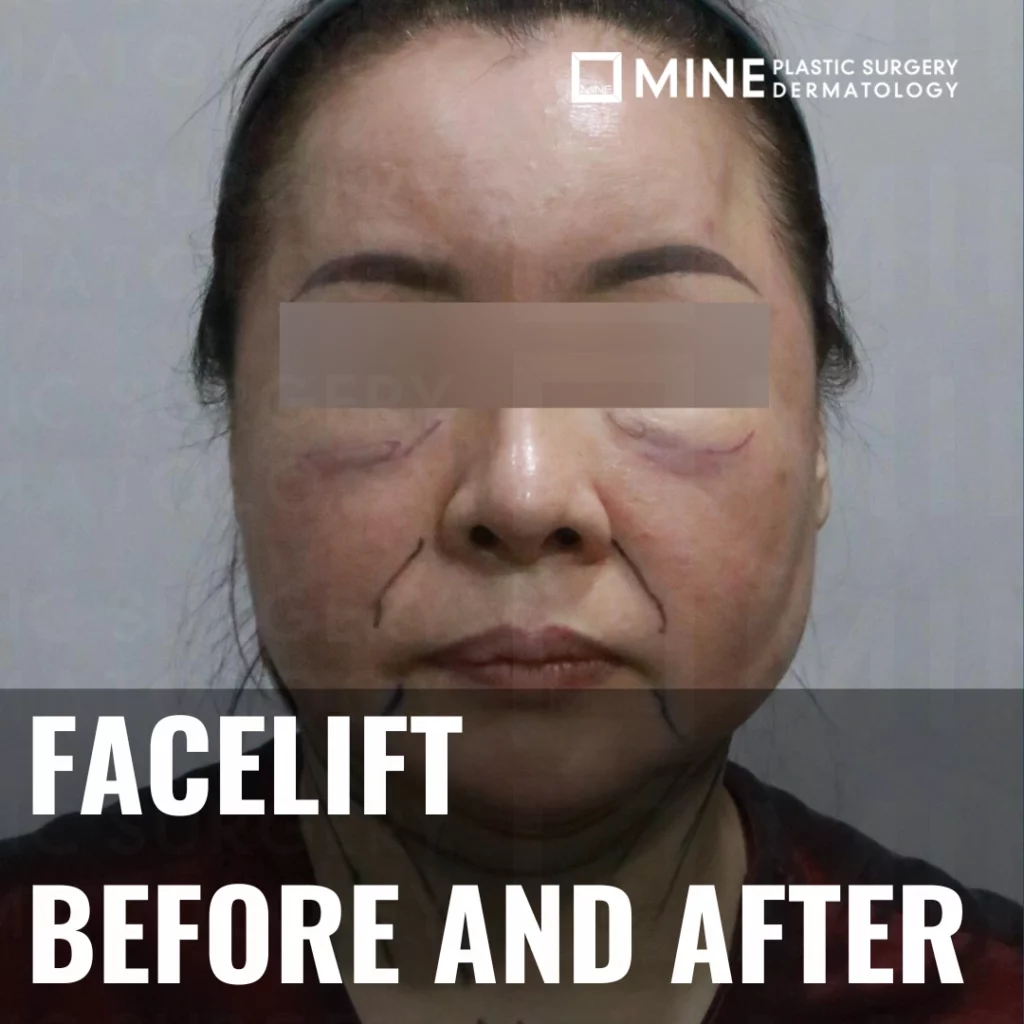
Mini facelift side effects are the short-term reactions and less common complications that can follow a mini facelift — mostly bruising, swelling and temporary numbness, with rarer risks such as hematoma, infection and facial nerve weakness. Most of them are part of normal healing and fade on their own.
The question I hear most often in consultation is simple: “The incision is small, so the risk must be small too, right?” The honest answer is: partly. A short incision does lower some risks, but the deep work under the skin is not “mini,” and that is where the more serious complications come from.
In this guide I sort mini facelift side effects into three tiers, explain who carries a higher risk, and give you a clear table of normal recovery symptoms versus the warning signs that mean you should call the clinic straight away.
What Are Mini Facelift Side Effects — and Does a Small Incision Mean Less Risk?
Mini facelift side effects come from two different places: the incision on the surface and the lifting work done in the deeper layers of the face. To understand which risks a mini facelift actually reduces, it helps to know exactly where the incision runs and how far the deep work goes.
Small Incision, Full-Width SMAS Lift
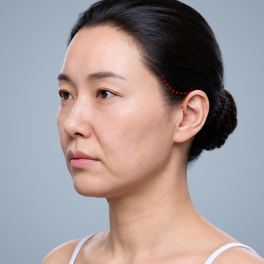
In our Deep SMAS mini facelift, the incision is short: it runs from the scalp at the temple down to the top of the ear. It stops there: it does not extend down to the antitragus (the small cartilage bump just above the earlobe) or to the earlobe itself, and it does not wrap around the back of the ear.
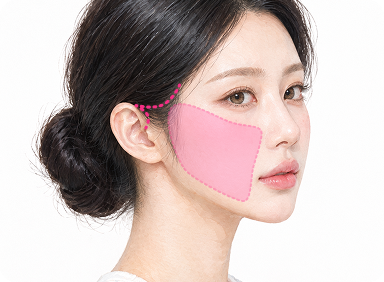
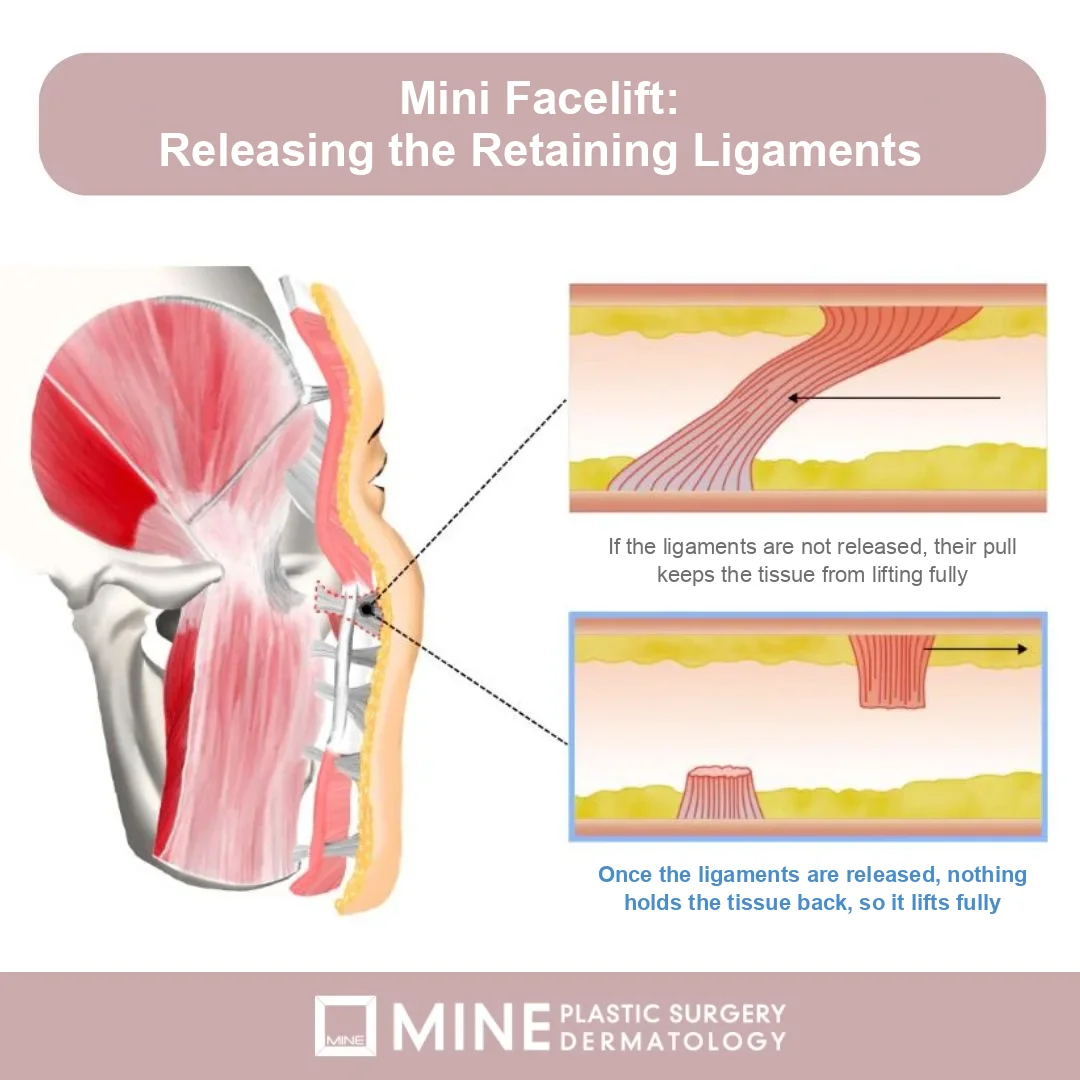
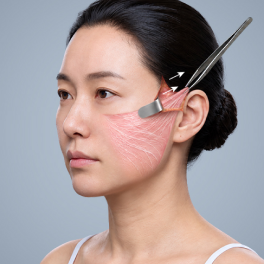
Through that small opening, however, the SMAS (the supportive layer of muscle and connective tissue beneath the skin) is released as widely as in a full facelift — across the cheekbone, the upper cheek and the lower cheek, down to the jowl. The retaining ligaments that tether this layer are released, and the SMAS itself is lifted back against the direction of sagging and secured in the deep layer, separately from the skin. It is not a thread-style pull.
Which Risks the Short Incision Lowers — and Which It Does Not
Because the incision is short and stays above the ear, incision-related problems are reduced by design: there is less scar length to heal, and because the earlobe and antitragus are left untouched, the risk of ear-shape distortion or a “pixie ear” (an earlobe pulled downward and stuck to the cheek) is lowered.
What the short incision does not change is the deep-layer risk. Because the SMAS is released across the same width as in a full facelift, hematoma (a collection of blood under the skin), facial nerve weakness and skin-healing problems belong to the same family of mini facelift complications as those of a full facelift. A mini facelift is a shorter operation, but it is not a “low-risk” one by default.
Who Is at Higher Risk of Mini Facelift Complications?
Mini facelift complications are more likely in people with certain health habits or conditions, and most of these can be managed if your surgeon knows about them in advance. A careful medical history is one of the most effective ways to reduce mini facelift side effects before surgery.
Risk Factors Your Surgeon Needs to Know
- Smoking — including past smoking. Plastic surgery textbooks note that smoking narrows the small blood vessels feeding the skin, and that some of this damage remains even after a person quits. This raises the risk of slow healing and skin breakdown, two of the complications most closely tied to lifestyle.
- Blood thinners, aspirin and some supplements. Anything that affects clotting can increase bleeding and bruising.
- High blood pressure. Blood-pressure spikes after surgery are closely linked to hematoma, so control before and after surgery matters.
- Being male. Published facelift series consistently report higher hematoma rates in men than in women.
- Diabetes. Poorly controlled blood sugar can slow wound healing.
- Previous facial surgery, keloid tendency or allergies. Scar tissue, thick-scar history and drug allergies all change how surgery and aftercare are planned.
What to Disclose Before Surgery
At your consultation, please tell us about:
- All prescription medicines, aspirin or painkillers, and supplements (fish oil, vitamin E, ginkgo and similar products)
- Whether you smoke or vape now, or have smoked in the past
- Blood pressure, diabetes, heart, bleeding or clotting conditions
- Any previous facelift, thread lift, filler or other facial procedure
- Past problems with thick scars, keloids or anesthesia
Mini Facelift Side Effects in 3 Tiers: Temporary, Watch Closely, Rare but Serious
Mini facelift side effects fall into three practical tiers: temporary reactions almost everyone has, problems that need close watching, and rare but serious complications. One important note first: the figures below come from published series on full facelift surgery. There are no large mini-facelift-only studies, but because the deep dissection is similar, these numbers are a reasonable reference. For the wider list from full facelifts, see our article on the side effects of a full facelift.
| Tier | Examples | What usually happens |
|---|---|---|
| 1 — Temporary and expected | Bruising, swelling, numbness, tightness, uneven swelling | Fades gradually over weeks; complete settling can take months |
| 2 — Watch closely | Hematoma, infection, scar problems | Uncommon; treatable, especially when caught early |
| 3 — Rare but serious | Facial nerve weakness, skin compromise | Rare; most cases improve with time and conservative care |
Tier 1 — Temporary and Expected: Bruising, Swelling, Numbness, Uneven Swelling
Bruising and swelling around the cheeks, jaw and temples are normal and usually peak in the first few days before slowly fading. Many patients also notice a tight feeling, mild numbness around the ear and cheek, or swelling that looks a little different on each side. These temporary effects are expected parts of healing, not signs that something has gone wrong.
Most visible bruising and swelling settle within the first few weeks, but some subtle residual swelling lasts longer. Plastic surgery textbooks allow about 6 months for all swelling to settle completely after facelift surgery, so final judgment of the result should wait until then.
Tier 2 — Watch Closely: Hematoma, Infection, Scar Problems
Hematoma. Facelift textbooks report hematoma as the most common complication, at about 2–3% in women and higher in men. In men, rates of up to 8% have been reported, falling to about 4% with meticulous technique and careful blood-pressure control. Another large textbook series of facelifts reported 1.5% in women and 4% in men. Hematoma usually appears within the first day or two, often as sudden, firm swelling on one side. When it is recognized early, it can usually be drained and managed promptly, which is why sudden one-sided swelling is the first symptom we ask patients to report.
Infection. Published facelift series put infection below 1%. Warning signs are increasing redness, heat, pain, discharge or fever, and most cases respond to antibiotics.
Scar problems. Some patients develop a thicker or darker scar. With a mini facelift, the incision stays in the temple hairline and along the top of the ear, so it is short and largely hidden. For details on where mini facelift scars sit and how they change over the first year, see our scar guide.
Tier 3 — Rare but Serious: Facial Nerve Weakness, Skin Compromise
Facial nerve weakness. The facial nerve moves the muscles of expression, so weakness can show up as a corner of the mouth that does not lift or an eye that does not close fully. In a textbook series of 3,500 facelifts, facial nerve weakness occurred in 0.1% of patients, and all cases resolved within 6 months. Most cases are caused by stretching or swelling around the nerve rather than a cut. We cover which nerve branches are involved and what gets checked in our article on facial nerve weakness after a facelift.
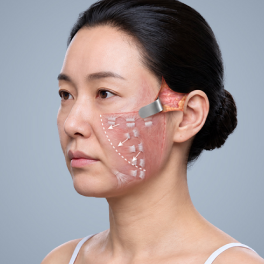
Skin compromise. Rarely, part of the lifted skin does not get enough blood supply, leading to a dark or scabbed patch (skin necrosis). Smokers and former smokers carry a higher risk. Textbooks advise conservative care, and most areas heal on their own; if a visible scar remains, it can be revised later.
For broader reading on facelift risks in general, the facelift safety information from the American Society of Plastic Surgeons is a helpful overview.
How MINE’s Mini Facelift Technique Is Designed to Lower Risk
MINE’s mini facelift technique lowers risk by keeping the incision short and ear-sparing while handling the deep layer precisely, so the lift does not depend on pulling the skin tight. No surgery is risk-free, but each step below is chosen with specific mini facelift side effects in mind.
About 1 Hour Under IV Sedation, Same-Day Discharge
A mini facelift at MINE takes about 1 hour under IV sedation, and most patients return to daily life in about 5 days. You go home the same day, and we see you for 3 follow-up visits so that swelling, the incision and sensation can be checked at each stage. A shorter operation also means less time under anesthesia.
Why Deep-Layer Fixation and an Ear-Sparing Incision Matter
When the retaining ligaments are left intact, they keep pulling the tissue back, and a surgeon may be tempted to compensate by stretching the skin harder. Releasing those ligaments lets the SMAS move freely, so it can be lifted without forcing tension.
The lifted SMAS is then secured in the deep layer, separately from the skin. Because the skin is not carrying the weight of the lift, it can be closed without excess tension, which supports better healing at the incision. And because the incision stops above the antitragus and earlobe, the earlobe is not pulled down — the main cause of pixie-ear deformity. In my clinical experience, nerve safety always comes first: no aesthetic gain is worth putting a motor nerve at risk.
Mini Facelift Recovery: Normal Symptoms vs Warning Signs
Mini facelift recovery warning signs are symptoms that get worse instead of better, appear suddenly, or affect only one side. Normal healing follows the opposite pattern: symptoms that slowly and steadily improve.
What Is Normal in the First Days and Weeks
| Usually normal | Call the clinic right away |
|---|---|
| Swelling and bruising that slowly decrease | Sudden, severe or rapidly growing swelling on one side |
| Tightness or pressure around the cheeks and jaw | Pain that keeps getting worse instead of easing |
| Mild numbness around the ear and cheek | Fever of 38°C (100.4°F) or higher |
| Itching as the incision heals | Foul smell, pus or spreading redness at the incision |
| Slight unevenness between the two sides | An eye that will not close or a mouth corner that will not move |
A typical recovery timeline looks like this:
- First 48 hours: rest with your head raised and use cold compresses as your clinic instructs.
- About 5 days: most patients are back to daily life.
- Following weeks: visible bruising fades and residual swelling keeps going down; your 3 follow-up visits fall within this period.
- Around 6 months: swelling settles completely, according to plastic surgery textbooks on facelift surgery.
Call the Clinic Right Away If You Notice These Signs
A fever of 38°C (100.4°F) or higher, or sudden swelling on one side of the face, is a reason to call the clinic the same day. The same goes for worsening pain, a foul smell or discharge from the incision, or difficulty closing an eye or moving the mouth. Do not wait for your next scheduled visit — early assessment makes most of these problems much easier to treat.
Precautions Before and After a Mini Facelift
Precautions before and after a mini facelift are the simple habits that keep mini facelift side effects to a minimum: preparing your body before surgery, protecting the incision early on, and caring for the scar in the months that follow.
Before Surgery
- Stop smoking. Our guidance at MINE is to stop smoking at least 2 weeks before surgery and stay smoke-free for about 4 weeks afterward. If you cannot stop, it is safer to postpone.
- Review your medicines. Blood thinners, aspirin and some supplements may need to be paused — only with your doctor’s approval.
- Get blood pressure and blood sugar under control before the day of surgery.
The First Two Weeks
- Take prescribed medicines exactly as directed.
- Avoid pressure on the incision and the side of your face while sleeping.
- Keep the dressing and incision clean; dressing care is checked at your follow-up visits.
- Avoid strenuous exercise, saunas and alcohol in early recovery, and follow the timing we give you at your follow-up visits.
Months 1–3
- Protect the scar from the sun with sunscreen or a hat.
- Use scar care as advised if the scar looks thick or red.
- Let us know at follow-up if numbness or any other symptoms are not gradually improving.
Mini Facelift Side Effects: Frequently Asked Questions
How common are mini facelift complications?
Most mini facelift side effects are temporary bruising, swelling and numbness. Serious complications are uncommon: textbook facelift series report hematoma in about 1.5–3% of women (higher in men), infection below 1% and facial nerve weakness around 0.1%. These are full facelift figures; there are no large mini-facelift-only series.
Are mini facelift side effects milder than a full facelift?
Partly. Incision-related problems are reduced because the scar is shorter and the earlobe and antitragus are left untouched. Deep-layer risks are similar, because the SMAS is released as widely as in a full facelift. If you are weighing the two, see our guide on choosing a mini facelift or full facelift.
How long does numbness last after a mini facelift?
Numbness, one of the most common mini facelift side effects, usually improves gradually over several months as small sensory nerves recover. If there is no improvement at all by about 6 months, your surgeon will re-evaluate the area.
Can smokers have a mini facelift?
Yes, but smoking raises the risk of poor skin healing and skin breakdown, and textbooks note that some blood-vessel damage remains even after quitting. Our guidance at MINE is to stop at least 2 weeks before surgery and stay smoke-free for about 4 weeks after. If you cannot stop, postponing is the safer choice.
Will I need revision surgery if a complication happens?
Rarely. Most mini facelift complications are managed without another operation: infection with antibiotics, hematoma by prompt drainage (often straightforward when caught early), and thick scars with laser or injection treatment. Revision surgery is usually considered only for marked asymmetry or a scar that does not improve.
When can I go back to work after a mini facelift?
Most patients return to daily life, including desk work, in about 5 days, even though some mild swelling and bruising may still be settling. Some residual swelling continues for a few weeks after that, and your 3 follow-up visits let us check that healing is on track.
Talk to Dr. Lee Before You Decide
Understanding mini facelift side effects is part of deciding whether the procedure is right for you. Which risks matter most depends on how much your face has sagged, the condition of your neck, your health history and your habits — and that is best judged in person.
At MINE Plastic Surgery in Apgujeong, Gangnam, Seoul, board-certified plastic surgeon Dr. Lee Sung-wook reviews your risk factors and possible mini facelift side effects with you before any surgery is planned. To book a consultation, call +82-2-516-1175 or visit us at 813 Nonhyeon-ro, Gangnam-gu, Seoul.
Written and reviewed by Dr. Lee Sung-wook, Board-Certified Plastic Surgeon, MINE Plastic Surgery
※ This content is for informational purposes only and does not replace professional medical advice, diagnosis, or treatment. Individual results may vary, and side effects may occur. Please consult with a board-certified plastic surgeon for personalized advice.