EN


Thread lift aftercare is the set of daily-life rules you follow for about the first month after a thread lift, while the threads settle into the tissue, to limit pressure on the face and lower the risk of infection.
Even when the procedure goes smoothly, many patients tell me the hardest part starts once they get home. Can I wash my face tonight? When can I shampoo? Is this much swelling normal? Without a clear reference point, feeling uneasy is completely understandable.
I’m Dr. Lee Sung-wook, a board-certified plastic surgeon at MINE Plastic Surgery & Dermatology in Seoul. This guide walks through the written aftercare instructions we actually give our thread lift patients, item by item, and adds what plastic surgery textbooks say about the normal course of recovery and possible complications. If you’d like to understand the procedure itself first — thread types and how the lift is created — start with how thread lifts work. This article focuses only on what happens after the procedure is finished.
Please keep in mind that this is general guidance. The number and placement of threads, any treatments done at the same time, and how quickly you heal can all change the details. The final word always belongs to the surgeon who performed your procedure.
Table of Contents
Table of Contents
Thread Lift Aftercare at a Glance: Day 1 to Month 3
At our clinic, patients can wash their face and hair the day after a thread lift, return to strenuous exercise, saunas, alcohol and smoking after 1 month, and resume ultrasound or radiofrequency treatments such as Ultherapy after 3 months. It’s worth getting this overall picture in your head before reading the details — once you know what is allowed and when, most of the unnecessary worry fades.
In short, a thread lift places fine threads under the skin to lift and hold sagging tissue, and those threads need time to anchor. That anchoring period is what the rules below protect. Recovery speed differs from person to person, so always put your own surgeon’s instructions first.
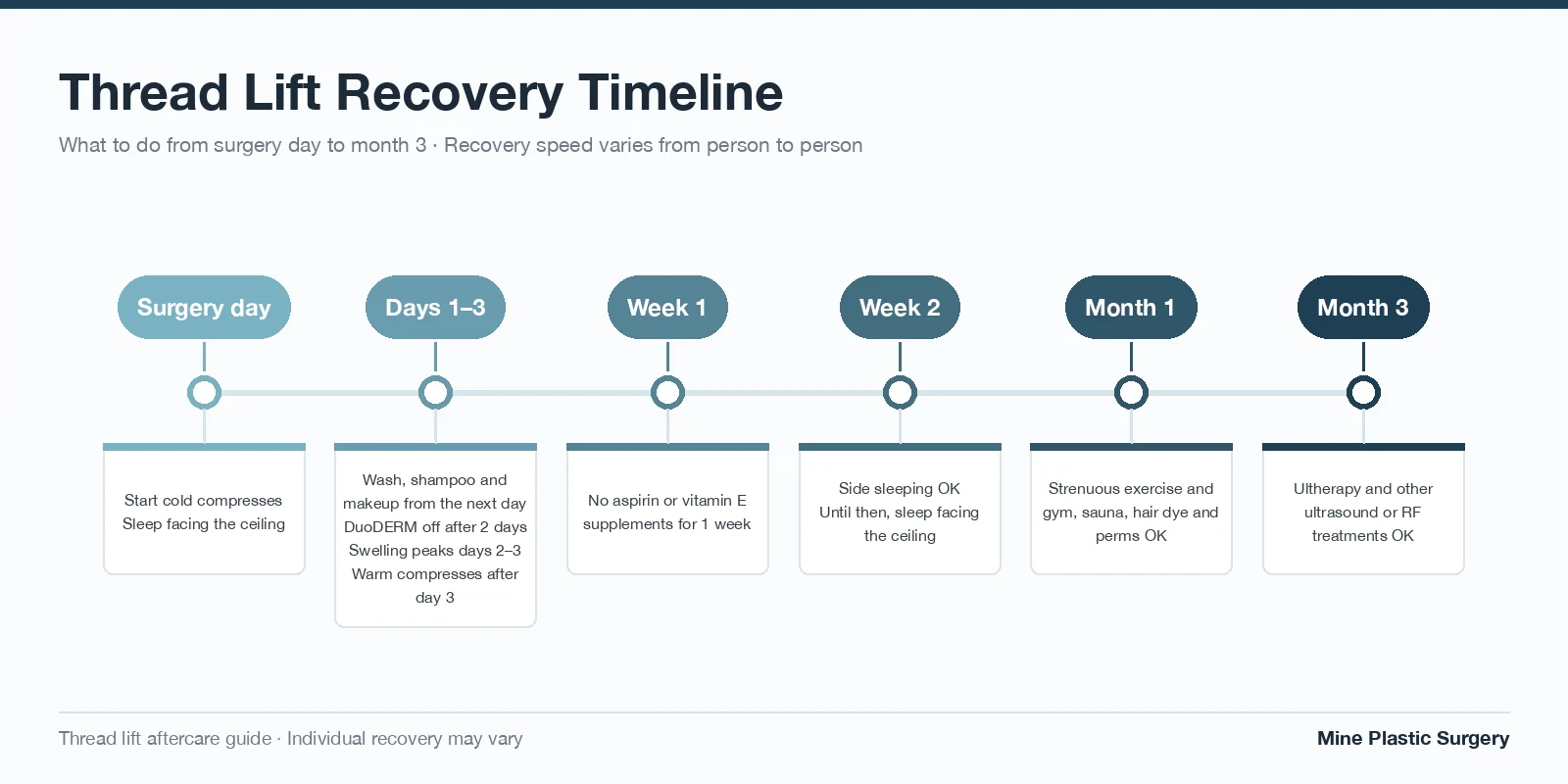
- Surgery day to day 3 — Swelling and bruising gradually build. Use cold compresses and sleep on your back, face toward the ceiling.
- The next day — You can wash your face, shampoo, wear makeup and put in contact lenses.
- Day 2 — Remove the small adhesive dressings (DuoDERM) we placed. There are no stitches to take out.
- Day 3 to week 2 — Switch from cold to warm compresses. Swelling slowly starts to come down.
- Week 2 — Sleeping on your side or stomach is fine from now on.
- Month 1 — Strenuous exercise, saunas, hair dye and perms, and facial massage are all allowed again. Keep avoiding alcohol and smoking until this point.
- Month 3 — You can go back to ultrasound and radiofrequency treatments, including Ultherapy.
Dr. Lee’s key takeaway: Most of the rules in thread lift aftercare are concentrated in the first month. That is roughly how long the threads need to settle and the surrounding tissue needs to heal.
Swelling and Bruising: What’s Normal in the First 2 Weeks
Swelling is the first thing patients ask about after a thread lift, and the part that surprises them most. It is normal for your face to look more swollen on the second or third day than on the day of the procedure. In our experience, swelling and bruising build for the first 2–3 days and then settle gradually over 2–4 weeks. How fast that happens varies a lot between people.
Bruising easily isn’t a sign that something went wrong. The face is packed with small blood vessels, and a thread passing through can press on or graze one. Medical textbooks classify pain, swelling and bruising as expected effects of a thread lift rather than complications, and note that most of them settle on their own over time. Textbooks also point out that bruising tends to be less when fewer threads are inserted — one reason recovery can look different from one patient to the next.
Cold First, Then Warm Compresses
Use cold compresses through day 3, counting the day of the procedure, and then switch to warm compresses. Getting the order wrong can actually make swelling last longer. Heat in the first few days increases blood flow and can worsen swelling, while sticking with cold after day 3 slows the body’s absorption of swelling and bruising that have already formed.
The compress pack we send home with you works for both. For warm compresses, use a heated sleep eye mask, or warm the pack in the microwave for about 15 seconds. It should feel comfortably warm, not hot, and shouldn’t sit directly on the skin for long periods.
Sleeping Position Matters
Sleeping position is a small but important part of thread lift aftercare. For 2 weeks after the procedure, don’t sleep on your side or stomach — sleep on your back with your face toward the ceiling. If one side is pressed into the pillow all night, swelling on that side lingers, and uneven force can be placed on threads that are still settling. Adding an extra pillow to raise your upper body slightly also makes morning puffiness noticeably milder.
You can eat normally, but go easy on very spicy or salty food. The saltier your meals, the longer the swelling tends to hang around.
Dr. Lee’s key takeaway: Looking most swollen on day 3 is not a sign that healing has gone off track — it is the expected order of things. Knowing this in advance saves a lot of needless alarm.
When Can You Wash Your Face, Shampoo, and Wear Makeup?
Of all the thread lift aftercare questions, this is the one people search for most. The short answer: you can wash your face and shampoo your hair from the day after the procedure. Many patients are surprised it’s that soon.
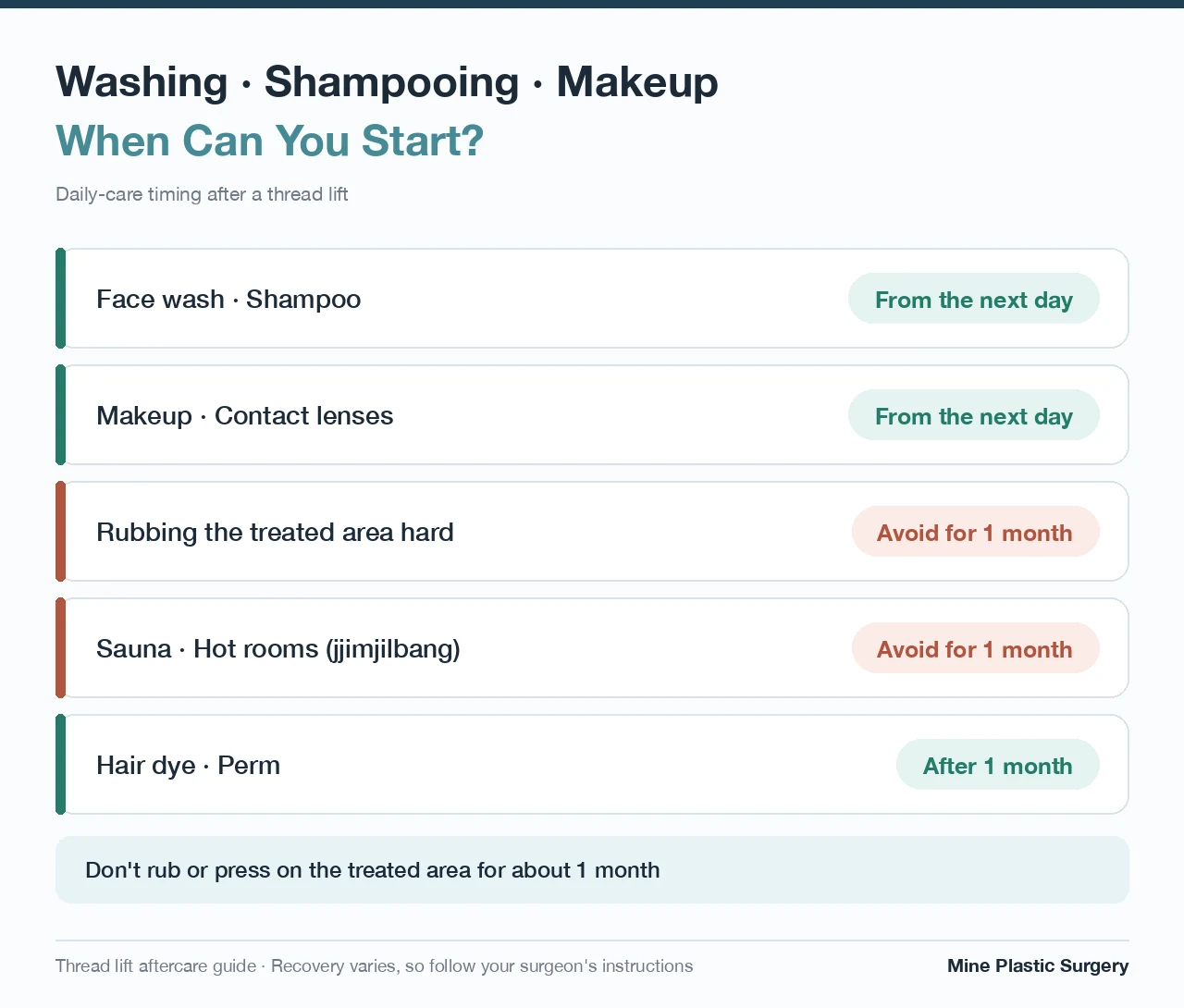
- Face washing and shampoo — from the next day.
- Makeup and contact lenses — from the next day.
- Rubbing the treated areas hard — avoid for about 1 month.
- Saunas and jjimjilbang (Korean bathhouses) — avoid for 1 month because of the infection risk.
- Hair dye and perms — from 1 month.
How to Wash Your Hair Safely for the First Month
“Allowed” is not the same as “business as usual.” You may wash your hair, but that doesn’t mean scrubbing hard. Follow these habits for the first month:
- Use lukewarm water, not hot. Hot water makes swelling worse.
- Wash gently with the pads of your fingers rather than your fingernails.
- Instead of bending far forward over the sink, tilt your head back under the shower — this puts less pressure on your face.
- Don’t rub your face or temples dry with a towel; press gently to soak up the water.
- Don’t point hot air from your hair dryer at the treated areas for long.
Clean hair and scalp matter for another reason, too. Some thread lift techniques use a small entry point at the temple, close to the hairline, and textbooks note that infections in this temple area are mainly linked to hair. Washing gently but regularly keeps that area clean without disturbing the threads.
Removing Makeup Without Rubbing
Makeup is fine from the next day, but taking it off is where most people slip up. For a month, set aside the habit of scrubbing your face up and down with cleanser. Instead, let the cleanser dissolve the makeup fully, then wipe or rinse it away with as little friction as possible.
Dr. Lee’s key takeaway: Washing starts the next day; rubbing waits a month. Keep those two apart in your mind and you’ll get this part right.
Entry-Point Care and Medications to Watch
With a thread lift, there are no stitches to remove, so caring for the entry points is simple: you just peel off the DuoDERM dressings after 2 days. Because of this, some patients assume there’s no wound care to think about at all. But the threads do pass under the skin, so keeping things clean still matters.
Medical textbooks describe infection as a rare complication of thread lifting and stress that clean conditions are essential both during the procedure and throughout recovery. Avoiding saunas for a month comes from the same reasoning.
Taking Your Prescribed Medication
Take your first dose of the take-home medication 30 minutes after your first meal following the procedure, then keep to the scheduled times. Don’t stop antibiotics early just because you feel better — finish the prescribed course. If you notice diarrhea, a rash, itching or other signs of an allergic reaction after taking your medication, stop it and contact us.
Aspirin and Vitamin E — and an Important Exception
Aspirin and vitamin E can make you bleed more easily, which means more bruising and swelling, so avoid them for 1 week after the procedure. That’s the general rule.
There is one thing I always emphasize. If you take aspirin or another antiplatelet or anticoagulant (blood thinner) to treat a heart or brain blood-vessel condition, do not stop it on your own based on this advice. Stopping these medicines without supervision can lead to problems far more serious than bleeding. Tell us about every medication you take at the consultation stage; whether and when to pause it is decided together with the doctor who prescribed it. The 1-week rule is meant for supplements such as vitamin E or omega-3 and for over-the-counter painkillers.
If you get a strong headache, you can take acetaminophen (Tylenol). It is a safer choice than taking aspirin or anti-inflammatory painkillers such as ibuprofen on your own.
Dr. Lee’s key takeaway: “No aspirin after surgery” refers to supplements and medicine-cabinet painkillers. Never stop a medicine prescribed for a medical condition by yourself — always talk to your doctors first.
What Not to Do After a Thread Lift: Exercise, Sauna, Alcohol, and Smoking
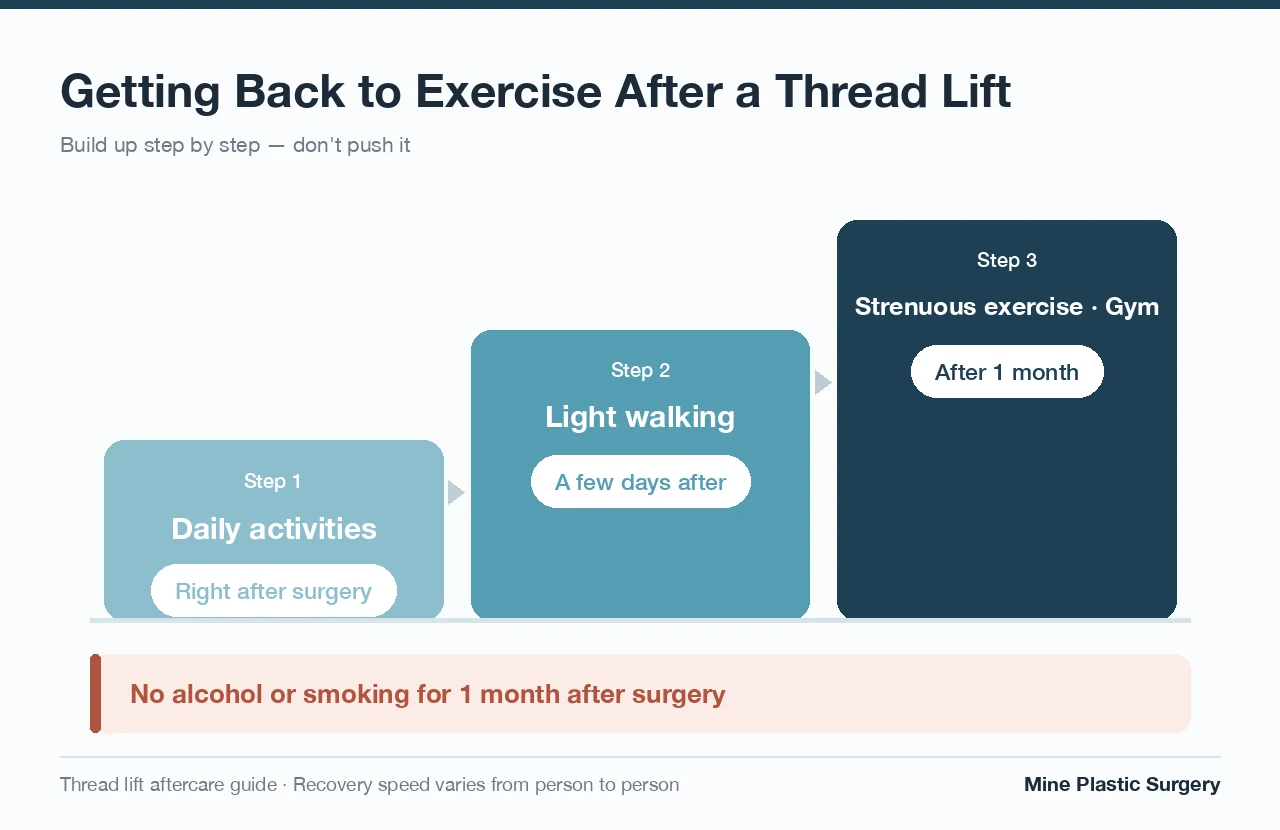
For people who love working out, this is often the hardest part of recovery. The good news is that normal daily life is fine right after the procedure. Going to work or doing housework doesn’t need to stop.
- Daily activities — right after the procedure.
- Light walking — from a few days after.
- Strenuous exercise — from 1 month. This includes weight training, running, Pilates and anything that makes you strain or sweat heavily.
- Saunas and jjimjilbang — avoid for 1 month.
- Alcohol and smoking — avoid for 1 month.
Why Hard Workouts Wait a Month
There are two reasons. First, intense exercise raises your blood pressure, which can bring swelling and bruising back. Second, straining tenses the muscles of your face and neck, putting unnecessary pull on threads that are still settling. In particular, avoid upside-down positions and moves where your face points toward the floor.
Alcohol and Smoking
Alcohol and smoking both work against you on bleeding, wound healing and infection, so we ask patients to avoid them for 1 month. Smoking is especially unhelpful because it reduces blood flow to the tissue and slows recovery. If a full month feels unrealistic, please at least hold off for the first 2 weeks, when swelling and bruising are at their worst.
Dr. Lee’s key takeaway: The test is “sweat and strain.” If an activity makes you sweat hard or clench your jaw, it’s still too early. A walk that doesn’t leave you out of breath is fine.
Your Thread Lift Recovery, Week by Week
In our experience, swelling and bruising peak at 2–3 days and settle over 2–4 weeks. By around 2 weeks, most people no longer look like they’ve had anything done, while the tight feeling is strongest at 1 month and eases over months 2–3. Recovery is hard to sum up in a single number because what others can see and what you can feel heal at different speeds.
- Week 1 — Swelling and bruising pass their peak and start to fade. A tight, pulled feeling in the face is obvious.
- Week 2 — Side sleeping is allowed. Visible bruising has mostly faded.
- Month 1 — The tight or slightly numb feeling can be at its most noticeable. This doesn’t mean recovery has stalled; it is the expected course.
- Months 2–3 — Tightness and firmness ease noticeably, and facial expressions feel more natural.
A tight or slightly dull sensation in the skin is part of normal healing and improves with time. The treated areas may feel firm to the touch or look a little uneven for a while; this also tends to smooth out. Textbooks explain that a temporary drop in sensation can come from swelling or minor bleeding under the skin rather than from nerve injury, which is why it usually fades as the swelling does.
Facial Movements and Massage to Avoid for a Month
For a month, be careful with opening your mouth very wide or making strong facial expressions. A big yawn or a hearty laugh can bring on a pulling pain. Also avoid facial massage or anything that presses on the face for a month. Massage at this stage isn’t just uncomfortable — it can interfere with the threads settling into place.
Ultherapy and RF: Wait 3 Months
Don’t have Ultherapy or other ultrasound or radiofrequency (RF) lifting treatments for 3 months. These devices deliver heat to the deeper layers of the skin, and heating the area while the threads are still holding can affect how well they hold. If you plan to have treatment at another clinic, be sure to tell them you had a thread lift and when.
Dr. Lee’s key takeaway: Feeling most uncomfortable at the 1-month mark is normal. Some patients worry something is wrong at this point and book a facial massage — that is exactly what sets the result back.
Normal Healing vs. Signs You Should Call Your Clinic
Knowing what is normal is one of the most useful parts of thread lift aftercare. Lumping everything under “side effects” makes it hard to judge what’s happening. It helps to separate the expected course that everyone goes through from complications that happen only occasionally. Medical textbooks do the same: pain, swelling and bruising are classed as expected effects, while infection, nerve problems and similar issues are treated as separate complications. Textbooks also note that dimpling and infection remain more common in older patients, even with modern dissolvable threads.
Things That Usually Settle on Their Own
Dimples (small dents where the skin is pulled slightly inward) are fairly common right after a thread lift. Textbooks describe mild dimples seen just after the procedure as tending to resolve once swelling goes down and normal facial movement returns. In our clinic, we often see them start to improve at around 1 month. Don’t try to press or massage them out yourself — doing so puts force on the threads.
Rarely, a nerve near the corner of the mouth is irritated, and one corner of the mouth may not lift as easily when you smile. In our experience this usually improves over 2–3 months, so there’s no need to panic. Textbooks note that nerve-related symptoms caused by threads can last longer than a month, so not being fully back to normal after a few weeks doesn’t mean the problem is permanent. That said, we always want to follow its progress with you in clinic.
Temporary facial stiffness, a dulled sensation and slight asymmetry between the two sides are also reported as possible findings during recovery. Most of them settle with time.
Call Us Right Away If You Notice These
In the following situations, don’t wait for your next appointment — contact the clinic. Caught early, most of these are straightforward to deal with.
- A fever or chills
- Sudden extra swelling and worsening pain on one side only
- Redness, heat or tenderness at the treated area, or any discharge or pus
- A thread end showing through or felt poking at the skin surface
- Asymmetry that becomes more obvious over time instead of less
- A rash, difficulty breathing or other signs of an allergic reaction after taking your medication
Dr. Lee’s key takeaway: What matters is the direction. If things are getting better day by day, it’s usually normal healing. If they’re getting worse, it needs to be checked.
How Long Do Results Last — and Why Some People Say “Don’t Get a Thread Lift”
Thread lift aftercare and longevity go hand in hand, so it’s worth looking at how long results actually last. Medical textbooks report that thread lift results are most visible from right after the procedure up to about 6 months and generally do not last beyond 2 years. As the small barbs on the threads are gradually absorbed by the body, their grip on the tissue weakens and the tissue tends to drift back toward where it started. It’s important to know before your procedure that a thread lift is not permanent.
Making Your Results Last
That is why the first month of care matters so much. While the threads are anchoring, repeated massage, pressure, exaggerated expressions or hard workouts can loosen the tension before it has set. The one-month rules above aren’t just about comfort — they connect directly to how long your result holds.
Aging also continues regardless of any procedure. Basic habits — daily sun protection, not smoking and avoiding big swings in body weight — help results last longer. To be honest with you, no procedure can stop aging on its own.
Why Some Patients Are Disappointed
If you’ve searched online, you may have come across people saying “don’t get a thread lift,” and it’s natural to feel uneasy. I don’t think those comments should be ignored. Understanding where they come from helps you make the right choice for yourself. When patients are unhappy, the reasons usually come down to a few things:
- Mismatched expectations — A thread lift has a different goal from a surgical facelift. It doesn’t remove sagging skin or reposition the deeper muscle layer; it lifts tissue with threads to refine the contour.
- The wrong candidate — When sagging is already advanced, threads alone may not produce the change you want.
- Misunderstanding longevity — Expecting a permanent result and then reading the gradual return as a failure.
- Skipping aftercare — Having massages or doing hard workouts in the first month. This is exactly what thread lift aftercare is meant to prevent.
In other words, the procedure itself isn’t the problem — satisfaction depends on whether it was used for the right face. The degree of sagging, skin thickness and elasticity, and how much change you’re hoping for all need to be weighed together. In some cases a different approach, such as a facelift, is the better fit; our comparison of thread lifts and mini facelifts explains how that decision is made. It can’t really be judged from photos or articles alone — it takes an in-person examination. General background on the procedure is also available from the American Society of Plastic Surgeons.
Dr. Lee’s key takeaway: I tell quite a few patients at consultation that a thread lift isn’t right for them. Not recommending a procedure that doesn’t suit you is part of good care.
Thread Lift Aftercare FAQ
When can I wash my hair after a thread lift?
You can wash your face and hair from the day after the procedure. For about a month, don’t rub the treated areas hard; use lukewarm water and wash gently with your fingertips. Hair dye and perms can wait until 1 month after the procedure.
How long does thread lift recovery take?
In our experience, swelling and bruising are worst at 2–3 days and settle over 2–4 weeks. By around 2 weeks, most people no longer look like they’ve had anything done, although the tight or dull feeling is strongest at 1 month and eases over months 2–3. Recovery speed varies from person to person.
When does swelling go down after a thread lift?
Swelling usually increases for the first 2–3 days and then gradually settles over 2–4 weeks. Use cold compresses through day 3 (counting the day of the procedure), switch to warm compresses after that, and sleep facing the ceiling for 2 weeks.
How long do thread lift results last?
Medical textbooks describe the effect as most visible from right after the procedure to about 6 months and generally not lasting beyond 2 years. It varies widely with the type and number of threads, where they’re placed, your skin and how quickly you age, so a consultation gives the most accurate picture for you.
When can I exercise after a thread lift?
Daily activities are fine right away, and light walking can start a few days later. We recommend waiting 1 month for exercise that makes you sweat heavily or strain. Saunas, jjimjilbang, alcohol and smoking should also be avoided for 1 month.
Is it normal to have a dimple after a thread lift?
Mild dimples right after the procedure are fairly common and usually start to improve at around 1 month as swelling goes down and you move your face normally. Don’t try to press them out with your fingers. If a dimple doesn’t fade or becomes more noticeable over time, have it checked at the clinic.
How soon can I get Ultherapy after a thread lift?
Avoid Ultherapy and other ultrasound or radiofrequency treatments for 3 months. Heat applied while the threads are still in place can affect how well they hold. If you’re treated at another clinic, always tell them you had a thread lift and when.
Planning Your Thread Lift at MINE in Seoul
Aftercare matters as much as the procedure itself. Over many years in practice, I’ve seen again and again that patients who have the same procedure recover at different speeds and get different results depending on how they spend the first month. If you remember just one thing from this thread lift aftercare guide, make it this: for one month, don’t press, rub or strain your face.
Instructions can differ with your skin and facial structure and with the type and number of threads used, so please don’t hesitate to contact us whenever a question comes up. At MINE Plastic Surgery & Dermatology, we assess each patient in a one-to-one consultation, in person or online for patients abroad. You can read how we perform the procedure on our thread lift at MINE page, reach us through our online consultation channels or by phone at +82-2-516-1175, and find more aftercare guides for other procedures.
Sources: The aftercare schedule in this article follows MINE Plastic Surgery & Dermatology’s post-procedure instructions for thread lift patients. Explanations of the expected recovery course, complications and how long results last draw on plastic surgery textbooks on thread lifting.
Written and medically reviewed by: Dr. Lee Sung-wook, Board-Certified Plastic Surgeon, Medical Director of MINE Plastic Surgery & Dermatology · +82-2-516-1175 · 813 Nonhyeon-ro, Gangnam-gu, Seoul
※ This content is for informational purposes only and does not replace professional medical advice, diagnosis, or treatment. Individual results may vary, and side effects may occur. Please consult with a board-certified plastic surgeon for personalized advice.