EN
EN


Table of Contents
Mini Facelift – Why Does Choosing the Right Clinic Matter So Much?
Do you notice sagging cheeks and a blurred jawline every time you look in the mirror?
As we enter our late 30s and 40s, facial contours often begin to change. A mini facelift can effectively address these concerns—but the results vary dramatically depending on where and by whom the surgery is performed.
From my clinical experience as a board-certified plastic surgeon, patient satisfaction after a mini facelift is largely determined by the surgeon’s expertise and the clinic’s safety system. I have met many patients who prioritized cost alone and later required revision surgery.
In this guide, I will explain the 7 essential factors you must check before choosing a mini facelift clinic, helping you make a safe and informed decision.

What Is a Mini Facelift?
Definition and Surgical Principle
A mini facelift is a less extensive version of a traditional facelift that uses smaller incisions while still effectively lifting the midface (cheeks, nasolabial folds) and lower face (jawline, double chin).
The incision is typically made along the natural crease in front of the ear and slightly into the hairline. Unlike superficial lifting techniques, a properly performed mini facelift lifts not only the skin but also the SMAS layer (Superficial Musculoaponeurotic System)—the deeper structural layer responsible for facial sagging.
Lifting and securing the SMAS layer is the key to achieving natural, long-lasting results.
Mini Facelift vs. Full Facelift
| Category | Mini Facelift | Full Facelift |
|---|---|---|
| Incision Range | Small incision around ear (2–4 cm) | Extended incision to temple, behind ear, occipital area |
| Surgery Time | 2–3 hours | 4–6 hours |
| Recovery Time | 1–2 weeks | 3–4 weeks |
| Ideal Candidates | 30s–40s, mild to moderate sagging | 50s+, significant sagging |
| Longevity | 5–7 years (average) | 8–10 years (average) |
Many patients mistakenly assume that a mini facelift is a “simple” procedure. In reality, because the surgical field is more limited, it requires even greater precision and experience to properly handle the SMAS layer and retaining ligaments.
Key Insight:
A mini facelift may look less invasive, but it is still a technically demanding surgery that requires advanced anatomical expertise.
7 Essential Checklist Items Before Choosing a Mini Facelift Clinic

1. Verify the Surgeon’s Credentials and Experience
The most important factor in mini facelift surgery is the surgeon.
You should confirm:
- Board certification in plastic surgery
- At least 5 years of experience in facelift procedures
- Training at a reputable teaching or university hospital
- Academic activity, research, or professional society involvement
A mini facelift is not a beginner-level surgery. Experience matters.
2. Confirm SMAS Layer Dissection and Retaining Ligament Release
The core of a successful mini facelift lies in lifting the SMAS layer—not just tightening the skin.
Ask these questions during consultation:
- “Do you lift only the skin, or do you dissect and lift the SMAS layer?”
- “How do you handle the retaining ligaments?”
- “Based on my degree of sagging, is a mini facelift sufficient?”
If only the skin is pulled, results fade quickly and may look unnatural.
3. Personalized Surgical Planning
No two faces age the same way. A quality clinic should:
- Conduct thorough facial analysis
- Evaluate skin elasticity, fat distribution, and ligament laxity
- Discuss realistic expectations
- Recommend combination procedures if necessary (e.g., neck lift, submental fat removal, salivary gland reduction)
Customized surgical planning is essential for natural results.
4. Safety System and Surgical Environment
Even though a mini facelift is less invasive than a full facelift, it is still surgery.
You must confirm:
- An anesthesiologist is present during surgery
- Emergency response protocols are in place
- A sterile operating room environment
- Regular equipment maintenance
Patient safety should never be compromised for cost.
5. Structured Postoperative Care Program
Aftercare significantly affects final results.
Important postoperative support includes:
- Scheduled follow-up visits (Day 1, Day 3, Week 1, Month 1, etc.)
- Swelling management programs (RF therapy, LDM, etc.)
- 24-hour emergency contact availability
- Scar management treatments
A mini facelift is not finished when surgery ends—proper recovery management is equally important.
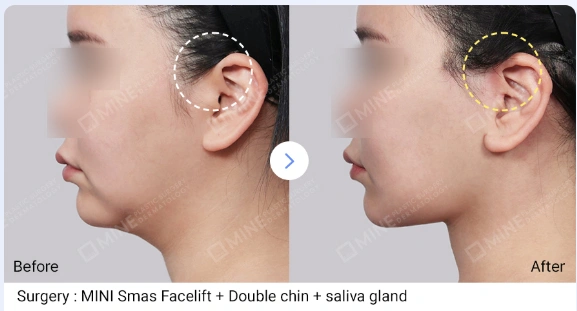
6. Authentic Before-and-After Photos
When reviewing mini facelift results:
- Ensure lighting and angles are consistent
- Look for images taken at different time points (1 month, 3 months, 6 months)
- Avoid overly edited or filtered photos
- Compare cases similar to your age and degree of sagging
Realistic expectations come from real cases.
7. Honest Explanation of Risks and Limitations
A trustworthy surgeon does not promise perfection.
Be cautious if you hear:
- “There are almost no side effects.”
- “You’ll look 20 years younger.”
- “Mini facelift works for everyone.”
A reliable clinic explains both what can and cannot be achieved.
Key Insight:
True professionalism includes clearly explaining limitations—not just benefits.
Potential Side Effects of a Mini Facelift
Like all surgeries, a mini facelift carries potential risks.
Common (Temporary) Side Effects:
- Swelling and bruising (peak during first 1–2 weeks)
- Tightness sensation
- Temporary numbness
Rare but Serious Complications:
- Hematoma (1–3% incidence)
- Infection
- Facial nerve injury (very rare)
- Hypertrophic scarring
- Skin necrosis (extremely rare)
Proper surgical technique and postoperative care significantly reduce risks.
Mini Facelift Recovery Timeline
| Period | Condition | Care Tips |
|---|---|---|
| Day 1–3 | Maximum swelling and bruising | Keep head elevated, apply cold compress |
| Week 1 | Swelling gradually decreases | Suture removal around Day 5–7 |
| Week 2 | Return to most daily activities | Avoid strenuous exercise |
| Month 1 | Residual swelling continues to improve | Avoid saunas and intense heat |
| 3–6 Months | Final results visible | Maintain sun protection |
Recovery speed varies from person to person, but following your surgeon’s instructions can accelerate healing.
Frequently Asked Questions About Mini Facelift
How long does a mini facelift last?
On average, results last 5–7 years, depending on skin condition and lifestyle. Aging continues, but patients typically look younger compared to their natural aging progression.
Will mini facelift scars be visible?
Incisions are placed along natural creases in front of the ear and within the hairline. In most cases, scars become barely noticeable within 3–6 months.
Is mini facelift better than thread lifting?
Thread lifting is suitable for mild sagging and offers temporary improvement. A mini facelift provides more significant and longer-lasting results because it addresses deeper structural layers.
What is the cost of a mini facelift?
Cost varies depending on surgical complexity, anesthesia type, and clinic systems. Extremely low prices may indicate reduced safety standards or limited experience.
Final Thoughts: Choose Safety and Skill Over Price
A mini facelift can effectively restore jawline definition, reduce sagging cheeks, and rejuvenate your facial contour. However, results depend heavily on:
- Surgeon expertise
- SMAS layer handling
- Personalized planning
- Surgical safety systems
- Postoperative care
- Authentic case review
- Honest communication
Rather than choosing the cheapest option, prioritize safety, experience, and structured care.
If you are considering a mini facelift and want a personalized assessment, schedule a consultation with a board-certified plastic surgeon to determine the most appropriate treatment plan for your facial anatomy and aging pattern.
Medical Disclaimer:
This article is for informational purposes only. All surgical procedures carry potential risks, including infection, bleeding, and nerve injury. A thorough consultation with a qualified plastic surgeon is essential before proceeding with surgery.