EN


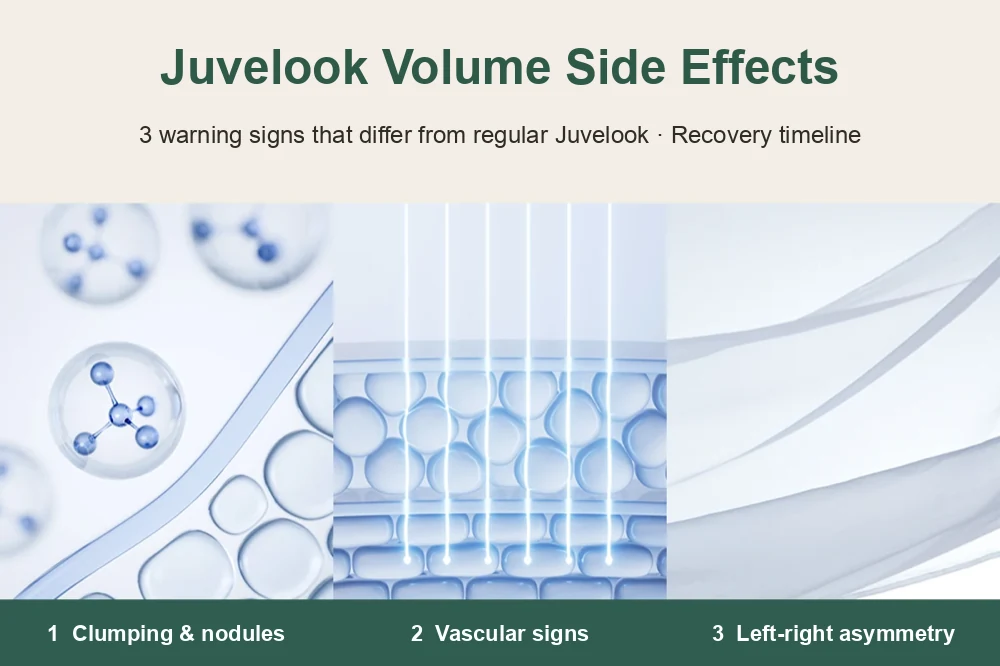
Juvelook Volume side effects are the nodules, asymmetry, and vascular reactions that can follow Juvelook Volume — a PDLLA (poly-D,L-lactic acid) and hyaluronic acid hybrid injected deeper and in larger amounts than regular Juvelook to restore volume in areas such as sunken cheeks and temples.
If you are thinking about filling hollow cheeks, it is completely normal to worry about what happens if something goes wrong. Juvelook Volume combines PDLLA (tiny particles from the lactic-acid family that the body breaks down slowly) with hyaluronic acid (HA, an ingredient that holds water in the skin). It is a larger-particle, higher-dose formulation designed to add volume rather than refine skin texture.
I’m Dr. Lee Sung-wook, a board-certified plastic surgeon at MINE in Seoul. In my clinical experience, the first thing patients ask about Juvelook Volume is not “Will it work?” but “What if something goes wrong?” Those who have already been treated usually want to know whether their swelling is normal, or whether one side looking fuller means the result is uneven.
Because Juvelook Volume goes deeper and in larger amounts, the signs worth watching are a little different from regular Juvelook. This guide answers four questions: how Juvelook Volume side effects differ from regular Juvelook, which vascular warning signs matter in the cheeks and temples, how to tell swelling from true asymmetry, and what is normal at each stage of recovery.
Juvelook Volume Side Effects: How They Differ From Regular Juvelook
The biggest difference is depth and dose, and that is why Juvelook Volume side effects call for a different checklist. Regular Juvelook goes into the superficial dermis in small amounts, while Juvelook Volume is placed from the deep subcutaneous layer to just above the periosteum (the thin membrane covering the bone) in larger amounts.
Same Ingredient Family, Different Goal: Texture vs. Volume
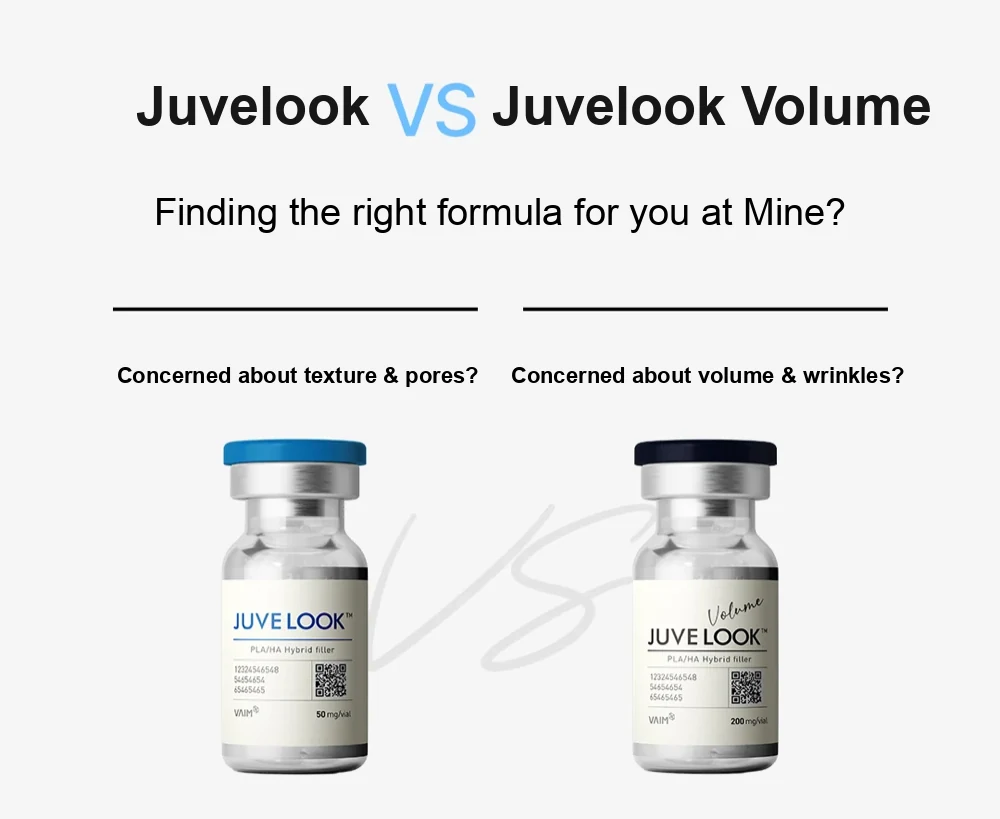
Regular Juvelook, often called the “skin” version, is used to refine surface texture: fine lines, enlarged pores, and uneven skin quality. It is placed in the dermis (the layer just under the surface that gives skin its firmness) in very small amounts, spread closely across the area.
Juvelook Volume has a different job: filling space. It is used where volume has been lost with age, such as sunken cheeks, hollow temples, or a flat forehead. To fill space, the product has to go deeper and in larger quantities. That is exactly why Juvelook Volume side effects deserve their own discussion. The ingredient family is the same, but when the depth and amount change, so do the structures nearby.
Comparison by Injection Depth, Dose, and Area
| Juvelook (Skin) | Juvelook Volume | |
|---|---|---|
| Injection layer | Superficial dermis | Deep subcutaneous layer to just above the periosteum |
| Typical amount per session | Small amounts, closely spaced | Relatively larger amount |
| Main purpose | Skin texture, fine lines, pores | Volume for sunken cheeks, temples, forehead |
| Side-effect axes to watch | Superficial clumping, swelling and bruising | Clumping and nodules, vascular signs, left-right asymmetry |
As the table shows, Juvelook Volume side effects narrow down to three axes: clumping from a larger total dose, closeness to blood vessels from deeper placement, and left-right differences from spreading product over a wide area. Reactions shared by every Juvelook treatment, such as allergic responses or temporary redness, are covered in our complete guide to Juvelook, so this article stays focused on what is specific to Volume.
Dr. Lee’s key point: Even with the same ingredient, where and how much you inject decides which signs you need to watch.
3 Risks Created by Deeper Placement and Larger Doses
Three structural features sit behind Juvelook Volume side effects. The more product you place, the deeper you place it, and the wider you spread it, the more each of these risks comes into play. Let me walk through them one at a time.
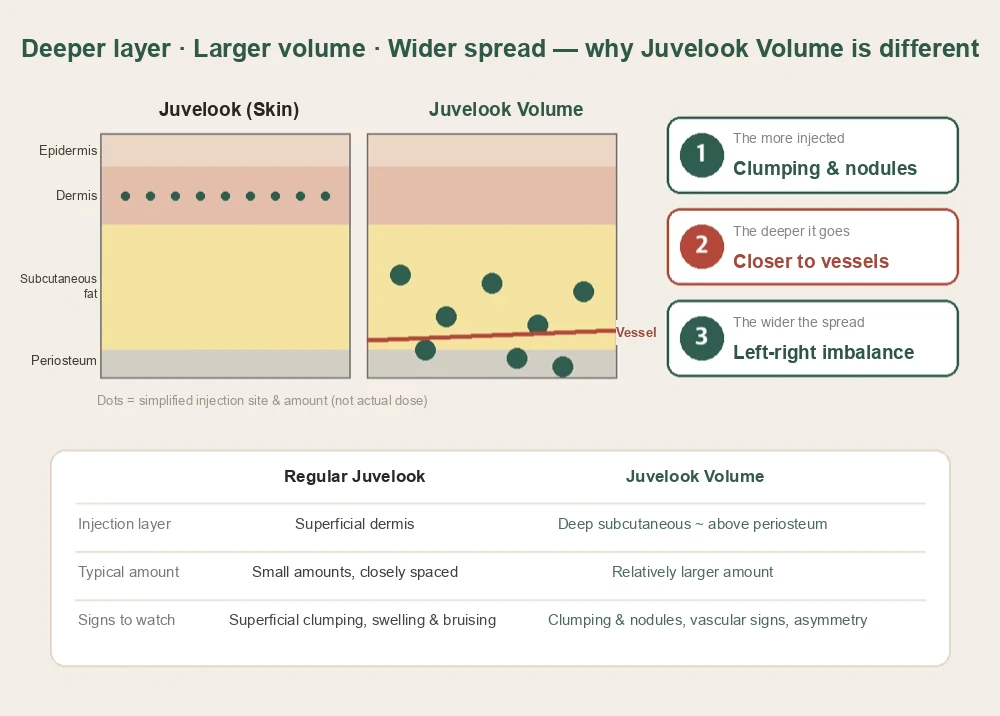
1) Larger Total Dose: Clumping and Nodules
A nodule is a small lump you can feel under the skin. Medical textbooks describe two types of nodules in this ingredient class (poly-L-lactic acid, or PLLA, the same polylactic-acid family as Juvelook’s PDLLA): early nodules that appear within several weeks, and granulomas (firm inflammatory lumps the body forms around foreign material) that can appear months to years after injection.
One cosmetic dermatology textbook reports nodule and granuloma rates of 6–52% for PLLA, a wide range that includes older formulations, so this is not a Juvelook Volume incidence rate. The same textbook explains that rates fell once injectors switched to more dilute product, avoided overcorrection, stopped injecting too superficially, and added post-injection massage. With Volume, the key is spreading the larger total dose so it never pools in one spot. For causes and stage-by-stage care, see Juvelook nodules: causes and care.
2) Deeper Placement: Closer to Blood Vessels
Textbooks on filler treatment note that injections into the dermis or shallow fat leave a relatively wide safety margin when it comes to blood vessels. The deeper a volumizing product goes, however, the closer it gets to larger vessels. That is why a precise knowledge of facial vascular anatomy is described as the single most important safety factor.
Vascular signs are rare among Juvelook Volume side effects, but they are the ones you most need to recognize. I explain them area by area in the next section.
3) Wider Distribution: Left-Right Differences
The cheeks and temples cover a large surface, so the product is divided across many injection points. The more points there are, the more room there is for small differences in amount and position between the two sides. Add the natural differences in bone structure and fat that every face already has, and one side can look fuller after treatment. That said, many left-right differences that look like Juvelook Volume side effects are simply uneven swelling, so timing matters when you judge them.
Dr. Lee’s key point: Volume goes in “more, deeper, and wider,” and those three words are your map of what to watch.
Vascular Warning Signs in the Cheeks and Temples
Vascular problems are uncommon, but when they happen, time matters. I wrote this section not to frighten you, but so you know exactly which signs mean you should not wait.
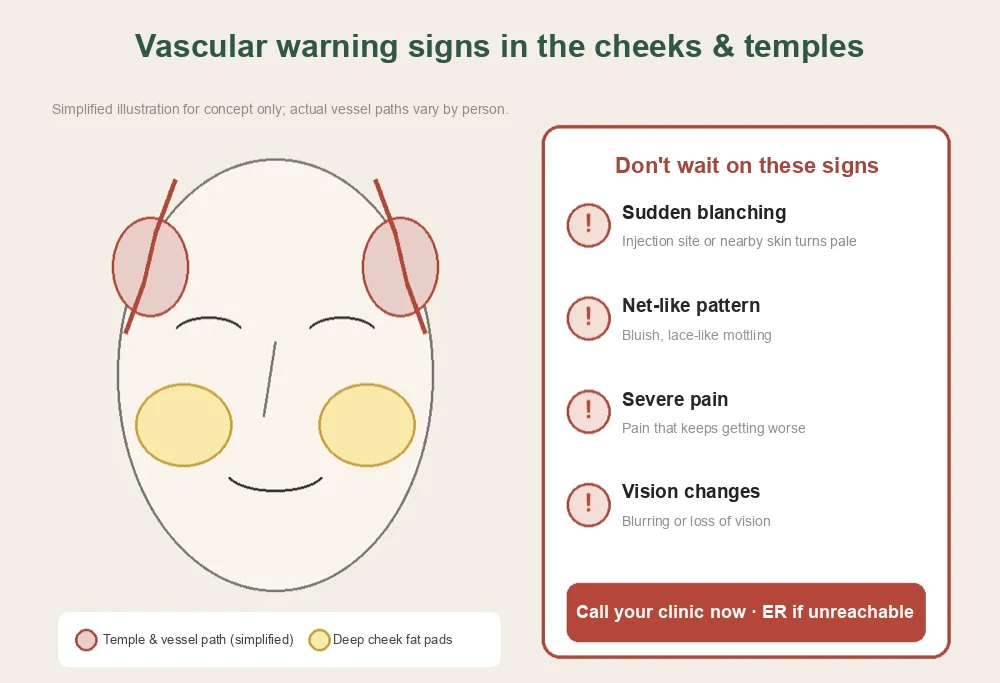
Temples: Where the Temporal Vessels Run
Several vessels pass through the temple: the front branch of the superficial temporal artery (an artery that runs close to the skin of the temple), the front branch of the deep temporal artery (which supplies the chewing muscle at the side of the head), and the middle temporal vein (a large vein crossing the middle of the temple). Aesthetic textbooks list two drawbacks of deep needle injections here: a chance of injuring these vessels, and the need for a relatively larger amount of product than in other areas.
Textbooks also point out that products without a reversal agent, meaning nothing that can quickly dissolve them, should generally be avoided in high-risk zones. PDLLA particles fall into that category. This is why, when it comes to Juvelook Volume side effects, the temples call for more caution than the cheeks: the layer, the choice between a needle and a cannula (a thin tube with a blunt tip), and the amount per pass all have to be planned around where the vessels run.
Cheeks: Deep Fat Compartments and Higher Total Dose
Inside the cheek, the fat that supports its shape is divided into separate pockets called deep fat compartments. When restoring sunken cheeks, product is often distributed into these deeper compartments, so the total amount tends to add up. Among Juvelook Volume side effects in the cheeks, I watch most closely for clumping and asymmetry, while keeping in mind that vascular signs, though rare, can still occur.
Go to Your Clinic or the ER Right Away: Blanching, Net-Like Mottling, Severe Pain, Vision Changes
According to dermatology textbooks, vascular occlusion (a blocked blood vessel) typically starts with sudden, intense pain and blanching during or right after injection, followed within minutes to hours by a bluish, net-like discoloration that follows the path of the vessel. Occasionally it develops with little or no pain. Severe vision loss after injecting products in this ingredient class has also been reported. It is rare, and most reported cases involve hyaluronic acid fillers in the nose, between the brows, or on the forehead, but it is the reason these signs are treated as emergencies.
If you notice any of the following, it is one of the Juvelook Volume side effects you should never wait out:
- Sudden blanching: the injection site or the skin around it suddenly turns pale or white
- Net-like mottling: a bluish or purplish lace-like pattern spreading across the skin
- Severe pain: pain that feels different from normal tenderness and keeps getting worse
- Vision changes: blurring, dimming, or loss of vision
Do not try to manage these at home with warm compresses or massage. Call the clinic that treated you immediately, and if you cannot reach them, go straight to the emergency room. Vision changes in particular are an emergency where minutes count.
Many patients ask about hyaluronidase (an enzyme that breaks down hyaluronic acid). It can act on the HA portion of Juvelook Volume, but it does not dissolve the PDLLA particles themselves. In a vascular emergency it is one of the options a doctor may use after assessing the situation, not a fix for all Juvelook Volume side effects.
Preventing serious Juvelook Volume side effects is the clinic’s responsibility. Textbooks list the main safeguards as thorough knowledge of facial vessel anatomy, Doppler ultrasound (an ultrasound that shows where vessels run), aspiration before injecting (a quick check that the needle is not inside a vessel), use of a cannula, slow injection in small amounts, and an emergency kit kept ready. I cover the questions you can ask your clinic further down.
Dr. Lee’s key point: Blanching, net-like mottling, severe pain, and vision changes are not “wait and see” signs. They are “call now” signs.
Swelling or True Asymmetry? How to Tell the Difference
Left-right differences within the first 1–2 weeks are usually swelling or bruising; symmetry is assessed after about 4 weeks. That is the first thing I tell patients who come in worried that uneven cheeks are one of their Juvelook Volume side effects.
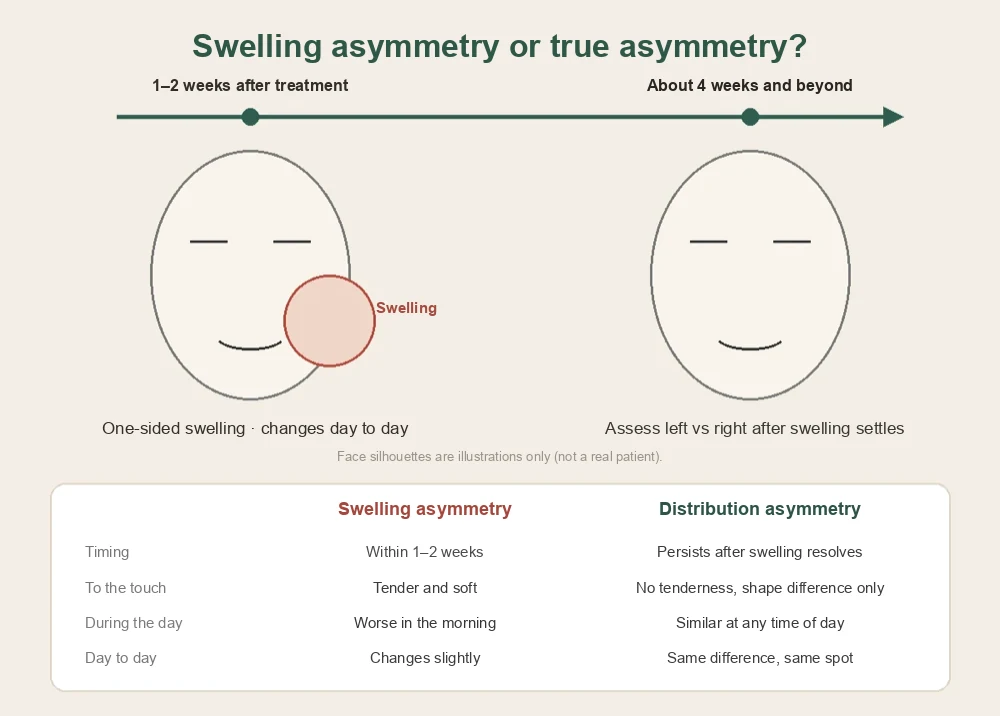
Differences in the First 1–2 Weeks Are Usually Swelling or Bruising
Juvelook Volume swelling rarely goes down evenly on both sides. If you tend to sleep on one side, that side may stay puffier. If a bruise forms on only one cheek, that cheek can look fuller. Natural differences in your bone structure and fat can also become more noticeable while the area is swollen.
Judge Symmetry After Swelling Settles: About 4 Weeks
With Juvelook Volume, the face right after treatment is not the final result. For the first few days the area looks full from the injected fluid. It then looks flatter as that fluid is absorbed, and the collagen response builds slowly after that. As a rule, we assess left-right balance after about 4 weeks, once the swelling has settled and the direction of change is visible. Timing varies between individuals, so this is confirmed at a follow-up visit.
| Swelling asymmetry | Distribution asymmetry | |
|---|---|---|
| Timing | Within 1–2 weeks of treatment | Persists after swelling resolves |
| To the touch | Tender and soft when pressed | No tenderness, shape difference only |
| During the day | Worse in the morning, better by evening | Similar at any time of day |
| Day to day | Changes slightly from day to day | Same difference in the same spot |
How you compare at home matters too. Every time the lighting or angle changes in the mirror, the same face can look different. Take photos in the same place, under the same light, from the front and both sides, a few days apart. You will see the swelling trend much more calmly, and the photos are useful to review with your doctor.
If It Is True Distribution Asymmetry: Adjusting at the Next Session
If the same difference in the same spot remains after all the swelling has gone, it is treated as a true distribution difference. This is better thought of as something to adjust than as a side effect. Juvelook Volume is usually given over several sessions, and textbooks on this ingredient class recommend waiting at least 4–6 weeks between sessions, which leaves time to rebalance the two sides at the next visit. How much to adjust depends on your face and is decided together at consultation.
Dr. Lee’s key point: Do not draw conclusions from how your face looks before the swelling settles. Judge the face that remains afterward.
Juvelook Volume Side Effects Timeline: Normal vs. See Your Doctor
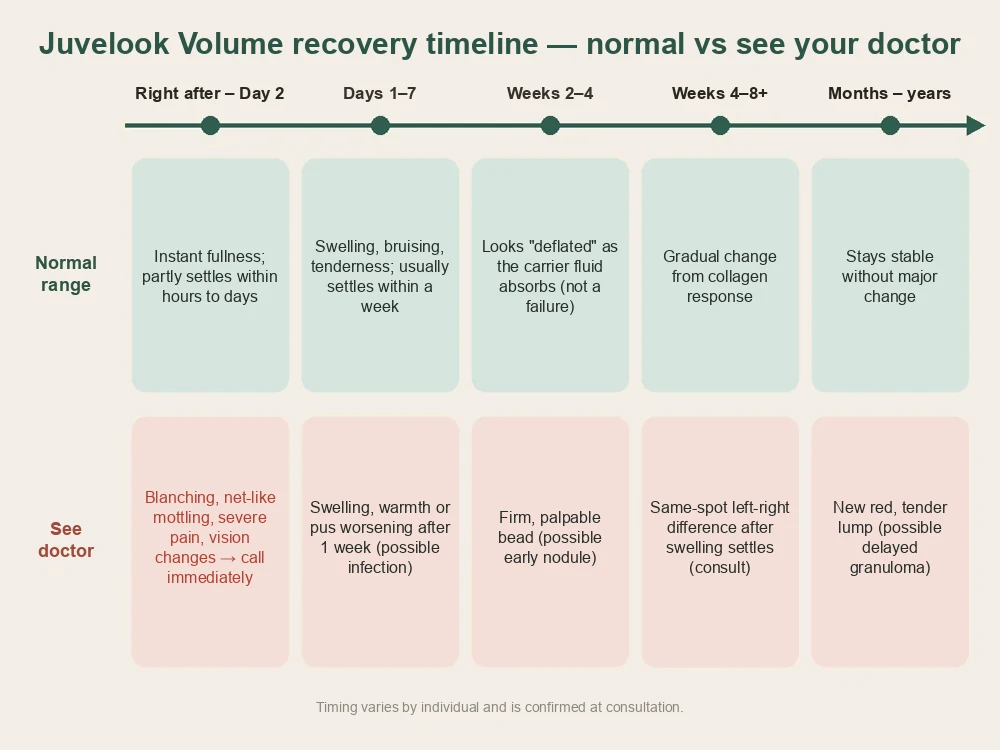
Swelling and bruising usually settle within about 1 week; a deflated look at weeks 2–4 reflects carrier fluid absorption, and gradual change follows at weeks 4–8. Knowing this timeline helps you avoid mistaking a normal stage for one of the Juvelook Volume side effects, and it also helps you catch real warning signs early.
| Timing | What’s usually normal | Signs to see your doctor |
|---|---|---|
| Right after to day 1–2 | Instant fullness from the injected fluid; some of it settles within hours to days | Blanching, net-like mottling, severe pain, vision changes (call immediately) |
| Days 1–7 | Swelling, bruising, and tenderness when pressed, usually settling within a week | Swelling, warmth, or pus that keeps getting worse after a week (possible infection) |
| Weeks 2–4 | Looks “deflated” as the carrier fluid is absorbed (not a failure) | A firm bead you can feel under the skin (possible early nodule) |
| Weeks 4–8 and beyond | Gradual change from the collagen response | A left-right difference in the same spot after swelling resolves (consult) |
| Months to years later | Result stays stable without major change | A new red, tender lump (possible delayed granuloma) |
Right After to Week 1: Instant Fullness, Swelling, Bruising
Your cheeks will look fuller as soon as Juvelook Volume goes in. That early fullness comes from the HA and the carrier fluid, so it is natural for some of it to settle over hours to days. Textbooks note that redness, swelling, and bruising are common in the days after any soft-tissue filler, and in practice most of it calms down within about a week. Vascular signs, however, need an immediate call whenever they appear.
Weeks 2–4: The “Deflated” Phase
Around this time, many patients worry that “it has all gone.” This is a normal part of the process as the carrier fluid is absorbed. It does not mean the treatment failed, and it is the stage most often mistaken for one of the Juvelook Volume side effects. If you notice a new firm bead under the skin during this period, though, it may be an early nodule and is worth having checked.
Weeks 4–8 and Months Later: Gradual Change and Late Signs
From around weeks 4–8, PDLLA breaks down slowly and stimulates fibroblasts (the cells that make collagen), so change builds gradually. For the mechanism and when you can expect to see it, read how Juvelook Volume restores sunken cheeks. Here, I will stay focused on spotting problems.
Textbooks describe granulomas in this ingredient class appearing months to years after injection. That is why a new red, tender lump that shows up months later is never treated as part of normal recovery. Late Juvelook Volume side effects like this should not be dismissed just because the treatment was a long time ago. See a doctor, and tell them when and where you were treated.
Swelling, warmth, or pus that gets worse after the first week should not be brushed off either. Dermatology textbooks list bacterial infection, biofilm (bacteria hiding under a thin protective film), and abscess (a pocket of pus) among the late complications of fillers and collagen stimulators. These reactions can blend in with ordinary swelling, which is exactly why it helps to look at Juvelook Volume side effects stage by stage. If warmth and pain keep increasing, do not wait.
Dr. Lee’s key point: Looking deflated at weeks 2–4 is part of the process. A new red, painful lump months later is a signal.
Before and After Treatment: What Dr. Lee Asks Every Patient to Know
The question I hear most is, “How can I lower my risk of Juvelook Volume side effects?” My answer is always similar: ask your clinic a few things before treatment, and know when to call afterward.
Questions to Ask Your Clinic Before Treatment: Layer, Tool, Emergency Plan
Check whether your doctor can give clear answers to these questions. Simply asking them helps you understand the treatment plan together.
- Which layer will be injected in each area, and how will the product be divided?
- Will a needle or a cannula be used, and in which areas?
- For the temples and other areas with major vessels, how are vessel positions checked before injecting?
- What emergency system is in place for a vascular event (emergency kit, hyaluronidase on hand)?
- If a warning sign appears after treatment, whom do I contact and how?
There are also things you should tell your doctor in advance: any medications or supplements you take, especially blood thinners; any previous filler or thread lift in the same area; and any allergies or skin conditions. Leftover material from earlier treatments can change the injection plan, and a tendency to bruise easily can change how sessions are scheduled. Small details are the starting point of a safe plan. You can read more about how we approach Juvelook treatment at MINE, and you are always welcome to ask questions at your consultation.
Aftercare for the First 1–2 Weeks and When to Call
- Follow the massage method and aftercare instructions your clinic gives you exactly. Do not rub the area hard on your own.
- While you are swollen, the usual advice is to avoid alcohol, saunas, and hot rooms that increase heat and blood flow.
- Sleeping face-down or always on the same side can make swelling more uneven.
- If any of the “see your doctor” signs in the timeline table appear, call straight away rather than waiting for your next appointment.
For general tips that apply to injectables, see our filler aftercare guide. It also helps to keep a simple record: the treatment date, the areas treated, when any symptom first appeared, and photos of the change. This makes it much easier for a doctor to tell genuine Juvelook Volume side effects from ordinary swelling.
If you travel to Korea for treatment, this matters even more because much of your recovery happens at home. Before you fly back, make a note of the product name (Juvelook Volume) and the exact areas treated, and keep your clinic’s contact details handy. If you need to see a local doctor about possible Juvelook Volume side effects, that information will save valuable time. For general background on injectable treatments, the American Society for Dermatologic Surgery (ASDS) offers patient-friendly information.
Dr. Lee’s key point: Before treatment, ask “which layer, and with what?” After treatment, remember “when do I call?”
Juvelook Volume Side Effects: Frequently Asked Questions
How long does Juvelook Volume swelling last?
Most Juvelook Volume swelling settles within about a week. Looking deflated around weeks 2–4 is the carrier fluid being absorbed, not a loss of results. If swelling keeps getting worse after the first week, or comes with warmth or pain, see your doctor. Recovery time varies from person to person.
Is it asymmetry if one side looks more swollen after Juvelook Volume?
Left-right differences in the first 1–2 weeks are usually caused by swelling or bruising. Symmetry is assessed after the swelling settles, at around 4 weeks. If the same difference remains in the same spot after that, ask your doctor about adjusting the distribution at your next session.
Why are temples riskier for Juvelook Volume than cheeks?
Vessels such as the superficial temporal artery and the middle temporal vein run through the temple. Textbooks note that deep injections here carry a chance of vessel injury and usually need a relatively larger amount of product. That is why knowledge of vessel anatomy and the choice of layer and tool are especially important in this area.
When should I go to the doctor or ER after Juvelook Volume?
Go immediately if your skin turns pale, a net-like discoloration appears, you have severe pain, or your vision becomes blurred. These are the most urgent Juvelook Volume side effects: call your clinic and, if you cannot reach them, go to the emergency room. A firm bead you can feel weeks later or a new red, tender lump months later also needs a doctor’s visit.
Can hyaluronidase dissolve Juvelook Volume nodules?
No. Hyaluronidase only acts on hyaluronic acid, so it cannot dissolve the PDLLA particles in Juvelook Volume. Nodules are managed in other ways, depending on when they appear and how they feel. This is separate from how a doctor may use hyaluronidase in a vascular emergency.
Book a Consultation at MINE Clinic
To sum up, Juvelook Volume side effects come from the way the treatment works: a larger amount placed deeper and spread more widely. You can watch for them along three axes: clumping and nodules, vascular signs, and left-right asymmetry. Swelling and the deflated phase are usually part of the process, but blanching, net-like mottling, severe pain, and vision changes mean you should call right away.
The right layer and amount depend on your skin, bone structure, and the area being treated, so an in-person assessment is the right place to start. At MINE, I examine each patient personally and explain the plan before any treatment is booked. To arrange a 1:1 consultation, call +82-2-516-1175.
※ This content is for informational purposes only and does not replace professional medical advice, diagnosis, or treatment. Individual results may vary, and side effects may occur. Please consult with a board-certified plastic surgeon for personalized advice.