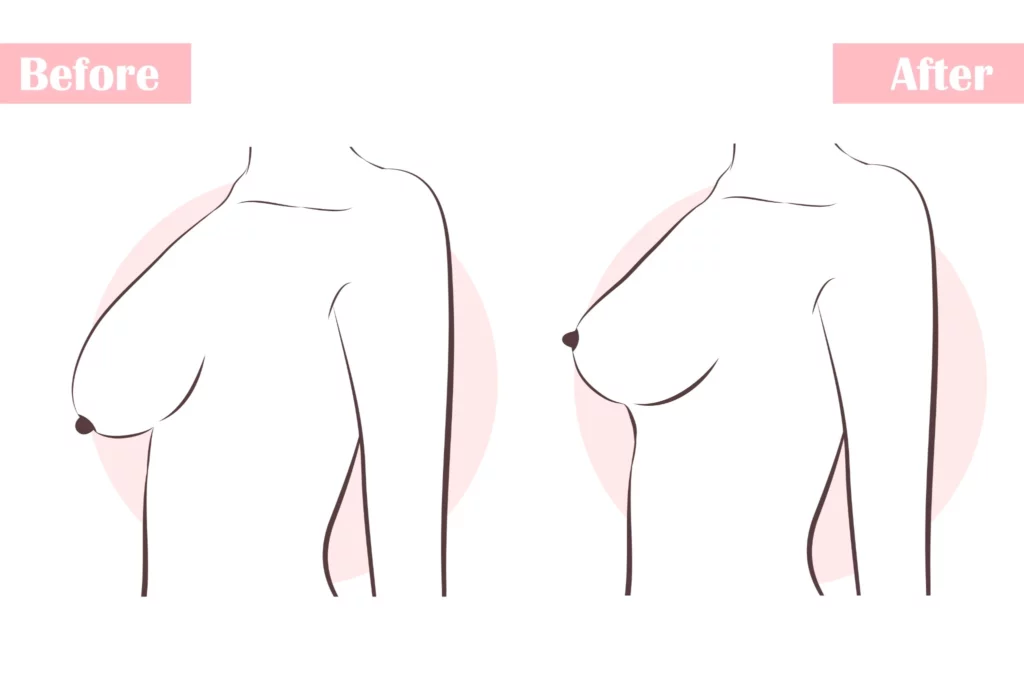
EN
EN


Quick answer: Breast implant malposition is when a breast implant settles in the wrong place after augmentation, so the implant sits too low, too high, too far to the side, or too close to the middle. It affects roughly 1 in 10 patients over time, can change the shape and symmetry of the breasts, and is usually corrected with revision surgery that repositions the implant and rebuilds the pocket that holds it. Individual results vary.
Table of contents
Understanding Breast Implant Malposition
Breast augmentation is one of the most popular cosmetic procedures, giving many women the shape and volume they want. But the implant has to stay in the right spot to look natural, and that does not always happen. Breast implant malposition simply means the implant has drifted out of its intended position, leaving the breasts looking uneven, distorted, or sometimes feeling uncomfortable.
This can show up within a few weeks of the original surgery, or it can creep in slowly over several years as gravity, tissue stretch, and scar tissue gradually shift the implant. It is more than a cosmetic worry: when an implant moves, it can also pull on the skin and cause aching or a feeling of tightness. The good news is that, in most cases, it can be corrected when treated at the right time.
Studies suggest that some degree of implant displacement affects roughly 8 to 15 percent of women after augmentation, which makes it one of the most common reasons for breast revision surgery. Knowing the warning signs early usually means a simpler, more reliable repair later.
Types and Causes of Breast Implant Malposition
Implant malposition is not a single problem. It comes in several distinct patterns, each with its own causes and its own repair. Recognising which pattern you have is the first step toward the right fix.
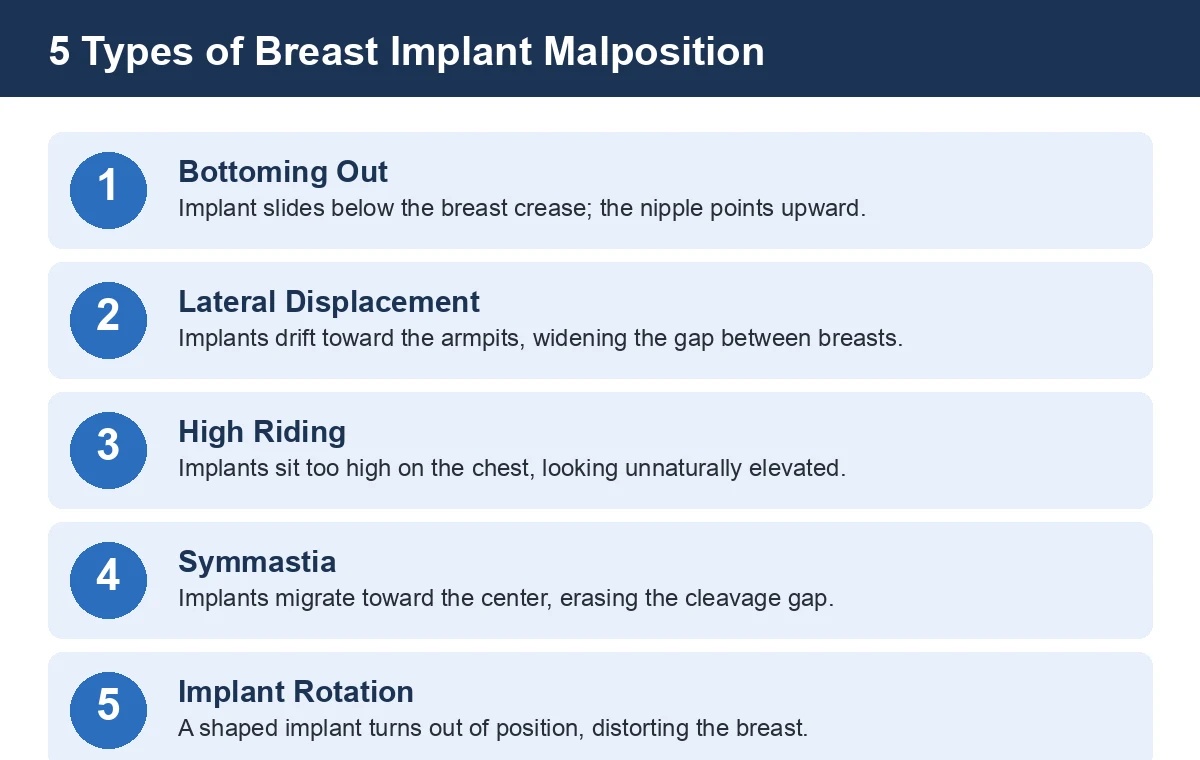
1. Bottoming Out (and the “Double Bubble”)
Bottoming out happens when the implant slides down below the natural breast crease (the inframammary fold). As it drops, the fullness collects low on the breast and the nipple ends up pointing upward. Sometimes a second crease appears across the lower breast, creating a “double bubble” look: the original crease stays where it was while the sagging implant pushes out a new bulge below it, so two parallel lines run across the lower pole.
Common causes:
- An implant that is too large or heavy for the breast
- Naturally thin or weak skin and tissue that cannot hold the weight
- Over-releasing the lower part of the pocket during the first surgery, or not securing the crease
- Not following recovery instructions in the early weeks
2. Lateral Displacement
Lateral displacement is when the implants slide outward toward the armpits, leaving too wide a gap between the breasts. It often becomes obvious lying down, when the implants fall to the sides instead of staying centred.
Common causes:
- A naturally wide chest
- Releasing the outer side of the pocket too far
- Weak support tissue on the outer breast
- An implant that is too wide for the frame
3. High Riding Implants
High riding implants sit too far up on the chest, so the upper breast looks overfull while the lower breast and nipple look empty. This is often caused by scar tissue tightening around the implant.
Common causes:
- The lower pocket was not opened up enough
- The chest muscle pulling an under-the-muscle implant upward
- Capsular contracture (tight scar tissue) squeezing the implant up
- Wearing the support garment incorrectly after surgery
4. Symmastia and Medial Malposition
When implants drift toward the centre of the chest, the cleavage gap narrows or disappears, and severe cases are sometimes nicknamed “uniboob.” It helps to know that doctors separate two closely related problems here. In medial malposition, the implants simply sit too close to the midline but the breastbone tissue is still attached. In true symmastia, the firm tissue anchored to the breastbone has actually pulled loose, so the two pockets join across the middle. Symmastia is the harder of the two to repair because that central attachment has to be rebuilt and held firmly, since the implant tends to push back into the gap.
Common causes:
- Releasing the inner side of the pocket too aggressively
- A naturally narrow space between the breasts
- Implants that are too wide for the chest
- Poor pocket positioning during the first surgery
5. Implant Rotation
Implant rotation is mostly an issue with shaped, teardrop implants. If the implant spins inside its pocket, the breast looks distorted because the teardrop shape is no longer upright. Round implants do not have this problem, since they look the same whichever way they turn.
Common causes:
- A pocket that is too big for the implant
- The wrong implant choice for the patient
- Capsular contracture distorting the pocket
- Vigorous activity before the implant has settled
According to the American Society of Plastic Surgeons, careful implant selection and surgical technique are the keys to avoiding these complications in the first place.
What Symptoms Does It Cause?
Implant malposition shows up in more than just appearance. Catching it early usually means an easier repair, so it is worth knowing what to watch for.
Visual Signs
- Asymmetry: one breast sitting higher or lower than the other
- Changed nipple direction: nipples pointing up, down, or off to the side
- Distorted shape: an unnatural contour, such as a hard, misshapen breast from capsular contracture
- Visible edges: the rim of the implant showing under the skin
Physical Signs
- Discomfort or pain, especially with movement or exercise
- A pulling sensation, as if the breast tissue is being stretched
- Persistent tightness in the breast
- Thinning or stretched skin where the implant presses
These changes can also chip away at confidence and make certain clothes or activities uncomfortable. If one or more of them sounds familiar, it is worth seeing a specialist to talk through your options.
How Is It Diagnosed?
An accurate diagnosis combines a hands-on exam with the patient’s history, and imaging when needed.
Clinical Examination
- Looking: checking breast shape both standing and lying down
- Feeling: assessing the implant position and the tissue around it
- Measuring: recording nipple position, crease position, and the distance between the breasts
Imaging
- Ultrasound: a quick look at implant position and the surrounding tissue
- MRI: a detailed view of the implant and pocket, and a check for rupture
- 3D scanning: mapping the breast shape and measuring asymmetry precisely
Reviewing your previous surgical records, how the change came on (suddenly or gradually), and your daily habits all help the surgeon pinpoint the cause and plan the most reliable repair.
Surgery to Correct Implant Malposition
Correction surgery is tailored to the specific problem. In general, the surgeon repositions the implant and rebuilds the pocket so it holds the implant in the right place. A few core techniques come up again and again, often in combination:
- Capsulorrhaphy – stitching the scar-tissue capsule to make the pocket smaller or tighter in the right spot, so the implant cannot drift back
- Capsular flaps – folding the patient’s own capsule tissue to create an internal sling that supports and braces the implant
- Acellular dermal matrix (ADM) – a soft tissue-support material added to reinforce thin or weak areas, almost like an internal scaffold
- Changing the pocket (site change) – moving the implant to a fresh, healthy plane, for example creating a new pocket just in front of the old one so the repair acts as a firm shelf rather than being stretched open
- Switching the implant – a smaller or narrower implant often takes pressure off the repair
Matching the Fix to the Problem
- Bottoming out / double bubble: rebuild and raise the breast crease, reinforce it with capsule tissue or ADM, and often move to a new pocket or downsize the implant
- Lateral displacement: tighten the outer pocket and reinforce the side wall to recentre the implant, sometimes with a narrower implant
- High riding: open up the lower pocket, release tight scar tissue, and free the muscle if it is pulling the implant up
- Symmastia: rebuild the central attachment to the breastbone with strong stay sutures, often combined with a site change, because this repair has to resist the implant pushing back into the gap
- Rotation: resize the pocket to fit the implant snugly, and consider switching to a round implant to prevent it happening again
One important point about downsizing: swapping a large implant for a smaller one is rarely a simple exchange. After years of stretching, the breast skin and tissue may need to be tightened (a lift) at the same time, and the surgeon has to protect the blood supply to the nipple. This is why revision surgery is generally more demanding than the first operation and is best done by an experienced specialist. The surgeon usually reaches the pocket through the previous scar, the crease, or the edge of the areola.
Recovery After Correction Surgery
Recovery from a revision procedure can take a little longer than the original surgery, and how carefully you recover has a real effect on the final result. Here is the general timeline.
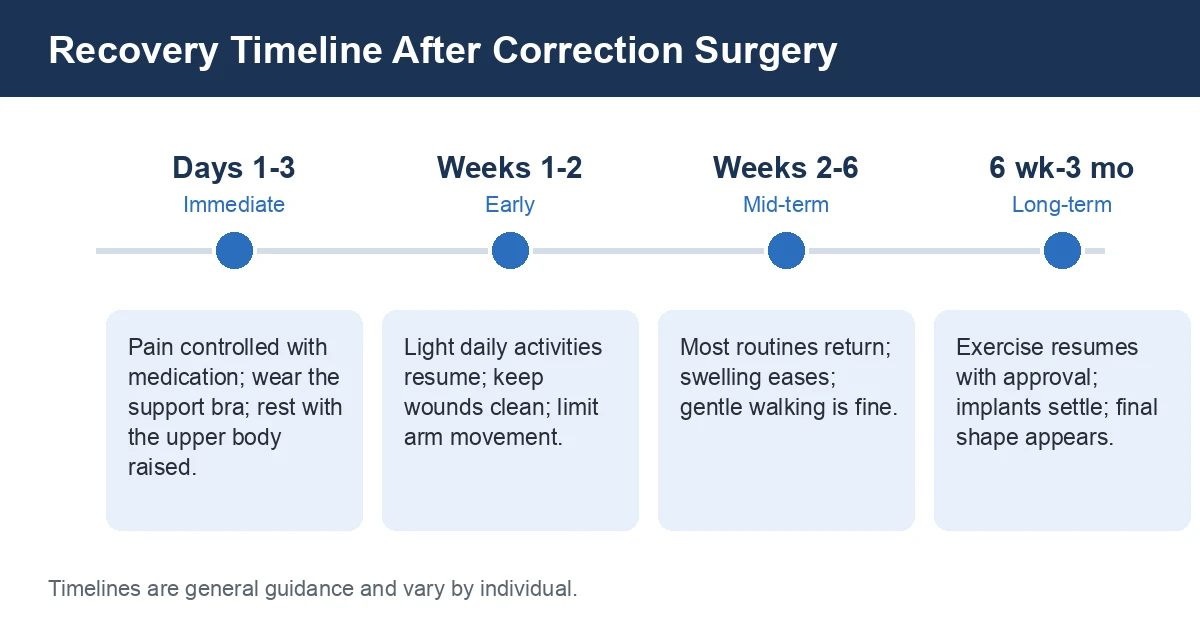
- Days 1-3: control discomfort with prescribed medication, wear the support bra around the clock, rest, and keep the upper body slightly raised to ease swelling
- Weeks 1-2: ease back into light daily activities, keep the incisions clean, and avoid big arm movements
- Weeks 2-6: most routines return and swelling settles; gentle walking is fine, but hold off on upper-body workouts
- 6 weeks to 3 months: exercise resumes once your surgeon approves, the implant settles into its new position, and the final shape becomes clear
Things to Avoid, and Things to Watch For
- Skip heavy lifting (over about 10 pounds) and strenuous upper-body exercise for at least 6-8 weeks
- Avoid sleeping face-down for at least 8 weeks
- Avoid alcohol and smoking, which slow healing
- Wear the support garment exactly as instructed; it is what keeps the implant in place
- Report severe pain, fever, or sudden swelling to your clinic straight away
Eating well, staying hydrated, resting properly, and keeping stress down all help the body heal. Recovery times differ from person to person depending on how complex the repair was.
How to Prevent Implant Malposition
You cannot remove every risk, but careful planning before surgery and disciplined care afterward lower the odds considerably.
Before Surgery
- Choose an experienced surgeon with a strong track record in augmentation and revision, and review their before-and-after results
- Pick the right implant, matched to your body width, tissue strength, and skin elasticity; oversized implants are a leading cause of malposition
- Plan the pocket carefully, based on a thorough assessment of your anatomy and any existing asymmetry
After Surgery
- Follow the recovery plan on garments, activity limits, and sleep position
- Keep your check-ups and do regular self-checks so any change is caught early
- Manage your lifestyle: avoid rapid weight swings, wear a supportive sports bra for exercise, and try to sleep on your back early on
Risk Management at a Glance
| When | What to check | What to do |
|---|---|---|
| Before surgery | Body and tissue assessment | Detailed analysis and a customised plan with your surgeon |
| Before surgery | Implant choice | Pick a size and shape that suits your frame |
| 1-2 weeks after | Support garment | Wear the medical bra as directed |
| 2-6 weeks after | Activity limits | Avoid upper-body exercise and heavy lifting |
| 6-12 weeks after | Gradual return | Build activity back up with your surgeon’s okay |
| Ongoing | Self-checks and reviews | Monitor position; attend checks at 3, 6, and 12 months |
Correction Case Studies
These examples show how different patterns of malposition can be corrected. Details have been changed to protect patient privacy, and outcomes vary from person to person.
Case 1: Bottoming Out
A woman in her late 30s, two years after augmentation, found both implants had dropped and her nipples were pointing upward. The repair rebuilt the breast crease, reinforced it with ADM, and replaced the implants with a slightly smaller size. The result was a natural shape with the implants holding steady and the nipple direction corrected.
Case 2: Lateral Displacement
A woman in her early 40s, three years post-augmentation, had implants that fell heavily toward her armpits when lying down, with a wide gap between them. Tightening the outer pocket, expanding the inner pocket to recentre the implants, and switching to narrower implants restored a more centred, natural contour that held even when lying down.
Case 3: Symmastia
A woman in her mid-30s, a year after augmentation, had a “uniboob” appearance with no gap between the breasts and skin changes over the breastbone. Rebuilding the central wall with strong stay sutures and fitting narrower implants restored a natural gap and a separate, defined contour for each breast.
Frequently Asked Questions
How common is breast implant malposition?
It is more common than most people expect. Research suggests around 8 to 15 percent of women who have augmentation develop some degree of implant displacement over time. Mild cases may cause no symptoms at all, while others become noticeable enough to need revision.
Is it dangerous to my health?
In most cases it is not life-threatening, but it can cause pain, discomfort, and visible changes. Severe cases may stretch or damage the skin and, rarely, risk exposing the implant, which is why early assessment matters.
How long is recovery after correction surgery?
- Back to daily activities: about 1-2 weeks
- Light activity: around 2-3 weeks
- Normal exercise: about 6-8 weeks
- Final result: roughly 3-6 months
Can it come back after surgery?
Recurrence is possible but much less likely with careful surgical planning, sound technique, and disciplined aftercare. Big implants, weak tissue, and skipping recovery instructions all raise the risk, so it helps to discuss your personal risk with your surgeon.
What matters most for prevention?
The biggest factors are choosing an experienced surgeon, selecting an implant that genuinely suits your body, following your aftercare plan, and keeping up with check-ups so problems are caught early.
Conclusion
Breast implant malposition can happen for many reasons, but in most cases it can be corrected. The key is an accurate diagnosis and a repair planned around your specific problem and anatomy. If something about your breasts has changed since augmentation, or they feel uncomfortable, an experienced specialist can tell you exactly what is going on and what your options are.
Mineclinic, in Seoul, focuses on breast revision and implant repositioning, using detailed assessment and individualised planning to restore a natural breast shape. Through a professional consultation, you can get an accurate diagnosis and a correction plan tailored to you.
This article is for general educational purposes and does not replace professional medical advice. Surgical results and recovery vary from person to person. For a diagnosis and treatment plan suited to your situation, please consult a qualified specialist.
※ This content is for informational purposes only and does not replace professional medical advice, diagnosis, or treatment. Individual results may vary, and side effects may occur. Please consult with a board-certified plastic surgeon for personalized advice.