EN
EN

Breast augmentation surgery is a choice many women make to enhance their confidence and achieve a more satisfying body shape. However, like all medical procedures, issues can develop over time. Breast augmentation implant rupture is one of the primary complications that can occur after breast augmentation, causing concern for many patients.
Implant rupture can happen suddenly or develop gradually, making it difficult to identify in some cases. Modern silicone implants, in particular, can experience “silent ruptures” where the contents don’t leak into surrounding tissues even after the implant shell breaks, making it even harder for patients to detect problems.
In this article, we’ll explore breast augmentation implant rupture symptoms, causes, and treatment options from a patient’s perspective, and discuss how to respond if you suspect problems with your implants.
Quick answer: a breast augmentation implant rupture is a tear or hole in the outer shell of a breast implant. A saline implant announces itself—the breast deflates within hours to days. A modern cohesive silicone implant often gives no sign at all, so it is found by imaging. Across FDA core studies, the 10-year rupture rate after a first-time breast augmentation runs between about 8.7% and 24.2% depending on the implant model. Confirmed ruptures are treated by removing the implant, with or without putting a new one in.
Table of contents
What is Breast Augmentation Implant Rupture?
Breast augmentation implant rupture occurs when the outer shell of an implant tears or breaks, potentially allowing the internal material to leak out or causing deformation of the implant shape. Breast implants generally fall into two categories—saline and silicone—each exhibiting different characteristics when rupture occurs.
Silicone Implant Rupture
Currently the most commonly used type, silicone implant ruptures can manifest in various ways depending on the implant type and extent of damage.
- Cohesive Silicone Gel: Modern implants use this gel which maintains its shape even after rupture and doesn’t leak into surrounding tissues—known as a “silent rupture.”
- Traditional Silicone Gel: These have lower viscosity and can potentially spread into surrounding tissues if ruptured.
Saline Implant Rupture
Saline implants contain a sterile saline solution within a silicone shell. When ruptured, the saline solution quickly absorbs into the body, causing a noticeable decrease in breast size that patients can identify immediately.
How Often Does Breast Augmentation Implant Rupture Actually Happen?
This is the question patients ask first, and a breast augmentation implant rupture deserves a number rather than a reassurance. The honest answer is that the risk is real, it is not the same for every implant, and it climbs with time.
- 10-year rupture rate: roughly 8.7% to 24.2%. That range comes from the FDA core clinical trials of silicone gel implants, measured in the MRI-screened cohorts of first-time (primary) breast augmentation patients. The wide spread is not measurement noise; different implant models really do behave differently.
- Risk rises after 6 to 8 years in place. Rupture is uncommon in the early years and then becomes steadily more likely as the shell fatigues. This is the reason screening starts around year 5, not year 1.
- The device you received matters. Outside the core-study range, device-level data have recorded one implant model at roughly a 33% rupture risk by about eight years in place — a different dataset with a different follow-up method, which is why that figure sits above the 24.2% ceiling quoted above. If you still have your implant card, the model and lot number tell your surgeon which curve applies to you.
- Saline behaves differently. Any break in a saline shell means total, obvious failure of that implant—the salt water leaks out and is harmlessly absorbed. There is no silent version.
Read that range the right way. It does not mean that every woman faces the same odds, or that a quarter of all implants fail by the ten-year mark. It means that if you are approaching a decade with your implants and have never been scanned, the chance that something has changed is high enough that a scan is worth booking—and that is the whole logic behind a breast augmentation implant rupture screening schedule.
Primary Symptoms Patients Experience
The symptoms of breast augmentation implant rupture vary depending on implant type and rupture pattern, and the same breast augmentation implant rupture can look completely different in a saline versus a silicone device. Many patients may not initially recognize symptoms or might attribute them to other issues.
Common symptoms that may occur (though not experienced by all patients):
- Changes in breast shape or size: Particularly with saline implants, a sudden decrease in breast size occurs.
- Breast asymmetry: If only one implant ruptures, noticeable differences between breasts may develop.
- Breast pain or discomfort: Persistent or intermittent pain, stabbing sensations, or burning sensations.
- Hardening of breast tissue: Leaking silicone may worsen capsular contracture (scar tissue formation).
- Skin changes: Redness or swelling may appear around the rupture site.
- Lumps or nodules: Previously undetected lumps might be felt during self-examination.
How the problem is usually noticed
According to Dr. Lee Sung-wook, a board-certified plastic surgeon at MINE Plastic Surgery in Seoul, a suspected breast augmentation implant rupture usually presents in one of three ways:
- A slow change on one side. Mild one-sided discomfort comes first, then the contour gradually looks different from the other breast, and a firm area can be felt. This pattern is typical of a silicone rupture that has been present for a while.
- A sudden loss of volume. One breast visibly deflates over hours to days. This is the classic saline pattern, because the salt water is simply absorbed by the body.
- Nothing at all. The breast augmentation implant rupture is found on a routine ultrasound or MRI in a patient who felt completely normal. With modern cohesive gel, this is common—which is exactly why the screening schedule exists.
None of these three patterns proves a rupture on its own. Each of them is a reason to book an imaging test rather than to wait and watch.
Silent Ruptures May Have No Symptoms
With modern cohesive silicone gel implants in particular, ruptures may be completely asymptomatic as the gel remains contained within the implant shell. These “silent ruptures” can only be detected through regular imaging tests like MRI or ultrasound.
Main Causes of Breast Augmentation Implant Rupture
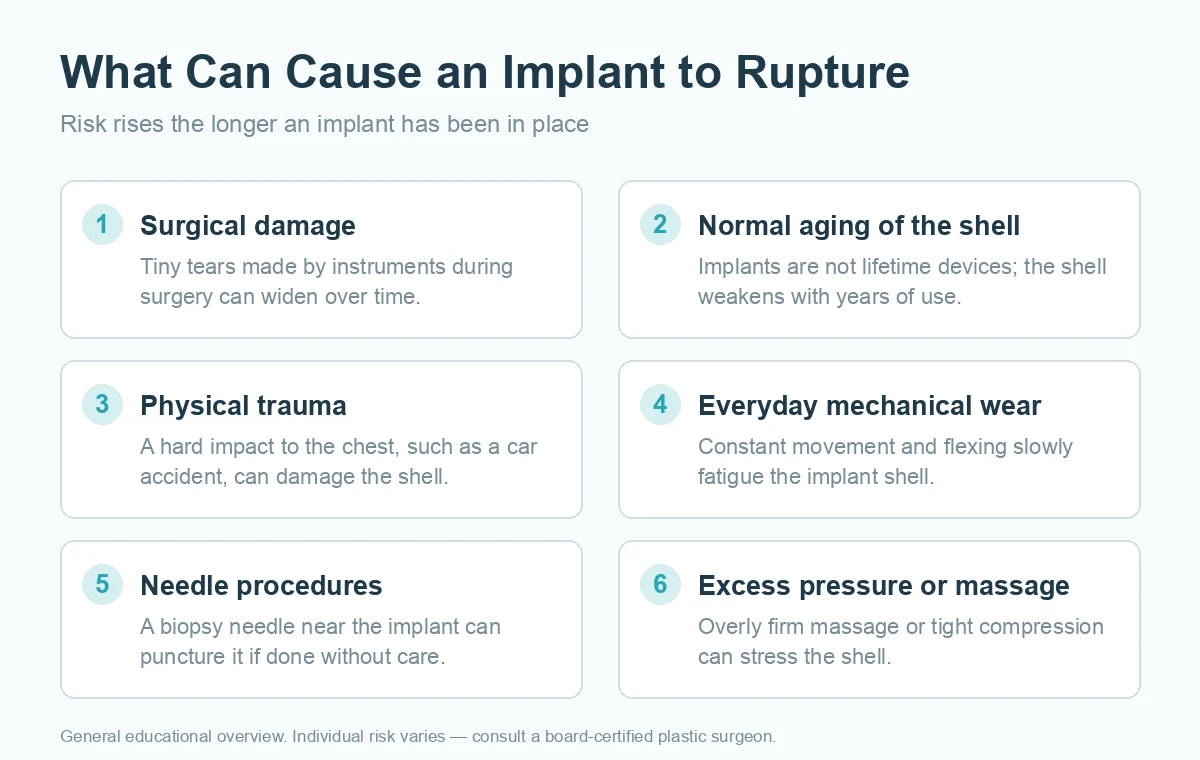
Breast augmentation implant rupture can occur for various reasons, and they are not all about the surgery itself. Here are the primary causes patients should be aware of:
1. Implant Aging and Lifespan
All implants have a finite lifespan. Generally, breast implants are expected to last 10-20 years, with the risk of rupture increasing as the implant shell deteriorates over time.
2. Physical Trauma
- Strong external impact: Car accidents, sports injuries, falls, or other strong impacts to the chest area
- Excessive pressure: Too much force during massage or breast examinations
- Repetitive movements in daily life: Certain exercise patterns or activities that stress the implants
3. Surgical Factors
- Damage during surgery: Instrument damage or improper handling during the procedure
- Implant pocket size mismatch: When the pocket size doesn’t match the implant, excessive movement can occur
- Damage from sutures or tissue: Sharp sutures or bone tissue can potentially damage implants over time
4. Manufacturing Defects
Though rare, a defect introduced during manufacturing can lead to a premature breast augmentation implant rupture, sometimes within the first few years. This is the scenario the manufacturer warranty is designed to cover.
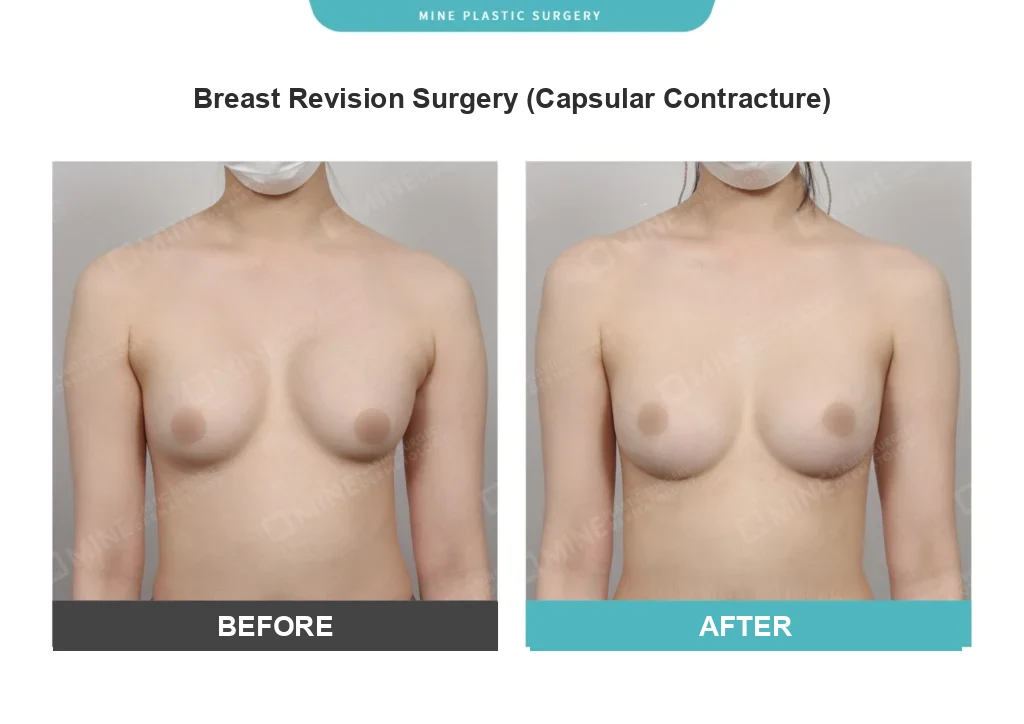
5. Capsular Contracture
Hard scar tissue (capsule) that forms around breast implants can squeeze the device hard enough to contribute to a breast augmentation implant rupture. Contracture and rupture also feed each other: leaked silicone irritates the capsule, and a tighter capsule stresses the shell further.
How to Detect Breast Augmentation Implant Rupture
If you suspect a breast augmentation implant rupture, professional medical imaging is necessary for accurate diagnosis. No blood test and no physical examination can confirm a breast augmentation implant rupture on its own. Here are the most common diagnostic methods:
1. Self-Examination
Many patients first notice changes in their breasts themselves. Monthly self-checks in front of a mirror to observe breast shape, size, and symmetry, along with manual examination to check for abnormalities, are recommended.
2. Medical Imaging Tests
MRI Scans
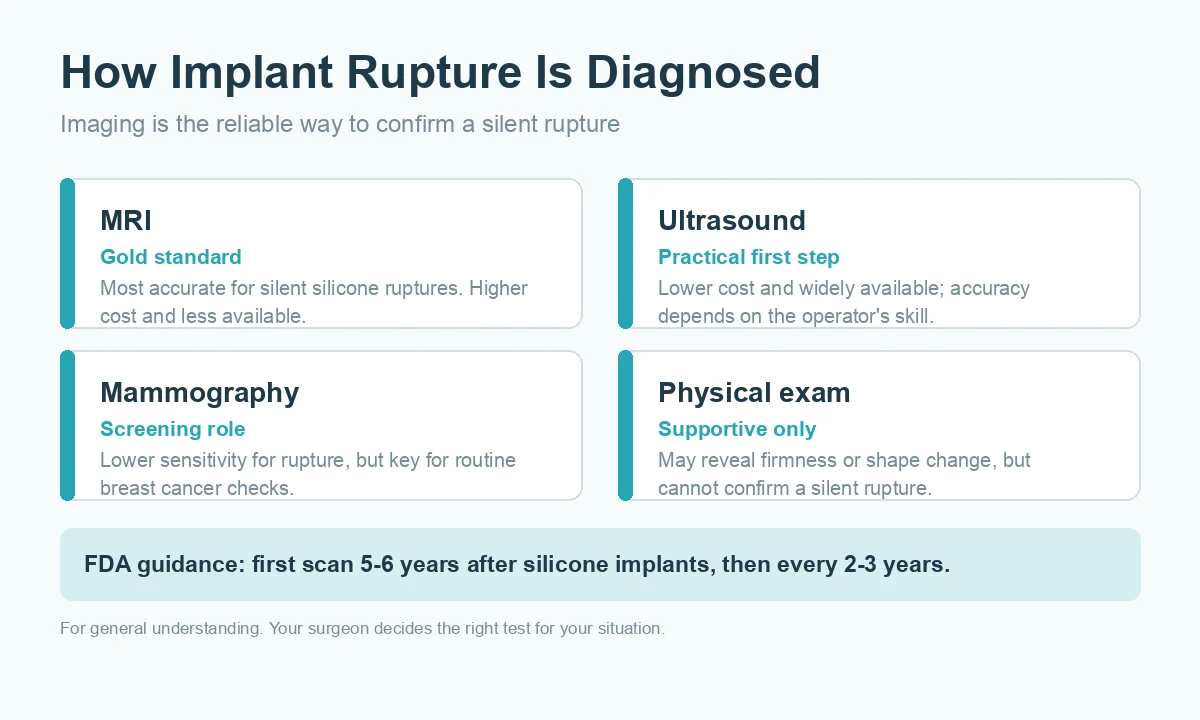
MRI is the most accurate way to confirm a silicone implant rupture, because it can show the collapsed shell inside the scar capsule even when the gel has not moved. The American Society of Plastic Surgeons safety guidance takes the same position.
Screening schedule (current guidance): the US Food and Drug Administration updated its silicone implant screening advice in 2020. Even if you have no symptoms, your first ultrasound or MRI should be done 5 to 6 years after your original implant surgery, and then repeated roughly every 2 years. High-definition ultrasound is now the preferred first test because it is cheaper and easier to access, and it agrees closely with MRI. An MRI is recommended if you develop symptoms at any time, or if the ultrasound result is unclear.
⚠️ If you have read the older advice—”MRI at 3 years, then every 2 years”—that recommendation has been retired. Many websites still repeat it. Ask your surgeon to schedule you on the current 5-to-6-year timetable instead.

Ultrasound Examination
Ultrasound is more affordable and easier to access than MRI, which is why it is now the recommended first test. In the surgical literature, high-definition ultrasound and MRI show high agreement when looking for a ruptured shell—so if the ultrasound clearly shows a rupture, an additional MRI is often unnecessary. MRI is still the more accurate test overall, and it is the right next step when the ultrasound is ambiguous or when your symptoms and the scan disagree.
| Test | When it is used | Strength | Limitation |
|---|---|---|---|
| Ultrasound | First test, from year 5–6 onward and whenever symptoms appear | Cheap, no radiation, available in the same visit | Operator dependent; unclear results need MRI |
| MRI | Symptoms present, ultrasound unclear, or silicone suspected outside the capsule after a breast augmentation implant rupture | Most accurate for silicone rupture | Costly, less available, contrast may be required |
| Mammography | Breast cancer screening in an implant patient | Detects some rupture signs incidentally | Not a rupture test; needs implant displacement technique |
Mammography
While primarily used for breast cancer screening, mammography can also detect some signs of implant rupture. However, patients with implants require special techniques (displacement techniques) during the procedure.
3. Professional Medical Consultation
If you notice changes in breast shape or experience pain, immediate consultation with a plastic surgeon is crucial. MINE Plastic Surgery offers prompt consultation and diagnostic services for patients with suspected implant ruptures.
4. What Happens at the Evaluation Visit
Knowing the sequence removes most of the anxiety. A breast augmentation implant rupture work-up usually runs like this:
- History. When was the original surgery, which implant was used, what changed and when. Bring your implant card or old operative record if you have one—it identifies the device and often the warranty status.
- Examination. Shape, symmetry, firmness, tenderness, and the position of the implant are assessed on both sides, standing and lying down.
- Ultrasound first. A high-definition scan is done in the same visit where possible. A clear breast augmentation implant rupture on ultrasound is usually enough to plan surgery.
- MRI if needed. Added when the ultrasound is inconclusive, when symptoms and imaging disagree, or when the surgeon needs to know whether silicone has moved outside the capsule.
- Plan. If the rupture is confirmed, the choice is between replacing the implant and removing it without replacement. If the imaging is still equivocal, the plan is a repeat scan on a set date. Either way, the options are talked through with the images on the screen in front of you.
Treatment Options for Implant Rupture
When a breast augmentation implant rupture is confirmed, implant removal or replacement surgery is typically necessary. There is no way to patch or repair a torn shell, so every route below starts with taking the failed device out. Treatment options include:
1. Implant Replacement Surgery
This procedure involves removing the ruptured implant and replacing it with a new one. During this process, patients can consider:
- Replacing with the same type and size of implant
- Switching to a different type of implant (e.g., from silicone to saline or vice versa) — see the ASPS overview of breast implant revision
- Changing implant size or shape (reflecting patient preferences or body changes)
2. Implant Removal Without Replacement (Explantation)
Some patients prefer to have their implants removed and not put back. In that case the breast tissue may look deflated or sagging afterwards, so a breast lift is often done in the same operation. The ASPS patient guide to breast implant removal covers what the breast typically looks like without an implant.
3. Surgical Process and Recovery
Implant replacement surgery typically proceeds as follows:
- Reusing original incision lines: When possible, surgeons reuse the original surgical incisions to minimize additional scarring.
- Removing the ruptured implant and capsule: The damaged implant and surrounding capsular tissue are removed.
- Adjusting the pocket: If necessary, the implant pocket is readjusted.
- Inserting new implants: The new implants chosen by the patient are inserted.
Recovery typically takes 1-2 weeks, often with less pain and discomfort compared to the initial breast augmentation surgery.
| Stage | What is typical |
|---|---|
| Day 1–3 | Swelling and tightness; oral pain relief; supportive garment worn continuously |
| Week 1 | Sutures checked or removed; desk work usually resumed |
| Week 2–4 | Light daily activity and walking; no lifting or chest exercise |
| Week 6+ | Gradual return to full exercise once cleared at follow-up |
Recovery after a breast augmentation implant rupture repair depends on whether the capsule was removed and whether a lift was done at the same time, so treat this table as a reference rather than a promise.
4. Having a Ruptured Implant Treated in Korea
Many patients who come to MINE Plastic Surgery in Seoul were first told about a possible breast augmentation implant rupture somewhere else, and want the diagnosis re-checked before committing to surgery. A typical international visit is compressed rather than rushed: consultation and high-definition ultrasound on the same day, surgery within the following days, suture check before you fly. Most patients plan for a stay of roughly 7 to 10 days in Seoul, and are usually cleared for a long-haul flight about a week after the operation.
For a suspected breast augmentation implant rupture, bring whatever paperwork you have — the implant card, the original operative note, and any scan already performed. It shortens the work-up and, where a manufacturer warranty applies, it is the document that decides whether the replacement device is covered.
5. Managing Complications
With ruptured implants, especially older silicone ones, silicone may leak into surrounding tissues and form inflammatory masses called granulomas. These cases may require additional removal procedures and treatment.
Frequently Asked Questions
Can you immediately tell if a breast augmentation implant ruptures?
Not all implant ruptures immediately show symptoms. Saline implant ruptures are usually noticeable quickly as the contents absorb rapidly, causing a visible decrease in breast size. However, cohesive silicone gel implants can maintain their shape after rupture (silent rupture), potentially remaining undetected for years.
What risks are associated with leaving a ruptured implant in place?
Leaving a ruptured implant, especially a silicone one, for extended periods may lead to:
- Migration of silicone into surrounding tissues, potentially forming granulomas in lymph nodes or other areas
- Worsening of capsular contracture
- Development of inflammation or pain
- Increased complexity of future removal surgery
Therefore, prompt removal or replacement is recommended once rupture is confirmed.
How can I reduce the risk of implant rupture?
While there’s no perfect prevention method, these steps can help reduce risks:
- Regular check-ups: Consult with specialists for appropriate MRI or ultrasound screening schedules
- Avoid strong impacts: Protect the chest area from severe impacts
- Avoid excessive breast massage: Particularly avoid intense pressure around implants
- Appropriate exercise: Avoid exercises that place excessive pressure on breast implants
- Regular self-examination: Monthly checks of breast shape, feel, and any pain
How often should implants be replaced?
There is no fixed expiry date, and an implant that is working well does not need to be swapped out just because years have passed. What does have a schedule is screening: an ultrasound or MRI at 5 to 6 years after the original surgery, then about every 2 years. Replacement is decided by what those scans and your symptoms show—not by the calendar alone. In practice, rupture rates begin to climb after roughly 6 to 8 years in place, which is why the screening clock starts around year 5.
Is a ruptured breast implant a medical emergency?
No — in almost all cases a ruptured implant is urgent but not an emergency. A breast augmentation implant rupture does not require same-day surgery, and there is no evidence that silicone gel that stays inside the scar capsule causes systemic illness. What it does require is a plan within weeks rather than years, because a rupture left in place makes the eventual operation harder: silicone can work its way into the capsule and nearby tissue, and capsular contracture tends to worsen. Sudden severe pain, spreading redness, fever, or rapid swelling are different—those need to be seen right away.
Is replacement covered by the implant warranty?
Most major implant manufacturers provide a warranty that covers a confirmed rupture, typically supplying a replacement device and sometimes contributing to surgical costs for a defined number of years after the original operation. Coverage is tied to the device serial number, so the implant card issued at your first surgery matters. Warranty terms vary by manufacturer and by country, and a warranty covers the device, not necessarily the whole operation—confirm the specifics with your clinic before scheduling.
Conclusion and Next Steps
Breast augmentation implant rupture is a complication that any breast augmentation patient may eventually need to consider. The key is early detection through regular professional check-ups and self-monitoring, followed by appropriate intervention.
If you take only three things from this guide: a saline rupture is obvious and a silicone rupture usually is not; the current screening schedule is an ultrasound or MRI at 5 to 6 years and then about every 2 years; and a confirmed breast augmentation implant rupture should be dealt with in a matter of weeks, not left indefinitely.
If you experience symptoms that suggest implant rupture or need a regular check-up after many years post-surgery, consulting with a specialized plastic surgeon is essential. MINE Plastic Surgery offers accurate diagnosis and optimal treatment plans provided by experienced specialists.
If you have concerns or questions about breast implants, don’t hesitate to schedule a consultation with MINE Plastic Surgery’s breast surgery specialists. We provide personalized diagnosis and solutions tailored to your individual situation.
MINE Plastic Surgery is committed to helping you make the best choices for your health and beauty.
Was this information helpful? If you know someone concerned about breast augmentation implant rupture, please share this article. If you have other questions about breast augmentation, leave a comment below to receive expert answers.
※ This content is for informational purposes only and does not replace professional medical advice, diagnosis, or treatment. Individual results may vary, and side effects may occur. Please consult with a board-certified plastic surgeon for personalized advice.