EN
EN

Table of contents
Ultherapy HIFU is a non-surgical skin-lifting treatment that uses microfocused ultrasound to deliver heat to precise depths beneath the skin — including the SMAS, the same deep support layer surgeons tighten during a facelift — so that the body rebuilds its own collagen without any cut to the surface. In plain terms, Ultherapy “aims” sound waves so they meet at a single tiny point under your skin, much like a magnifying glass focusing sunlight, and that focused warmth gently encourages firmer, lifted skin over the following months.
This guide walks through the science of Ultherapy step by step: how the ultrasound energy works, how it reaches the deep layers, how it stimulates collagen, when results appear, and how it compares with other lifting options. You can also read more about the Ultherapy treatment at Mineclinic.
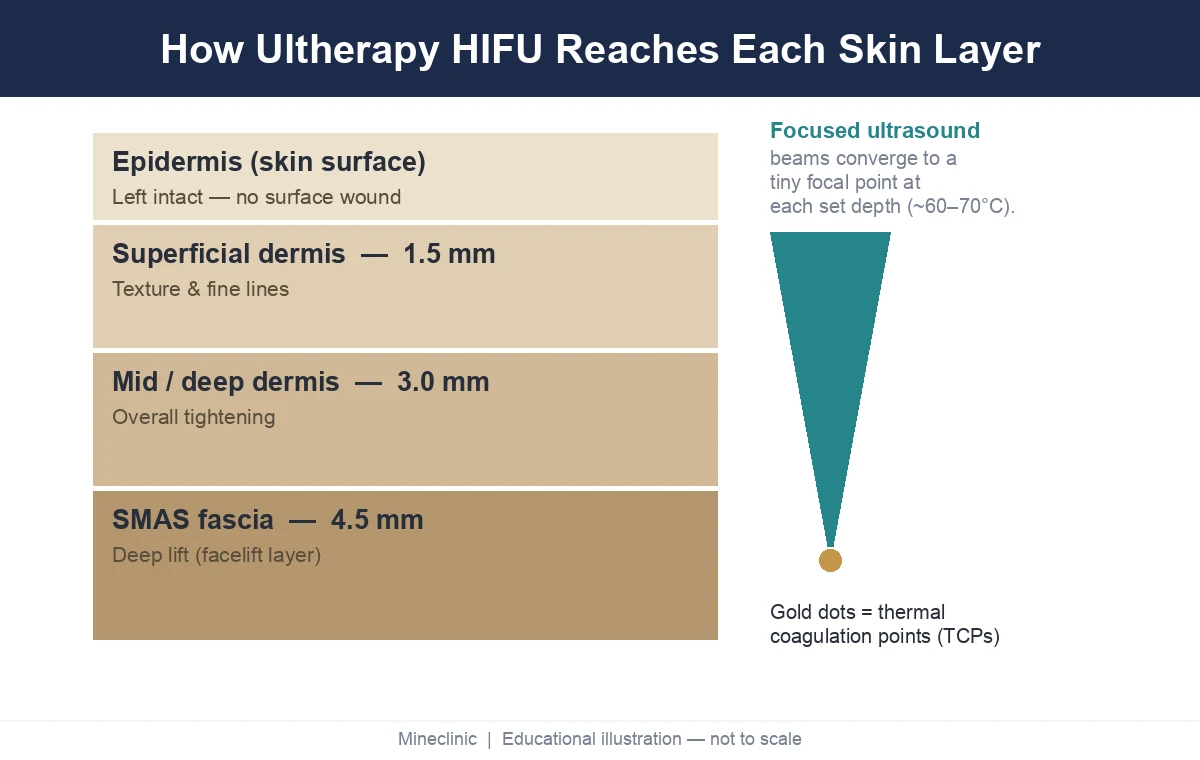
Ultherapy HIFU directs microfocused ultrasound through the skin so the energy converges at set depths — reaching the dermis and the deep SMAS fascia — without wounding the surface.
Understanding Ultherapy HIFU Technology
What Is Ultherapy HIFU?
Ultherapy is an FDA-cleared device that uses High-Intensity Focused Ultrasound (HIFU) for non-surgical skin lifting and tightening. Since receiving FDA clearance in 2009, it has become one of the most widely studied non-invasive alternatives to a surgical facelift. The underlying idea — focusing ultrasound to a single point to create heat deep in tissue — comes from established medical ultrasound, and it has been refined specifically for tightening facial and neck skin. The simplest way to picture it: instead of cutting and pulling skin tight from the outside, Ultherapy HIFU warms the deep support tissue from within so your body does the tightening itself.
High-Intensity Focused Ultrasound (HIFU) Technology Principles
HIFU works by concentrating ultrasound energy at an exact depth in the skin, creating a small zone of heat while the tissue above and around it stays untouched. As described in dermatology textbooks, the focused beam finds the right plane in the skin and delivers energy to a very exact spot, making an “invisible wound” that the body then repairs — and that repair builds new collagen. At each focal point the temperature rises into the range that makes collagen tighten and renew (roughly 60–70°C). Unlike ordinary ultrasound, which spreads energy over a wide area, HIFU pinpoints it, the way a magnifying glass turns broad sunlight into a single hot dot.
The key characteristics of Ultherapy’s ultrasound energy include:
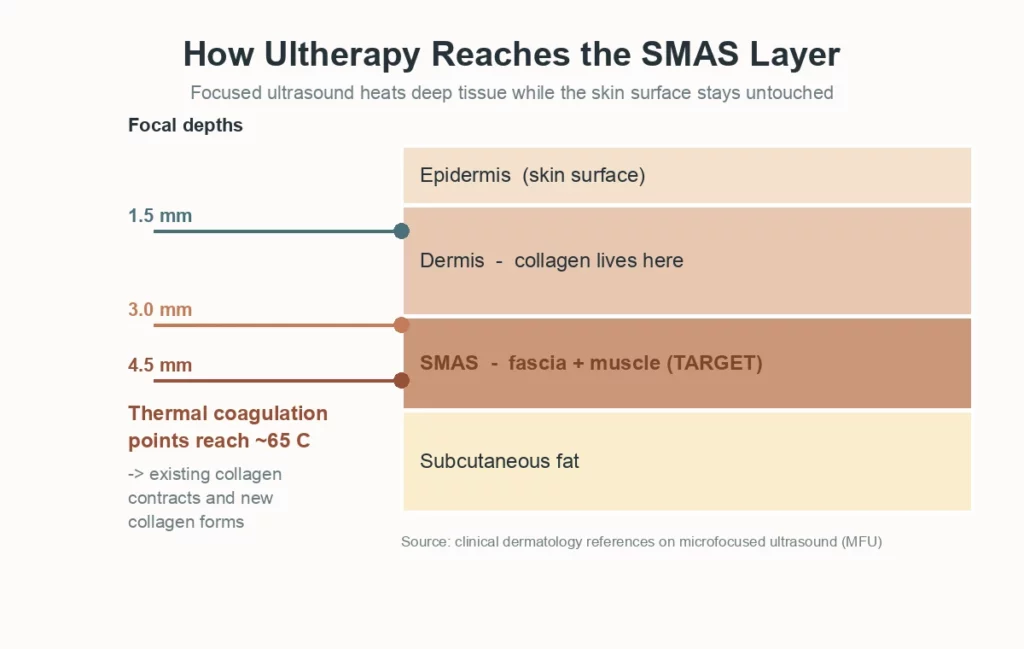
- Precise depth control: energy is delivered at set depths of about 1.5 mm, 3.0 mm, and 4.5 mm using different transducers
- Controlled deep heating: focused energy warms the target spot to roughly 60–70°C
- Selective targeting: only the focal points are affected, while neighboring healthy tissue is preserved
- Non-invasive delivery: the energy passes through the skin with no incisions or needles
One feature that sets Ultherapy apart from many other HIFU devices is its real-time ultrasound imaging (DeepSEE), which lets the practitioner actually see the skin layers on screen and place the energy where it is intended to go rather than treating “blind.”
How Ultherapy HIFU Works: The Scientific Mechanism
The Ultherapy mechanism can be understood as three simple steps that happen at each focal point:
- Energy delivery: microfocused ultrasound is aimed at a set depth in the skin
- Heat generation: where the beams converge, the tissue briefly heats to about 60–70°C
- Tissue response: that heat makes existing collagen contract right away and signals the body to grow new collagen over the following months
During treatment, Ultherapy lays down tiny heat spots — called thermal coagulation points (TCPs) — in neat lines. Each one is microscopic, roughly a millimeter across, and healthy skin is deliberately left between them so the area heals quickly. This is the core of why the treatment can firm skin without surface damage: the heat is concentrated in tiny, spaced-out points rather than spread across the whole surface.
A particular strength of Ultherapy is that it can reach the SMAS (Superficial Muscular Aponeurotic System) — the deep fibrous layer sitting roughly 4.5 mm beneath the surface. The SMAS is exactly the layer a surgeon repositions during a facelift. As this layer and its supporting ligaments weaken with age, the face begins to sag and jowls form. Dermatology references note that when this fibrous tissue is heated, it shrinks and tightens almost immediately, producing a visible lifting effect. Ultherapy’s 4.5 mm transducer is designed to warm this layer non-invasively, which is why it can lift in a way that surface-only devices cannot.
Because the device offers more than one depth, treatment is usually layered for a complete result:
- 1.5 mm: superficial dermis — surface texture and fine lines
- 3.0 mm: mid-to-deep dermis — overall tightening
- 4.5 mm: SMAS layer — the deepest lifting effect
Treating several depths means collagen is stimulated throughout the skin’s support structure, not just at one level, which helps the final result look natural rather than “pulled.”
Ultherapy’s Impact on Collagen Production
Collagen is the protein scaffolding that keeps skin firm; we make less of it, and of poorer quality, as we age. Everything Ultherapy does comes down to one goal — restarting collagen production through carefully controlled heat. Dermatology textbooks describe the process clearly: heat causes collagen to denature and contract, which gives the immediate tightening felt after treatment, and then — as with other non-ablative devices — fresh collagen is laid down over the following months, gradually firming the skin further.
Step by step, the collagen stimulation process after Ultherapy looks like this:
- Immediate contraction: the heat shrinks existing collagen fibers, giving a small instant tightening
- Repair signal: the tiny heat spots trigger the body’s normal wound-healing response
- Fibroblast activation: collagen-making cells (fibroblasts) switch on and start working
- New collagen and elastin: those cells build fresh collagen, elastin, and other matrix components
- Remodeling: the new collagen integrates with existing tissue to create stronger, more elastic skin
It is worth understanding what happens to this new collagen, because it is one of the real differences between energy devices. Research summarized in cosmetic dermatology references indicates that the collagen produced after focused ultrasound tends to build up across the upper, middle, and lower reticular dermis — the deeper, structural part of the skin — whereas radiofrequency devices tend to deposit new collagen mainly in the more superficial papillary and upper reticular dermis. In everyday language: ultrasound tends to firm the skin more deeply, which is part of why it is favored for lifting.
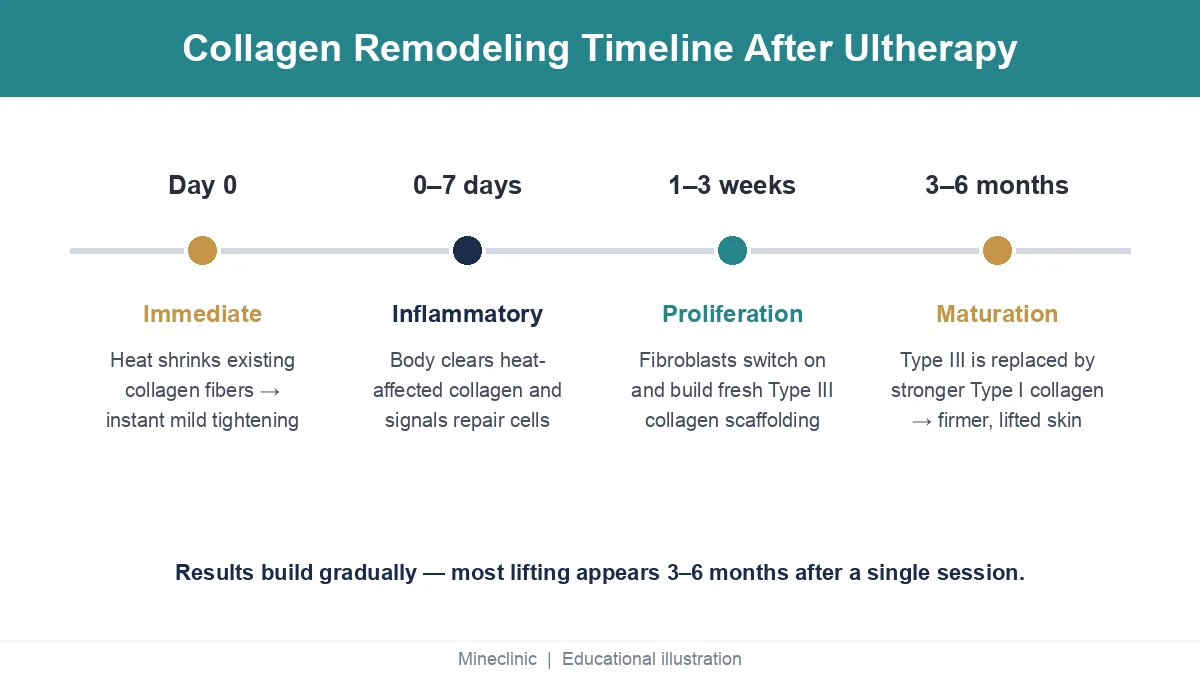
Collagen remodeling after Ultherapy unfolds in phases — immediate contraction, then weeks to months of building and strengthening new collagen.
The remodeling itself moves through recognizable phases over several months. In the first days an inflammatory phase clears heat-affected collagen and prepares the area for rebuilding. Over the next few weeks, a proliferation phase sees fibroblasts laying down new Type III collagen as scaffolding. Then, across roughly three to six months, a maturation phase replaces that early Type III collagen with stronger, longer-lasting Type I collagen, which is what produces sustained firmness. This is biology on its own schedule — and it is exactly why Ultherapy results appear gradually rather than overnight.
When Do Ultherapy HIFU Results Appear?
Ultherapy results arrive in two waves, and knowing this upfront prevents disappointment. There is a small immediate effect, then a much larger gradual one:
Immediate effects:
- Mild tightening as existing collagen contracts
- A slight improvement in skin firmness
- Sometimes temporary redness or swelling, which settles quickly
Gradual, longer-term effects:
- Progressive firming as new collagen forms
- Reduced sagging and softening of jowls
- Better-defined contours along the jawline
- Improved overall skin texture and firmness
A realistic timeline looks like this: in the first two weeks any swelling or redness fades and a little early tightening may be felt; from about one to three months new collagen production picks up and lifting becomes more noticeable; and around three to six months the result peaks as collagen remodeling matures. Most people see their best result roughly three to six months after a single session.
How long it lasts depends on individual factors — age and natural collagen levels, baseline skin quality, sun exposure, smoking, and general skin care — but effects commonly last in the range of one to two years, with many practitioners suggesting maintenance every 12–18 months. For a deeper look at the clinical data, see this overview of the scientific evidence for Ultherapy results.
Ultherapy vs Other Skin Lifting Treatments
It helps to see where Ultherapy sits among the popular non-surgical options. The short version: Ultherapy uses focused ultrasound and reaches the deep SMAS, Thermage uses radiofrequency and works mainly in the dermis, and thread lifts add physical support under the skin. None is simply “best” — they suit different goals.
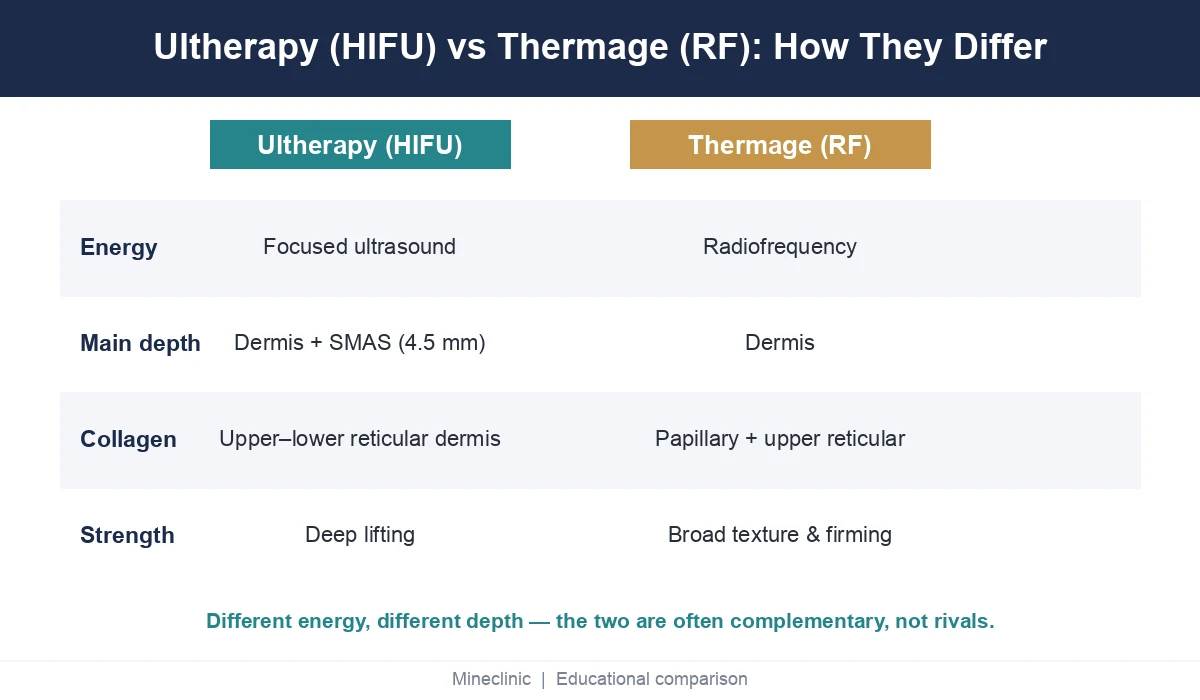
Ultherapy (HIFU) vs Thermage (RF). Both tighten skin without surgery, but they use different energy and reach different depths. Ultherapy uses focused ultrasound to reach the dermis and the SMAS at about 4.5 mm, generating concentrated heat at precise points for a stronger lifting effect. Thermage uses radiofrequency that mainly heats the dermis at a gentler, broader temperature, which makes it excellent for overall skin texture and surface firming across larger areas. As noted above, the new collagen also tends to form deeper with ultrasound and more superficially with radiofrequency — so the two are often considered complementary rather than direct rivals.
Ultherapy vs generic HIFU devices. Many machines now use HIFU, but they are not all equal. Ultherapy is the original FDA-cleared device with extensive clinical study behind it, and its DeepSEE imaging lets the operator see the layers being treated. Many generic devices treat without real-time imaging — essentially “blind” — and energy output and safety can vary between brands. Lower-cost devices may be appealing, but precise targeting is what keeps the energy in the right layer and out of the wrong ones.
Ultherapy vs thread lifts. Ultherapy is fully non-invasive and stimulates your own collagen, with little to no downtime and gradual results over three to six months — a good fit for mild to moderate laxity. A thread lift is minimally invasive: dissolvable threads are placed under the skin to give immediate physical support plus some collagen stimulation, with a short recovery, and it suits more pronounced sagging that needs structural lift. For a fuller side-by-side, see this comparison of lifting procedures.
Scientific Changes During Ultherapy HIFU Treatment
It can be reassuring to know exactly what is happening under the skin during a session. In order, the steps are:
- Energy travels in: the transducer sends ultrasound waves through the skin layers
- Energy focuses: the waves converge at the chosen depth to form a heat spot
- Heat builds: that focal point briefly reaches roughly 60–70°C
- Proteins respond: collagen and nearby proteins denature and contract
- Heat spots form: microscopic thermal coagulation points appear in tidy lines
Crucially, these changes happen only at the focal points; the tissue in between is left intact. That selectivity is the reason the surface skin is not damaged and recovery is quick. The thermal coagulation points themselves do two jobs at once: they contract collagen for an immediate tightening, and they kick off the healing response that produces new collagen over the months that follow.
Recovery follows a predictable path. In the first couple of weeks there may be mild redness or swelling as repair cells gather around the heat spots and clear away heat-affected collagen. Between roughly two weeks and three months, fibroblasts ramp up and lay down early Type III collagen, often alongside improved local blood supply. From about three to six months, that early collagen is replaced by stronger Type I collagen and the fibers reorganize, giving the firmer, lifted look — the changes you actually see in the mirror.
Frequently Asked Questions
How does Ultherapy HIFU lift skin?
Ultherapy uses focused ultrasound to deliver heat to deep skin layers and the SMAS fascia. The heat makes existing collagen contract for an immediate, mild tightening, and it triggers the body to grow new collagen over the next several months. Because the energy is focused at depth, the skin surface is not wounded, and the lifting effect builds gradually as the new collagen strengthens the skin’s support structure.
What’s the difference between Ultherapy and Thermage?
Ultherapy uses focused ultrasound and can reach the deep SMAS layer at about 4.5 mm, which makes it strong for lifting. Thermage uses radiofrequency and works mainly in the dermis at a gentler temperature, which makes it strong for broad surface tightening and texture. The new collagen also tends to form deeper after ultrasound and more superficially after radiofrequency, so many people view them as complementary rather than as either-or choices.
When will I see Ultherapy results?
Results build gradually. A little tightening may be noticeable early on, but the main improvement comes from new collagen, which typically becomes visible from about two to three months and peaks around three to six months after a single session. Patience is part of the treatment — the gradual timeline is what makes the result look natural.
How deep does Ultherapy HIFU penetrate?
Ultherapy treats at set depths chosen by transducer: about 1.5 mm for the superficial dermis, 3.0 mm for the mid-to-deep dermis, and 4.5 mm to reach the SMAS fascia. The 4.5 mm depth matters most for lifting because it reaches the same layer surgeons address in a facelift. Treatment plans often combine depths for a more complete result.
Is Ultherapy the same as HIFU?
HIFU is the technology; Ultherapy is a specific FDA-cleared HIFU device, widely regarded as the original and a benchmark for aesthetic use. Many devices now use HIFU, but Ultherapy is distinguished by its real-time DeepSEE imaging, which lets the practitioner see the layers being treated for more precise, consistent energy delivery.
How long do Ultherapy HIFU results last?
Ultherapy effects commonly last in the range of one to two years, depending on age, baseline skin quality, sun exposure, smoking, and skin care. Because the skin keeps aging, many practitioners recommend a maintenance session every 12–18 months to sustain the lift; some people hold their result longer, while others prefer more frequent touch-ups.
Conclusion
The science behind Ultherapy HIFU explains why it has become a trusted option for non-surgical lifting: by focusing ultrasound to precise depths, it creates tiny, controlled heat spots that both contract existing collagen and prompt the body to build new collagen over the following months. Its ability to reach the deep SMAS layer without any incision is what allows a meaningful lift with little downtime — and the gradual, collagen-driven nature of the result is what keeps it looking natural rather than tightened.
If you are weighing non-surgical options for skin laxity, the most useful next step is a proper skin assessment, since the right depth plan and the choice between ultrasound, radiofrequency, and threads depend on your individual skin. You can learn more about Ultherapy at Mineclinic or arrange a consultation to discuss the approach best suited to your goals.
※ This content is for informational purposes only and does not replace professional medical advice, diagnosis, or treatment. Individual results may vary, and side effects may occur. Please consult with a board-certified plastic surgeon for personalized advice.
References:
- Essentials for Aesthetic Dermatology in Ethnic Skin: Practice and Procedure (2023)
- Cosmetic Dermatology — non-ablative skin tightening and neocollagenesis
- Textbook of Cosmetic Dermatology, 6th edition — focused ultrasound and radiofrequency collagen distribution
- American Society for Dermatologic Surgery — Ultrasound skin tightening overview