EN
EN


Table of Contents
Juvelook vs Juvelook Volume — both are PDLLA (Poly-D,L-Lactic Acid) plus hyaluronic acid injectable skin boosters approved in Korea, but they differ in particle size, injection depth, and the skin concern they target. This guide explains how the two compare so you can decide which one fits your goals.
What Is Juvelook? Understanding the K-Beauty Skin Booster
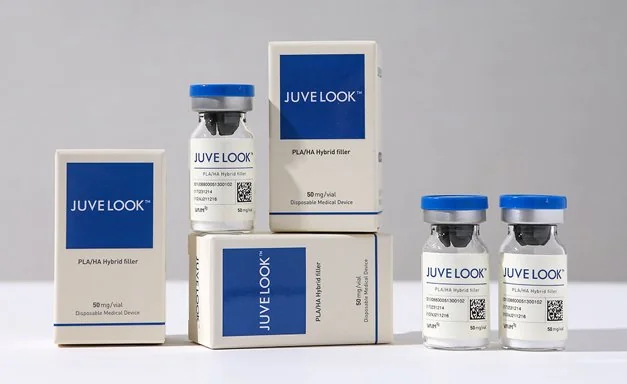
The Juvelook skin booster has rapidly become one of the most requested injectable treatments among international patients visiting Seoul. Developed in Korea and approved by the Korean Ministry of Food and Drug Safety (MFDS), this K-Beauty skin booster is a hybrid injectable that combines PDLLA (Poly-D,L-Lactic Acid) microspheres with non-cross-linked hyaluronic acid (HA).
Unlike traditional fillers that simply add volume, this treatment works as a biostimulator — a product that does not just sit under the skin, but prompts your skin to rebuild itself. Medical textbooks and research on collagen biostimulators describe a two-step (bimodal) mechanism that is helpful to understand:
- Step 1 — Immediate hydration (the HA part): The hyaluronic acid delivers instant moisture and a subtle plumping effect. This component is gradually absorbed by your body within a few days, so it is a short-term benefit.
- Step 2 — Long-term collagen stimulation (the PDLLA part): Over the following weeks to months, the tiny PDLLA microparticles slowly break down. As they do, they gently signal your skin’s fibroblasts (the cells that produce collagen) to switch on, leading to new collagen forming over time. This is what gives the gradual, natural-looking result.
PDLLA belongs to the same family of biocompatible material used in dissolvable surgical sutures, so it has a long-established safety profile in medicine. In short, the HA works fast and fades, while the PDLLA works slowly and lasts — together they offer both immediate freshness and lasting renewal.
Key Takeaway: Juvelook is not a quick volume fix. It is a regenerative treatment that helps your skin restore itself from within — making it ideal for patients seeking authentic, long-lasting K-Beauty results rather than an obvious “filled” appearance.
Who Is Juvelook Recommended For?
This injectable treatment is highly versatile and suits a wide range of skin concerns commonly seen in international patients aged 25 and above:
- Loss of skin elasticity and early signs of sagging
- Enlarged or visible pores
- Fine lines around the eyes, forehead, and mouth
- Dull, uneven skin texture
- Acne scars and shallow depressions
- Tear trough hollows and sunken cheeks (Volume type)
If you are exploring multiple regenerative options, you may also want to read our complete guide to Juvelook treatment areas, or learn how it compares with other K-Beauty boosters such as Rejuran skin healing injections or NCTF 135HA mesotherapy.
Juvelook vs Juvelook Volume: Side-by-Side Comparison
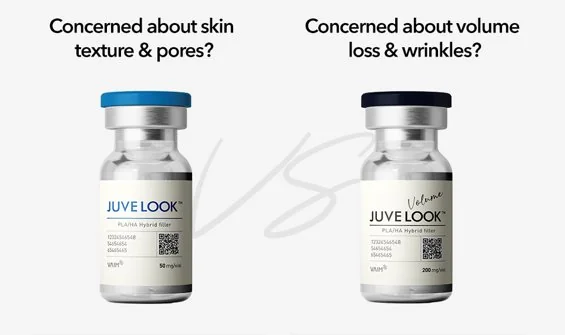
Many patients arrive at Mine Clinic asking the same question: “Which Juvelook is right for me?” Both formulations share the same core PDLLA + HA technology, but they are engineered for different layers of the skin and different goals. Understanding the juvelook vs juvelook volume difference comes down to particle size and how deep the product is placed.
Juvelook (Regular)
The original formula uses smaller PDLLA microspheres (around 20–50 micrometers). This allows it to be injected into the superficial and mid-dermis without creating visible bumps or volume distortion.
Best for:
- Overall skin texture improvement
- Tightening of pores
- Fine lines and crepey skin
- Dull complexion and “glass skin” effect
- Patients in their late 20s to early 40s
Juvelook Volume
Juvelook Volume contains larger PDLLA particles suspended in a thicker HA carrier, designed for injection into the deep dermis or subcutaneous layer. It provides a noticeable lifting and volumizing effect while still stimulating long-term collagen growth. For a deeper look at a specific use case, see how Juvelook Volume for sunken cheeks works.
Best for:
- Restoring lost facial volume (cheeks, temples, tear trough)
- Deeper wrinkles and nasolabial folds
- Sagging jawline and lower face
- Patients in their late 30s and beyond, or those with significant volume loss
One important safety note: because Volume uses larger particles placed deeper, injecting it too superficially can raise the risk of small lumps (nodules). This is exactly why physician expertise and correct injection depth matter so much.
Quick Comparison
| Feature | Juvelook (Regular) | Juvelook Volume |
|---|---|---|
| Primary Goal | Skin quality & glow | Volume & lifting |
| Injection Depth | Superficial / mid-dermis | Deep dermis / subcutaneous |
| Particle Size | Smaller PDLLA | Larger PDLLA |
| Visible Effect Onset | 4–6 weeks | 2–4 weeks |
| Duration | 12–18 months | 18–24 months |
| Recommended Sessions | 2–3 sessions | 1–2 sessions |
Key Takeaway: Choose regular Juvelook if your concern is texture, pores, and overall skin radiance. Choose Juvelook Volume if you want to restore facial contours and lift sagging areas. Many patients at Mine Clinic combine both for full-face rejuvenation. If duration is your priority, our guide on how long Juvelook Volume lasts goes into more detail.
The Procedure at Mine Clinic Seoul
Step 1: Consultation and Skin Analysis
Every international patient begins with a personalized consultation. Our medical team evaluates your skin condition, lifestyle, and aesthetic goals to recommend the optimal protocol — regular, Volume, or a combination. Language assistance is provided through our International Patient Service team.
Step 2: Preparation and Anesthesia
The treatment area is thoroughly cleansed, and a topical numbing cream is applied for approximately 20–30 minutes. A small amount of lidocaine is also commonly mixed into the product itself to help reduce injection discomfort, making the procedure comfortable even for first-timers.
Step 3: Precision Injection
Using ultra-fine needles or blunt-tip cannulas, the physician injects the product in a uniform pattern across the target area. The technique varies depending on the formulation:
- Regular Juvelook: Microdroplet or “pan-facial” technique for diffuse skin renewal
- Juvelook Volume: Bolus or fanning technique in deeper layers for structural support
Step 4: Massage and Aftercare
Gentle massage is performed immediately after injection to ensure even distribution of the PDLLA microspheres and prevent clumping. The entire session typically takes 30 to 45 minutes.
Why Choose Mine Clinic in Korea for Juvelook
Korea is widely recognized as the global capital of advanced injectable aesthetics, and Seoul’s Gangnam district is the heart of that ecosystem. Here is why international patients consistently choose Mine Clinic:
- Authentic Product Guarantee: Counterfeit injectables are a documented risk in many overseas markets. At Mine Clinic, every vial is sourced directly through licensed Korean distribution and verifiable on-site.
- Physician-Only Injections: All treatments are performed exclusively by board-certified physicians — never by aestheticians or nurses.
- Customized Protocols: Our doctors do not use a one-size-fits-all approach. They tailor particle distribution, injection depth, and session intervals to each patient’s facial anatomy.
- Combination Expertise: Mine Clinic specializes in pairing this treatment with complementary options such as Ulthera HIFU lifting, Exosome therapy, or thread lifting for synergistic results.
- Seamless International Care: From airport pickup coordination to multilingual aftercare instructions, every detail of your medical tourism experience is managed for you.
Important: Risks, Side Effects & Safety
As a YMYL (Your Money or Your Life) topic, transparency about risks is essential. While this biostimulator has an excellent safety record, no medical injection is entirely risk-free.
Common, Temporary Side Effects
These typically resolve within a few days without intervention:
- Mild redness and swelling at injection sites
- Minor bruising (especially around the eyes)
- Tenderness or itching for 24–48 hours
- Small palpable lumps that soften within 1–2 weeks
Less Common Risks
- Nodule formation: Rare with proper injection technique and post-treatment massage
- Infection: Extremely uncommon when sterile protocols are followed
- Allergic reaction: Rare due to the biocompatible nature of PDLLA and HA
- Vascular complications: Very rare but serious; minimized when performed by experienced physicians familiar with facial anatomy
Clinical research on this class of collagen biostimulator notes that the risk of nodules or irregular bumps can increase with a few specific factors: injecting too superficially, using too low a dilution, not allowing the product enough reconstitution time (under 24 hours), or injecting too much material at once. Certain high-movement areas — such as crow’s feet near the eyes or the corners of the mouth — and very thin-skinned zones around the eyes also need separate evaluation, because they carry a higher chance of visible papules. Mine Clinic’s safety standards directly address these factors through adequate dilution, proper reconstitution time, correct injection depth, and post-treatment massage.
According to the American Academy of Dermatology, the safety of any injectable treatment depends heavily on practitioner expertise, product authenticity, and proper aftercare — three pillars that Mine Clinic strictly upholds. The product itself is approved by the Korean Ministry of Food and Drug Safety (MFDS).
Mine Clinic’s Safety Standards
- Sterile, single-use needles and cannulas
- Emergency hyaluronidase available on-site
- Detailed pre-treatment medical screening (allergies, medications, autoimmune conditions)
- Continuous staff training on advanced injection techniques
Recovery Timeline in Korea
One of the major advantages of this skin booster is its minimal downtime, making it perfect for medical tourists with limited time in Seoul.
Day-by-Day Recovery
- Day 0 (Treatment Day): Mild redness and pinpoint swelling. You may return to your hotel immediately. Avoid makeup for the first 12 hours.
- Day 1–2: Most visible swelling subsides. Light makeup is permitted. Avoid heat (saunas, hot showers).
- Day 3–5: Skin looks completely normal to others. You can resume light tourism, shopping in Gangnam, or sightseeing.
- Day 7: Safe to fly home. No stitch removal is needed.
- Week 4–6: Initial collagen-stimulation effects become visible.
- Month 3: Full results emerge as new collagen matures.
Aftercare Recommendations
- Avoid alcohol and intense exercise for 48 hours
- No facial massage, sauna, or jjimjilbang for at least 1 week
- Use gentle, fragrance-free skincare
- Apply broad-spectrum SPF 50+ daily
- Drink plenty of water to help your skin’s HA stay hydrated
How Long Should I Stay in Korea?
For this treatment alone, a 3–4 day stay in Seoul is typically sufficient — including consultation, treatment, and one follow-up check. Patients combining it with surgical procedures should plan a longer stay; refer to our International Service Page for tailored itinerary planning.
Key Takeaway: This is a “lunch-break friendly” treatment, but its full rejuvenating effects unfold over 1–3 months. Plan multiple sessions if you can return to Seoul, or consult our team about combining sessions during a single trip.
Frequently Asked Questions
How long does Juvelook last compared to traditional fillers?
Traditional HA fillers typically last 6–12 months. Results from this biostimulator last 12–18 months for the regular formulation and 18–24 months for Juvelook Volume, because the PDLLA component continues to stimulate your own collagen long after the initial HA dissolves. To explore other filler options, see our Filler Treatment Page.
Is Juvelook better than Rejuran or Exosome therapy?
They serve different purposes. Rejuran (PDRN) focuses on cellular DNA repair and is excellent for sensitive or damaged skin. Exosomes target deep regeneration at the stem-cell signaling level. This treatment combines instant hydration with long-term collagen stimulation. Many patients combine treatments for layered results — for a closer look, read our Juvelook vs Rejuran complete comparison, and your physician will recommend the right combination during consultation.
How many sessions of Juvelook will I need?
Most patients see optimal results after 2–3 sessions of regular Juvelook spaced 4 weeks apart, or 1–2 sessions of Juvelook Volume. Maintenance is typically once every 12–18 months.
Can men get Juvelook treatment?
Absolutely. This skin booster is increasingly popular among male patients seeking subtle rejuvenation without an obvious “done” look. The treatment works well alongside other male aesthetic procedures offered at Mine Clinic.
What is the cost of Juvelook at Mine Clinic Seoul?
Pricing depends on the number of vials, target areas, and whether the treatment is combined with other procedures. We provide transparent, personalized quotes — consultation required for personalized pricing. You can request a quote through our Online Consultation form.
Final Call to Action
Interested in this procedure? Contact Mine Clinic today for a personalized online consultation. We are ready to assist you on WhatsApp and guide you through your K-Beauty journey in Seoul. Read up on more Juvelook blogs.
Reviewed by Dr. Lee Sung-wook, Board Certified Plastic Surgeon at Mine Clinic.
※ This content is for informational purposes only and does not replace professional medical advice, diagnosis, or treatment. Individual results may vary, and side effects may occur. Please consult with a board-certified plastic surgeon for personalized advice.