EN
EN

Table of Contents
- What Gynecomastia Surgery Recovery Actually Involves
- Who Needs to Follow These Precautions Most Closely
- Gynecomastia Surgery Recovery Timeline: Day 1 to Year 1
- Swelling and Bruising: What Is Normal and What Is Not
- Compression Garment and Scar Care Schedule
- When You Can Exercise, Shower, Eat and Sleep Normally
- Medication, Alcohol and Smoking You Need to Avoid
- Warning Signs That Mean You Should Call Your Surgeon
- Frequently Asked Questions About Gynecomastia Surgery Recovery
- Planning Your Gynecomastia Recovery With MINE in Seoul
Gynecomastia surgery recovery is the healing period after male breast reduction, when compression, swelling control, scar care and activity limits decide how smoothly the new chest contour settles. It runs from the first day after the operation to roughly one year later, when the scars and the final shape have finished maturing.
I am Dr. Lee Sung-wook, a board-certified plastic surgeon and the director of MINE Plastic Surgery & Dermatology in Seoul. In my clinical experience, the operation decides what is possible and the weeks that follow decide how much of it you keep. This guide covers gynecomastia (male breast reduction) surgery aftercare as seven essential precautions, in the order you will live them: posture, meals, swelling, the vest, scars, exercise and medication — plus the warning signs that deserve a phone call.
What Gynecomastia Surgery Recovery Actually Involves
Gynecomastia is the benign enlargement of breast tissue in men, and it is far more common than most patients assume — you can read a plain-language overview of gynecomastia (breast enlargement in males) for background. Surgery removes the excess gland and fat and reshapes the chest so the contour reads as flat and masculine.
This is a sensitive subject for many men, and I want to say plainly that there is nothing here to feel self-conscious about. It is a physical condition with a physical solution, and recovery is simply a set of instructions to follow, not a test of willpower.
Why the healing period decides the final contour
Once the tissue is removed, a thin space is left between the skin and the chest wall. Fluid gathers there easily, and the skin has to re-drape and stick down onto its new, flatter foundation. Compression, sleeping position and activity limits exist to close that space quickly and evenly. That is the logic of gynecomastia surgery recovery in one sentence.
Plastic surgery textbooks put the operation itself at about 90 to 120 minutes and describe a pressure garment worn day and night for 4 to 6 weeks afterwards. The surgical part is over in an afternoon; the part you control lasts weeks. That imbalance is why I spend so much of the consultation on aftercare.
What happens under the skin after the tissue is removed
For the first few days your body sends fluid and inflammatory cells into the operated area, which is why swelling climbs before it falls. Over the following weeks that fluid is reabsorbed, the skin adheres, and scar tissue matures from red and firm to pale and flat. Rushing gynecomastia surgery recovery does not shorten it — it only raises the risk of bleeding, fluid collection, or a contour that shifts after it had settled.
Who Needs to Follow These Precautions Most Closely
Everyone follows the same core plan, but some patients begin with a higher risk of bleeding, fluid collection or delayed healing. If you are in one of the groups below, treat every step of gynecomastia surgery recovery as non-negotiable rather than as a guideline.
- Large resections — the more tissue removed, the larger the space that has to close, and the more the vest matters.
- Cases involving skin reduction — longer incisions mean more tension on the wound.
- Patients who have lost a large amount of weight — loose, thinned skin drapes less predictably.
- Smokers — nicotine narrows the small vessels feeding the nipple-areola complex.
- Anyone on aspirin, vitamin E or blood-thinning supplements — these raise the risk of hematoma early on.
Large resections, skin reduction and post-weight-loss patients
Drains are not routine here. The surgical literature reserves them for large resections, for cases where skin is reduced, and for patients operated on after massive weight loss. If you have a drain, it is a considered decision for your anatomy, not a sign that something went wrong.
International patients flying home after surgery
Most of my gynecomastia patients travel to Seoul from abroad, and the flight home adds a layer to gynecomastia surgery recovery that the average aftercare sheet ignores. Plan to stay until your sutures come out at day 7 to 10 so wound checks happen in person. On the flight, keep the vest on for the whole journey, walk up and down the aisle every hour or two, and drink water steadily.
Before you fly, ask for wound photographs, a written operation summary and a direct line to the clinic. A local doctor who can check the incisions is a sensible backup. Our guide on what to prepare before you fly home covers the practical side.
Gynecomastia Surgery Recovery Timeline: Day 1 to Year 1
Recovery is not one long stretch of identical rules. It divides into stages of days, weeks and months, each with its own priority. Knowing where you are on the gynecomastia surgery recovery timeline makes it much clearer what to protect and what to relax.
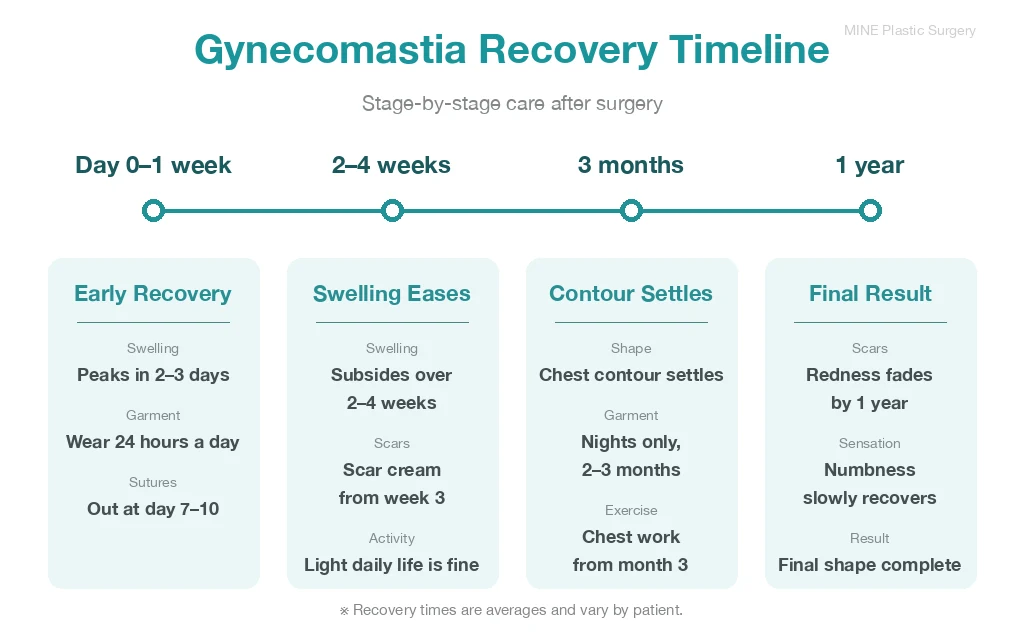
| Stage | What you feel | What you must do | Watch for |
|---|---|---|---|
| Day 0 to day 3 | Swelling, bruising and pain at their worst | Vest 24 hours a day, sleep propped up on pillows, rest | One side swelling and hardening |
| Around week 1 | Soreness easing, chest still tight | Sutures out day 7 to 10, desk work, short walks | Redness, heat or discharge |
| Weeks 2 to 4 | Swelling dropping, contour appearing | Vest around the clock, scar cream from week 3, no alcohol or smoking | A wobbly, fluid-filled feel |
| Month 3 to year 1 | Shape settled, scars fading | Vest at night only, scar care continues, chest training from month 3 | Pain that settles, then worsens |
Day 0 to day 3: swelling and pain peak
These are the hardest three days of gynecomastia surgery recovery, and they are supposed to be: swelling, bruising and discomfort all climb rather than fall. Keep the garment on continuously, sleep propped up on your back, and take painkillers on schedule instead of waiting for pain to build. The only job of this stage is to stay still.
Around week 1: sutures out, back to desk work
Sutures are removed 7 to 10 days after gynecomastia surgery, and most patients are back to ordinary daily life by then. Office work, walking and light errands are fine; pushing, pulling or lifting a suitcase is not. My rule for this week is simple — walking is good, weights are not.
Weeks 2 to 4: swelling drops, contour appears
Now the result starts to look like a result. Swelling falls noticeably and the flatter chest line emerges. Keep the vest on 24 hours a day through the end of the first month, begin scar cream at week 3, and hold the line on alcohol and cigarettes. Our post-operative aftercare guide sets out the same principles we apply across our other chest procedures.
Month 3 to year 1: shape and scars finish
From month 3 you can return to chest-loading exercise and the garment drops to nighttime wear. Scar redness usually starts fading around 6 months and improves noticeably by about a year, while residual numbness keeps improving through this final stage.
Dr. Lee’s Key Point: the emphasis shifts as you move through gynecomastia surgery recovery — rest and compression early, scar care in the middle, and a gradual, unhurried return to activity later.
Swelling and Bruising: What Is Normal and What Is Not
The most common question I get during gynecomastia surgery recovery is some version of “is this normal?” Almost always the answer is yes. Early swelling, uneven sides and odd nerve sensations are the standard course. What matters is recognizing the small number of changes that are not.
Why swelling gets worse before it gets better
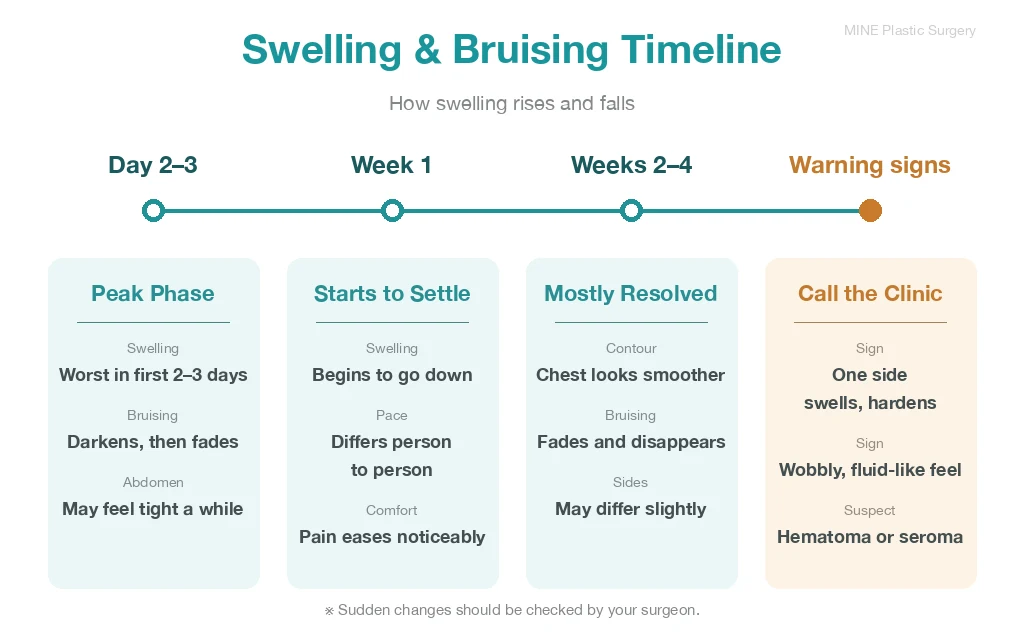
Swelling and bruising build for the first 2 to 3 days and then subside over 2 to 4 weeks, with a good deal of variation between patients. Your body is reabsorbing pooled tissue fluid and the small amount of bleeding that follows any resection. Gravity plays a part too, so fluid can drift down and leave the upper abdomen feeling tight for a while.
Left-right differences during healing
The two sides rarely settle at the same speed. They started with different amounts of tissue and reabsorb fluid at different rates, so one side can look fuller for weeks. Final symmetry only appears once swelling has fully resolved, several months out. Judging your result in the first month is like judging a photograph while it is still developing.
Numbness and shooting pain around the nipple
Tightness, dull patches of skin and sudden electric twinges around the nipple are part of normal healing. Fine sensory nerves are disturbed when tissue is lifted, and sensation returns as those nerves regenerate. Surgical textbooks list altered nipple sensation as a known part of gynecomastia surgery recovery, and the literature describes it settling over several months, sometimes up to about 1 year.
| Normal healing | Call the clinic |
|---|---|
| Swelling that peaks by day 3, then slowly falls | One side swelling rapidly and turning hard |
| Bruising that darkens, yellows and fades | A soft, wobbly, fluid-filled bulge |
| Uneven sides that gradually even out | Redness, heat, fever or discharge |
| Numb patches and occasional shooting pains | Pain that improved and is now worsening |
Compression Garment and Scar Care Schedule
If you remember one instruction from this guide, make it the vest. Compression is the one part of gynecomastia surgery recovery you control hour by hour, and it does more for the final contour than anything else you do at home.
How long to wear the compression vest
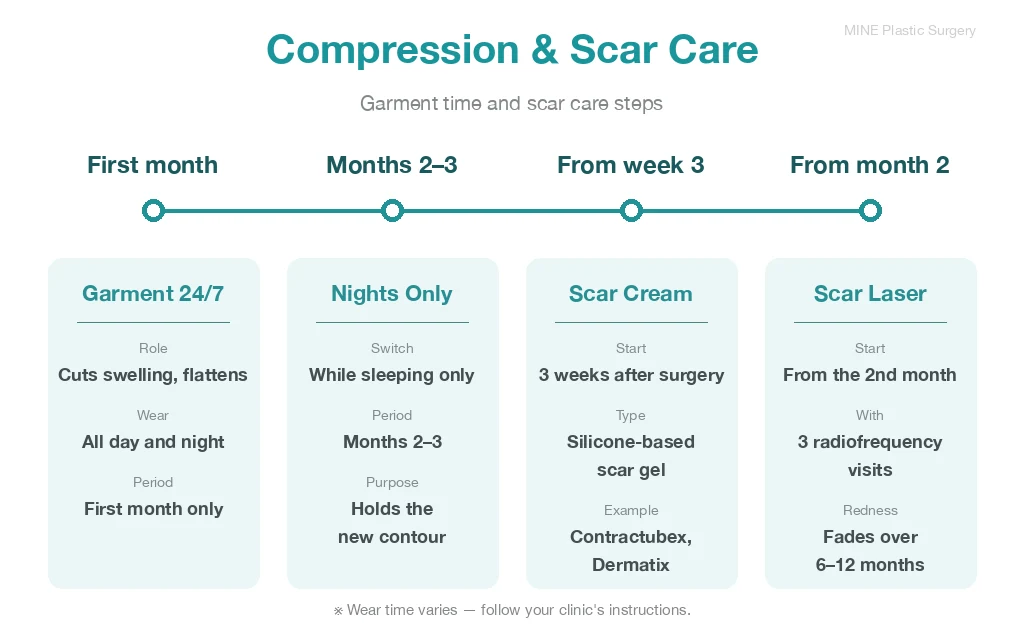
The compression garment is worn 24 hours a day for the first month, then at night only for another 2 to 3 months. Plastic surgery textbooks recommend a compression garment day and night for 4 to 6 weeks, so our plan of one month around the clock followed by 2 to 3 months of night wear sits on the more conservative side of the literature. Exact wear time still varies between patients.
Scar cream from week 3, laser from month 2
Scar care is the longest-running task in gynecomastia surgery recovery, and it starts earlier than most patients expect. Scar cream starts 3 weeks after surgery and scar laser treatment starts in the 2nd month, with 3 radiofrequency sessions available from day 7 onward. Silicone-based scar gels such as Contractubex or Dermatix are sold over the counter in most countries. Scar redness can last about 6 months and usually improves noticeably by 1 year, though skin type makes a real difference. Consistency matters more than the brand, and our guide to managing surgical scars sets out the same approach in more detail.
Why the garment does more than just squeeze
Patients often assume the vest holds a shape in place, like a corset. It does not. It reduces swelling by limiting the space fluid can collect in, and presses the skin down so it adheres to the reshaped chest wall. Take it off early and that space reopens — which is how seromas and irregular contours appear.
| Item | Timing | Notes |
|---|---|---|
| Compression vest, all day | First month | Off only for showering, once allowed |
| Compression vest, nights | Months 2 to 3 | Holds the contour as swelling resolves |
| Suture removal | Day 7 to 10 | Varies by patient and incision |
| Silicone scar gel | From week 3 | Applied daily, over the counter |
| Scar laser | From month 2 | Staged sessions at the clinic |
| Radiofrequency care | 3 sessions from day 7 | Booked on dates that suit you |
When You Can Exercise, Shower, Eat and Sleep Normally
This is the practical half of gynecomastia surgery recovery: what you may do, and when. The dates below are the ones I give my own patients.
Sleeping position: upright first, on your back for 3 months
For the first week, sleep with your upper body raised on pillows; if that hurts your lower back, lying flat is acceptable. Sleep on your back for 3 months, and avoid your side or front entirely for the first 3 weeks. Sleeping face down is only safe from month 3. Even pressure keeps the contour even, which is why sleeping position matters so much in the first weeks.
Eating and showering
You can eat 6 hours after surgery, starting with something light such as broth or porridge, because anesthesia often leaves the stomach unsettled. Showering is allowed from the day after your sutures are removed, and the same rule applies to stitches from any procedure done at the same time.
Return to exercise by intensity
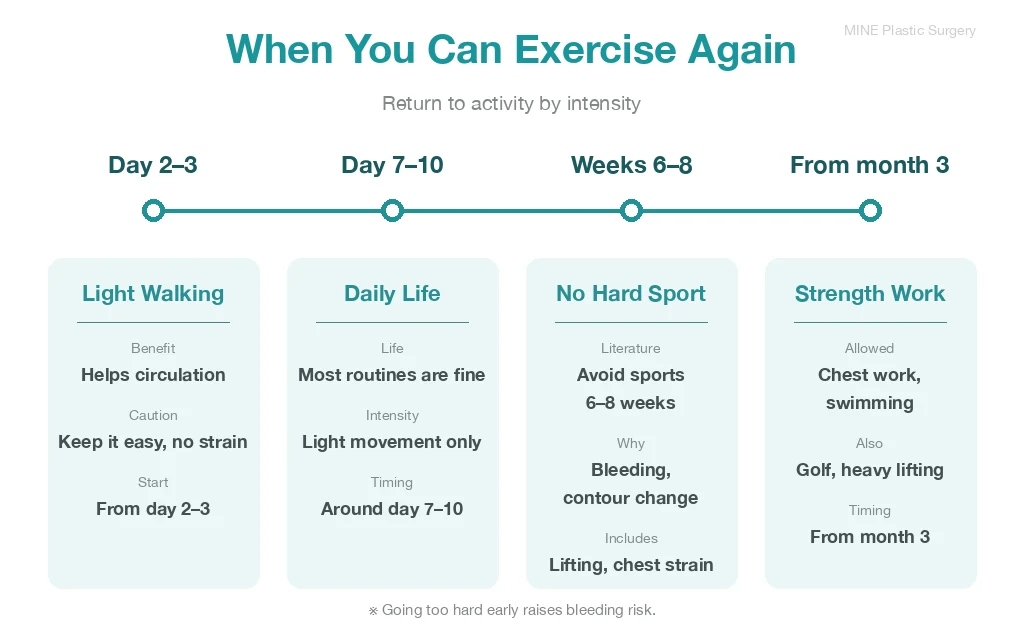
Chest-loading exercise such as weight training, swimming and golf resumes from month 3, while light walking is allowed from day 2 to 3. The literature generally advises avoiding sports for 6 to 8 weeks, and we extend the restriction on chest-loading exercise to 3 months for the same reason: bleeding risk and contour distortion. Gentle walking, by contrast, helps circulation and is encouraged from the start.
| Activity | Earliest restart | Why |
|---|---|---|
| Light walking | Day 2 to 3 | Helps circulation without loading the chest |
| Desk work and errands | Day 7 to 10 | Sutures out, wounds stable |
| Showering | Day after suture removal | The incision tolerates water safely |
| Jogging, lower-body training | After 6 to 8 weeks | Matches general advice in the literature |
| Chest training, swimming, golf | From month 3 | Chest loading risks bleeding and shape change |
| Sleeping face down | From month 3 | One-sided pressure can distort the contour |
The same intensity-based logic runs through our other chest procedures, and you can compare it with the breast lift and reduction surgery precautions we publish.
Medication, Alcohol and Smoking You Need to Avoid
Medication and lifestyle are where a smooth gynecomastia surgery recovery is quietly won or lost. None of these rules are difficult; they simply have to be kept for the full period rather than the first week.
Painkillers: what the strong one does to you
Start your discharge medication 30 minutes after your first meal, then take it on a fixed schedule. The stronger painkiller you were prescribed, typically a tramadol-type tablet, can cause dizziness and nausea. If that happens, skip that dose and take the milder acetaminophen-type painkiller instead. Prescribing rules differ between countries, so check with us before substituting anything you brought from home.
Aspirin and vitamin E for 3 weeks
Aspirin and vitamin E are stopped for 3 weeks, and alcohol and smoking for 1 month, because they increase bleeding and slow wound healing. Aspirin and vitamin E both thin the blood, which makes hematoma more likely in a chest that has just had tissue removed. If you take aspirin for a heart or circulation condition, do not stop it on your own — tell us, and we will coordinate with your prescribing doctor.
Why smoking is the single worst thing for this surgery
Nicotine constricts small blood vessels and cuts blood flow to the skin and the nipple-areola complex, exactly where this operation works. Reduced flow means slower healing and, rarely, necrosis — tissue that dies because it cannot get enough blood. Skin and nipple necrosis sits on the standard textbook list of complications, and smoking is the most avoidable route to it.
- Stop for 3 weeks: aspirin, vitamin E and blood-thinning supplements.
- Stop for 1 month: alcohol and all smoking, including vaping.
- Start 30 minutes after your first meal: the antibiotics and painkillers you were prescribed.
- Swap if needed: the stronger painkiller for an acetaminophen-type one if it makes you dizzy.
- Restart only after discussion: any regular medication you paused for surgery.
Warning Signs That Mean You Should Call Your Surgeon
Complications are uncommon during gynecomastia surgery recovery, but they are easiest to treat early. The gynecomastia surgery overview from the American Society of Plastic Surgeons describes the same risk profile that textbooks list: bleeding and hematoma, seroma, infection, skin or nipple necrosis, contour problems such as a depressed nipple, altered sensation, loose skin, residual asymmetry, scar problems, and over- or under-correction, with revision occasionally needed.
Hematoma and seroma
A hematoma is a collection of blood, and it usually shows as one side swelling quickly and turning firm, tense and painful in the first few days. A seroma is a collection of clear tissue fluid and feels quite different: soft and wobbly, almost like a water balloon under the skin. Ordinary swelling, by contrast, is symmetrical, gradual and slowly improving.
Infection
Infection announces itself with redness spreading around the incision, heat, increasing pain, discharge, or fever. Pain that had been settling and then starts climbing again is one of the most reliable early warning signals, and it is worth a phone call on its own.
How these are managed
In the surgical literature, standard management of a seroma is aspiration with a fine needle, continued compression and activity restriction, with surgery reserved for collections that keep recurring. A significant hematoma may need draining, and infections are treated with antibiotics and close wound care. The earlier we see any of them, the smaller the intervention.
Frequently Asked Questions About Gynecomastia Surgery Recovery
How long do I have to wear a compression garment after gynecomastia surgery?
You wear the compression garment 24 hours a day for the first month, then at night only for another 2 to 3 months. Plastic surgery textbooks recommend day and night wear for 4 to 6 weeks, so this schedule is slightly more conservative than the usual published advice. Exact wear time varies with how much tissue was removed and how your own gynecomastia surgery recovery progresses.
When can I go back to the gym after gynecomastia surgery?
Light walking is fine from day 2 to 3 and normal daily activity returns around day 7 to 10, but chest-loading exercise such as weight training, swimming and golf waits until month 3. The general advice in the literature is to avoid sports for 6 to 8 weeks; we extend the chest-specific restriction because loading the chest early in gynecomastia surgery recovery risks bleeding and contour change.
Is numbness or shooting pain around the nipple normal after surgery?
Yes. Numbness, tightness and sudden electric twinges around the nipple are a known part of gynecomastia surgery recovery, caused by fine sensory nerves being disturbed during the operation, and they can come and go for up to about a year. What is not normal is swelling that suddenly worsens or pain that steadily increases.
When do gynecomastia surgery scars fade?
Scar maturation is the slowest stage of gynecomastia surgery recovery. Scars often stay reddish for about 6 months and usually improve noticeably by 1 year, though skin type changes the pace considerably. Silicone-based scar gel starts at week 3 and scar laser treatment from month 2, and using both consistently is what makes the difference. Sun exposure will darken a fresh scar, so keep it covered.
What are the warning signs I should not ignore during gynecomastia surgery recovery?
Call your surgeon if one side suddenly swells and hardens, if you feel a soft fluid-filled bulge, if there is redness, heat, discharge or fever, or if pain that had been settling starts getting worse. These point to hematoma, seroma or infection, all far easier to treat when caught in the first days.
Planning Your Gynecomastia Recovery With MINE in Seoul
Every chest is different. How much gland you have relative to fat, how elastic your skin is, and whether skin needs to be removed all affect the operation and the recovery plan that follows. That is why the schedule you are given in person may differ slightly from the general timelines above.
For international patients, two questions about gynecomastia surgery recovery are worth settling before you book: how long you can stay in Korea, and who will check your wounds once you get home. Ten days in Seoul covers surgery and suture removal comfortably. Costs depend on the extent of the surgery, so we confirm them at your in-person consultation rather than quoting a figure in advance.
If you would like your own case assessed, review the surgical approach for gynecomastia (male breast reduction) surgery at MINE, or call us at +82-2-516-1175 to arrange an in-person or online consultation in Seoul.
Written and medically reviewed by Dr. Lee Sung-wook, board-certified plastic surgeon, MINE Plastic Surgery & Dermatology.
※ This content is for informational purposes only and does not replace professional medical advice, diagnosis, or treatment. Individual results may vary, and side effects may occur. Please consult with a board-certified plastic surgeon for personalized advice.