EN


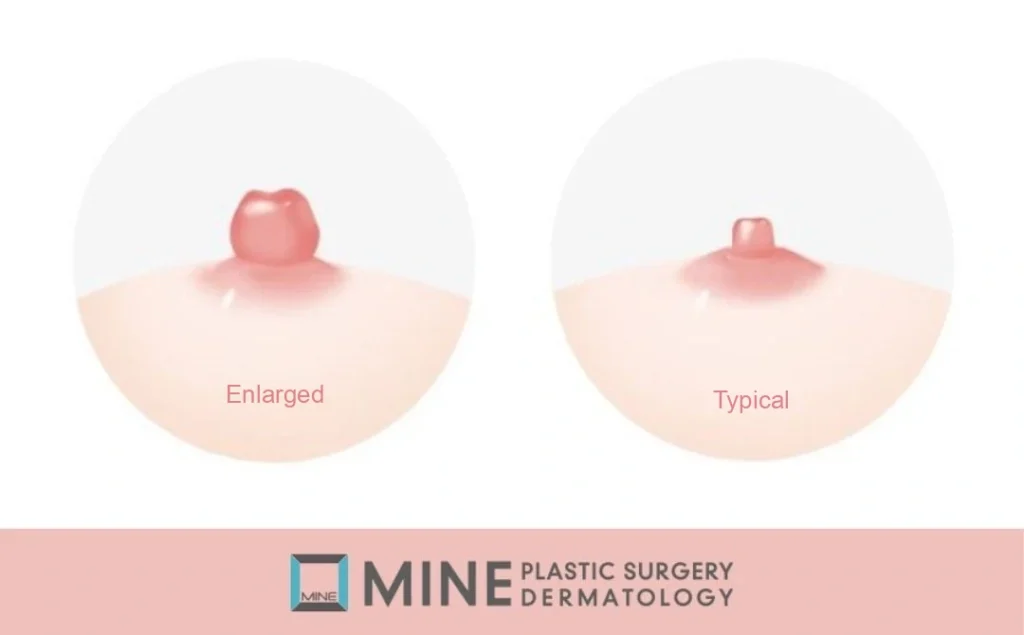
Normal nipple size is not one fixed measurement. Nipples vary widely from person to person, and plastic surgeons judge them mainly by proportion: a nipple roughly one-third the diameter of the areola (the darker circle of skin around it) tends to look balanced. Fit with the areola and the breast matters far more than any single number.
Many women I see are happy with their breasts, yet one thing quietly bothers them: nipples that look too large or too long, or that show through a thin top. Some start avoiding pools, saunas or fitted clothes, and most carry this private worry alone for years.
I’m Dr. Lee Sung-wook, a board-certified plastic surgeon at MINE Plastic Surgery in Seoul. Below I’ll explain what a normal nipple size really means, the five common causes of enlarged nipples, and how surgeons match a reduction technique to the nipple’s shape.
What Is a Normal Nipple Size? Why There Is No Single Number
A common misunderstanding I hear in consultation is that there must be an official chart for normal nipple size, with a “correct” width and height. In reality, there is no single medical standard. Nipple diameter and projection (how far the nipple sticks out) differ a great deal between healthy people and change with age, pregnancy and even temperature. Two women with very different measurements can both have a perfectly normal nipple size.
That is why online charts often disagree. Rather than chasing a figure in millimeters, look at how the nipple relates to the areola and the breast.
The 1:3 nipple-to-areola ratio behind normal nipple size
Plastic surgery textbooks describe a natural nipple-to-areola diameter ratio of about 1:3. In plain terms, the nipple is roughly one-third as wide as the areola around it. Breast surgery textbooks describe the areola itself as roughly 4 to 5 cm across. Surgeons use these proportions to describe a normal nipple size in terms of balance, but they are guides, not pass-or-fail limits.
The same textbooks note that the areola normally has small raised bumps called Montgomery glands (tiny oil and sweat glands that keep the skin moist). They are a normal part of the anatomy, not a sign of enlargement.
For a rough self-check, compare the width of your nipple with the width of your areola in the mirror. A nipple clearly wider than about one-third of the areola, or one that projects far beyond the surrounding skin, sits outside the typical proportion for normal nipple size. That is not a diagnosis; it only suggests a closer look may be worthwhile.
Signs your nipples may be larger than you’d like
- They show through clothing or a padded bra, even when you are not cold.
- Their projection or length bothers you, often after breastfeeding.
- There is a clear difference in size or shape between the left and right side.
- They rub against clothing during exercise or daily activity and feel uncomfortable.
None of these signs means your nipples are abnormal; normal nipple size covers a wide range. They are simply reasons people choose to talk with a surgeon.
5 Causes of Enlarged Nipples
Nipples that once matched a normal nipple size can enlarge later, while others are larger from the start. Knowing the cause helps your surgeon understand the tissue and choose the right approach.
Born with it: genetics and puberty hormones
1. Genetics. Some people simply inherit larger nipples, just as they inherit eye color or nose shape.
2. Puberty hormones. Hormonal changes in the teenage years drive breast and nipple development, and in some people this growth is more pronounced.
Pregnancy and breastfeeding
3. Pregnancy and nursing. In my clinical experience, this is the most common reason women ask about reduction. Pregnancy hormones enlarge the nipple, and months of breastfeeding stretch it. After nursing ends, stretched nipples often do not return to their former size on their own.
Weight change, friction and ageing
4. Major weight change. Rapid weight gain or loss affects skin elasticity across the breast. When the skin loosens, the nipple can look larger or start to droop.
5. Repeated friction and ageing. Constant rubbing from underwear can enlarge the nipple gradually, and with age the skin loses elasticity, so the nipple may lengthen or sag.
One important safety note: a sudden change on one side only, nipple discharge, a lump, or a change in the skin of the nipple or areola is a medical question, not a cosmetic one about normal nipple size. Please see a doctor first. MedlinePlus (U.S. National Library of Medicine) on breast conditions is a good starting point for general information.
When Nipple Reduction Is Worth Considering
Nipple reduction is a small procedure, but it is still surgery. People who tend to benefit are those whose nipples sit well outside the roughly 1:3 proportion surgeons associate with normal nipple size, show through clothing, became long or drooping after nursing, or cause physical discomfort.
Two groups should pause and plan carefully first. If you hope to breastfeed later, technique matters, because some methods divide the milk ducts; I explain this in my article on breastfeeding after nipple reduction. If your nipples point inward rather than being enlarged, that is a different condition; see inverted nipple recurrence or the complete guide to nipple reduction surgery in Korea.
Nipple Reduction Techniques: Matching the Method to Your Nipple’s Shape
No single nipple reduction suits everyone. The goal is not to hit a number but to bring the nipple back toward a normal nipple size for your areola and breast. The right method depends on whether your nipple is mainly too wide, too long, or both. I group the options into duct-preserving methods and larger-reduction methods.
Duct-preserving options: width, length and combined size correction
Why can some techniques spare the milk ducts? Plastic surgery textbooks explain that the lactiferous ducts (milk ducts) gather in a central core of the nipple, and this core is surrounded by a fine network of small blood vessels just under the skin. This layout lets a surgeon remove outer skin and tissue while leaving the central core and its blood supply in place.
Width correction. This suits nipples that are mainly wide. Part of the outer nipple skin is removed according to how much width needs to come off. The remaining tissue is then gathered toward the center and sutured, which helps prevent the nipple from spreading wide again.
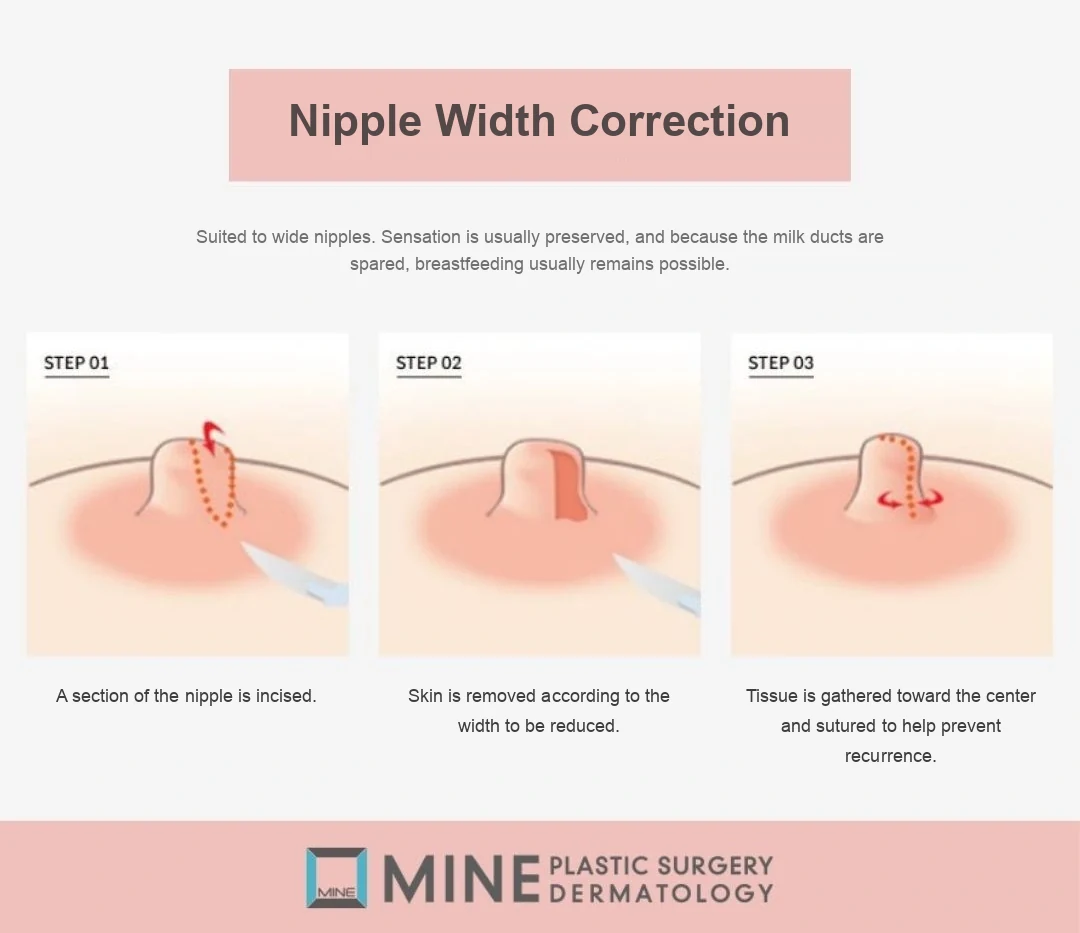
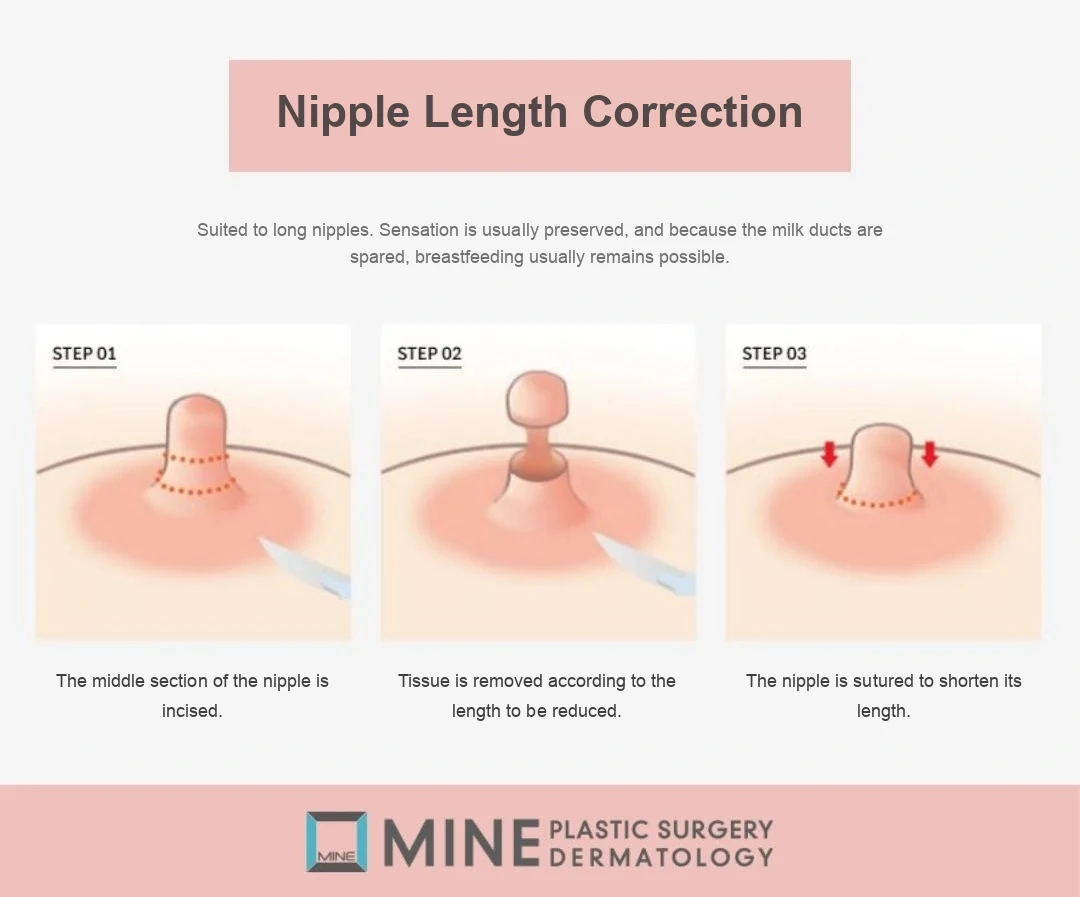
Length correction. This suits nipples that are mainly long. An incision is made around the middle section of the nipple, the excess length is removed, and the nipple is sutured back together at a shorter height. The approach is designed to preserve sensation and the milk ducts.
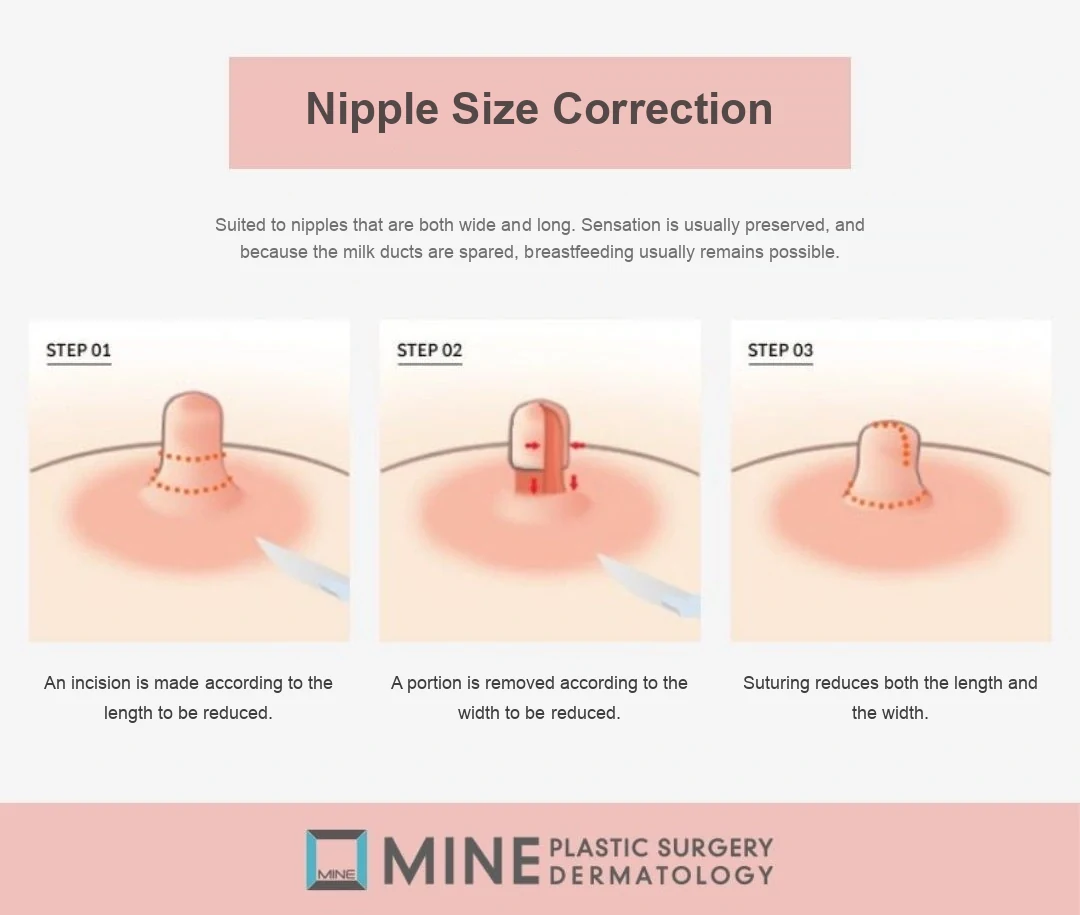
Size correction. When a nipple is both wide and long, well beyond a normal nipple size for its areola, the two methods are combined in one tailored excision. Length and width are reduced together while the duct core is preserved, with the aim of keeping a natural, rounded shape.
Larger-reduction options: V, L-shaped and wedge excision
These methods remove more tissue and generally suit people with no plans to breastfeed.
- V excision: The upper part of the nipple is removed in a V shape and closed. It gives a strong reduction, but the milk ducts are divided, so breastfeeding from that side should not be expected.
- L-shaped excision: Particularly effective for reducing length, and the operation itself is short. Depending on how it is performed, it may affect the milk ducts.
- Wedge excision: Nipple tissue and skin are removed in a wedge shape to reduce overall volume. As with the L-shaped method, the ducts may be affected depending on the technique.
Technique comparison at a glance
How each method reduces an enlarged nipple toward a normal nipple size:
| Technique | Suits (shape) | Reduction effect | Milk ducts |
|---|---|---|---|
| Width correction | Wide nipples | Moderate | Preserved by design |
| Length correction | Long nipples | Mild to moderate | Preserved by design |
| Size correction | Wide and long nipples | Moderate | Preserved by design |
| V excision | Large nipples needing strong reduction | Strong | Divided |
| L-shaped excision | Mainly long nipples | Strong | May be affected; ask your surgeon |
| Wedge excision | Overall bulky nipples | Strong | May be affected; ask your surgeon |
Surgery day: anesthesia, duration and discharge
Nipple reduction is usually done under local anesthesia and takes about 30 to 40 minutes for both sides, with same-day discharge. I recommend a method only after checking your nipple’s width, length, skin quality and pregnancy plans. See how we approach Korean nipple reduction at MINE on our procedure page.
Nipple Reduction Recovery: The First Three Weeks
Stitches are typically removed around day 7, and swelling and bruising usually settle within 1 to 2 weeks.
Recovery timeline table
| Stage | What usually happens |
|---|---|
| Day 1 to 2 | Mild soreness and swelling; light desk activity is often possible within a day or two |
| Around day 3 | First check-up and wound review |
| Around day 7 | Stitch removal and second check-up |
| Week 1 to 2 | Swelling and bruising usually settle |
| About 2 weeks | Strenuous exercise can usually resume, if your surgeon agrees |
| 2 to 3 weeks | Saunas and hot baths can usually resume |
What healing usually feels like
Light daily activity is often possible within a day or two, but your surgeon will confirm when your normal routines can fully resume. At first the nipples may feel tender and look slightly swollen, and some people notice reduced sensation that usually recovers over weeks to months.
The shape keeps refining for several weeks as swelling fades, so judge the new proportion, and whether it now looks like a normal nipple size for you, after healing is complete.
Risks and Precautions Before and After Nipple Reduction
Possible side effects, honestly explained
Every operation carries some risk. These are the points I go over with every patient:
- Temporary numbness: Sensation may feel dull for a while; in most cases it returns within weeks to months.
- Scarring: Nipple skin usually heals well, so scars are often inconspicuous, but this varies with skin type.
- Infection or bleeding: Uncommon, but possible.
- Asymmetry: Over- or under-correction can leave the two sides slightly uneven.
- Permanent change in sensation: Rare, but it can happen.
Before surgery: a 4-point checklist
- Review your medicines. Blood-thinning medicines and supplements such as aspirin and vitamin E are usually paused 7 to 10 days before surgery, with your doctor’s approval. Never stop a prescribed medicine on your own.
- Stop smoking for about 2 weeks before and after surgery; it slows wound healing.
- Share your health history. Tell your medical team about conditions such as high blood pressure or diabetes.
- Check your cycle. Bleeding can increase during your period, so it is better not to schedule surgery then.
After surgery: a 5-point checklist
- Keep the area clean and follow your wound-care instructions.
- Avoid pressure. Skip tight bras and compressive underwear; choose soft, comfortable ones.
- Rest from hard exercise for about 2 weeks.
- Avoid heat. Saunas and hot baths are best avoided for 2 to 3 weeks, and strenuous exercise for about 2 weeks.
- Attend every check-up on the scheduled dates.
Normal Nipple Size and Nipple Reduction: Frequently Asked Questions
What is a normal nipple size?
There is no single normal nipple size. Healthy nipples vary widely in width and projection. Plastic surgery textbooks describe a natural nipple-to-areola diameter ratio of about 1:3, with an areola of roughly 4 to 5 cm across, so surgeons look at proportion and balance with the breast rather than one measurement.
Can enlarged nipples shrink on their own?
Nipples enlarged by pregnancy, breastfeeding or ageing often do not return to their former size without treatment. Creams and devices that claim to shrink nipples lack reliable evidence. A sudden change, especially on one side, should be checked by a doctor.
Does nipple reduction leave noticeable scars?
The incisions are small and nipple skin usually heals well, so scars are often inconspicuous. Healing varies, so if you tend to form raised or keloid scars, mention it at your consultation.
Can nipple and areola reduction be done at the same time?
Yes. If both the nipple and the areola concern you, they can be corrected in one operation. It can also be planned together with breast augmentation or breast reduction for a more balanced result.
How long is recovery after nipple reduction?
Stitches are usually removed around day 7, and swelling and bruising tend to settle within 1 to 2 weeks. Strenuous exercise is generally paused for about 2 weeks, and saunas or hot baths for 2 to 3 weeks.
Can I breastfeed after nipple reduction, and can men have it?
Breastfeeding depends on whether the technique preserves the milk ducts; read more about breastfeeding after nipple reduction. Men can have the procedure too, and it is often simpler because duct preservation is less of a concern. See my article on male nipple reduction.
Not Sure If You Have a Normal Nipple Size? Talk to Dr. Lee
Photos and online charts cannot tell you whether you have a normal nipple size for your body. Proportion, skin quality, future breastfeeding plans and overall breast balance all shape the answer, and they are judged most reliably in person.
At MINE Plastic Surgery in Gangnam, Seoul, I examine each patient personally, explain whether your nipples fall within a normal nipple size for your build, and go over the options before any plan is made. You can read more about Korean nipple reduction at MINE, start with an online consultation, or call +82-2-516-1175.
※ This content is for informational purposes only and does not replace professional medical advice, diagnosis, or treatment. Individual results may vary, and side effects may occur. Please consult with a board-certified plastic surgeon for personalized advice.