EN


Inverted nipple surgery breastfeeding planning starts with one fact: inverted nipple surgery releases the short milk ducts and fibrous bands that pull the nipple inward, and whether those ducts are preserved or divided decides whether you can nurse from that side later. The right method therefore depends on two things, your inversion grade and your plans for breastfeeding.
In my consultation room, people considering this operation almost always ask me two questions: “Will I still be able to breastfeed?” and “Will it go back in?” The two are linked. To make re-inversion less likely, the structures holding the nipple down have to be released more completely, and if that release cuts through the milk ducts, breastfeeding on that side is affected. Keep the ducts, and some chance of the nipple sinking back remains.
I’m Dr. Lee Sung-wook, a board-certified plastic surgeon at MINE Plastic Surgery & Dermatology in Seoul. This guide is built around a single decision: given your grade and your nursing plans, which approach should you start from? It also covers a question few articles answer: if your nipple inverts again after duct-preserving surgery, can the ducts be spared a second time?
What Inverted Nipple Surgery Means for Breastfeeding
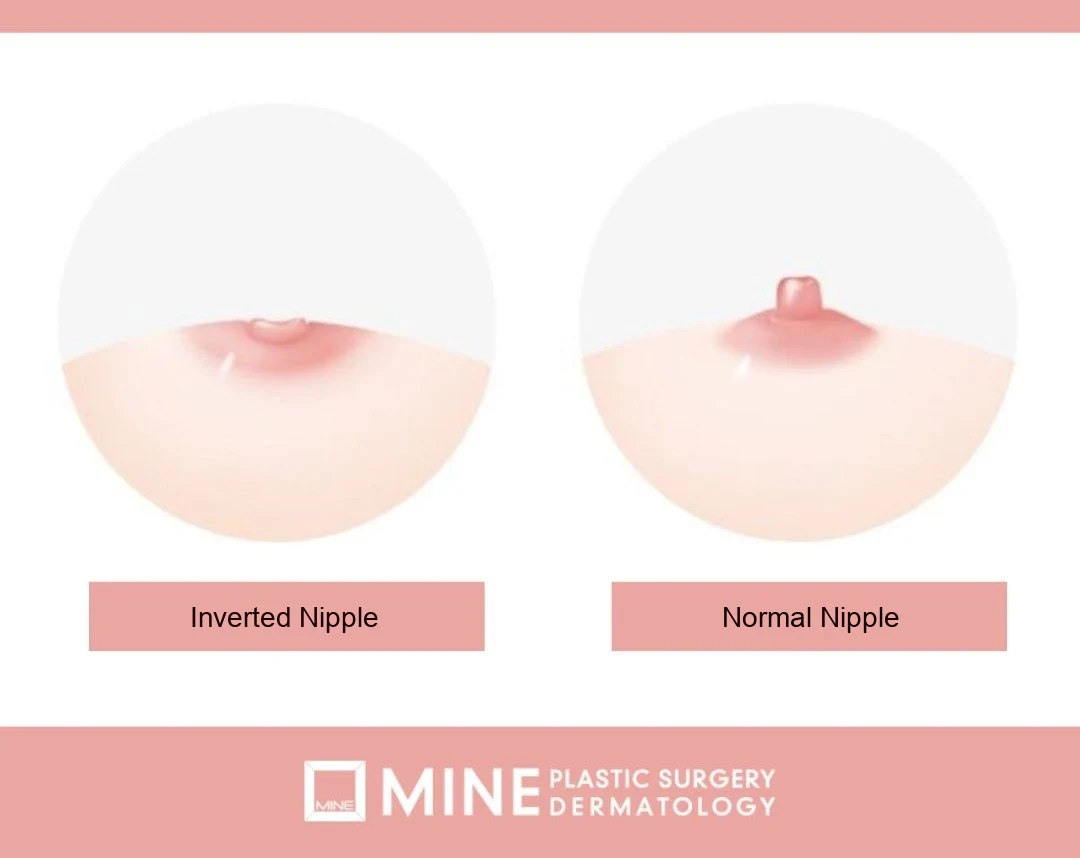
An inverted nipple is one that folds inward into the areola instead of pointing outward. It is easy to think of it as purely cosmetic, but it can cause practical problems too. After childbirth, a baby may struggle to latch onto a nipple that stays tucked in, and repeated attempts can leave the nipple sore or cracked and raise the risk of mastitis (a painful breast infection). Sweat and secretions can also collect in the fold and lead to odour or irritation. And many people simply feel self-conscious in swimwear or in intimate moments.
Why short ducts and fibrous bands pull the nipple in
Plastic surgery textbooks describe two main culprits. The first is milk ducts (the small tubes that carry milk to the nipple) that are shorter than normal. The second is tight fibrous tissue, like little internal tethers, anchoring the nipple from underneath. Together they act like a drawstring pulling the nipple inward. The stronger that pull, the more severe the inversion and the more tissue has to be released to bring the nipple out.
Why the method you choose decides whether you can nurse
Breast anatomy texts show that the milk ducts gather from all over the breast and converge into the centre of the nipple. That is the key to everything in this article. If the ducts are divided just beneath the nipple, milk from that breast no longer has a route out. So the most important question in inverted nipple correction is not “how” in general, but “how much of the duct system will be kept?” For a broader introduction to the condition and the procedure, see my overview of inverted nipple correction in Korea.
Dr. Lee’s key point: An inverted nipple is not only a cosmetic issue. It can affect breastfeeding and hygiene, which is why the choice of technique matters so much.
Check Your Grade First: Who Is a Candidate for Which Approach
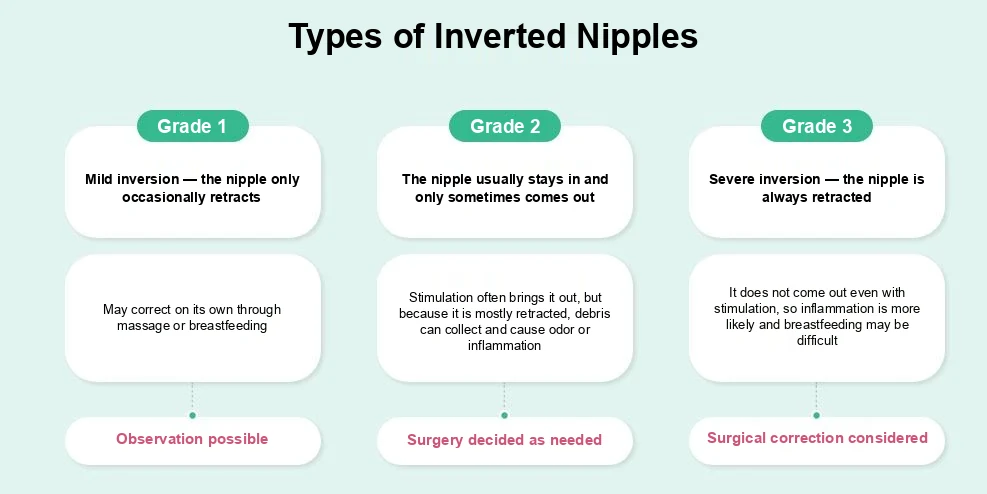
Plastic surgery textbooks classify nipple inversion into 3 grades, based on how easily the nipple comes out and whether it stays out. Knowing your likely grade is the first input in any inverted nipple surgery breastfeeding decision, because it shows which options are realistic before you even sit down for a consultation.
Grade 1: comes out easily and stays
The nipple is usually out and only occasionally retracts. A light touch brings it out, and it stays out for a while. The pull here is weak, so if it causes you no trouble, simply keeping an eye on it is reasonable. If it bothers you, a non-surgical or simple correction may be worth trying first.
Grade 2: comes out but sinks back quickly
Stimulation brings the nipple out, but it slips back in as soon as you let go. This tells us the tissue around the ducts is pulling quite firmly. When grade 2 patients want correction, I usually plan a duct-preserving operation first.
Grade 3: does not come out at all
Fibrous tissue and short ducts hold the nipple down so firmly that no amount of stimulation brings it out. Non-surgical methods have little to offer here, and correction means surgically releasing the tethers. Of the three grades, grade 3 is the one most likely to need some of the ducts divided.
| Grade | Comes out? | Stays out? | First approach to consider |
|---|---|---|---|
| Grade 1 | Easily | Yes | Observation; non-surgical or simple correction if desired |
| Grade 2 | Yes | No, sinks back quickly | Duct-preserving surgery first |
| Grade 3 | No | – | Surgery that may include partial duct division |
Dr. Lee’s key point: Two people with grade 2 inversion can have very different amounts of pull. Your final grade is decided by examination, not by a home check alone.
Inverted Nipple Surgery Breastfeeding Decision Matrix: Grade × Nursing Plan
Every technique for inverted nipple correction falls on one side of a basic divide: it either keeps the milk ducts or cuts them. Before looking at the matrix, it helps to understand what each approach actually does.
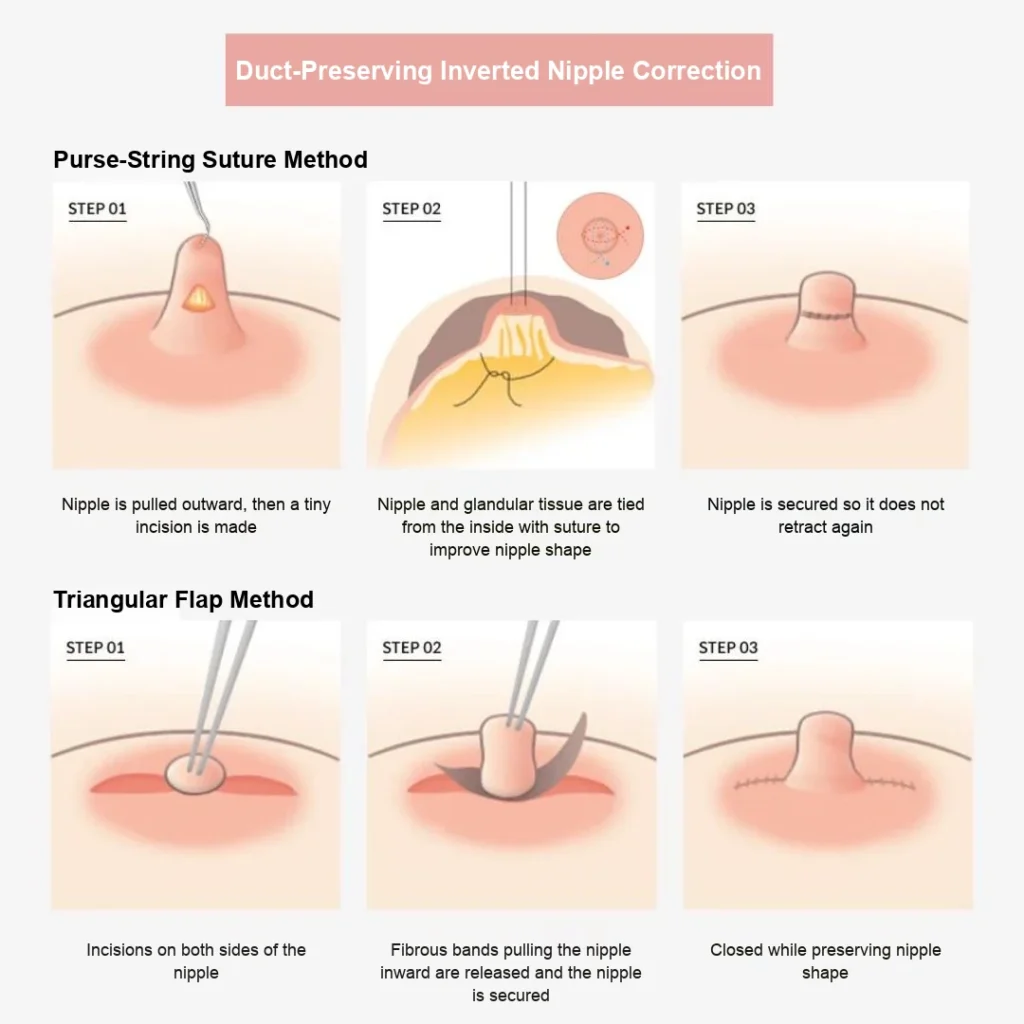
Duct-preserving correction (purse-string suture, triangular flap)
Here the surgeon selectively releases only the fibrous bands pulling the nipple in and keeps the milk ducts as intact as possible. Methods such as the purse-string suture (a stitch placed in a circle and drawn tight like the cord of a pouch) and the triangular flap (small triangles of nearby tissue used as a support) belong to this group. Both work by giving the nipple a firm base from underneath, using either suture or the patient’s own tissue.
- Advantages: better at protecting the possibility of future breastfeeding, and better at preserving nipple sensation.
- Limitations: may be hard to apply in severe grade 3 inversion, and leaves more chance of re-inversion than duct-dividing correction.
- Usually considered for: grade 1–2 inversion in people who hope to breastfeed.
Duct-dividing correction: what the textbook technique does
In this approach, the short ducts and surrounding fibrous tissue are cut so the nipple is fully freed, and the base of the nipple is then narrowed from the inside so it cannot sink back. The technique described in a standard breast surgery textbook uses an incision of about 3 mm at the base of the nipple, where it meets the areola.
While a temporary stitch gently pulls the nipple outward, the deeper ducts and tethering structures are divided with fine scissors. The surgeon feels the nipple skin with a fingertip throughout so that its inner layer is not cut by mistake. Finally, an absorbable stitch is run around the inside of the base like a drawstring, making the base narrower than the nipple itself so the nipple has nowhere to retreat.
- Advantages: releases the tethering structures thoroughly, putting the weight on lowering the chance of re-inversion; can be used even in severe grade 3 cases.
- Limitations: breastfeeding from the treated side is effectively no longer possible, and divided ducts cannot be restored, so the decision needs careful discussion beforehand.
- Usually considered for: grade 2–3 inversion in people who have finished breastfeeding or have no plans to, or for whom avoiding re-inversion is the priority.
The matrix: which method to start from in your situation
This is how I approach inverted nipple surgery breastfeeding decisions at consultation. Read across your row: the middle column is where we start, and the right column is what we weigh together before deciding.
| Your situation | Method to consider first | What to weigh at consultation |
|---|---|---|
| Planning to have children and nurse, grade 1–2 | Duct-preserving surgery | The chance of re-inversion, and what the options would be in a revision |
| Planning to have children and nurse, grade 3 | Examination first: can the ducts realistically be preserved? | If preservation looks difficult, whether to postpone surgery until after breastfeeding |
| Finished breastfeeding, or no plans to nurse | An approach that lowers re-inversion, including duct division | Possible change in nipple sensation |
| One side much worse than the other | Assess each side separately | Symmetry if the two sides receive different methods |
The grade 3 row deserves a word of honesty. If you are planning to nurse and your nipple is held down very firmly, we first check whether a duct-preserving release is genuinely feasible. If it is not, postponing surgery until you have finished breastfeeding is a perfectly reasonable choice, and sometimes the wisest one. Surgery is not recommended during pregnancy or while nursing in any case.
If you want to see how a wider range of nipple procedures compare on this point, I’ve written separately about how different nipple techniques affect breastfeeding. To confirm a surgeon’s specialist credentials in Korea, you can also refer to the Korean Society of Plastic and Reconstructive Surgeons.
Common misunderstanding: “other ducts will still work”
Patients often tell me, “Even if a few ducts are cut, the rest will still carry milk, right?” Unfortunately, it doesn’t work that way. When duct-dividing correction is used, you should assume that breastfeeding from that breast is effectively not possible, and textbooks stress that this must be weighed before surgery. That is why, if you hope to nurse one day, the starting point is a method that leaves the ducts intact.
The opposite is also true: preserving the ducts does not guarantee that breastfeeding will succeed. Milk supply depends on many factors, including the condition of the glandular tissue and how things go after delivery. It is most accurate to think of duct-preserving surgery as a choice that keeps the possibility open, not a promise.
Dr. Lee’s key point: Please tell me about any plans for pregnancy and nursing at your consultation. Once ducts are divided they cannot be reconnected, so your grade and your plans are always weighed together.
If It Recurs After Duct-Preserving Surgery: Can Ducts Be Saved Again?
“I had surgery, so why has it gone back in?” Re-inversion is one of the concerns patients raise most often. I cover the full list of causes and prevention steps in a separate article on the causes and prevention of re-inversion. Here I’ll keep to what matters for inverted nipple surgery breastfeeding plans: choosing a method and planning a second operation.
Why re-inversion happens (3 short causes)
- Tethering tissue left behind: if the fibrous bands or short ducts were not released enough, what remains can pull the nipple back in.
- Weak support underneath: if the stitches or tissue support under the nipple are not strong enough, the nipple can settle back down as it heals.
- Early aftercare lapses: the first weeks after surgery, when the nipple must be kept in its new position, matter a great deal. Skipping the protector or taping during this period raises the risk.
Four things checked before revision
A re-inverted nipple can usually be corrected again, but a revision is not the same as a first operation. Before a revision, I check four factors: what was done the first time, your current nursing plan, the scar tissue, and the timing.
- What the first operation actually did. Whether the ducts were preserved or divided changes what is still possible. If the ducts on that side were already divided, there is nothing left to preserve there, and the revision is planned on that basis. Please bring your operative records if you can.
- Your nursing plan now. Your plans may have changed since the first surgery. Revisions often bring duct division onto the table, because it gives a more thorough release, so I will ask you to state your plans again before we decide.
- Scar tissue. Scarring from the first operation can itself become a new tether pulling the nipple in. Freeing it while sparing the ducts takes finer, more careful dissection than the first time.
- Timing. Revision is generally done once swelling and scarring have fully settled. The exact timing is set individually after examination.
So, can the ducts be saved again? Sometimes, yes, if they were not divided the first time and the scar and tension allow it. But neither a yes nor a no can be promised before examination; the answer comes from looking at these four factors together.
Pre-revision checklist to bring to consultation
- Operative records from your first surgery (if they are in another language, a translated summary helps)
- Roughly when you might become pregnant or plan to nurse
- Which side or sides have re-inverted, and how the nipple behaves now when stimulated
- When the first operation was done
Dr. Lee’s key point: Releasing the tethers fully, building good support and following early aftercare are what keep re-inversion down. For a revision, the first operation and your current nursing plan are the starting points.
Recovery Timeline After Inverted Nipple Correction
Recovery is much the same whichever side of the inverted nipple surgery breastfeeding trade-off you choose. Inverted nipple correction uses small incisions, and most patients go home the same day. Here is what a typical course looks like.
What to expect week by week
| Timing | What to expect |
|---|---|
| Day of surgery | Usually done under local anaesthesia; takes around 30 minutes depending on the method; you go home the same day |
| Days 1–3 | Mild swelling and discomfort; most daily activities are possible |
| Weeks 1–2 | Stitches removed if needed; wear the protector for the period you are told |
| Weeks 2–4 | Most swelling has gone; light exercise is possible |
| Months 1–3 | The shape settles |
At MINE, we follow your recovery through our aftercare programme, which is especially helpful during the early weeks when the nipple position is still setting.
Dr. Lee’s key point: This is usually a same-day procedure, but how you care for the nipple afterwards affects the result. Please follow your aftercare instructions closely.
Risks and Precautions Before and After Surgery
The incisions are small, but every operation carries some risk. Knowing what to expect helps you avoid unnecessary worry.
Common, usually temporary reactions
- Swelling and bruising: usually fade gradually over 1–2 weeks.
- Temporary change in sensation: the nipple may feel numb or oversensitive for a while. This usually recovers with time, though the pace varies from person to person.
Less common risks to know
- Re-inversion: thorough release, solid support stitches and good aftercare reduce the chance.
- Infection: rare, and more likely if wound care is neglected. Come in straight away if you develop a high fever or severe pain.
- Scarring: incisions are usually small and placed at the nipple base or along the edge of the areola, so they tend to be fairly discreet and fade over time, though this depends on your skin.
- Duct injury: depending on the extent of surgery, the ability to breastfeed can be affected. If you choose duct division, decide knowing that nursing from that side will not be possible.

Before surgery checklist
- Stop aspirin, omega-3, vitamin E and other medicines or supplements that can increase bleeding 2 weeks before surgery, after checking with your doctor.
- Stop smoking at least 2 weeks before, as it slows wound healing.
- Wear a comfortable front-opening top on the day, and bring a sports bra rather than an underwire.
- Tell us about your nursing plans, any previous nipple surgery and any breast-related medical history.
After surgery: what to follow
- No alcohol or smoking: avoid both for at least 4 weeks, as they slow recovery.
- Protector: wear it for the full period you are told, to keep the nipple in its corrected position.
- Keep it clean and dry: shower only as instructed by your care team.
- Limit movement: avoid wide arm movements and heavy lifting for 2 weeks.
- Warning signs: severe pain, high fever or unusual discharge mean you should come in promptly.
Frequently Asked Questions
Can you breastfeed after inverted nipple surgery?
It depends on the method. On a side where the milk ducts were divided, breastfeeding is effectively not possible. Duct-preserving surgery keeps the possibility open, but it cannot guarantee successful nursing, because milk supply also depends on your glandular tissue and how things go after delivery.
How do I know which inverted nipple grade I have?
Gently stimulate the nipple. If it comes out and stays out, that suggests grade 1; if it comes out but sinks back quickly, grade 2; if it never comes out, grade 3. This is only a rough guide, and your final grade is confirmed by examination.
Can ducts be preserved again in revision surgery?
Only if they were not divided the first time and the scar tissue and tension allow it. This is decided by examination. Because revisions often consider duct division for a more thorough release, please state your nursing plans clearly before a second operation.
Should I wait until after breastfeeding to have surgery?
Surgery is not recommended during pregnancy or while nursing. If you have grade 3 inversion, plan to breastfeed, and examination shows that keeping the ducts would be difficult, postponing surgery until after breastfeeding is a reasonable option to discuss.
What anaesthesia is used for inverted nipple surgery?
Usually local anaesthesia. You may feel a brief sting during the injection, but once it takes effect, pain during the procedure is kept well under control. If you feel very anxious, let us know at consultation.
Can I have only one side corrected?
Yes. If only one nipple is inverted, only that side needs surgery. When both are inverted they are often corrected on the same day, and if the two sides are different grades, each can be treated with a different method.
Can men have inverted nipple correction?
Yes. Men can also have inverted nipples, and the same principles of surgical correction apply. Because breastfeeding is not a consideration, the range of suitable methods may be wider.
Planning Your Consultation at MINE
To sum up, the direction of inverted nipple surgery breastfeeding decisions is set by your nursing plans. If you hope to breastfeed, we start from duct-preserving correction. If you have finished nursing, or re-inversion worries you more, we can also discuss duct division. Which approach is truly right for you, though, can only be decided by examining how strongly your tissue is pulling.
If you have had surgery before, please bring your operative records; if you are planning a pregnancy, a rough timeline helps too. You can read more about our techniques on the MINE nipple surgery page. At our clinic near Apgujeong Station in Seoul, every patient has a 1:1 in-person examination with me before we choose a method. International patients are welcome to start with an online consultation, by WhatsApp or by email, or call +82-2-516-1175.
※ This content is for informational purposes only and does not replace professional medical advice, diagnosis, or treatment. Individual results may vary, and side effects may occur. Please consult with a board-certified plastic surgeon for personalized advice.