EN



An inverted nipple self check is a simple at-home routine (a mirror check, a gentle pinch test and a short symptom list) that shows whether your nipple tends to stay pulled in and which of the three clinical grades it most likely resembles, before a doctor confirms it at an exam.
Maybe you noticed it in the shower or while changing, and it has been on your mind ever since. An inverted nipple is far more common than most people think, but because it is such a private area, many women worry about it alone for years. Searching online often makes the worry bigger, not smaller.
I’m Dr. Lee Sung-wook, a board-certified plastic surgeon at MINE Plastic Surgery & Dermatology in Seoul. In this guide I’ll walk you through an inverted nipple self check you can do in about 2 minutes in front of a mirror, how to read the result, and which signs mean you should see a breast specialist first. One thing to keep in mind from the start: a self check gives you a rough idea and flags warning signs, but your actual grade is confirmed at an in-person exam. If you want to know why inversion happens in the first place, read what causes inverted nipples.
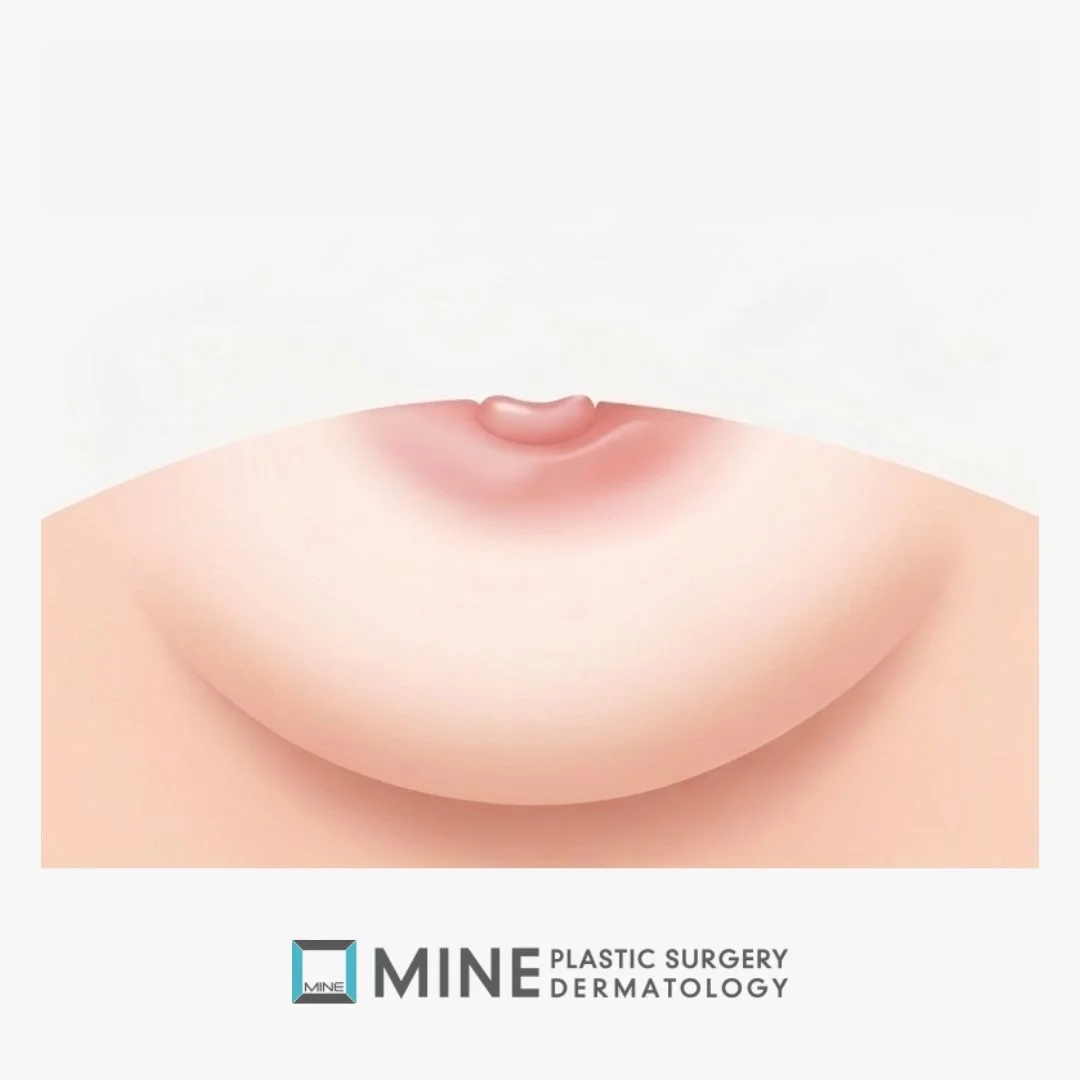
Table of Contents
Table of Contents
What Is an Inverted Nipple? A 1-Minute Primer
An inverted nipple is a nipple that sits inward, into the areola (the darker skin around it), instead of pointing outward. Underneath the nipple run milk ducts, the small channels that carry milk to the surface. When these ducts are unusually short, or when fibrous bands of tissue tether the nipple from below, the nipple is held in.
The causes fall into three broad groups:
- Congenital: present from birth because the ducts formed short. This is the most common type and often affects both sides.
- Acquired: appears later, after pregnancy and breastfeeding, rapid weight loss, breast infection (mastitis) or, rarely, a breast tumor.
- Age-related: skin and breast tissue lose elasticity, so inversion can show up for the first time in middle age.
Doctors usually describe inverted nipples on a 3-grade scale, based on how easily the nipple comes out and whether it stays out. The inverted nipple self check below follows the same logic, so you can see roughly where you fit. For a fuller explanation of each cause, see our article on what causes inverted nipples.
How to Do an Inverted Nipple Self Check in 3 Steps
An inverted nipple self check takes about 2 minutes and has 3 steps: a mirror check, a pinch test and a symptom checklist. Before you start:
- Use good light and a mirror where you can see both breasts.
- Warm your hands first. Cold fingers make the nipple react.
- Avoid checking straight after a cold shower or exercise, when the nipple may look different from usual.
- Always check both sides and compare them.
Step 1: The Mirror Check
This first part of an inverted nipple self check is simply looking. Stand facing the mirror with your arms relaxed at your sides, then raise them above your head and look again. Raising your arms tightens the skin and can make a subtle inversion easier to see. Notice which of these best describes each nipple at rest:
| What you see at rest | What it may suggest |
|---|---|
| The nipple points outward normally | Normal projection |
| The nipple is flat, level with the areola | Borderline, or an early grade 1 pattern |
| The nipple sits inside the skin | Grade 1 pattern or higher |
| The nipple is deeply pulled in and barely visible | Grade 2 to 3 pattern |
Also note whether the two sides look the same. Inversion that has been there since your teens on both sides is the usual pattern. A difference that is new is worth paying attention to, as we’ll cover in the red flags section.
Step 2: The Inverted Nipple Pinch Test
The pinch test is the most useful part of an inverted nipple self check, because it shows how firmly the nipple is being held in.
- Place your thumb and index finger on the skin just outside the edge of the areola, one on each side of the nipple.
- Press gently inward and then bring your fingers together, as if easing the nipple outward. Do not squeeze hard.
- Let go and watch the nipple for a few seconds. Does it come out? Does it stay out, or sink back?
Repeat on the other side. The test should not hurt. If it is painful, or if any fluid comes out, stop and make a note of it, because discharge is one of the signs that needs a doctor’s attention first.
Step 3: The Everyday Symptom Checklist
The last step looks at how the nipple affects your daily life. Check whether any of these apply to you:
- Eczema, irritation or skin trouble keeps coming back around the nipple.
- There is an odor or discharge from the inverted area.
- When breastfeeding, your baby can’t latch on properly.
- You feel self-conscious wearing thin or fitted clothing.
- The inversion appeared within the last few months (if so, see the red flags section: breast imaging comes first).
If you ticked one or more items, it is worth seeing a specialist. At that point the issue is not only cosmetic; it can affect hygiene, comfort and breastfeeding too.
Dr. Lee’s key point: If your pinch test looks like a grade 2 or 3 pattern, or you’re dealing with hygiene or breastfeeding problems, that is the time to think seriously about correction.
Reading Your Pinch Test: Grade 1, 2 or 3 Signs
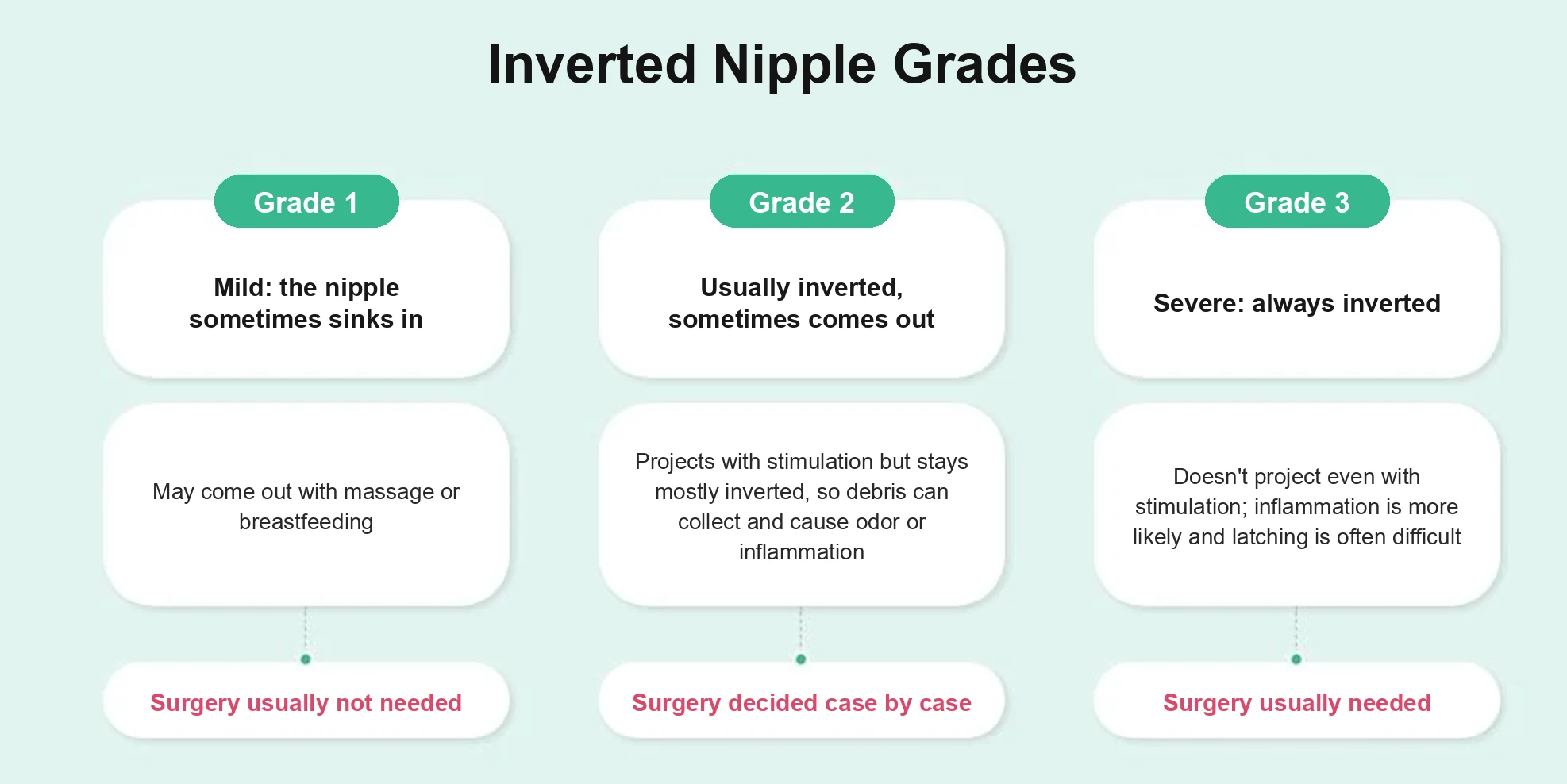
A widely used clinical classification, described in plastic surgery literature since the late 1990s, sorts inverted nipples into 3 grades. Put simply, grade 1 comes out easily and stays out, grade 2 comes out but sinks back, and grade 3 will not come out without force. Here is how your inverted nipple pinch test result usually lines up:
| What you see after letting go | Likely pattern | What it usually means | Typical next step |
|---|---|---|---|
| Comes out easily and stays out | Grade 1 | Little fibrous tissue holding the nipple in | Often managed without surgery, such as with a suction device or a simple correction; surgery is usually not needed |
| Comes out, but sinks back as soon as you let go | Grade 2 | Moderate tightening of the ducts and surrounding tissue | Correction usually works well; the decision is made case by case |
| Won’t come out, or only with strong force | Grade 3 | Marked fibrous tissue and short ducts | Surgical release is usually needed |
Treat the table as a guide to your inverted nipple self check, not a diagnosis. Temperature, touch and arousal can all change how a nipple looks on a given day, so the same nipple may seem different from one check to the next. Different grading systems also exist, so your doctor may describe your nipple slightly differently.
A note on breastfeeding: with a grade 3 pattern, latching is often difficult. Whether breastfeeding is possible depends on the individual, and if you have a correction, on how the milk ducts are handled during surgery. If future breastfeeding matters to you, read our guide on breastfeeding and choosing a method by grade.
What a Self Check Can and Can’t Tell You
An inverted nipple self check is a good first step, but it has clear limits. Knowing them helps you use the result well and avoid unnecessary worry.
What It Can Tell You
- A rough sense of which grade pattern your nipple resembles
- Whether the two sides are different
- Whether you have symptoms such as hygiene trouble, latching problems or discomfort
- Whether any red flags are present that need a breast check first
What Only an Exam Can Tell You
- How much fibrous tissue is holding the nipple in
- How short the milk ducts are, and whether they can be preserved
- Which correction technique, if any, suits you
- Whether a new change is benign
So bring your notes to the consultation: when you first noticed it, whether it is on one side or both, what happened in the pinch test, and any discharge or skin changes. These details make the exam faster and more useful. Our article on what causes inverted nipples also lists questions worth asking at your appointment.
Red Flags: When to Get Breast Imaging Before Anything Else
Most inverted nipples are harmless. Inversion that has been present since puberty, on both sides, is the usual benign pattern. However, a nipple that turns inward can also be a sign of a breast condition, so some changes you notice during an inverted nipple self check should be examined by a breast specialist before anyone talks about cosmetic correction. Watch for:
- A nipple that has suddenly turned inward on one side, within recent months
- Nipple discharge, especially if it is bloody or from one side only
- A hard lump in the breast or armpit
- Dimpling of the skin, or skin that looks like orange peel
- A change in the color or texture of the areola, or a rash on the nipple
An inverted nipple that appears suddenly on one side, or comes with discharge or a lump, should be checked with breast ultrasound or mammography before any cosmetic correction. This comes first, for your safety.
The NHS lists a nipple turning inwards among the changes to have checked by a doctor (NHS guidance on breast changes to look out for), and its page on nipple discharge explains when discharge needs a GP visit. Most breast changes turn out not to be cancer, but only an exam and imaging can tell.
If Correction Makes Sense: A Short Overview
If your inverted nipple self check and exam point toward correction, the approach depends on your grade and your goals. We don’t recommend surgery for everyone who has an inverted nipple; the plan is built around your pattern and what you want.
- Grade 1 pattern: may improve with a suction device or a simple correction. Because inversion is a structural problem underneath, though, temporary methods can stop working once you stop using them. If the nipple keeps going back in, or hygiene or breastfeeding problems continue, surgical release is considered.
- Grade 2 to 3 patterns: the tissue that pulls the nipple in is released surgically so the nipple can stay out on its own.
The incision is small and sits at the base of the nipple, along the edge of the areola, where the scar is hard to see. Plastic surgery textbooks describe the nipple and areola as fed by a fine network of blood vessels just under the skin, which is one reason surgeons work through a small incision rather than a large one. Inverted nipple correction usually takes about 30 to 60 minutes under local anesthesia, without an overnight stay.
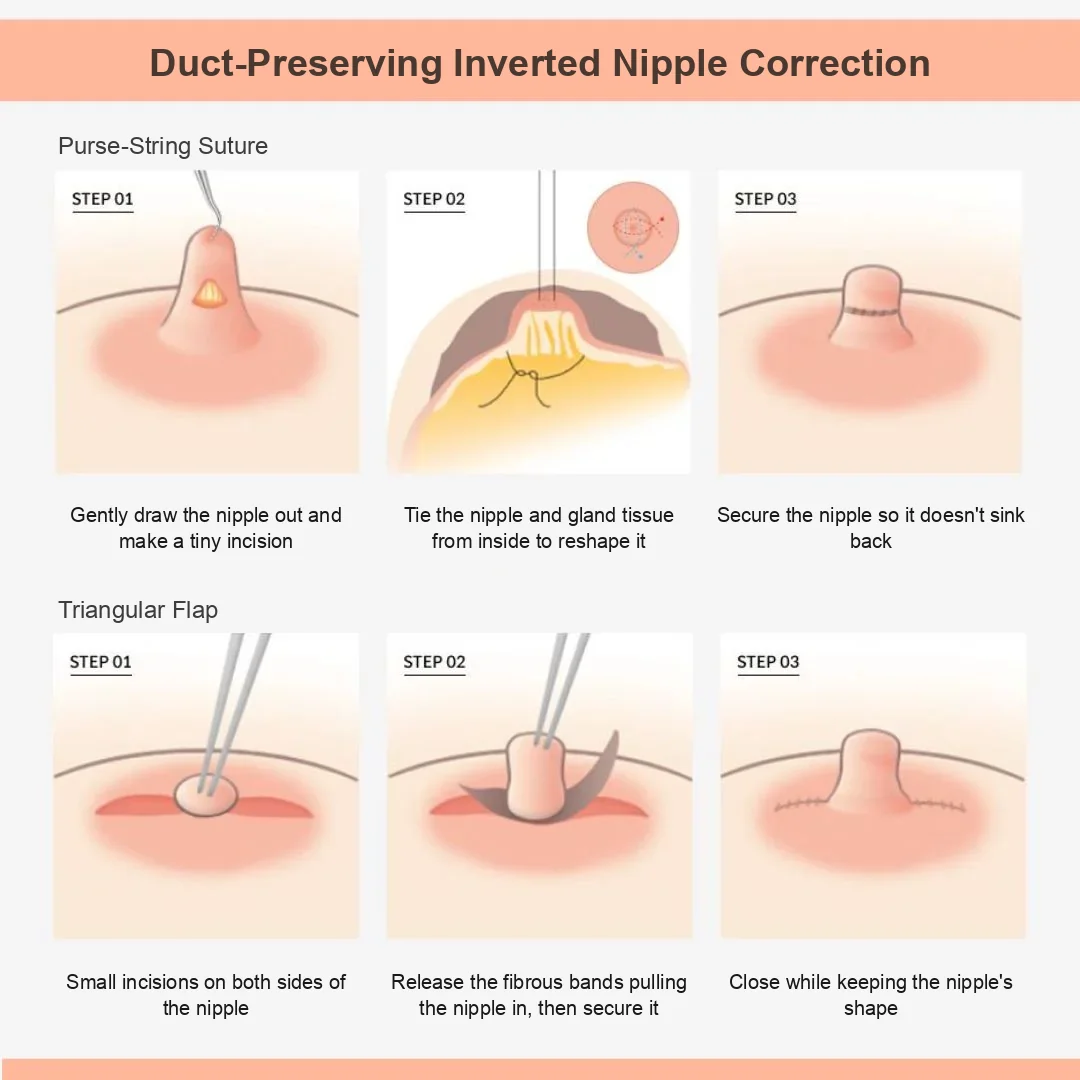
If you want to breastfeed in the future, tell your surgeon at the consultation. Duct-preserving techniques, such as the purse-string suture and the triangular flap, are designed to keep the milk ducts in place, and this choice directly affects the plan. For the full technique, risks and grading at our clinic, see our full guide to inverted nipple correction in Korea.
Recovery at a Glance
If you go ahead after your inverted nipple self check and consultation, recovery is usually short. Stitches are usually removed 7 to 10 days after inverted nipple correction, and most swelling settles within 2 to 4 weeks.
| Time after surgery | What to expect |
|---|---|
| Days 1 to 3 | Mild pain, swelling and a little oozing; a compression dressing stays on |
| Days 3 to 5 | Most people return to desk work; avoid strenuous movement |
| Days 7 to 10 | Stitches are removed at a clinic visit; normal showering from then |
| Weeks 2 to 4 | Most of the swelling goes down |
| Months 1 to 3 | The final shape becomes clear |
Possible side effects include:
- Swelling, bruising and temporary pain or reduced sensation, which usually settle within a few weeks
- Infection, which is rare and is largely prevented with prescribed antibiotics and good hygiene
- A small scar at the base of the nipple, usually hard to notice
- Recurrence, which depends largely on how thoroughly the fibrous tissue is released. Surgical textbooks also note that nipple projection can lessen over time after correction, which is why the shape is followed over the first 1 to 3 months. Read more on why an inverted nipple can come back.
- Reduced breastfeeding function if a method that divides the ducts is chosen
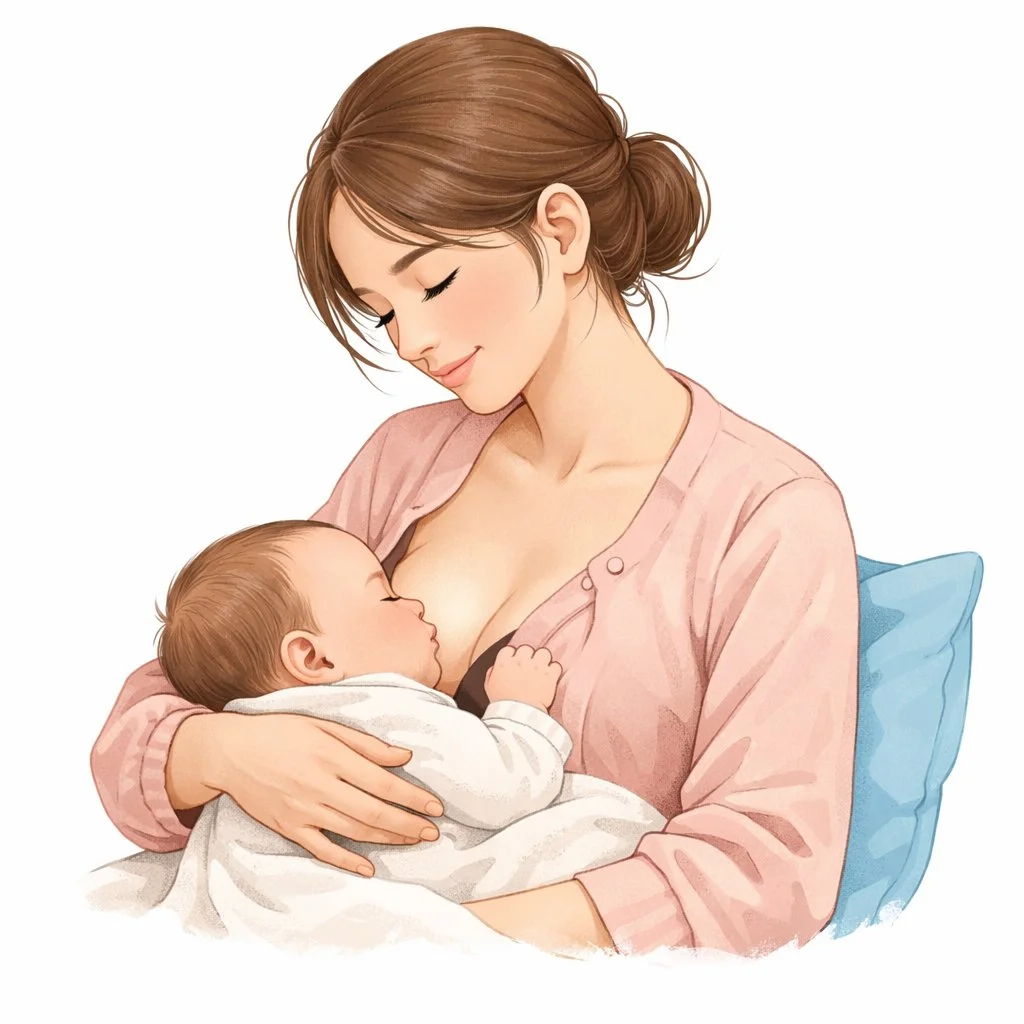
Before surgery, a few things matter. Have imaging done first if the inversion is acquired or there is discharge. If you take aspirin or blood thinners, ask your doctor whether and when to stop them, usually about 2 weeks before. Stop smoking at least 2 weeks beforehand, because smoking reduces blood flow and slows healing. If you are breastfeeding now, wait until you have finished; at least 3 months after weaning is recommended.
Inverted Nipple Self Check: Frequently Asked Questions
How can I tell if I have an inverted nipple at home?
Do a 2-minute inverted nipple self check. Look in a mirror with your arms down and then raised, try a gentle pinch test at the edge of the areola, and run through a short symptom list. This gives you a rough pattern; a doctor confirms the grade at an exam.
What does it mean if my nipple comes out with the pinch test but goes back in?
That is the grade 2 pattern, which usually means moderate tightening of the ducts and surrounding tissue. It is usually correctable. Whether to treat it depends on your symptoms and your breastfeeding plans.
Do I need surgery if my self check looks like grade 1?
Not necessarily. A grade 1 pattern is often watched, or managed with a suction device or a simple correction. Surgery is considered if the inversion bothers you, keeps coming back, or causes hygiene problems.
Can I breastfeed after inverted nipple correction?
It depends on your grade and on whether the milk ducts are preserved during correction. Tell your surgeon about any pregnancy or breastfeeding plans before surgery. Our guide to breastfeeding and choosing a method by grade explains the options; no method can promise a result either way.
When should a new inverted nipple be checked by a doctor first?
If it appeared suddenly, is on one side only, or comes with discharge, a lump or skin changes. In those cases, get breast ultrasound or mammography before any cosmetic correction is considered.
Can an inverted nipple come back after correction?
Yes, it can. The risk depends mainly on how thoroughly the fibrous tissue was released and on aftercare. Learn more about why an inverted nipple can come back.
Not Sure What Your Self Check Means? Talk to Us
An inverted nipple self check is a good way to start, but it can’t give you a final answer. If your result looks like a grade 2 or 3 pattern, or you’re dealing with hygiene or breastfeeding concerns, a consultation will tell you where you really stand. If a visit feels awkward, many patients start with an online consultation; your privacy is protected at every step.
You can read more about nipple surgery at MINE, send us your questions through our online consultation form, or call +82-2-516-1175.
Written and medically reviewed by: Dr. Lee Sung-wook, Board-Certified Plastic Surgeon, Representative Director of MINE Plastic Surgery & Dermatology
※ This content is for informational purposes only and does not replace professional medical advice, diagnosis, or treatment. Individual results may vary, and side effects may occur. Please consult with a board-certified plastic surgeon for personalized advice.