EN


The surgery is over, but for most patients the worrying starts afterwards.
Forehead reduction recovery is the stage-by-stage aftercare period — from surgery day to about one year — during which the lowered hairline incision heals, swelling settles over 2–4 weeks, and scalp sensation gradually returns. Each stage comes with its own simple rules that protect the incision while the scalp settles into its new position.
I’m Dr. Lee Sung-wook, a board-certified plastic surgeon at MINE Plastic Surgery & Dermatology in Seoul. The two questions I hear most often in clinic after this operation are “When can I wash my hair?” and “Is this swelling normal?” This guide answers both, and it is built from the written aftercare instructions we give every forehead reduction (hairline lowering) patient, organized as a timeline.
Details about the operation itself — technique, anesthesia and what to expect before surgery — are on MINE’s forehead reduction procedure page. This article covers only what happens after the surgery is finished.
Table of Contents
Table of Contents
What Forehead Reduction Recovery Involves — and Who This Guide Is For
It helps to know what was actually done to your scalp, because almost every aftercare rule follows from it. In a forehead reduction, also called hairline lowering, the surgeon makes an incision along the front hairline and frees the scalp from the skull far back toward the crown. Small relaxing cuts are then made in the galea (the tough, fibrous layer that lies beneath the scalp skin) so the scalp can stretch forward. The scalp is advanced to the new, lower position and anchored to the bone so it stays there. This is the standard technique described in plastic surgery textbooks.
In other words, your new hairline is held in place by fixation, not by tension alone. That is why the first three months focus on protecting the forehead from pressure while the tissues bond in their new position.
This guide is for patients who have had forehead reduction (hairline lowering) surgery at MINE, or who are planning it and want to know what recovery really looks like.
Please check the name of your operation first. A brow lift, which raises the eyebrows and forehead upward, uses different incisions and has a different recovery. And if your hairline was lowered by moving hair follicles rather than by surgery on the scalp, your aftercare is different as well — our comparison of hairline lowering vs hair transplant explains how the two differ.
Dr. Lee’s Key Point: The scalp was released, moved forward and fixed to bone. Most aftercare rules exist to protect that fixation and the incision line while they heal.
Forehead Reduction Recovery Timeline: Day 0 to 1 Year
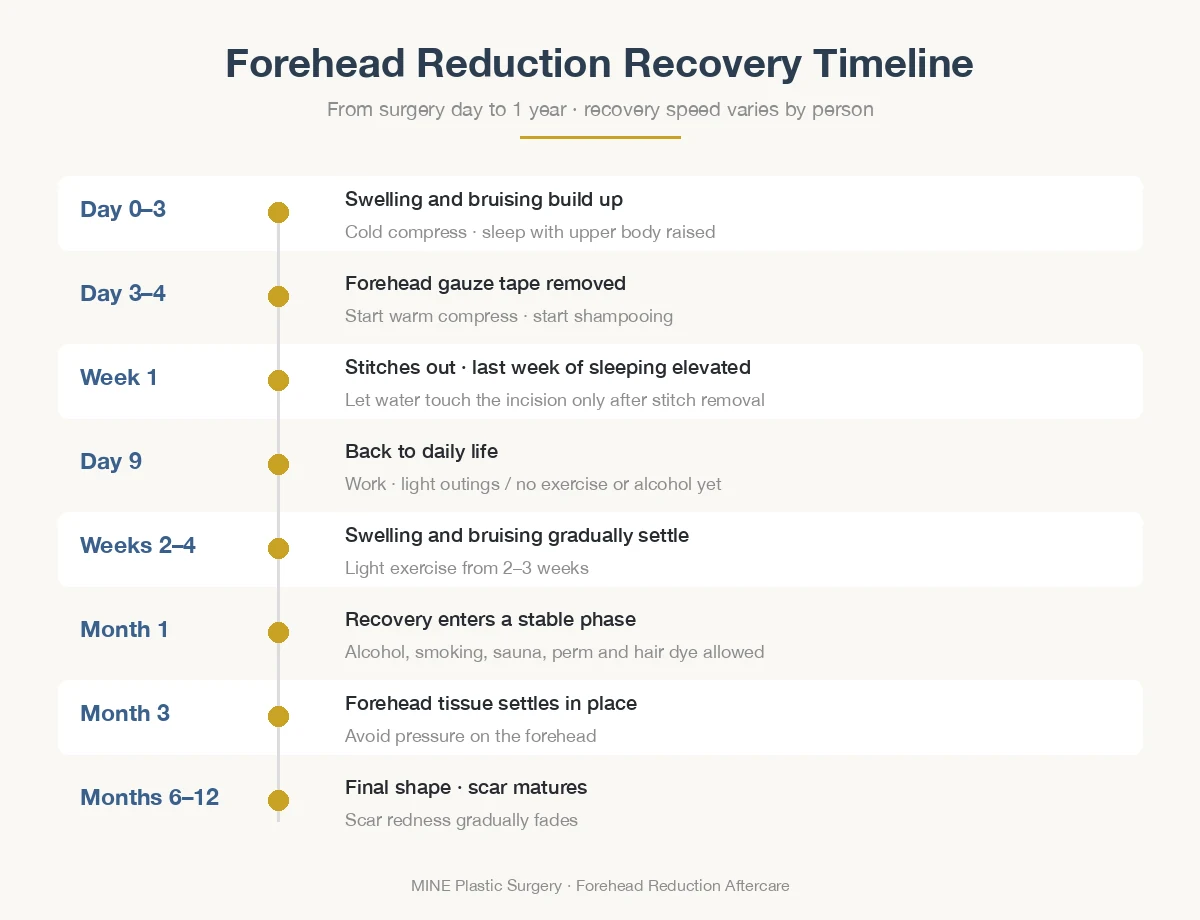
Forehead reduction recovery follows a predictable order. If you know in advance when each restriction is lifted, a lot of unnecessary worry disappears. The table below shows the timeline we give our patients at MINE. Everyone heals a little differently, so treat these as typical points rather than fixed deadlines.
| Time | What happens | What to do | What to avoid |
|---|---|---|---|
| Day 0 (surgery day) | Swelling and bruising begin | Cold compress; sleep with your upper body raised; take prescribed medication 30 minutes after your first meal | Lying on your side or face down |
| Days 1–3 | Swelling and bruising gradually increase | Continue cold compresses; keep your head above heart level | Spicy or irritating food |
| Days 3–4 | The gauze tape on the forehead is removed | Switch to warm compresses; start shampooing | Running water directly over the incision |
| Day 7 (1 week) | Stitches are removed | Keep sleeping with your upper body raised through this week (sleeping face-up continues for 3 months) | Aspirin and vitamin E |
| Day 9 | Return to daily life | Normal daily activities within comfortable limits | Strenuous activity, heavy lifting |
| Weeks 2–4 | Swelling and bruising fade; things start to stabilize at weeks 3–4 | Light exercise from 2–3 weeks; dry your hair on the cool setting for 2 weeks | Hard workouts |
| Month 1 | Recovery enters a stable phase | Alcohol, saunas, perms and hair dye are fine again; if you smoke, stay off cigarettes as long as you can | Heavy strength training |
| Month 3 | The forehead tissues settle into place | Sleep face-up; keep pressure off the forehead | Any physical force on the surgical area |
| Month 6 | The final shape stabilizes | Moisturize the scar and use sun protection | Rubbing or picking at the scar |
| Year 1 | Scar redness fades and sensation returns | Attend scheduled follow-up checks | Stopping aftercare without checking with us |
For overseas patients planning travel, the two dates that matter most are stitch removal at about one week and the return to daily life around day 9.
Dr. Lee’s Key Point: Forehead reduction recovery is not “be careful for a month and you’re done.” Remember five checkpoints instead: day 3, week 1, day 9, month 1 and month 3.
The First Week After Surgery: What Matters Most
In the first week, you only need to focus on four things: sleeping position, compresses, diet and medication. These four largely decide how much swelling you will have over the following two weeks.
Sleeping Position: Why Keep Your Head Raised?
For the first week, sleep with your upper body raised so that your head stays above heart level, and avoid letting your neck bend sharply. This helps the swelling go down faster.
Don’t lie on your side or on your stomach — sleep facing the ceiling. Please keep to this face-up position for about three months.
Many patients ask why position matters so much. Swelling drains away through the veins and the lymphatic system (the network of thin vessels that carries excess fluid away from tissues). When your head is lower than your heart, that drainage slows down and swelling lasts longer. This is exactly why surgical textbooks recommend keeping the head elevated after forehead and scalp procedures.
Swelling and Bruising: Cold Compress for 3 Days, Then Warm
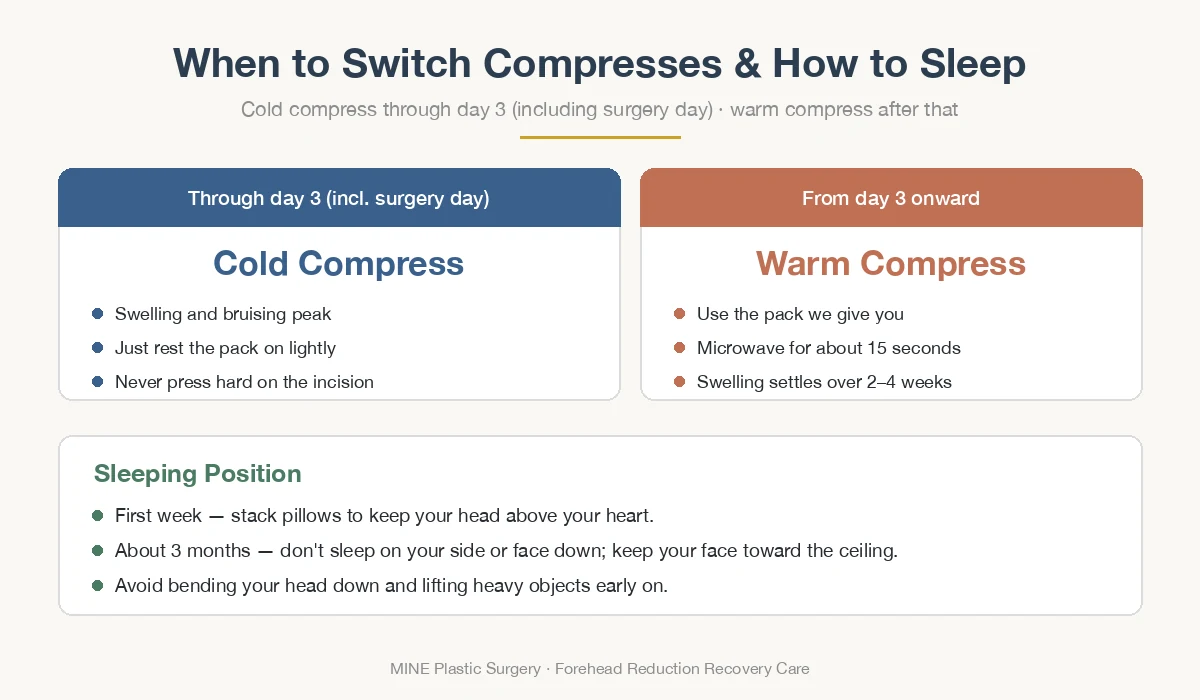
Swelling and bruising usually get worse for the first 2–3 days, then fade gradually over 2–4 weeks. The exact pace varies from person to person.
Use cold compresses through day 3 (counting surgery day), then switch to warm ones. Use the compress pack we give you. For a warm compress, heat the pack in the microwave for about 15 seconds.
Plenty of patients call us on day 3, alarmed that the swelling is at its worst and wondering if something went wrong. That peak is an expected part of healing. In fact, if you keep using cold compresses after day 3, circulation slows and bruises take longer to clear.
Diet: What to Avoid
You can eat normally — there is no need to fast or follow a special diet. Just cut back in the early days on foods that make your face feel flushed, such as very spicy or salty dishes and piping-hot soups.
Medication: When and How to Take It
Take the medication prescribed at discharge starting 30 minutes after your first meal following surgery, and take it on schedule. If you develop diarrhea or an allergic reaction after taking it, contact the clinic.
For one week after surgery, do not take aspirin or vitamin E, as both can increase bleeding.
Dr. Lee’s Key Point: Cold for three days, then warm. Getting just this one rule right makes the first two weeks much easier.
Caring for the Incision and Stitches
Of all the steps in forehead reduction recovery, incision and stitch care takes the most attention. The incision runs along the hairline, and because hair partly hides it, it is surprisingly easy to neglect.
- Do not remove the tape or gauze on your forehead yourself.
- The gauze tape on the forehead is removed after 3–4 days.
- Stitches are usually removed about one week after surgery, although timing can vary between patients. Plastic surgery textbooks give a similar window for scalp stitches, typically 7–10 days.
- Do not pick at or touch scabs or wounds on the scalp.
- Apply the prescribed ointment twice a day, morning and evening.
- Depending on skin type, the scar may stay red for 6 months to a year, and in most cases it looks much better by about one year.
Pulling a scab off before it is ready can leave pigmentation (a darker mark) or widen the scar, so let scabs fall away on their own.
Dr. Lee’s Key Point: Tape off at 3–4 days, stitches out at one week. In between, your only job is to leave the incision alone.
When Can I Wash My Face, Shampoo and Shower?
This is the question I’m asked most often, so here is a simple reference table.
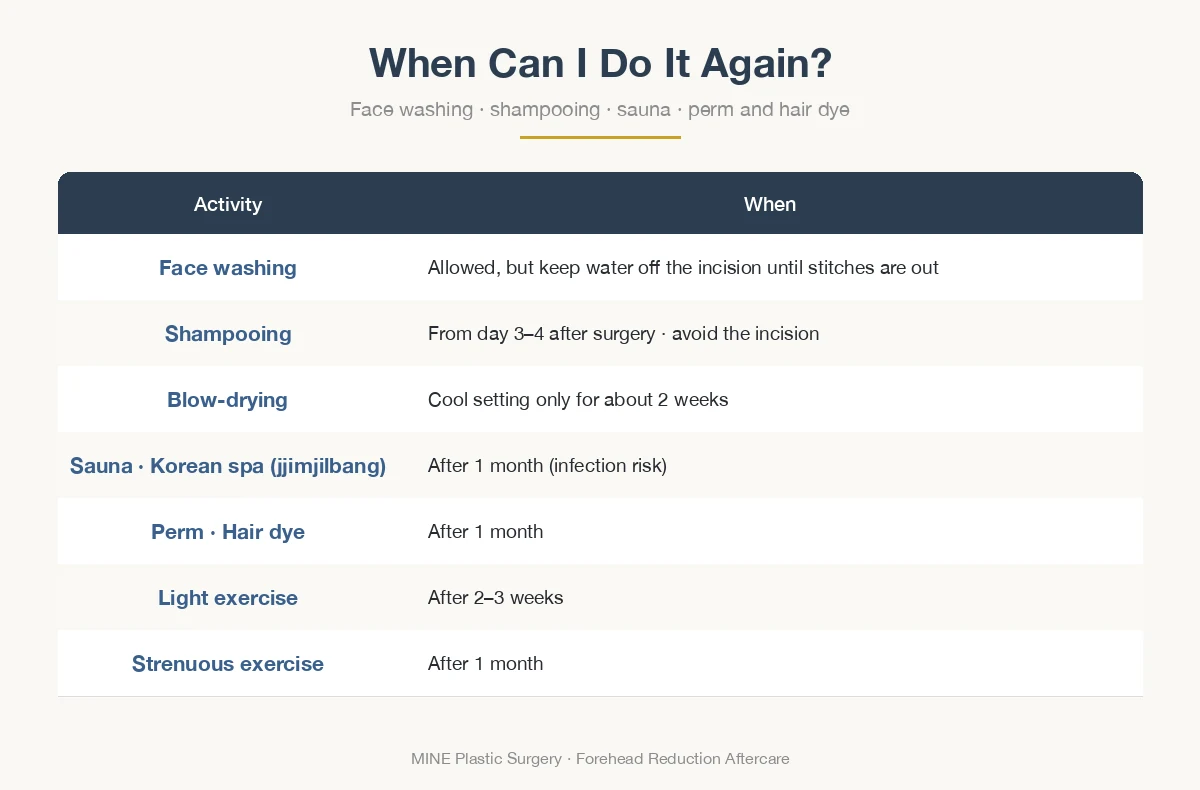
| Activity | When you can resume | Caution |
|---|---|---|
| Face washing | Right after surgery | Keep water off the incision until the tape and stitches are removed |
| Shampoo | From 3–4 days after surgery | Wash around the incision where possible; don’t pick off scabs |
| Blow-drying | From when you start shampooing | Use the cool setting for about 2 weeks |
| Sauna, Korean spa (jjimjilbang) | 1 month after surgery | Avoided for one month because of the risk of infection |
| Perm, hair dye | 1 month after surgery | The scalp is still sensitive — keep chemicals off the incision line |
You may wash your face, but keep water away from the surgical area until the tape and stitches have been removed.
Shampooing is possible from 3–4 days after surgery. Try to wash around the incision rather than over it, and never force scabs off your scalp. For about two weeks, dry your hair with cool air only.
Saunas are off-limits for one month after surgery because of the risk of infection. Perms and hair dye can be done one month after surgery.
Dr. Lee’s Key Point: Hot water and hot air are the two enemies of early healing. Keep the water lukewarm and the dryer on cool.
Returning to Work, Exercise and Daily Life
Stitches are usually removed about 7 days after forehead reduction, and most patients return to daily life around day 9. This matches the guidance on our forehead reduction surgery overview.
- Light exercise: from 2–3 weeks after surgery
- Strenuous exercise: from 1 month after surgery
- Physical pressure on the forehead: avoid for about 3 months
Here, “returning to daily life” means you can go to work and run light errands. It does not mean that exercise and alcohol are allowed again. A surprising number of people mix these two up.
Why No Alcohol or Smoking for One Month?
Alcohol and smoking are prohibited for one month after surgery because they increase bleeding and interfere with wound healing and infection control.
Smoking matters most. Medical literature has repeatedly shown that smoking narrows the small blood vessels at the skin’s surface and reduces blood flow to a wound. The forehead reduction incision depends on the scalp’s blood supply to heal, so when that flow drops, healing slows and the scar is more likely to widen. Plastic surgery textbooks also note that when the scalp has been widely freed, reduced blood flow to the skin can, in some cases, cause a small area of skin to break down — another reason to protect circulation. Alcohol, on the other hand, widens blood vessels and makes swelling and bleeding worse.
Dr. Lee’s Key Point: Day 9 is a return to normal routine, not to the gym. Workouts that make you sweat wait 2–3 weeks; workouts that leave you breathless wait a month. And a month without cigarettes is not just a waiting period — it shapes the quality of your scar.
Forehead Reduction Scar: How the Incision Line Matures
I want to be honest about this one: because the incision follows the hairline, there will be a scar. Plastic surgery textbooks list a permanent scar as the main drawback of a front hairline incision. The goal is not to hide that fact, but to manage the scar through careful design and aftercare.
- Surgery to stitch removal (week 1): The incision is covered by tape and gauze. Leaving it alone is all the care it needs.
- Stitch removal to 3 months: The scar turns red and firm. Protect your forehead from pressure for these three months.
- 6 months: The final shape settles, though some redness may remain.
- 6–12 months: The scar gradually fades past the six-month mark and keeps improving up to a year. The pace depends on skin type.
Textbooks describe four incision designs that help make a hairline scar less visible. You don’t need to do anything with this information, but it explains why the scar is easier to hide.
- The incision is placed just inside or right behind the fine baby hairs at the front.
- The blade is angled parallel to the hair follicles (the small pockets hair grows from), a technique called beveling.
- In another approach, the cut deliberately crosses the follicles so hair grows up through the scar (a trichophytic incision).
- The line follows a gentle, irregular wave rather than a straight line, so it doesn’t stand out as a single stripe.
If you would like a month-by-month look at how scars along the hairline change, see our guide on how hairline incision scars mature over 12 months.
Dr. Lee’s Key Point: No surgery makes a scar disappear. The aim is to leave it where it is hard to see, in a shape that heals well.
Numbness and Tingling: When Does Scalp Sensation Return?
A tight or numb feeling in the skin, together with headaches, is a normal part of healing and improves gradually over several months.
You may also feel occasional tingling or throbbing around the incision, and this can come and go for up to a year. It is a natural sign of nerves recovering, so try not to worry.
Understanding why this happens makes it far less unsettling. When the scalp is cut through its full thickness, the sensory nerves that run up to the forehead and scalp are cut too. An incision along the hairline crosses these nerves closer to where they start, so plastic surgery textbooks describe the loss of feeling as more noticeable than with an incision across the top of the head (a coronal incision). Over time the nerves grow back, and the tingling you feel is the signal of that regrowth.
In a 2026 systematic review and meta-analysis of 3,213 patients, temporary loss of sensation after forehead reduction was reported in 97.3% of cases. In other words, almost everyone goes through it. This figure refers to temporary numbness only — it is a different item from permanent nerve damage.
For a broader explanation of why skin feels numb after surgery and how long it usually lasts, see our article on numbness after plastic surgery.
Dr. Lee’s Key Point: Numbness is not a sign that something is wrong — it’s a sign that feeling is on its way back. But if one side suddenly gets much worse, contact us.
Can a Lowered Hairline Move Back Up?
This is one of the most common worries after surgery. The short answer: this operation pulls the scalp forward and fixes it to the bone, so it is designed to hold its position.
As described above, relaxing cuts in the galea let the scalp move forward, and fixing it to the bone sets the new hairline in place.
A 2026 study following 100 patients for over 12 months reported that the lowered hairline stayed statistically stable from the first follow-up visit onward. The same study reported temporary hair shedding right after surgery in 14% of patients, and all of them recovered after treatment.
Permanent hair loss along the incision was reported in 0.7% — a figure from the systematic review of 3,213 patients. Please note that the 14% and the 0.7% are different items, drawn from different studies with different patient groups and definitions, so they should not be compared directly. Hair that sheds just after surgery usually grows back, and permanent loss affects fewer than 1 in 100 patients.
That said, I won’t tell you the hairline can “never” move. The hairline itself can recede with age, and male-pattern hair loss or frontal fibrosing alopecia (a scarring type of hair loss at the front of the scalp) can change long-term results. What the research shows is that the fixed position is reported to hold beyond 12 months.
Dr. Lee’s Key Point: Your scalp was not just “pulled” — it was “fixed.” That is why the rule of keeping force off your forehead for three months matters.
Forehead Reduction Side Effects: Reported Rates
Knowing about side effects in advance actually helps recovery. The table below shows figures from a 2026 systematic review and meta-analysis that pooled 14 studies and 3,213 patients. These are rates reported by large international studies, not MINE’s own outcomes.
| Item | Reported rate |
|---|---|
| Overall complications | 5.9% |
| Folliculitis (inflammation of hair follicles) | 25.1% |
| Scar-related problems | 5.5% |
| Seroma (clear fluid collecting under the skin) | 2.4% |
| Revision surgery | 1.3% |
| Additional hair transplant | 1.2% |
| Permanent hair loss at the incision | 0.7% (0.3% in sensitivity analysis) |
| Temporary paresthesia (numbness or altered sensation) | 97.3% |
Source: 2026 systematic review and meta-analysis of forehead reduction complications.
One thing to keep in mind when reading this table: the overall complication rate of 5.9% is the share of cases counted as complications, while each item below it was calculated separately, so the two use different counting methods. That is why you cannot add the rows together or compare the 5.9% with the individual figures — and why some items come out higher than the overall rate.
Notice that the most common item is folliculitis. Picking at scabs or washing with hot water has a direct effect on it. The face-washing and shampoo rules in this guide are, in the end, what keep this number low.
It also helps to set realistic expectations. A multi-ethnic study of 650 cases concluded that there is a limit to how much the forehead can be shortened in one operation, that correcting the temples has its limits too, and that patients should know about scarring and folliculitis before surgery. Across several studies, the reported forehead shortening averages 2.3–2.6 cm. Because male-pattern hair loss or frontal fibrosing alopecia can worsen long-term results, we always check for them during the pre-surgery consultation.
Dr. Lee’s Key Point: This list isn’t meant to scare you. I share it because folliculitis, the most common item, is something your own aftercare can reduce.
Warning Signs: When to Contact the Clinic Right Away
Finally, here is when you should reach out. Most discomfort during forehead reduction recovery is part of normal healing, but if you can tell these two lists apart, you’ll know when to simply wait and when to call.
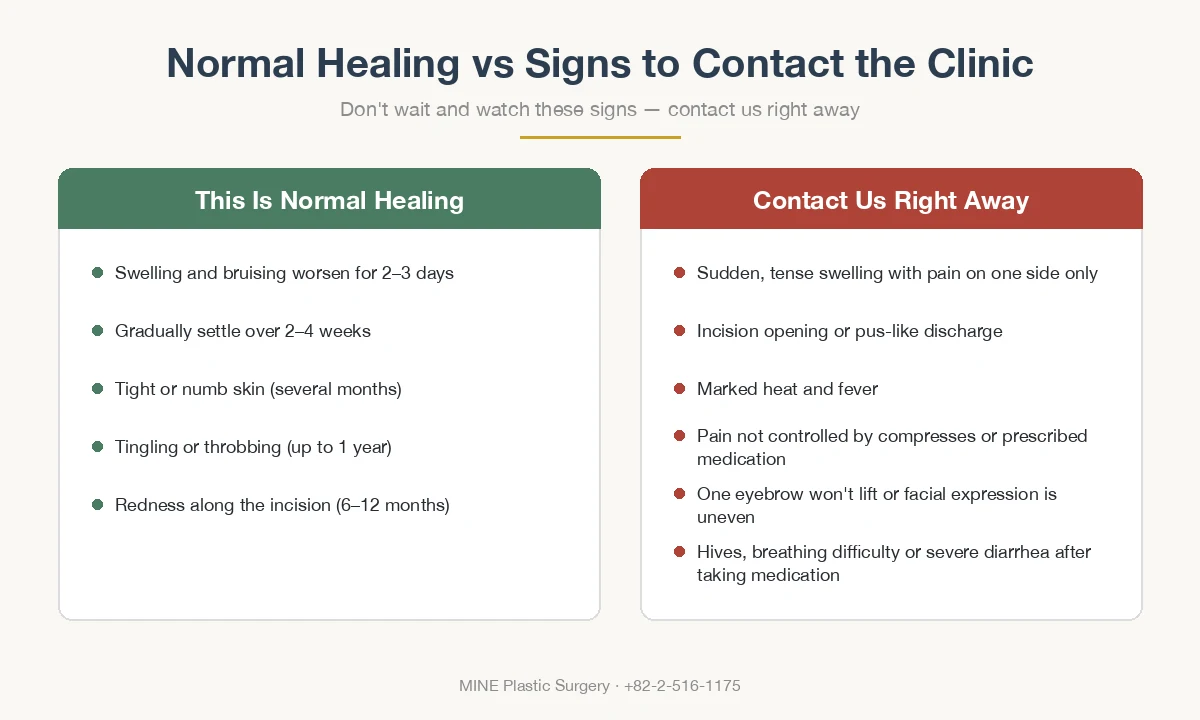
Normal Healing — Fine to Watch
- Swelling and bruising that increase over the first 2–3 days, then settle
- A tight or numb feeling in the forehead and scalp, and mild headaches
- Occasional tingling or throbbing around the incision
- Small scabs forming along the incision line
Contact Us Right Away
- Sudden swelling on one side only, or a left–right difference that grows noticeably within a day
- Fever with pain that keeps getting worse
- Pus or an unpleasant smell from the incision
- Redness spreading beyond the incision line
- Bleeding that won’t stop
- One eyebrow that doesn’t lift properly, or a clearly uneven expression when you smile
- Diarrhea, an allergic reaction, hives or shortness of breath after taking your medication
If you’re unsure, don’t just put up with it — get in touch. Outside clinic hours, you can send us a message with photos through our online consultation channels, or call +82-2-516-1175.
Dr. Lee’s Key Point: The two most important warning signs are “the two sides look different” and “it keeps getting worse.”
When Will I See the Final Result?
Swelling begins to stabilize at 3–4 weeks and the final shape settles around 6 months. Individual healing varies. Keep pressure off your forehead for the first three months.
Aftercare matters as much as the surgery itself, so thank you for following these steps carefully. Follow-up care and progress checks continue at the clinic throughout your recovery, so please contact us whenever you have a question.
Dr. Lee’s Key Point: At 3–4 weeks things start to “look different,” and at 6 months they “settle in.” Please don’t judge the final result after just one month.
Forehead Reduction Recovery FAQ
How long is forehead reduction recovery?
Stitches come out at about one week, and most people return to daily life around day 9. Swelling fades over 2–4 weeks and begins to stabilize at weeks 3–4, the final shape settles at about 6 months, and scar redness can last 6–12 months. Healing speed varies from person to person.
When can I wash my hair after forehead reduction?
You can shampoo from 3–4 days after surgery, washing around the incision where possible. Dry your hair on the cool setting for about two weeks, and don’t pick off any scabs.
What are the side effects of forehead reduction?
Because the operation involves an incision, swelling, bruising and temporary numbness around the incision are common during recovery. Less often, hair near the incision sheds temporarily (a condition called telogen effluvium) and then grows back, or the scar ends up more noticeable than expected. Reported rates from the research are in the table above, and your own risk factors should be checked during a consultation.
Where is the forehead reduction scar, and how visible is it?
The incision is placed at or just inside the existing hairline and closed in a way that preserves hair follicles, so hair can grow through the scar line and soften its edge. The scar does not disappear — it is managed to be less noticeable — and results vary with scalp thickness, scalp flexibility and how your skin usually scars.
Can the hairline move back up after forehead reduction?
A lowered hairline is designed to stay in its new position and is not expected to return to where it was. However, if the scalp is very tight and the hairline is lowered too aggressively, the incision can come under strain and the hairline may settle slightly higher than planned. That is why the amount of lowering is decided by how flexible your scalp is, and tissue expansion or a hair transplant is planned alongside surgery when needed.
What should I check before deciding on forehead reduction?
The right surgery depends on why your forehead looks large — the hairline position, drooping brows or the shape of the forehead bone. If the cause is different, forehead reduction alone may not give the change you expect. Ongoing hair loss, the density of hair at the front and any previous scalp surgery also affect whether and how surgery can be done, so have a specialist assess these first.
Planning Your Forehead Reduction Recovery with MINE
Aftercare rules are not identical for everyone. How much can be removed, and how quickly you heal, depend on your scalp flexibility, hairline shape and forehead height, so we recommend an in-person or online consultation at MINE Plastic Surgery & Dermatology. If questions come up while you are healing, you can reach us through our online consultation channels or by phone at +82-2-516-1175. If you are traveling from abroad, share your dates so we can plan your stitch removal visit within your stay. Aftercare instructions for other operations are collected in our recovery guides for other procedures.
You can confirm whether your surgeon is a certified plastic surgeon on the website of the Korean Society of Plastic and Reconstructive Surgeons.
Sources: The recovery schedule in this article follows MINE Plastic Surgery & Dermatology’s post-operative instructions for forehead reduction patients. The surgical technique, nerve anatomy and incision design explanations draw on plastic surgery textbooks; complication and hairline-stability figures come from the studies linked above.
Written and medically reviewed by: Dr. Lee Sung-wook, Board-Certified Plastic Surgeon, Medical Director of MINE Plastic Surgery & Dermatology · +82-2-516-1175 · 813 Nonhyeon-ro, Gangnam-gu, Seoul
※ This content is for informational purposes only and does not replace professional medical advice, diagnosis, or treatment. Individual results may vary, and side effects may occur. Please consult with a board-certified plastic surgeon for personalized advice.