EN



Table of contents
What Is Double Chin Lifting?
Double chin lifting is a group of cosmetic treatments that reduce the soft fullness under the chin and restore a clearer line between the face and neck. The medical name for that fullness is submental fat (“submental” simply means “under the chin”). Surgeons describe the goal as sharpening the cervicomental angle — the angle where the underside of the chin meets the neck. When that angle is soft and rounded, the lower face can look heavier or older than a person feels.
Double chin fat removal is the part of double chin treatment that removes or shrinks the fat under the chin. This fat sits in two layers, with the thin platysma muscle in between. The upper layer lies just under the skin (doctors call it subcutaneous or “preplatysmal” fat), and liposuction or fat-dissolving injections can reduce it. The deeper layer sits under the muscle (subplatysmal fat). A liposuction tube cannot reach it, so a surgeon removes it directly through a small cut under the chin. This is why the right method depends on which layer is full.
Fullness under the chin is rarely about weight alone. It can appear in slim, healthy people because of how the area is built. Common reasons include:
- Genetics and natural face and neck anatomy
- Age-related loosening of the skin and the platysma (the thin sheet of muscle in the neck)
- Weight changes over time
- The position of the hyoid bone and the depth of fat layers, which a person cannot change with diet
Because the chin and neck have several layers — skin, surface fat, the platysma muscle, deeper fat, and even the small digastric muscles and salivary glands underneath — the best treatment depends on which layer is causing the fullness. That is why a careful consultation matters more than choosing a single “best” procedure.
How Does Double Chin Lifting Work?
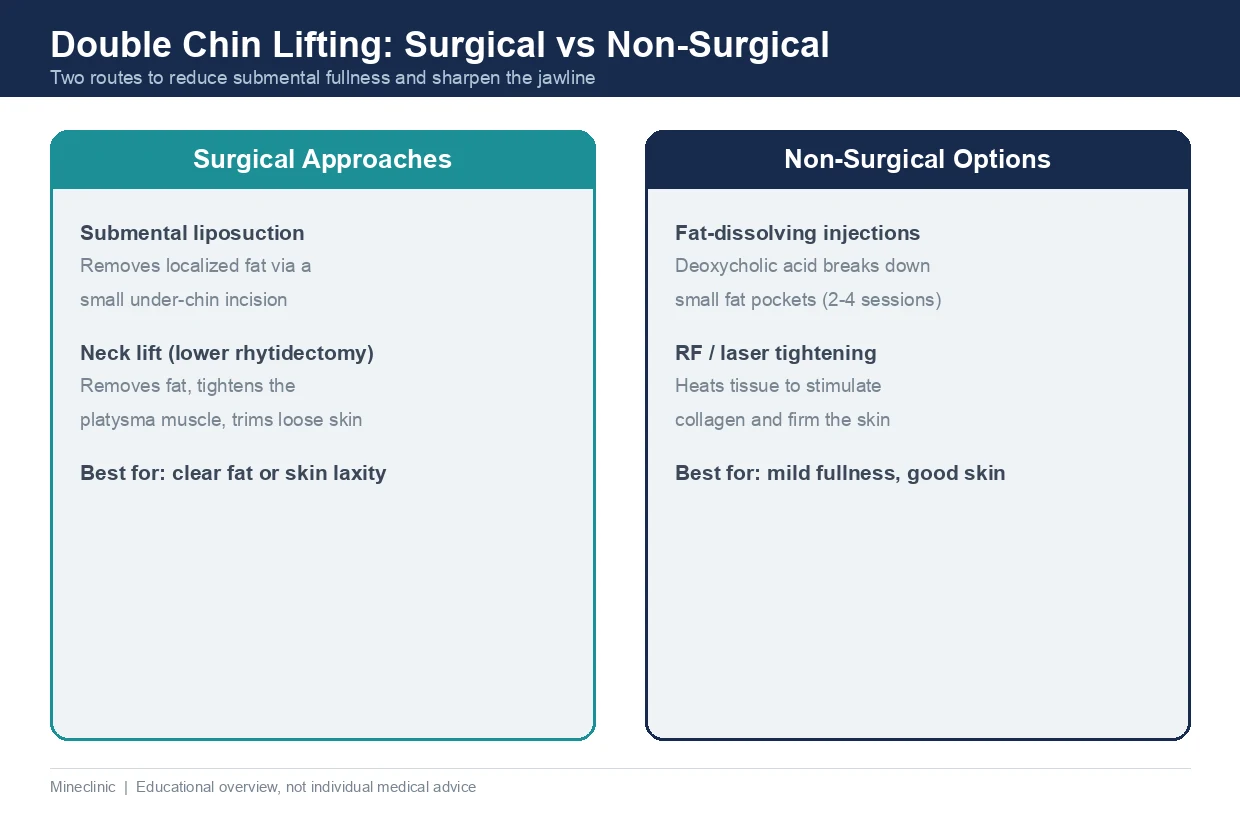
This treatment works by targeting the layer responsible for the fullness: removing or dissolving excess fat, tightening loose skin, or firming the platysma muscle. Broadly, the options fall into surgical and non-surgical groups, and many people combine them. You can read more about submental liposuction as one common starting point.
Surgical Methods
Surgery gives the most noticeable, longest-lasting change, especially when there is real excess fat or loose skin. The main techniques are:
- Submental liposuction. A tiny incision under the chin lets the surgeon remove the surface fat that sits above the platysma muscle. It suits people with good skin elasticity and fat as their main concern.
- Neck lift with platysma tightening. Through the same under-chin incision, the surgeon removes fat and stitches the platysma muscle into a firmer “corset.” This is chosen when loose muscle or skin, not just fat, is causing the heaviness.
- Deeper-layer work. Some fat lies below the platysma and cannot be reached by ordinary liposuction. In selected patients, surgeons address this deep fat — and occasionally the small digastric muscles or salivary glands — through the same submental approach. Skipping these deeper structures is a common reason the area can look only partly improved.
When deep fat is the problem, a thoughtful plan is essential: our article on why submuscular fat removal can be necessary and our guide to submuscular fat and double chins explain this layer in more detail.
Non-Surgical Options
For mild fullness and good skin quality, non-surgical double chin fat removal and skin tightening can help without an incision:
- Fat-dissolving injections. Deoxycholic acid, a substance the body uses to break down dietary fat, is injected to gradually reduce small fat pockets. Most people need two to four sessions spaced several weeks apart.
- Radiofrequency (RF) and laser tightening. Devices warm the deeper skin to encourage new collagen, which firms the surface over a few months.
- Laser-assisted fat reduction. Controlled laser energy can reduce a small amount of fat while also tightening skin.
Non-surgical methods are gentler and need little downtime, but they treat smaller amounts of fat and the results are usually temporary. They are not a substitute for surgery when there is significant fat or sagging skin. After non-surgical double chin fat removal with injections, mild redness or swelling usually settles within 1–2 days.
How Can You Tell Fat From Loose Skin or a Salivary Gland at Home?
You can get a rough idea of what is behind the fullness with a few simple checks in front of a mirror. These are home clues only, not a diagnosis, but they can help you get more out of your consultation.
- Gentle pinch. Pinch the skin under your chin between your thumb and finger. A soft, thick roll suggests that surface fat is part of the fullness. If the pinch feels thin but the area still looks full, the fullness may come from deeper tissue.
- Tilt your head back and look up. If the bulge mostly flattens, loose skin is the more likely cause. If it stays, fat or a salivary gland is more likely.
- Tuck your chin down and feel the area. Fat usually feels soft and spread across the middle. A firmer, rounded swelling on each side, just under the jawbone, can be an enlarged submandibular (salivary) gland.
- Tighten your neck, as if grimacing. Vertical cords that pop out are usually the front edges of the platysma muscle. Mention them to your doctor if you see them.
A 2018 study of neck anatomy found that enlarged or drooping submandibular glands are common from around age 50. So a firm bulge at the sides in an older adult deserves a closer look. Doctors use a similar pinch test in the clinic, but they also feel the area while you tense your neck muscle, which is hard to do on yourself.
Fat, loose skin, muscle, and glands are often mixed together, so the final answer comes from an in-person exam and an ultrasound scan, not from a mirror. Our article on why an ultrasound check matters before surgery explains what the scan can show. Knowing which layer is involved is the first step in planning double chin fat removal.
How to Choose a Double Chin Fat Removal Method
There is no single best way to remove fat under the chin. The right choice depends on which layer is full, how firm your skin is, and whether muscle or glands are involved. The table below shows how doctors usually match each method to the situation.
| Your situation | Usually considered | What the doctor checks at consultation |
|---|---|---|
| A small pocket of surface fat, with good skin firmness | Fat-dissolving injections | How thick the fat above the muscle is when pinched (with the neck muscle tightened), skin quality, and a safe injection zone below the jawline |
| Surface fat is the main cause, and the skin is firm | Submental liposuction | Skin elasticity, how much fat sits above versus below the muscle, and whether a thin fat layer can be left under the skin |
| Deep fat under the muscle, or loose platysma bands | Direct fat removal through a small under-chin incision, plus platysma stitching (plication) | Fullness that stays when the skin is pinched thin, muscle bands at rest and when tensed, and the neck-chin angle; if loose skin remains, whether a neck lift is also needed |
| A firm, rounded bulge at the sides under the jaw | A separate salivary gland evaluation first | An ultrasound scan to confirm the submandibular gland, its size, and its position |
This table is a starting point for the conversation, not a promise of a certain amount of fat loss or how long it will last. Your doctor confirms a plan only after examining you. If the side bulge turns out to be a gland, salivary gland reduction is planned as a separate treatment.
Injections need care too. According to plastic surgery textbooks, fat-dissolving injections go into the fat above the platysma, at least 1–1.5 cm below the jawline, and should be given by an experienced doctor.
When Liposuction Alone Can Make Sagging More Visible
Fat under the chin also acts as padding. When liposuction alone removes it, skin and muscle that were already loose can become more visible, a bit like a tent that sags once its pole is taken out. Plastic surgery textbooks note that liposuction alone under the chin may lead to looser skin over time. The chance is higher with:
- Skin that has lost elasticity, so it cannot shrink back neatly once the fat is gone
- A loose platysma, whose front edges have drifted apart and may show as cords in the neck
- Older age, because neck skin gets thinner and less elastic and the muscle loosens over the years
In these cases, surgeons often combine double chin fat removal with platysma tightening, or add a neck lift if the skin is loose. Taking out too much is also a problem. Surgeons usually leave a thin layer of fat under the skin, because removing too much of the deep fat can leave a hollow, “dug-out” look under the chin. Small facial nerve branches run close to the deep fat, which is another reason it is removed with care.
If you want to see what the surgery itself involves, step by step, with before-and-after comparisons, read our complete guide to double chin removal surgery.
Who Is a Good Candidate for Double Chin Lifting?
A good candidate for double chin fat removal or lifting is usually someone who:
- Has stubborn fullness under the chin that stays despite a stable, healthy weight
- Is in generally good health and not pregnant
- Has reasonable expectations about what the procedure can and cannot change
- Feels self-conscious about the side profile
- Has fair skin elasticity, which matters most for the non-surgical options
Candidate selection is where experience counts. Because fullness can come from surface fat, deep fat, loose muscle, or heavy salivary glands, double chin fat removal that targets only the surface fat may not be enough for everyone. A consultation at Mineclinic helps match the method to the actual cause.
What Results Can You Expect?
Most people who have these treatments notice a slimmer, more defined profile. Typical physical changes include:
- A sharper jawline with a clearer separation between face and neck
- Less fullness under the chin and a smoother side profile
- A firmer neck contour with less bulging or sagging
- A fresher, more rested appearance, since the neck often shows early signs of aging

There are emotional benefits too. Many patients say they stop tilting their head in photos, feel more at ease on video calls, and worry less about their profile in everyday situations. After double chin fat removal or lifting, results look most natural when the chosen method matches the cause — for example, tightening the platysma when muscle laxity, not just fat, is the issue.
How Long Do Double Chin Lifting Results Last?
How long results last depends on the method, your skin quality, and how stable your weight stays. The chart below shows realistic expectations for each approach, from surgery to skin tightening. Results from RF and laser tightening usually last around 1–2 years, and maintenance sessions can extend the effect.
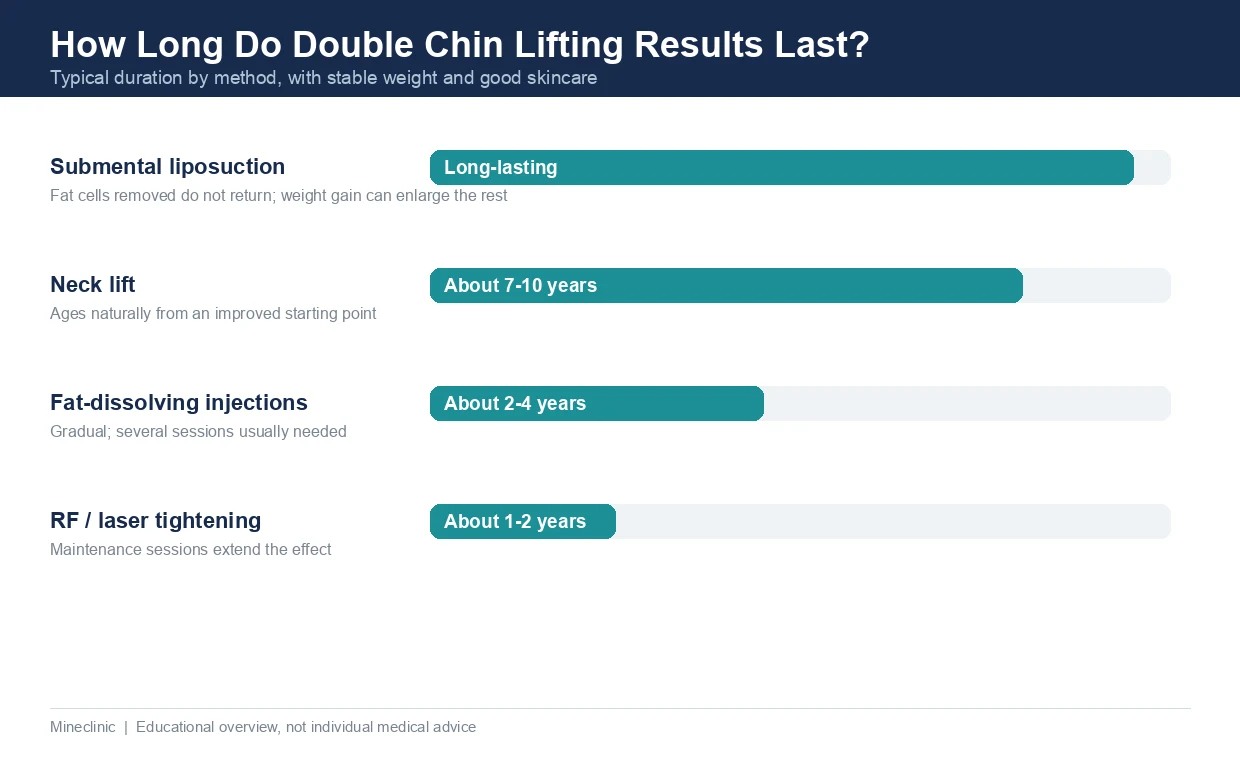
- Surgical fat removal tends to be long-lasting, because fat cells that are removed do not grow back. Significant weight gain can still enlarge the fat cells that remain.
- Neck lift results commonly hold for several years and then age gradually from an improved starting point.
- Fat-dissolving injections often last a few years before a touch-up is considered.
- RF and laser tightening usually last around one to two years, with maintenance sessions extending the effect.
Several everyday factors influence how long any result lasts:
| Factor | Effect on how long results last |
|---|---|
| Age and skin elasticity | Firmer skin holds a new contour longer |
| Weight stability | Weight swings can soften results with any method |
| Sun exposure | Too much UV breaks down collagen and ages skin faster |
| Smoking | Slows healing and speeds skin aging |
| Genetics | Influences how tissue ages after treatment |
What Is Recovery Like After Double Chin Lifting?
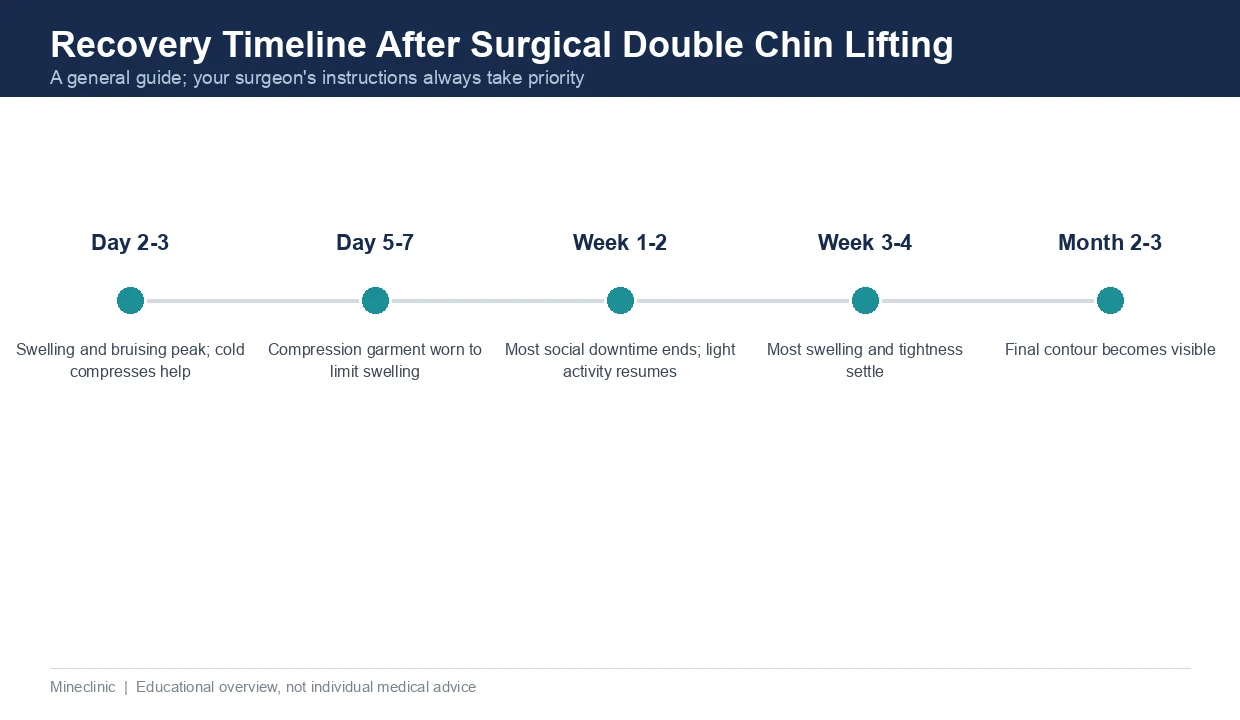
Recovery is very different for surgical and non-surgical treatments. Surgery needs more downtime but treats more; non-surgical options are easier but milder. After surgical double chin fat removal, most people need about 1–2 weeks before facing the public, and the final contour appears after 2–3 months.
After Surgical Procedures
- About one to two weeks of social downtime before facing the public comfortably
- Swelling and bruising that often peak around day two or three
- Temporary numbness or tightness in the treated area
- A compression garment, usually for several days, to limit swelling
- Most everyday symptoms easing within three to four weeks
- The final contour becoming clear after about two to three months
After Non-Surgical Procedures
- Little to no downtime, with many people returning to normal activities the same day
- Mild redness or swelling that usually settles within one to two days
- Mild tenderness that is easy to manage
- Gradual improvement over several weeks as the body clears treated fat
- Several sessions spaced a few weeks apart for the best effect
Double Chin Lifting vs. Jawline Contouring
It helps to know how this treatment differs from jawline contouring, because they solve different problems:
- Double chin lifting mainly removes excess fat and firms loose skin or muscle under the chin.
- Jawline contouring builds or reshapes structure, often with implants or fillers along the jaw.
- For many people whose only concern is fullness under the chin, treating the area under the chin alone is enough.
- When both fullness and a weak jaw outline are present, combining the two can give the most balanced profile.
If skin laxity is your main concern, comparing neck procedures can also help; our guide on the difference between a full neck lift and a mini neck lift is a useful next read.
What Are the Possible Side Effects?
Double chin fat removal, skin tightening, and muscle procedures are generally considered safe when performed by qualified specialists, but every treatment carries some risk. Most side effects are temporary:
- Swelling and bruising around the treated area
- Numbness or reduced sensation that improves over time
- Tightness or firmness that softens as healing continues
- Mild discomfort at injection or incision sites
Less common but more serious risks include infection, noticeable asymmetry, scarring, or temporary nerve irritation that affects movement or sensation. Serious complications are uncommon in skilled hands, which is why choosing an experienced surgeon and following aftercare instructions are so important.
Aftercare for Long-Lasting Results
Good aftercare protects your investment and helps your results last. In the first days and weeks:
- Follow all instructions from your Mineclinic specialist closely
- Take any prescribed medication as directed
- Use cold compresses as advised to ease swelling
- Sleep with your head elevated for the first week
- Avoid strenuous activity until your provider clears you
Over the long term, a stable weight, daily sunscreen, a simple skincare routine, good hydration, and avoiding smoking all help preserve a slim, defined jawline. Occasional maintenance treatments can extend non-surgical results.
Frequently Asked Questions
Is double chin lifting permanent?
Surgical fat removal is long-lasting because the removed fat cells do not return, although major weight gain can still change the area. Non-surgical treatments are temporary and usually need maintenance.
Is double chin lifting painful?
Surgery is done under anesthesia, so you do not feel it during the procedure, and most discomfort afterward is mild and short-lived. Non-surgical sessions cause only mild, brief tenderness for most people.
Will a double chin come back after treatment?
If your weight stays stable and your skin ages normally, surgical results generally hold well. Significant weight gain, smoking, and heavy sun exposure are the main reasons fullness can partly return.
Can liposuction remove all double chin fat?
No. Plastic surgery textbooks describe two layers of under-chin fat, and liposuction reaches only the upper layer above the platysma. Fat under the muscle cannot be suctioned, so when it needs treatment it is removed directly through a small under-chin incision. Which layer is involved is checked at consultation, often with ultrasound, before any double chin fat removal is planned.
How long is recovery after double chin fat removal?
After surgery, most people need about one to two weeks before they feel comfortable in public, and the final contour becomes clear after about two to three months. Fat-dissolving injections need little to no downtime, with mild swelling that usually settles within one to two days.
For advice tailored to your anatomy and goals, contact Mineclinic to arrange a consultation. You can also review the wider range of facial and neck options recognized by the American Society of Plastic Surgeons to prepare your questions. (laser vs. surgical double chin removal)
Medical disclaimer: This article is for general education and is not a substitute for professional medical advice. Results, recovery, and risks vary from person to person. Always consult a qualified specialist before deciding on any double chin lifting procedure.
※ This content is for informational purposes only and does not replace professional medical advice, diagnosis, or treatment. Individual results may vary, and side effects may occur. Please consult with a board-certified plastic surgeon for personalized advice.