EN
EN

You have cut calories. You have done the jawline exercises. You may even be at your goal weight. And yet, in every side-profile photo, the same soft shadow sits between your chin and your neck.
If that sounds familiar, you are not imagining things — and you are not doing anything wrong. A double chin is one of the few facial concerns that often refuses to respond to diet and exercise, because in many people the tissue causing it is not the fat you can influence at the gym.
This guide walks you through what actually changes in a double chin before and after photo, how Mine Clinic in Gangnam, Seoul approaches the procedure, what the risks honestly are, and how long international patients need to stay in Korea. Our aim is to give you enough information to ask better questions at your consultation — wherever in the world you choose to have it.
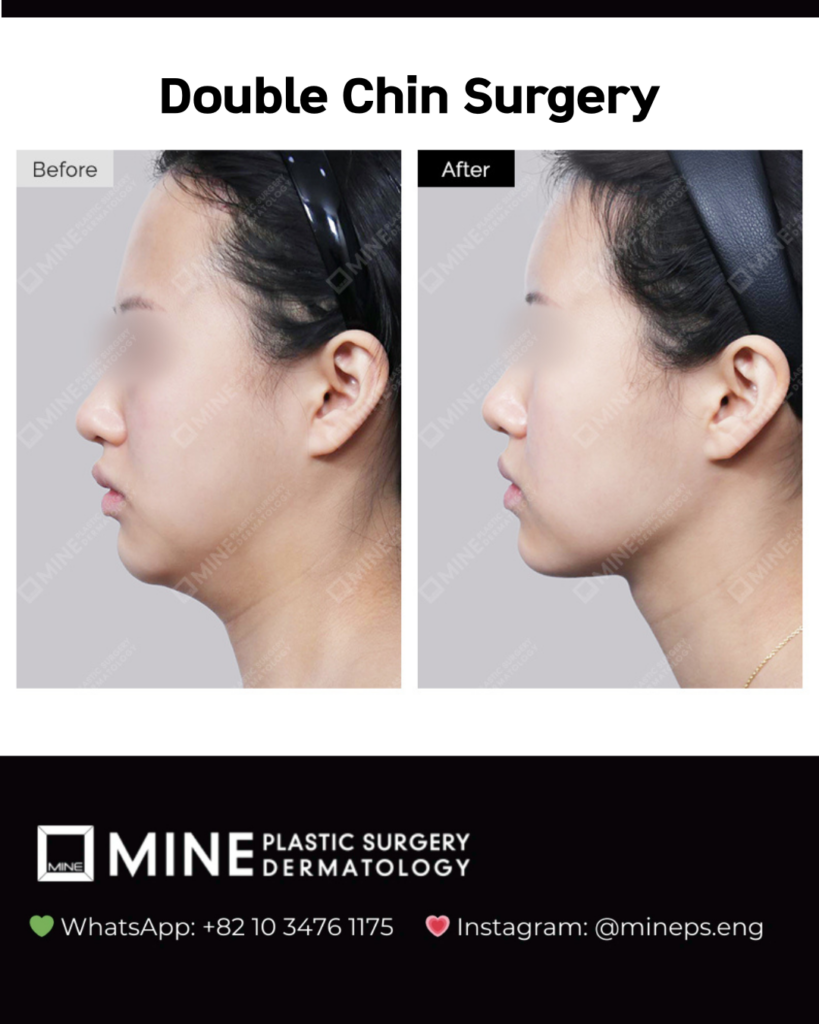
Table of Contents
What Causes a Double Chin? (And Why Diet Alone Often Fails)
In medical language, a double chin is called submental fullness — excess volume in the triangle beneath the chin. What most people do not realise is that this area is built in layers, and each layer causes a slightly different-looking double chin.
The five common causes
- Subcutaneous fat — the fat between skin and muscle. This is the layer that responds best to diet, weight loss, and standard liposuction.
- Deep (subplatysmal) fat — fat sitting underneath the platysma, the thin sheet of muscle that covers the front of the neck. This layer does not shrink meaningfully with weight loss, and a simple suction cannula cannot reach it safely. It is the single most common reason people say “I lost 10 kg and my double chin stayed.”
- A loosened platysma muscle — the platysma naturally separates down the midline with age. Once it slackens, it stops supporting the tissue above it, and the chin-to-neck border blurs even in slim patients.
- A short or backward-set chin — if the chin bone projects less than average, the soft tissue behind it has nowhere to drape. The result reads as a double chin on camera even when very little fat is present.
- Skin laxity and enlarged salivary glands — in patients in their 40s and beyond, sagging skin and prominent submandibular glands can create fullness that fat removal alone will not correct.
A double chin is not one problem — it is up to five. Fat, muscle, bone, skin, and gland each contribute differently. The reason two people can have the same procedure and get very different results is usually that only one of them was treated for the right layer.
Q: Why do I have a double chin even though I am thin? A: Most likely deep subplatysmal fat, a separated platysma muscle, or a short chin projection — none of which respond to weight loss. This is extremely common and is one of the most frequent reasons slim patients in their 20s and 30s consult us.
Q: Can chin exercises or facial massage remove it? A: They can improve posture and circulation, which slightly sharpens how the jawline photographs. They cannot remove fat beneath a muscle, and they cannot re-approximate a separated platysma. Be cautious with online claims that promise otherwise.
Before-and-after galleries are persuasive, but they are only useful if you know what to look at. Lighting, camera angle, and head position can flatter a result far more than surgery ever could. Here is what an experienced eye checks first.
Four things to look for in any double chin before and after photo
| What to check | Why it matters |
|---|---|
| The cervicomental angle | This is the angle where the underside of the chin meets the neck. A youthful, defined profile typically sits near 90–110 degrees. A genuine result opens and sharpens this angle. |
| A continuous jawline shadow | Look for an unbroken line running from the chin to the earlobe. If the jaw border disappears halfway back in the “after” photo, only the front pocket of fat was treated. |
| Identical head position | If the chin is lifted or the head is rotated in the after photo, the angle change may be posture, not surgery. Compare the ear and shoulder position between the two frames. |
| The neck below the chin | Fat removed only under the chin, with a thick upper neck left untouched, creates a “shelf.” A well-planned result blends smoothly down the neck. |
About the cases shown on this page
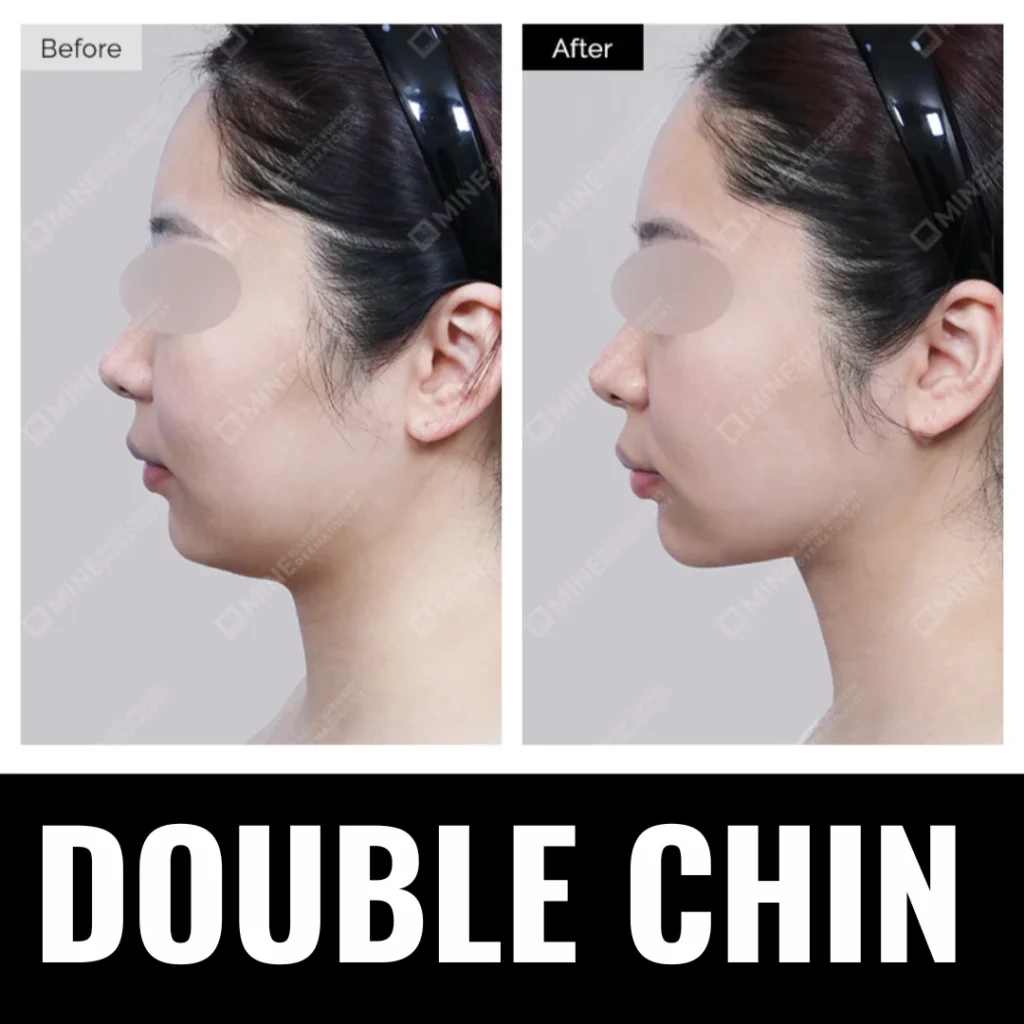
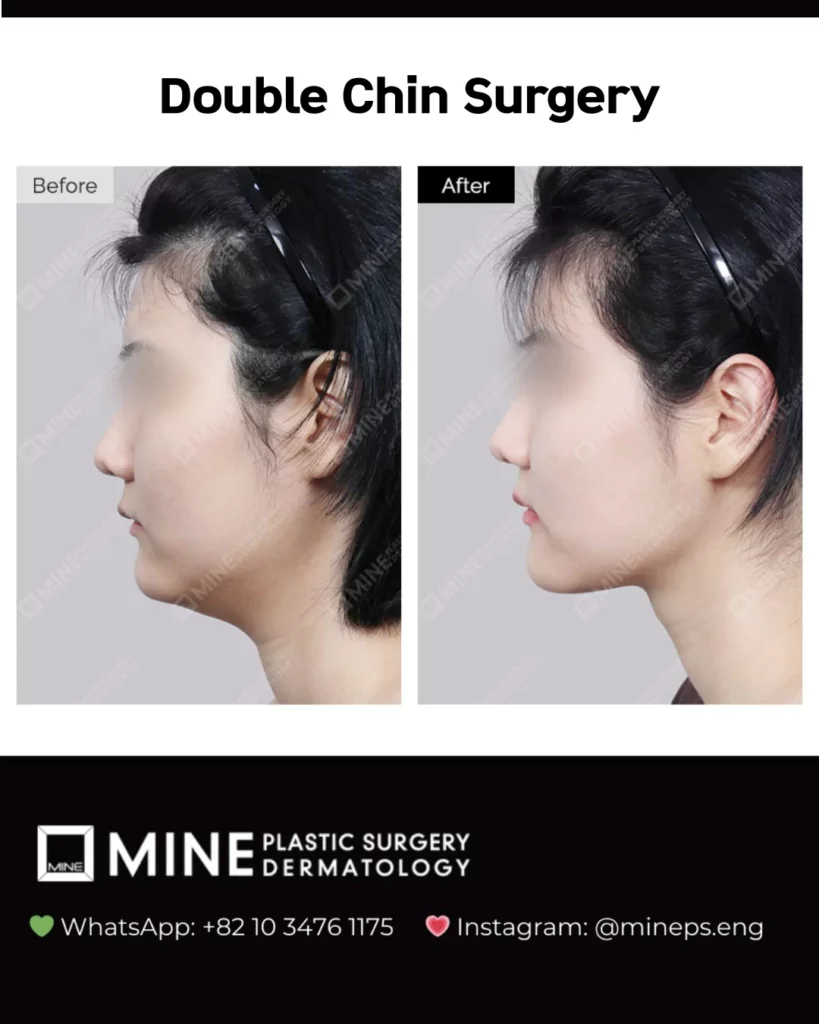
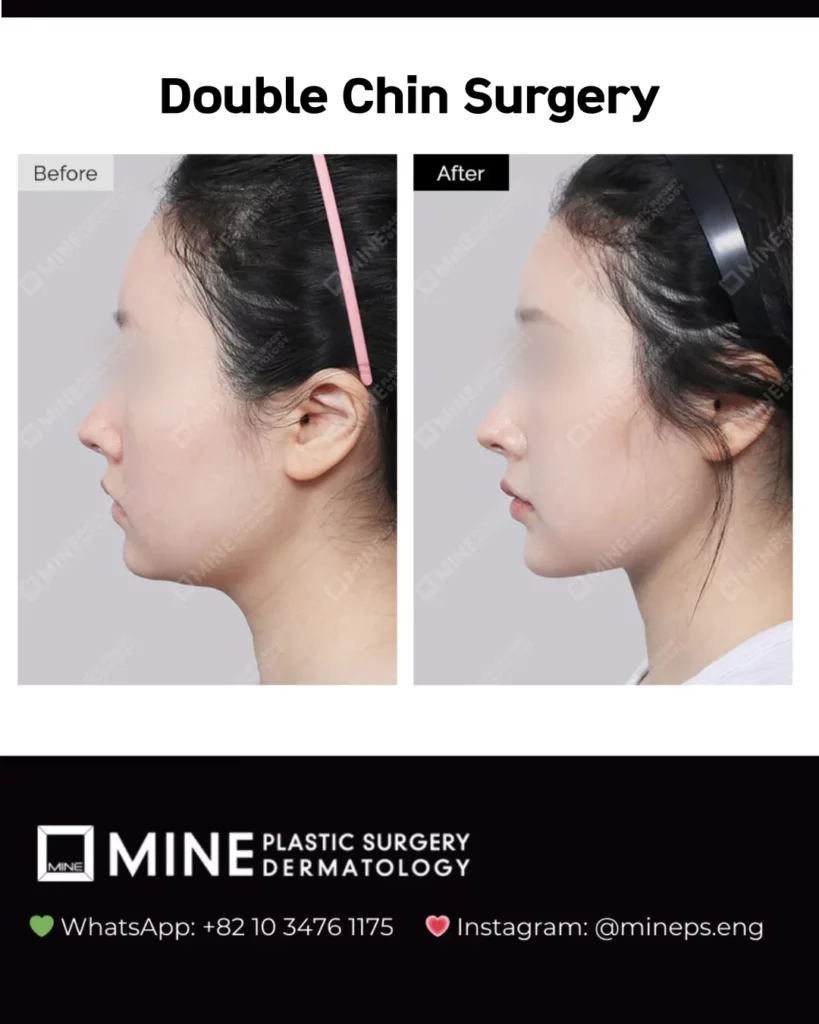
The following before-and-after cases are actual Mine Clinic patients photographed in our standardised clinic lighting and identical side-profile position. Our surgical before-and-after comparisons are generally taken at approximately two months post-operatively, once the majority of swelling has settled but before the final contour at three to six months — meaning most patients continue to improve beyond what these photos show.
Case gallery
Case 01 — Blurred chin-to-neck border
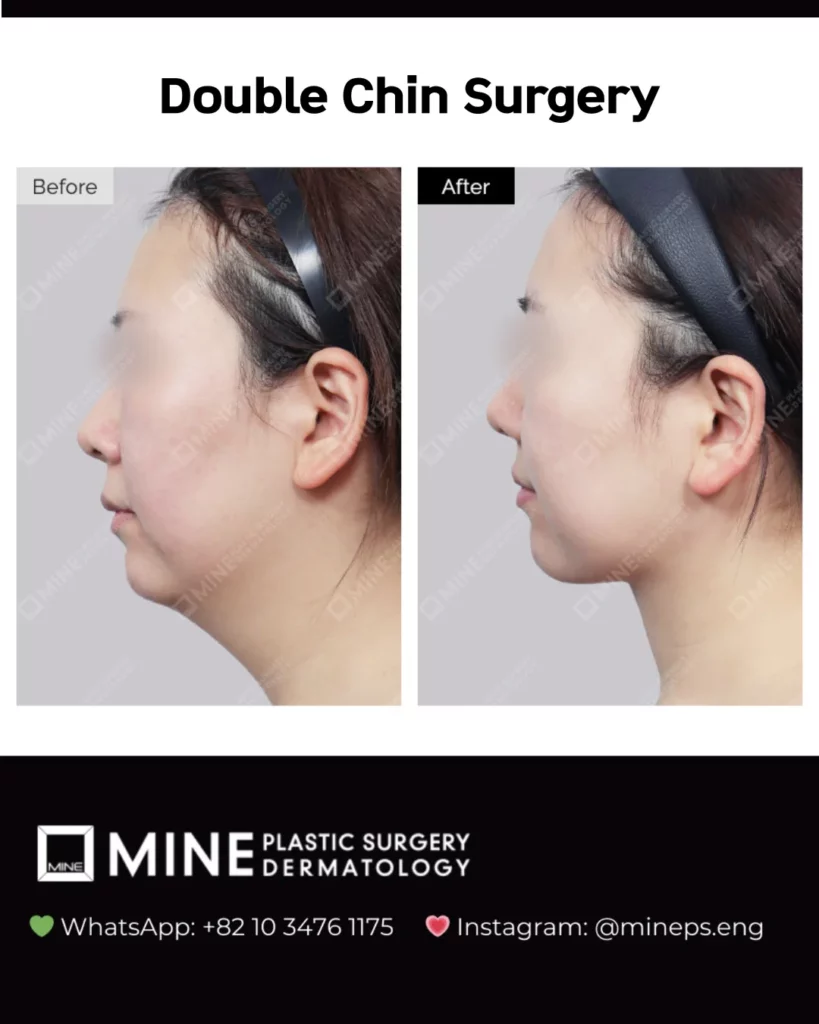
The “before” frame shows almost no separation between the underside of the chin and the neck. After surgery, the jaw border is traceable along its full length.
Case 02 — Fullness extending down the neck
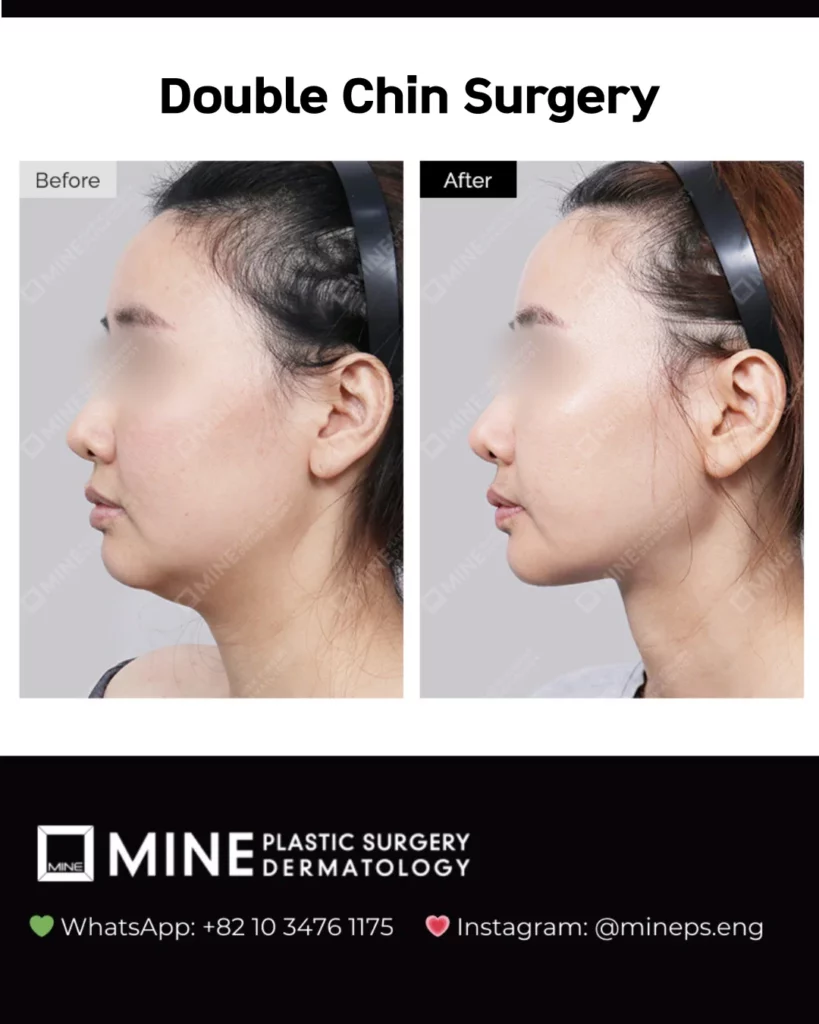
Note that the change is not limited to the pocket under the chin — the upper neck is slimmer too, which is what prevents a “shelf” from forming.
Case 03– Short Chin
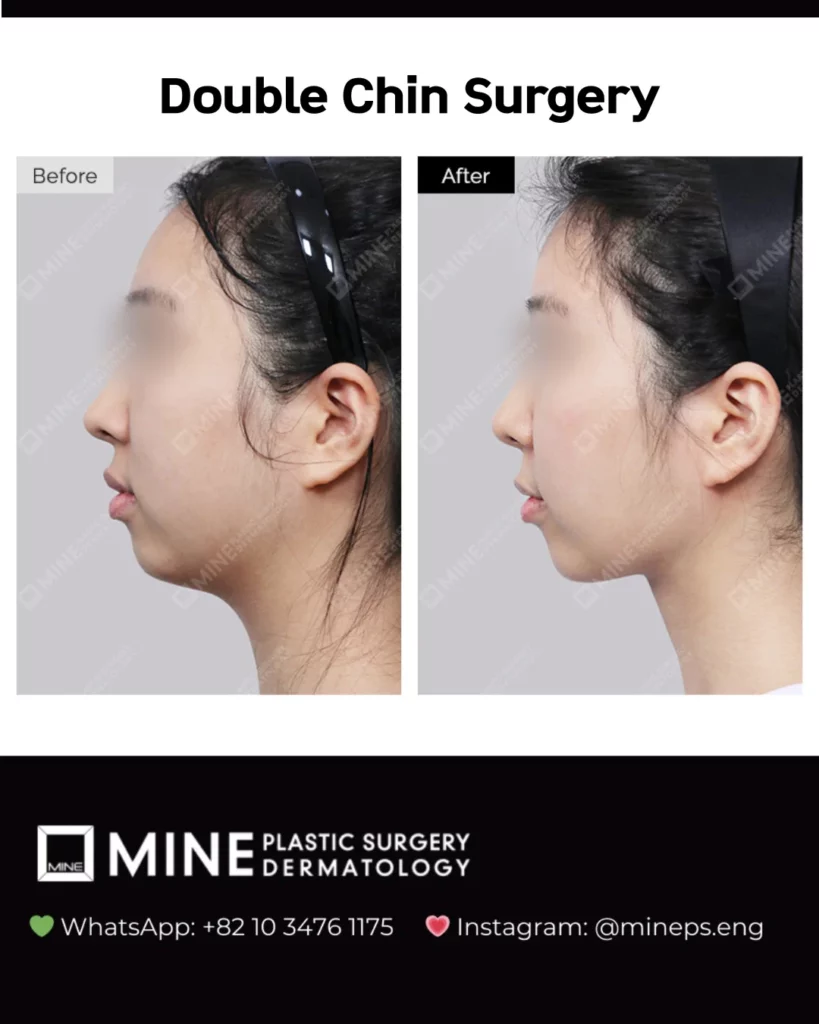
To browse a wider range of verified patient outcomes, see the Mine Clinic Real Story gallery and our full Before & After archive.
Judge a before-and-after by the jawline shadow and the chin-to-neck angle — not by how slim the face looks. And always check that the head is in the same position in both frames.
The Procedure: MINE Vlimming Double Chin Surgery, Step by Step
Because a double chin has several possible causes, Mine Clinic does not treat every patient with the same technique. Our signature approach — known internally as MINE Vlimming, or double chin muscle tying — combines staged fat removal with platysma muscle tightening in a single session.
Before anything else: diagnosis
At consultation, the surgeon palpates the submental area to distinguish soft subcutaneous fat from firm deep fat, assesses platysma tone by asking you to tense your neck, evaluates chin projection in profile, and checks skin elasticity. Where the picture is unclear — particularly in thicker necks — MRI imaging can be used to confirm how much fat sits below the muscle before a plan is finalised.
This step matters more than the surgery itself. A patient whose fullness is 80% subplatysmal will be disappointed by simple liposuction, no matter how skilfully it is done.
The staged fat removal and muscle tying technique
Step 1 — Subcutaneous fat, between skin and muscle. A round-tipped fine cannula is used to reduce trauma to skin tissue and small nerves, which in turn limits bruising and shortens recovery.
Step 2 — Fat granules attached to bone and outer muscle. Fat adherent to the muscle layer and near the mandible resists suction. Each deposit is addressed individually rather than left behind — this is a common source of residual fullness after ordinary liposuction elsewhere.
Step 3 — Fibrous fat between the overlapping neck muscles. This tissue cannot be suctioned. It requires careful delamination without damaging the muscle, performed through a minimal incision beneath the chin.
Step 4 — Fat pads between the separated platysma muscles. Once this deep volume is reduced, the loosened muscle edges are brought together and sutured, producing a lifting effect rather than a hollow.
Step 5 — Additional fat blocks, for thicker necks only. In patients whose fullness runs in a straight line from the mid-neck to under the chin, fat blocks beneath each side of the platysma must also be removed. This region contains significant veins and nerves and is left untouched at many clinics. It is performed at Mine Clinic on the basis of case volume and experience — and only where the anatomy justifies it.
Platysma Muscle Tightening
After volume reduction, both sides of the platysma are drawn together and sutured along the midline. A parallel release in the lower-mid platysma then allows the muscle to travel upward, which is what sharpens the border between neck and chin. This is the structural step that distinguishes the procedure from liposuction alone.
The lifting effect visible here comes from the platysma sutures, not from fat removal alone.
Procedure snapshot
| Surgery time | Approximately 1 hour |
| Anaesthesia | Sleep (sedation) anaesthesia |
| Hospital stay | Discharge the same day |
| Incisions | Small access point behind the ear; approximately 1.5 cm beneath the chin |
| Visibility of scar | Concealed under the chin — not visible unless the head is tilted back |
| Pricing | Consultation required for personalized pricing |
Detailed technique illustrations, MRI comparisons, and case-type breakdowns are available on our Korean Double Chin (Vlimming) procedure page, and the anatomy is explained further in our article on double chins and submuscular fat.
Q: Do I need surgery, or will a non-surgical treatment work?
A: If your fullness is mild, purely subcutaneous, and your skin has good elasticity, non-surgical options may be appropriate — including Ulthera focused ultrasound, thread lifting, or fat-dissolving Vlimming injections. Our complete guide to non-surgical double chin removal compares these honestly, including their limits. If your fullness is deep or your platysma has separated, injectables and energy devices will not reach the problem.
Q: What if my double chin is caused by a short chin or sagging skin?
A: The plan changes accordingly. A retruded chin may be better addressed with chin implant; significant skin laxity may call for a mini neck lift or a full neck lift; prominent glands may require salivary gland reduction. The difference between these approaches is explained in our article on mini neck lift versus double chin surgery.
Why Choose Korea and Mine Clinic for Double Chin Surgery
Korea’s reputation in this field is not simply marketing. It rests on volume: submental and jawline contouring is performed here at a frequency that few countries match, and high case volume in a narrow specialty tends to produce refined technique and clearer protocols.
What we would ask you to look for specifically — at Mine Clinic or anywhere else:
- The surgeon who consults is the surgeon who operates. Ask this directly. It is a reasonable question and any reputable clinic will answer it plainly. You can review our medical staff credentials before you travel.
- Deep-plane capability, not just liposuction. Many clinics will only offer subcutaneous suction because the subplatysmal layer is technically demanding. If your fat is deep, that limitation becomes your result.
- A dedicated international department. Language is the most common friction point in medical travel. Mine Clinic’s International Service provides English-language coordination from first enquiry through post-operative follow-up, with WhatsApp support after you return home.
- Transparent safety systems. Our MINE Safety System covers anaesthesia monitoring, sterilisation standards, and emergency protocols. You are entitled to see this before booking.
- One-stop planning. Because Mine Clinic operates as both a plastic surgery and dermatology practice, complementary treatments — skin tightening, V-line jaw contouring, or facial fat grafting — can be planned into one trip rather than several.
The clinic is located on Nonhyeon-ro in Gangnam-gu, a short walk from Apgujeong Station on Line 3. Full directions and transport details are on our site.
The advantage of having double chin surgery in Korea is access to surgeons who routinely operate beneath the platysma. If a clinic — here or at home — only offers surface liposuction, ask what happens to the deep layer.
Important: Risks, Side Effects & Safety
Every surgical procedure carries risk, and any clinic that presents this one as risk-free is not being straight with you. Here is what you should expect and what you should watch for.
Expected, temporary effects
These are part of normal healing rather than complications:
- Swelling, typically peaking around days 2–3 and settling substantially over 2–4 weeks
- Bruising along the jaw and upper neck, usually resolving within 1–2 weeks
- Numbness or altered sensation under the chin, generally recovering over several weeks to a few months
- Tightness or firmness as internal scar tissue matures — often most noticeable at weeks 3–6, then softening
- Temporary asymmetry while swelling resolves unevenly, which is common and rarely permanent
Less common risks
- Contour irregularity or a small residual pocket, occasionally requiring minor revision
- Seroma (fluid collection) or haematoma (blood collection), which may need drainage
- Infection, managed with antibiotics and monitored closely at follow-up
- Prolonged numbness where a small sensory nerve is stretched
- Marginal mandibular nerve neuropraxia — temporary weakness affecting one side of the smile. This is uncommon and usually self-resolving, but it is the risk most worth understanding before consenting, particularly for deep-layer work.
- Skin laxity becoming more apparent after volume is removed, in patients with poor skin elasticity
- Anaesthesia-related risks, which is why pre-operative screening matters
Who is not a good candidate
Surgery may be deferred or declined for patients with uncontrolled diabetes, bleeding disorders or anticoagulant use that cannot be safely paused, active infection in the area, unstable weight, significant untreated skin laxity that would be better served by a lifting procedure, or expectations that do not match what the anatomy allows. A responsible clinic will tell you no when no is the right answer.
Recovery in Korea: Your Day-by-Day Timeline
The most practical question international patients ask is simple: how long do I need to be here? For most double chin surgery patients, the answer is 7 to 10 days in Korea.
| Timeframe | What to expect |
|---|---|
| Day 0 (surgery day) | Procedure takes around 1.5 hour under sleep anaesthesia. Discharge the same day. A compression band is fitted. Rest with your head elevated. |
| Days 1–3 | Swelling peaks. Bruising appears. Discomfort is usually described as tightness rather than sharp pain and is managed with prescribed medication. Soft foods, no alcohol, no smoking. |
| Days 4–6 | Swelling begins to recede. Light walking and gentle daily activity are fine. Compression band worn as directed. |
| Day 7 | Suture removal (usually day 5–7 depending on healing). Final review with your surgeon. Post-op instructions issued in English. |
| Days 7–10 | Most patients are cleared to fly home after suture removal and a satisfactory check-up. Move around the cabin during long flights and stay hydrated. |
| Weeks 2–4 | Bruising resolves. Roughly 60–70% of swelling has settled. Light exercise may be resumed on your surgeon’s advice. |
| Weeks 4–8 | Contour becomes clearly visible. This is when most before-and-after comparison photos are taken. Firmness continues to soften. |
| Months 3–6 | Final result. Scar continues to fade and typically becomes very difficult to see. |
Approximately two months post-operatively — swelling largely settled, with further refinement still to come through months three to six.
Practical notes for international patients
- Book your return flight flexibly. Healing occasionally runs a day or two longer, and no one should be flying on a fixed ticket they cannot change.
- Stay near the clinic. Apgujeong and Sinsa have extensive short-stay accommodation within a few minutes of the clinic. Our international coordinators can advise.
- Bring loose, front-opening clothing. Pulling a t-shirt over your head is uncomfortable in the first week.
- Plan follow-up from home. Post-operative check-ins continue by WhatsApp once you return, including photo review at the one- and three-month marks.
For a more detailed aftercare breakdown, see our complete guide to double chin surgery recovery and aftercare and our article on how long double chin lifting results last.
Frequently Asked Questions
How long do double chin surgery results last?
Fat cells removed during the procedure do not return, and the platysma sutures are permanent. In that sense the structural correction is lasting. However, significant weight gain can enlarge the remaining fat cells, and natural ageing continues to affect skin elasticity. Patients who maintain a stable weight generally keep their result long-term. See our full discussion of result longevity.
Will there be a visible scar?
The submental incision is approximately 1.5 cm and sits in the natural shadow beneath the chin, where it is not visible unless the head is tilted back. The access point behind the ear is similarly concealed. Scars are typically most noticeable at weeks 4–8 and fade substantially by three to six months. If you scar poorly or form keloids, tell your surgeon at consultation — it affects planning.
Is double chin surgery painful?
The procedure itself is performed under sleep anaesthesia, so you feel nothing. Afterwards, most patients describe pressure and tightness rather than sharp pain, well controlled with prescribed medication. Discomfort is generally most noticeable in the first 48 hours and eases quickly.
Can double chin surgery be combined with other procedures?
Yes, and for international patients this is often the more sensible plan. It is commonly combined with V-line jaw contouring, thread lifting, facial fat grafting, or skin treatments. Combining procedures means one anaesthesia and one recovery period, though it may extend your stay. Your surgeon will advise what can safely be done together.
How much does double chin surgery cost in Korea?
Pricing depends on which layers require treatment, whether muscle tying is included, and whether the procedure is combined with anything else — so a consultation is required for personalized pricing. Send photographs through our online consultation form and our international team will provide a tailored assessment before you commit to travel.
Am I too old — or too young — for this procedure?
Neither, necessarily. Patients in their 20s and 30s more often need deep fat removal and muscle tying; patients in their 40s and 50s more often need lifting components addressed alongside it. The plan changes with age, not the eligibility. Browse more articles in our double chin category and the wider lifting and anti-aging blog.
Ready to Take the Next Step?
Interested in this procedure? Contact Mine Clinic today for a personalized online consultation. We are ready to assist you on WhatsApp and guide you through your K-Beauty journey in Seoul.
📱 WhatsApp: +82 10 3476 1175 📸 Instagram: @mineps.eng 🗓️ Book an Online Reservation | 💬 Free Online Consultation 📍 4F, 813 Nonhyeon-ro, Gangnam-gu, Seoul, Korea (Apgujeong Station, Line 3, Exit 4)
Reviewed by Dr. Lee Sung-wook, Board Certified Plastic Surgeon at Mine Clinic.
This content is for informational purposes only and does not substitute professional medical advice. Individual results vary depending on anatomy, skin condition, and healing response. Always consult a qualified physician before making decisions about surgical treatment.