EN
EN


Table of contents
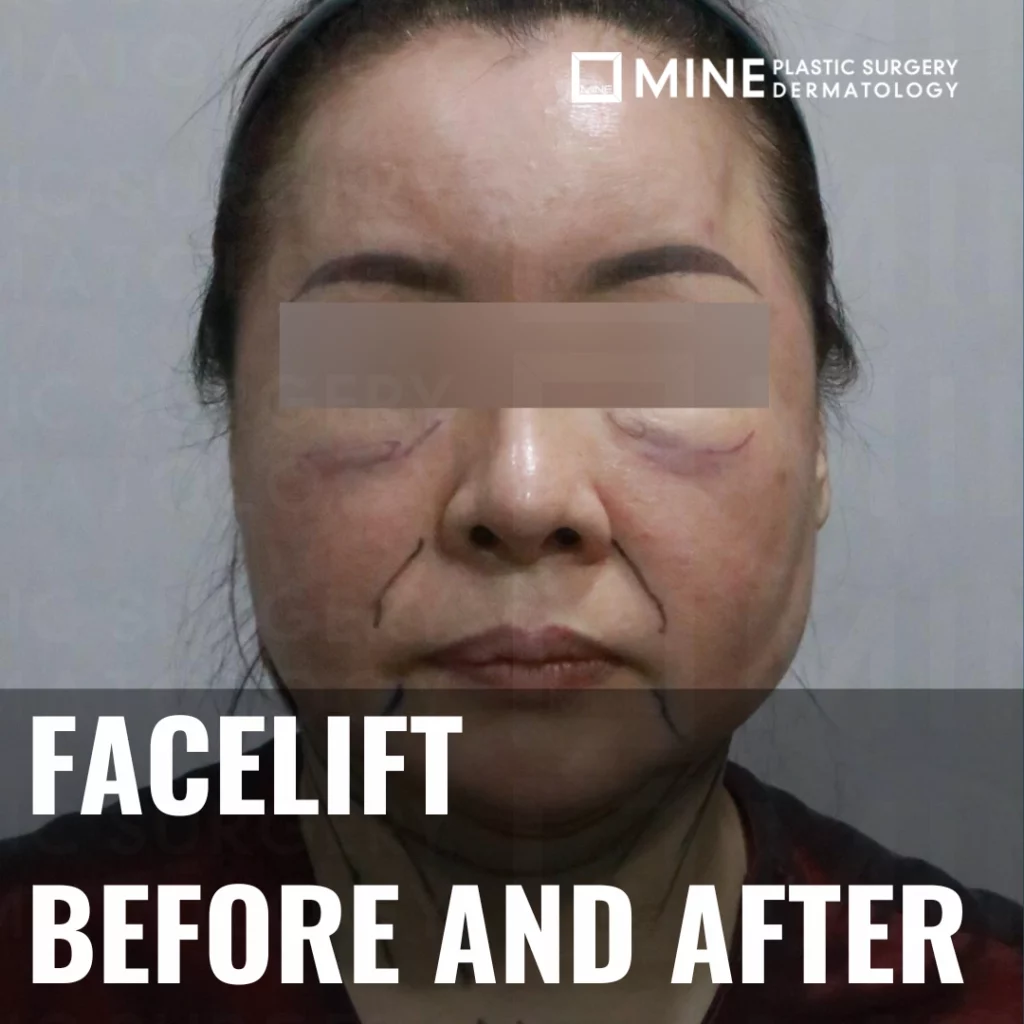
A deep plane facelift is a surgical technique that lifts the skin and the muscle-and-connective-tissue layer beneath it (the SMAS) together as a single unit, after first releasing the ligaments that tether the face to the bone underneath. Because the two layers move as one, surgeons can reposition the cheek and jawline at their natural depth instead of stretching the skin on its own. This is the structural idea behind the modern Korean facelift, and it is the main reason it looks so different from an older skin-only lift.
Korean plastic surgeons have refined this approach around a philosophy of “natural beauty” — subtle changes that preserve a person’s own features rather than producing an obvious, operated look. Facial rejuvenation is now one of the most requested procedures in Korea, and that high volume has helped surgeons here turn it into a carefully standardized, repeatable operation.
Cultural Influence on Natural Beauty Standards
The Korean approach to facial enhancement is rooted in the idea of “natural beauty.” Rather than chasing a dramatic change, Korean facelift techniques aim to refresh existing features while keeping a person’s ethnic characteristics and individual identity intact.
This philosophy shapes how surgeons plan the operation, with the focus on:
- Subtle improvement rather than a dramatic transformation
- Preserving natural facial expression and movement
- Harmonious results that suit the whole face
- Planning for how the face will age, so the result lasts
Understanding Deep Plane Facelift Technology
The deep plane facelift is one of the most refined approaches to facial rejuvenation. It was first described by Dr. Sam Hamra in 1990, who showed that dissecting below the SMAS of the midface lets a surgeon release the key facial retaining ligaments and free up the soft tissue far more completely than older methods allowed.
The Science Behind Deep Plane Technique
To understand why this matters, it helps to picture the layers of the face. Under the skin sits the SMAS — short for the superficial musculoaponeurotic system — a continuous sheet of thin muscle and connective tissue. Holding that sheet in place are the facial retaining ligaments, tough fibrous anchors that connect the SMAS and skin down to the deeper fascia and bone. The most important for a facelift are the zygomatic ligaments over the cheekbone and the masseteric ligaments along the jaw muscle. As these anchors slacken with age, the cheek fat and jawline drift downward and the face changes shape.
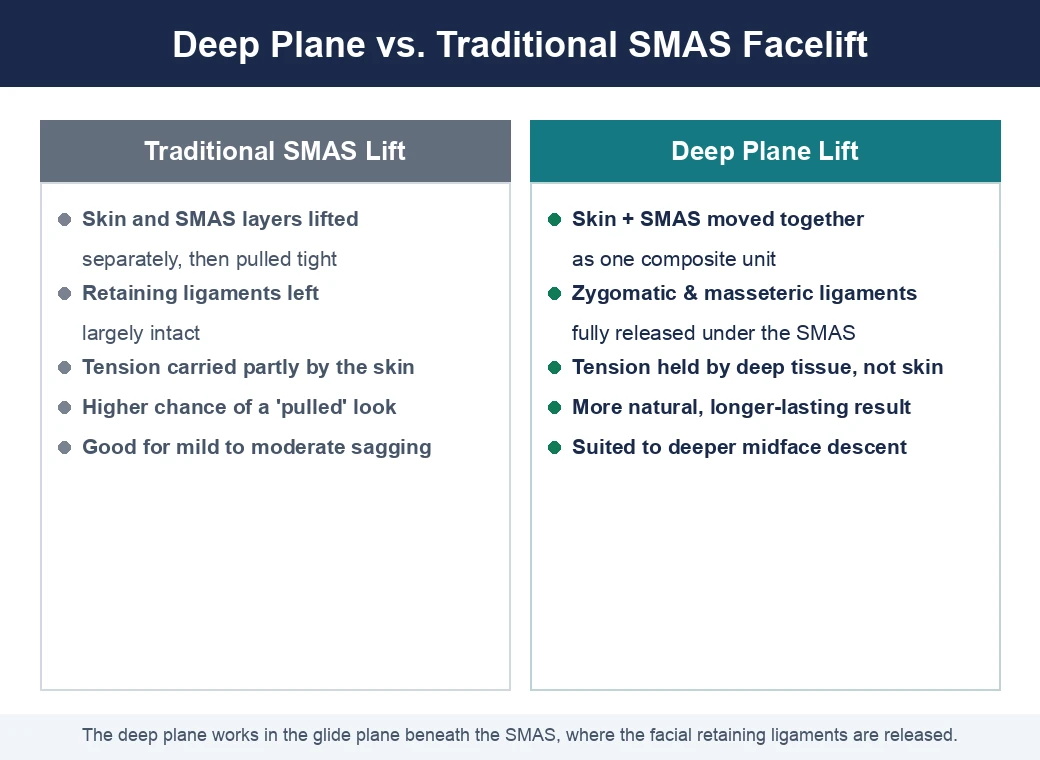
An older, skin-only facelift separates the skin from the muscle layer and tightens each one on its own. That puts the workload on the skin, which can create tension at the surface and the tell-tale “wind-swept” look. The deep plane technique works differently: the surgeon enters the natural glide plane just beneath the SMAS, releases the retaining ligaments, and then moves the skin and SMAS together as one piece — a composite flap. Because the tissue is repositioned at its own depth, the skin can be laid back down without being pulled taut.
There is an important safety point hidden in this anatomy. The same cheek ligaments that anchor the SMAS also mark where the delicate branches of the facial nerve cross beneath it. Surgical anatomy studies describe how the zygomatic and buccal nerve branches travel just next to these ligaments, so a surgeon who knows the planes precisely can release the anchors while protecting the nerves. This is exactly why the deep plane is considered technically demanding and best left to an experienced facelift surgeon.
The thinking behind the procedure addresses the three things that age a face:
- Volume loss in the cheeks, which often begins in the late 30s
- The downward pull of gravity on tissue, more noticeable from the late 40s
- Loss of facial bone support, which tends to accelerate around the 50s
By working in the space between the SMAS and the deeper structures, the surgeon can lift descended fat pads back toward their youthful position without adding artificial tension to the skin.
Korean Innovations in Deep Plane Surgery
Korean plastic surgeons have adapted the classic deep plane technique with several refinements:
Extended neck work: Korean surgeons often add tightening of the neck muscle (platysmaplasty) to address neck bands and sharpen the jawline in the same operation.
Composite flap preservation: Keeping the skin and SMAS together protects the blood supply to the flap, which supports steadier healing.
Careful ligament release: Precise release of the zygomatic and masseteric ligaments lets the tissue settle back into a natural, higher position rather than simply being pulled sideways.
How Does Korean Deep Plane Facelift Work?
The Korean facelift follows a systematic sequence that has been refined over decades. Walking through the steps helps explain why the operation takes the skill and time that it does.
The Surgical Procedure
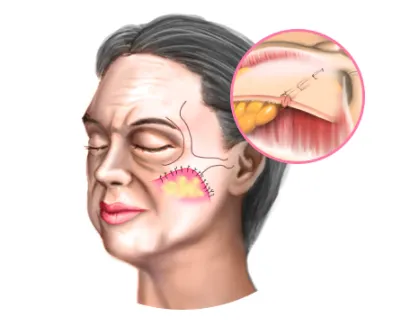
Step 1: Planning the incisions. Incisions are placed within the hairline and along the natural contours of the ear so that healed scars are easy to conceal. Careful angling of the incision helps protect hair follicles and preserve the natural shape of the ear.
Step 2: Raising the composite flap. The surgeon lifts a flap that includes both the skin and the SMAS together, keeping their natural relationship and shared blood supply.
Step 3: Deep plane dissection. Working beneath the SMAS, the surgeon releases the facial retaining ligaments — especially the zygomatic ligaments that anchor the cheek.
Step 4: Repositioning the tissue. The freed tissue is moved upward along a more vertical vector — lifting against gravity rather than pulling the face sideways — which avoids the “windblown” appearance.
Step 5: Tension-free closure. The key advantage here is that the holding tension sits on the deeper tissue, so the skin can be closed without stress on it.
Advanced Modifications
- Including the lateral orbicularis muscle in the composite cheek flap for a smoother midface
- Treating the mobilized cheek and neck flap as one continuous unit
- Using a more upward (superior) lift vector for a natural result
- Setting the new tissue position with planned, secure suture techniques
What Are the Benefits of Korean Deep Plane Approach?
The Korean approach to this facelift offers several advantages over older skin-only methods, which is why it has become a popular choice for patients who want a natural, durable result.
Longer-Lasting Results
A deep plane facelift is generally reported to last longer than a skin-only lift, with results commonly cited in the range of about ten years or more, though this varies from person to person. The durability comes from addressing the structural causes of ageing rather than simply tightening the surface.
There is good anatomical support for this. A large cadaver anatomy study published in Plastic and Reconstructive Surgery in 2024 helped explain why: once the deep retaining ligaments are released and the tissue is moved to a higher position, the ligaments reattach in that new position and resume their natural job of resisting gravity. In other words, the anatomy itself helps hold the result, rather than the repair carrying all of the load.
Superior Natural Appearance
Because the Korean philosophy prioritizes facial harmony, the goal is to enhance rather than alter natural beauty. Typical benefits include:
- Preserved expressions and natural movement
- No “pulled” or artificial look
- Restored cheek volume from repositioning the fat pads
- A defined jawline without over-correction
Comprehensive Facial Rejuvenation
Rather than treating each concern in isolation, this approach improves the whole lower two-thirds of the face at once:
- Midface lift that restores cheek fullness
- Lower-face tightening that softens jowls
- Neck contouring that sharpens the jawline
- Better-supported skin as the deeper structure is restored
Reduced Recovery Complications
The technique itself can help recovery go smoothly, thanks to:
- A preserved blood supply, which supports healing of the flap
- Tension-free closure, which reduces stress on healing tissue and helps scars settle
- Dissolvable sutures in many of the deeper layers
- Structured aftercare, such as guided swelling management and wound care
Recovery and Long-Term Results
Understanding the recovery timeline for this facelift helps patients prepare and set realistic expectations for healing.
Immediate Post-Operative Period (Days 1-7)
The first week centers on managing swelling and bruising:
- Days 1–3: Mild to moderate swelling and bruising, managed with rest, head elevation and cold care
- Days 4–7: Swelling gradually settles, and most patients feel comfortable with light activity
- Suture removal: usually somewhere between days 5 and 10, depending on healing
Many Korean clinics also offer supportive care during this period, such as lymphatic drainage massage to ease swelling and attentive wound care with appropriate dressings. Any specific adjunctive treatment should be discussed with your surgeon, as the right plan depends on your health and how you are healing.
Intermediate Recovery (Weeks 2-6)
Most patients see steady improvement during this phase:
- Week 2: Return to most normal daily activities as swelling keeps decreasing
- Week 4: Gradual return to exercise and more demanding activity, as advised
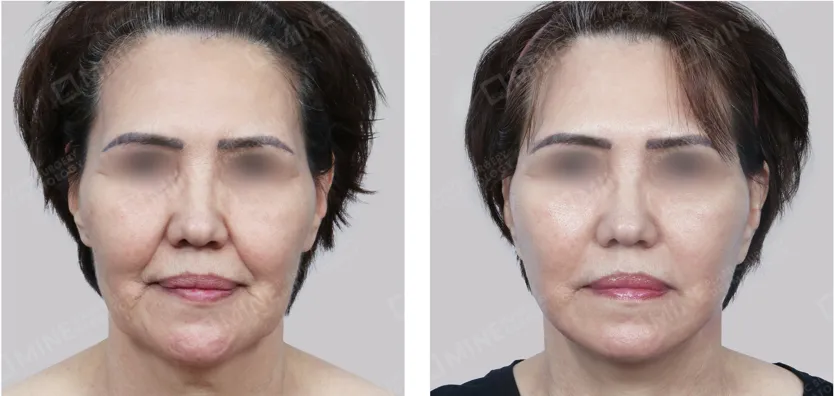
- Week 6: Most swelling has resolved and the result begins to show clearly
Long-Term Results and Aging
The result is designed to age gracefully:
Year 1: tissues fully settle and the result is at its best. Years 2–5: the refreshed appearance holds well. Years 5–10 and beyond: the face continues to age naturally, but from a younger-looking baseline, without a sudden “drop-off” of the result.
Factors Affecting Recovery and Results
Several things influence both healing and how long the result lasts:
- Age and skin quality
- Lifestyle factors such as smoking, sun exposure and nutrition
- How closely after-care instructions are followed
- The surgeon’s experience with the deep plane technique
Korean vs. Traditional Facelift Techniques
Comparing the deep plane method with older approaches makes the difference easy to see.
Technical Differences
- Works mainly on the skin, with limited handling of the SMAS
- Tends to pull the skin sideways, which can look unnatural if overdone
- Treats the skin and the deeper layer as separate units
- Leaves the retaining ligaments largely intact
A deep plane facelift:
- Addresses the structural causes of ageing, not just the surface
- Uses natural lift vectors that preserve expression
- Moves the skin and SMAS together, protecting their blood supply
- Fully releases the retaining ligaments so tissue can sit higher
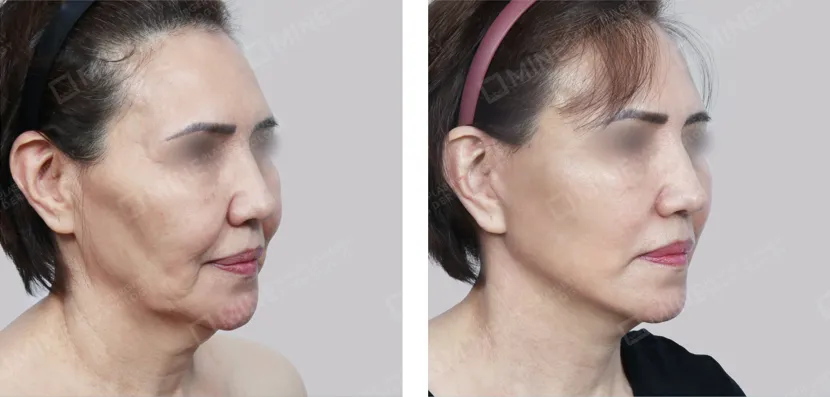
Technology and Innovation
Korea’s high surgical volume has helped facelift technique advance quickly here:
- Continuous refinement of technique through experience across many cases
- Detailed pre-surgical planning, often with imaging
- Specialized instruments suited to fine sub-SMAS dissection
- A strong training culture among facelift surgeons
For background on facelift surgery in general, the American Society of Plastic Surgeons is a reliable, independent reference.
Who Is a Good Candidate?
Deciding whether this facelift is right for you involves more than age alone.
Ideal Candidates
Age range: Most patients who benefit are roughly between 45 and 70, though individual ageing patterns matter more than the number itself.
Concerns it addresses well:
- Deep nasolabial folds that involve more than just the skin
- Sagging of the deeper facial structures, not only surface looseness
- Jowls with underlying muscle laxity
- Midface volume loss as the cheek descends
- Neck bands and a softening jawline
Physical Health Requirements
A thorough health check comes first:
- Cardiovascular health suitable for general anesthesia
- Reasonable skin elasticity and healing capacity
- A stable weight for several months before surgery
- Not smoking, or stopping well before surgery
Psychological Readiness
Good outcomes also depend on the right mindset:
- Realistic expectations about results and recovery
- Understanding that this is natural rejuvenation, not a dramatic change of identity
- A commitment to aftercare during healing
- Comfort with subtle enhancement over a dramatic transformation
Medical Contraindications
Some conditions may make surgery unsafe or unwise:
- Poorly controlled high blood pressure
- Blood-clotting disorders
- Expectations that cannot realistically be met
- Active smoking, which substantially increases the risk of healing problems
A consultation with a board-certified plastic surgeon experienced in the deep plane technique is essential to confirm whether the procedure is right for you.
Frequently Asked Questions
How long do Korean deep plane facelift results last?
Results are generally reported to last longer than a skin-only lift, often cited at around ten years or more, although the exact figure varies with age, skin quality and lifestyle. The longevity comes from releasing and repositioning the deep retaining ligaments, which then reattach and continue to support the lifted tissue, rather than relying on surface tension alone.
Is deep plane facelift more painful than traditional facelift?
It is often not more painful. Because the technique preserves the blood supply and closes the skin without tension, many patients report only mild to moderate discomfort for the first several days, which is usually well controlled with prescribed pain medication and standard aftercare.
Can Korean deep plane facelift be combined with other procedures?
Yes. Surgeons commonly combine it with complementary procedures such as a neck lift, brow lift, eyelid surgery or fat grafting, so the whole face is rejuvenated in balance. Whether combining procedures is safe for you depends on your health and your surgeon’s assessment.
What are the risks of Korean deep plane facelift?
As with any surgery, there are risks. These can include temporary weakness of a facial nerve branch, collection of blood under the skin (hematoma), delayed healing, scarring, infection and minor asymmetry that may need a small revision. Choosing an experienced, board-certified surgeon who knows the sub-SMAS planes well is the single most important way to keep these risks low. Your surgeon will review your individual risk profile during consultation.
What is a deep plane facelift?
A deep plane facelift repositions the SMAS layer and releases the facial retaining ligaments as one unit, instead of pulling only the skin. Because the lift happens at the structural layer where sagging actually starts, the result tends to look natural in motion and avoids the tight, pulled look associated with skin-only lifts.
How is a deep plane facelift different from a mini facelift?
A mini facelift uses shorter incisions around the ear and targets early jowling in the lower face, with a smaller dissection and shorter downtime. A deep plane facelift releases and repositions the deeper ligaments over a wider area, so it addresses more advanced sagging of the midface, jawline, and neck. The right choice depends on the degree and location of sagging, which is assessed during consultation.
How long should international patients stay in Korea for a facelift?
Most patients plan their trip around stitch removal at about 7–10 days after surgery, so a stay of roughly 7–10 days in Seoul is the usual baseline. Visible bruising and swelling begin to settle within the first two weeks, and the remaining swelling continues to go down over the following weeks. Recovery speed varies by individual.
Where are facelift incisions placed, and will the scars be visible?
Incisions follow the natural creases in front of the ear and are hidden behind the ear or along the hairline where needed. With time and scar care they typically become difficult to notice over several months, although healing varies from person to person.
How much does a facelift in Korea cost?
The cost depends on the technique (mini, full, or deep plane), the extent of sagging, and whether it is combined with procedures such as a neck lift. An exact quote is provided after an in-person or online consultation, once the surgical plan is confirmed.
Transform Your Appearance with Advanced Techniques
The deep plane facelift represents a thoughtful, anatomy-based approach to facial rejuvenation. By releasing the deep retaining ligaments and moving the skin and SMAS together, it aims for a result that looks natural and lasts — which is exactly what the Korean philosophy of subtle, harmonious enhancement is built around.
If you are considering facial rejuvenation and want to understand whether this technique suits your face, the best next step is a careful consultation. Mineclinic Plastic Surgery & Dermatology offers in-depth consultations to help you understand which approach best fits your anatomy and your goals.
With the right candidate and an experienced surgeon, the procedure can give a refreshed, natural appearance while keeping the features that make you look like yourself. (mini facelift in Korea)
Disclaimer: This article is provided for informational purposes by Mineclinic Plastic Surgery & Dermatology in compliance with medical advertising regulations. It is reviewed by Dr. Lee Sung-wook, a board-certified plastic surgeon in Korea. All surgical and non-surgical procedures carry potential risks including inflammation, bleeding, infection, scarring, and nerve damage. Individual results may vary significantly. A thorough consultation with a board-certified specialist is required before undergoing any procedure. Mineclinic Plastic Surgery | 813 Nonhyeon-ro, Gangnam-gu, Seoul, Korea | +82-2-516-1175
※ This content is for informational purposes only and does not replace professional medical advice, diagnosis, or treatment. Individual results may vary, and side effects may occur. Please consult with a board-certified plastic surgeon for personalized advice.