EN



“I look tired all the time, even when I’m not.” Patients say this to me more than almost anything else. When they point to the mirror, it is rarely the skin they are worried about. It is the cheeks: fuller and higher a few years ago, now flatter on top and heavier lower down.
A mini facelift for sagging cheeks is a short-incision surgery that lifts the loosened SMAS layer (the thin supportive layer under the skin and fat) up and back, carrying drooping cheek fat back over the cheekbone instead of simply pulling the skin tight. The incision is small, but the lift happens in the deeper layer that actually dropped.
In my clinical experience, most people who come in with this concern are between their late 30s and early 50s. This article answers one question: will a mini facelift for sagging cheeks really lift your midface, which changes will it fix, and which ones won’t it fix? I’ll explain it the way I do at the consultation desk.
Why Do Cheeks Sag? The Three Layers Behind It
Sagging cheeks are not just a skin problem. Plastic surgery textbooks describe the ageing face as changes in at least three layers at once: the skin, the soft tissue underneath, and the way fat is distributed. To understand what a mini facelift for sagging cheeks can and can’t do, it helps to look at each layer separately.
| Layer | What happens with age | What you see in the mirror |
|---|---|---|
| Skin | Collagen and elastin production slows, so the skin loosens | Fine lines, a less firm surface |
| SMAS | The supportive layer under the skin stretches and can no longer hold the cheek up | Cheeks and jowls drift downward, the jawline blurs |
| Cheek fat | The cheek fat pad slides down from below the eye toward the smile line | Flatter cheekbones, a deeper smile line, a hollow under the eye |
Skin loses elasticity
As we age, the skin makes less collagen and elastin, the proteins that keep it springy. The skin becomes thinner and looser. This is real, but on its own it mostly causes fine lines and a softer surface. It doesn’t explain why the whole cheek seems to have moved.
The SMAS layer loosens
Beneath the skin and fat sits the SMAS (superficial musculo-aponeurotic system), a thin sheet of fibrous tissue that works like a sling for the cheek. Facelift textbooks describe the SMAS as anchored to the deeper tissues by small ligaments, like tent ropes, with movable areas in between. Over time the sheet stretches and the cheek hangs lower on those anchors.
This is the reason creams, facials and skin-tightening devices have limits. They work on the skin. They can’t reposition a sling that sits several layers deeper and is held down by ligaments.
Cheek fat slides down
Dermatology textbooks describe midface ageing as the cheek fat pad sliding down from just below the eye and collecting along the smile line (nasolabial fold). Three things follow: the cheekbone looks flatter, a hollow appears under the eye, and the smile line looks deeper because more fat now sits on top of it.
Dr. Lee’s key point: Sagging cheeks come from the skin, the SMAS and the cheek fat weakening together. If only the skin is treated, the deeper layers stay where they dropped.
How a Mini Facelift Lifts Sagging Cheeks
A mini facelift for sagging cheeks works on the layer that actually moved. The goal is not to stretch the skin over a low cheek. It is to put the cheek back where it used to be.
A small incision from the temple to the top of the ear
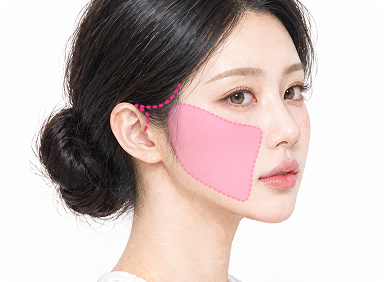
At MINE, the incision starts in the scalp at the temple and ends at the upper part of the ear. It stays short: it does not continue down the front of the ear to the earlobe, and it does not wrap around to the back of the ear. Most of it sits inside the hairline. I cover healing and scar care in a separate article on mini facelift scars.
Wide SMAS release, lifted up and back
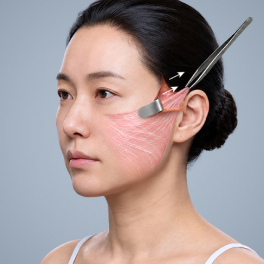
Here is the part of a mini facelift for sagging cheeks that most people don’t expect. Although the incision is small, the dissection underneath is wide. Through that opening I release the SMAS across the cheekbone, the upper cheek, the lower cheek and down to the jowl and jawline. Freeing the ligaments that tether it lets the whole sheet move again. The area of SMAS that gets lifted is close to that of a full facelift. Only the incision is smaller.
The released SMAS is then lifted in the direction it sagged, up and back, and fixed to a deeper, stable layer. According to facelift surgery textbooks, lifting the SMAS this way moves 2 things back up together: the jowl and the cheek fat that had slid down. That is how the fullness returns to the top of the cheek.
Skin redraped without tension
The SMAS is fixed on its own, separate from the skin. The skin isn’t pulled. It is simply laid back over the lifted tissue and closed without tension. Because the skin carries no tension, the face keeps its normal expressions and avoids the stretched, “windswept” look.
At MINE, the mini facelift takes about 1 hour under sedation, patients go home the same day, and most return to daily life in about 5 days.
- Surgery time: about 1 hour
- Anesthesia: sedation (sleep) anesthesia
- Hospital stay: same-day discharge
- Back to daily life: about 5 days
- Clinic visits: 3
For the full step-by-step method and our surgical system, see the mini facelift procedure at MINE. For a general patient overview of facelift surgery, the American Society of Plastic Surgeons facelift overview is a good place to start.
What Does a Mini Facelift Fix? 4 Changes to Expect
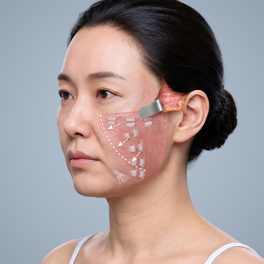
Each change a mini facelift for sagging cheeks brings follows from the layer work described above. The question is never just “what looks different,” but “which layer moved, and why.”
1. Sagging midface cheeks lifted
Before: the top of the cheek looks flat and the lower cheek looks heavy. After: the fullness sits back over the cheekbone. Why: the SMAS carries the descended cheek fat up with it. This is the main reason people choose a mini facelift for sagging cheeks, and it is the change patients usually notice first. The face looks more alive even at rest.
2. Smile lines softened
When the cheek fat moves up off the smile line, the fold becomes shallower. A deep smile line rarely has a single cause, though. An MRI study described in dermatology literature found that the deepening fold reflects at least 2 changes: tissue sagging plus thickening of the fat and skin over the fold. So a lift softens the fold, but a very deep one may still benefit from an add-on such as filler. I explain these options in my article on smile lines and face sagging.
3. A cleaner jawline and less jowling
Jowls are part of the same sagging SMAS sheet, and the dissection reaches down to the jawline. As that tissue is lifted back, the edge of the jaw looks sharper. A mild double chin can also look better, because the tissue that spilled over the jawline is pulled back into place. Significant loose skin or bands in the neck are a separate question (see below).
4. A fresher, less tired overall look
Put the three changes together and the overall result is a face that looks rested rather than “done.” I don’t promise a number of years. How much younger someone looks depends on where they started. What patients most often tell me is that people stop asking whether they are tired.
Dr. Lee’s key point: A mini facelift for sagging cheeks lifts the midface, softens smile lines and tidies the jawline, because all three come from the same sagging layer.
What a Mini Facelift Won’t Fix
Being clear about the limits matters as much as the results. A mini facelift for sagging cheeks is not the right tool for:
- Loose neck skin and neck bands: these sit below the area the mini lift treats and usually need a neck lift.
- Fine wrinkles, skin texture and pigmentation: these are skin-surface issues and respond better to skin treatments.
- Volume loss (hollows): if the cheek has deflated rather than dropped, fat grafting or filler may be needed to restore volume.
- Heavy, advanced sagging: when sagging is severe or involves the neck, a full facelift is often more suitable. I compare the two in mini or full facelift.
Thread lifting is the common non-surgical alternative. Recovery is quicker, but the effect is shorter, about 1–2 years, so it suits mild sagging best.
Is Your Cheek Sagging in Mini Facelift Range?
You may be a good candidate for a mini facelift for sagging cheeks if most of these sound familiar:
- Your cheeks or jowls have dropped, but the change is early to moderate rather than severe.
- Your jawline has started to look blurred from the side.
- Your smile lines have deepened as the cheek has dropped, not only from volume loss.
- Your skin still has reasonable elasticity when you gently lift it.
- Your neck is still relatively firm.
There is no fixed age. Most people consider it after 35, but some in their early 30s have clear cheek drop because of genetics or rapid weight loss. The final decision needs an in-person exam: skin thickness, the degree of sagging and bone structure all change which approach is best.
Recovery, Risks and Preparation
Recovery at a glance
Recovery after a mini facelift for sagging cheeks is shorter than most people expect, because the incision is small.
| Time after surgery | What to expect |
|---|---|
| Right after | Swelling and bruising; a compression dressing is worn |
| About 5 days | Stitches removed; back to daily life |
| 1–2 weeks | Most swelling settles; social activities resume |
| 1 month | A natural contour starts to form |
| 3–6 months | Final result |
Swelling and bruising usually settle within 1–2 weeks, and the final result is judged at 3–6 months. How long results last depends on your skin, lifestyle and ageing; I cover this in how long a mini facelift lasts.
Possible side effects
Common and temporary: swelling and bruising, a tight feeling that eases over time, and temporary numbness around the ear that usually recovers within a few months.
Rare: hematoma (a collection of blood under the skin), infection, facial nerve injury (very rare), asymmetry and scar problems. A careful pre-surgery assessment and structured aftercare help keep these risks low.
Before and after surgery
Before surgery:
- Stop smoking at least 2 weeks beforehand; smoking reduces blood flow and slows healing.
- Stop aspirin, vitamin E and other products that increase bleeding 1–2 weeks beforehand.
- Tell us about any conditions such as high blood pressure or diabetes.
After surgery:
- Take prescribed medication as directed.
- Keep your head raised above your heart for 2–3 days.
- Avoid intense exercise, saunas and alcohol for 2 weeks.
- Protect your skin from the sun.
Frequently Asked Questions

How soon can I wear makeup after a mini facelift?
Light makeup is usually possible after stitch removal, about 5–7 days after surgery. Keep products off the incision line itself, and avoid harsh or irritating products for about 2 weeks.
Will a mini facelift for sagging cheeks get rid of my smile lines completely?
It softens them, because the cheek fat that was sitting on the fold is lifted back up. Very deep folds have several causes, so some patients add a treatment such as filler. See smile lines and face sagging for the options.
How long do mini facelift results on the cheeks last?
The lifted SMAS keeps ageing like the rest of your face, so the timeline varies with your skin, lifestyle and how quickly you age. Sun protection and not smoking help results last longer. More detail is in how long a mini facelift lasts.
Is a thread lift enough for sagging cheeks instead?
For mild sagging, it can be. A thread lift is non-surgical with a faster recovery, but the effect lasts about 1–2 years. A mini facelift for sagging cheeks repositions the SMAS itself, so the lift is more lasting. An in-person exam is the best way to decide.
What age is right for a mini facelift for sagging cheeks?
There is no set age. Most people consider it after 35, but it can make sense in the early 30s when genetics or rapid weight loss have caused clear cheek drop and a blurred jawline.
Considering a Mini Facelift for Sagging Cheeks in Seoul?
The same “sagging cheeks” can come from different layers in different people, so the same surgery isn’t right for everyone. At MINE Plastic Surgery in Seoul, I examine your skin thickness, the degree of sagging and your bone structure in person before recommending anything, including a non-surgical route if that suits you better.
If you’d like to know whether a mini facelift for sagging cheeks fits your face, please call us at +82-2-516-1175 or send an online consultation request. We’re happy to answer your questions before you travel.
Written and medically reviewed by Dr. Lee Sung-wook, Board-Certified Plastic Surgeon (Korea), MINE Plastic Surgery.
※ This content is for informational purposes only and does not replace professional medical advice, diagnosis, or treatment. Individual results may vary, and side effects may occur. Please consult with a board-certified plastic surgeon for personalized advice.