EN
EN


Table of contents
Understanding Double Chin Concerns
A well-defined jawline significantly impacts facial aesthetics, which is partly why double chin concerns affect so many individuals seeking facial contouring. Submental fullness — the medical term for a double chin — is one of the most common reasons patients ask about non-surgical double chin removal, and it is not confined to people who are overweight — a genetically inherited fat pad or an early loss of skin tone can produce it at a perfectly normal body weight.
Double chin can result from multiple factors:
- Genetic predisposition to fat storage beneath the chin
- Age-related skin laxity causing sagging in the neck area
- Weight fluctuations contributing to stubborn fat deposits
- Poor posture potentially emphasizing submental fullness
- Natural aging process affecting skin elasticity and muscle tone
One anatomical detail decides how well any of these treatments can work: where the fat actually sits. Under the chin there are two separate fat compartments. The superficial one lies between the skin and the platysma, the thin sheet of muscle that fans across the front of the neck. A deeper pocket sits underneath that muscle. Only the superficial compartment can be reduced without surgery. Injectable medication is kept above the platysma, and energy devices heat down to the platysma but no further. Fat trapped beneath the muscle can only be addressed surgically.
That single fact explains most disappointing outcomes. Two people with an almost identical profile photo can respond completely differently to the same plan, simply because one carries the fullness above the muscle and the other below it. It is also why a hands-on assessment — pinching the tissue, checking how quickly the skin springs back, looking at the jaw-to-neck angle — tells you far more than picking a device from a brochure.
The growing demand for non-surgical jawline definition reflects the desire for visible change without the recovery time and risks of surgery. This guide walks through the five main non-surgical double chin removal treatments used for submental fullness, what each one can and cannot do, and how long each takes to show results. Availability varies by clinic, so confirm which of these are offered before you book.
What Are Non-Surgical Double Chin Removal Options?
The field of aesthetic medicine has evolved dramatically, offering several effective non-surgical treatments for double chin reduction. Each option works through different mechanisms to address submental fat and skin laxity.
Fat Dissolving Injection
An injectable double chin treatment designed to reduce the fat pad under the chin. Most of these injectables work through a fat-dissolving agent — deoxycholic acid, a bile acid the body already makes to help digest the fat in food, is the best-studied of them. Formulations differ between countries and clinics, so ask which agent is being used and what it is licensed for.
Placed into the fat layer, it behaves like a detergent: it breaks open the membrane of the fat cells it touches so they can no longer store fat, and the immune system clears the debris over the following weeks. That clean-up is why the area swells afterwards. That clean-up is what makes the area swell afterwards. The swelling is not a sign that something has gone wrong; it is the treatment doing its job.
How It Works
The treatment process involves:
- Customized treatment planning based on your unique facial anatomy
- Multiple small injections strategically placed beneath the chin
- Gradual breakdown of fat cells as the deoxycholic acid disrupts fat cell membranes
- Natural elimination of destroyed fat cells through the body’s lymphatic system
Most patients need two to four sessions, spaced at least four weeks apart, and the contour keeps settling for weeks after the final visit. In phase 3 randomized trials of deoxycholic acid injection, treated patients showed a measurable reduction in submental fat compared with placebo, while swelling, bruising, numbness and firmness in the treated area were the common — and temporary — side effects. The American Society of Plastic Surgeons publishes plain-language patient information on non-surgical fat reduction if you want to read more before your consultation.

Benefits
- Long-lasting fat reduction — destroyed fat cells do not grow back, although the cells left behind can still enlarge with weight gain
- Minimally invasive alternative to liposuction
- No incisions or anesthesia required
- Short treatment sessions (typically 15-20 minutes)
- Natural-looking jawline definition that develops gradually
Considerations
- Temporary swelling is common for 1-2 weeks after treatment
- Multiple sessions required for optimal results
- Potential for bruising or temporary numbness
- Not ideal for significant skin laxity issues
Ultrasound Treatments (Ultherapy)
Ultherapy uses microfocused ultrasound to heat tiny points at set depths beneath the skin, including the SMAS — the fibrous support layer a surgeon tightens during a facelift. It is a lifting and tightening treatment rather than a fat-removal one. It sharpens a jawline that has gone soft because of loose skin; it will not empty a thick fat pad.
How Ultherapy Works
This innovative treatment:
- Delivers focused ultrasound energy to precise depths beneath the skin
- Creates controlled thermal injury in targeted tissue layers
- Stimulates collagen production through the natural healing response
- Gradually tightens and lifts the skin over 2-3 months
A systematic review of microfocused ultrasound studies found consistent — though modest — tightening of facial and neck skin after treatment. Most of the change shows up two to three months later, as new collagen is laid down, rather than on the day of the appointment.
Benefits of Ultherapy
- Reaches the deep support layer that creams and surface devices cannot affect
- Non-invasive procedure with no incisions
- Single-session treatment for many patients
- Natural collagen regeneration process
- Long-lasting results documented up to about one year in the published studies, with longer-term data still limited
Considerations
- Mild discomfort during the procedure
- Temporary redness or swelling may occur
- Gradual results developing over 2-3 months
- More effective for skin tightening than fat reduction

Radiofrequency Treatments
Radiofrequency (RF) devices heat the dermis in bulk rather than at focused points. The current passes through tissue and warms it into the narrow range where existing collagen fibers contract and the body is prompted to build new ones. RF is a skin-tightening and skin-quality treatment: it firms the envelope around the jawline, and any apparent loss of fullness follows indirectly from tighter skin, not from fat being removed.
How RF Treatments Work
The procedure typically involves:
- Applying a specialized handheld device to the treatment area
- Delivering radiofrequency energy to heat deeper skin layers
- Triggering collagen remodeling through controlled thermal injury
- Tightening the skin envelope so the jawline reads more cleanly in profile
Benefits of RF Treatments
- Minimal discomfort during treatment
- No downtime for recovery
- Progressive improvement over multiple sessions
- Enhanced skin quality beyond simple tightening
- Complementary effects when combined with other treatments
Considerations
- Multiple sessions required for optimal results
- Limited effect on significant fat deposits
- Results vary significantly between individuals
- Maintenance treatments may be needed
HIFU (High-Intensity Focused Ultrasound)
HIFU (high-intensity focused ultrasound) concentrates ultrasound energy at preset depths so the heat lands where it is wanted — including the SMAS support layer — while the surface of the skin is spared. Like Ultherapy, it belongs to the tightening family of non-surgical double chin removal treatments. Ultherapy is one specific microfocused ultrasound platform — the one that adds live imaging so the operator can see the layer being treated, while “HIFU” in everyday clinic language covers the other focused-ultrasound devices that work on the same principle without that imaging step. That is why the two appear as separate rows in the table above. It is not designed to dissolve a fat pad, so it suits a jawline that has softened rather than one that is genuinely full.
The HIFU Process
Treatment involves:
- Marking the target treatment area and choosing the transducer depth for your tissue thickness
- Delivering focused ultrasound pulses to precise tissue depths
- Creating micro-thermal coagulation points in targeted areas
- Stimulating collagen production and cellular regeneration
- Gradual tissue remodeling over 3-6 months
Benefits of HIFU
- Precise targeting of multiple tissue layers
- Customizable treatment depths for personalized results
- Reaches the SMAS layer without an incision, at a depth surface devices cannot heat
- Long-lasting results compared to some other non-surgical options
- No downtime after treatment
Considerations
- Mild discomfort during the procedure
- Potential for temporary numbness in treated areas
- Results develop gradually over several months
- May not be suitable for significant submental fat deposits
Cryolipolysis (Fat Freezing)
Cryolipolysis takes the opposite approach to the heat-based devices. A cup-shaped applicator draws the fat under the chin into it and cools it to just above freezing for roughly 30 to 45 minutes. Fat cells are more vulnerable to cold than skin, nerves or blood vessels are, so they are damaged selectively, and the body clears them gradually over the next two to three months.
Dermatology textbooks and pooled analyses of the clinical studies report a genuine, measurable drop in the thickness of the treated fat layer, along with some incidental skin tightening and high patient satisfaction. Two cautions matter. The applicator needs enough pinchable tissue to hold, so a small or firm double chin is not suitable. And a rare reaction called paradoxical adipose hypertrophy — the treated area becoming firmer and larger months later — is documented in the literature and should be discussed before you agree to treatment.
Numbness of the treated skin is common in the first weeks and usually settles on its own. As with every option on this list, cryolipolysis only reaches the fat above the platysma muscle.
How Do Targeted Exercises Help Reduce Double Chin?
Exercise is the first thing most people try, so it deserves an honest answer: targeted neck and jaw exercises strengthen muscle, they do not remove fat. There is no mechanism by which contracting a muscle burns the fat that happens to lie on top of it, and “spot reduction” has never held up in exercise research. What these movements can do is improve the tone and resting position of the platysma and the deep neck flexors, which changes how sharp the jaw-to-neck angle looks — a real but modest effect, and most noticeable when the fullness is mild or posture-related.
Effective Double Chin Exercises
Include these exercises in your daily routine:
- Chin Lifts
- Tilt your head toward the ceiling
- Pucker your lips as if kissing the ceiling
- Hold for 5-10 seconds
- Repeat 10-15 times daily
- Neck Stretches
- Sit with straight posture
- Turn head to right, then upward at 45° angle
- Hold for 5 seconds
- Repeat on left side
- Complete 10 repetitions on each side
- Ball Exercise
- Place a 9-12 inch ball under your chin
- Press chin down against the ball with gentle pressure
- Hold for 5 seconds
- Repeat 10-15 times daily
- Jaw Release
- Sit with lips closed
- Move jaw as if chewing
- Inhale deeply through nose
- While exhaling, say “ahh” while opening mouth
- Complete 10 repetitions
Performed consistently for at least 8 weeks, these exercises can improve muscle tone in the jaw and neck. Expect months rather than weeks, and expect a subtle change. If the fullness comes from fat or from skin that has lost its elasticity, exercise alone will not shift it — that is where non-surgical double chin removal treatments earn their place, with exercise as a complementary habit rather than a substitute.
What Results Can You Expect From Non-Surgical Treatments?
Expectations should be realistic when considering non-surgical double chin removal. Results vary significantly based on:
- Individual anatomy and fat distribution patterns
- Skin elasticity and quality
- Age and genetic factors influencing tissue response
- Treatment type and number of sessions
- Lifestyle factors including weight stability
Most patients experience:
- Visible reduction in submental fullness
- Improved jawline definition and profile
- Gradual enhancement over 1-3 months
- Natural-looking results without obvious signs of treatment
- Boosted confidence from improved facial aesthetics
Timelines differ enough between the non-surgical double chin removal options to be worth setting side by side before you choose:
| Treatment | Typical sessions | First visible change | Full result | Suited to |
|---|---|---|---|---|
| Fat-dissolving injection | 2 to 4, four weeks apart | 4 to 6 weeks | 2 to 3 months after the last session | A small, pinchable fat pad above the muscle |
| Cryolipolysis | 1 to 2 | 4 to 6 weeks | 2 to 3 months | Fat that can be drawn into the applicator |
| Microfocused ultrasound (Ultherapy) | Usually 1 | 6 to 8 weeks | About 3 months | Mild laxity, a softened jaw angle |
| HIFU | 1 to 2 | 6 to 8 weeks | 3 to 6 months | Laxity with reasonable skin quality |
| Radiofrequency | A course of 3 to 6 | After the course | 2 to 3 months | Early laxity, skin-quality maintenance |
Before and after documentation is crucial for tracking progress, as improvements develop gradually and are usually more subtle than surgical alternatives. Photographs taken in the same light, at the same angle, beat memory every time.
Limitations of Non-Surgical Double Chin Removal
Non-surgical double chin removal has real advantages, but understanding where it stops working is essential for an informed decision:
Treatment-Specific Limitations
- Efficacy Ceiling
- Best results for mild to moderate submental fullness
- Limited effectiveness for severe fat deposits or significant skin laxity
- May require combination approaches for comprehensive results
- Treatment Timeline
- Results develop gradually over weeks to months
- Multiple sessions typically required
- Full results may take 3-6 months to manifest
- Result Predictability
- Variable outcomes between individuals
- Results depend on tissue quality and natural healing responses
- Maintenance treatments may be necessary for long-term results
- Candidacy Restrictions
- Not everyone is an ideal candidate for non-surgical approaches
- Medical contraindications exist for certain treatments
- Patients with extensive skin laxity may require surgical intervention
In practice, the most satisfied patients are the ones who understood the trade-off from the start: non-surgical double chin removal buys a fast return to normal life in exchange for a smaller, slower change than surgery delivers. Patients who expect a surgical result from a non-surgical treatment end up disappointed no matter how well the treatment itself performed, which is why an honest conversation about the ceiling of each option matters more than the brand name on the machine.
Non-Surgical vs. Surgical Solutions: Which Is Right For You?
Choosing between non-surgical and surgical approaches depends on several key factors:
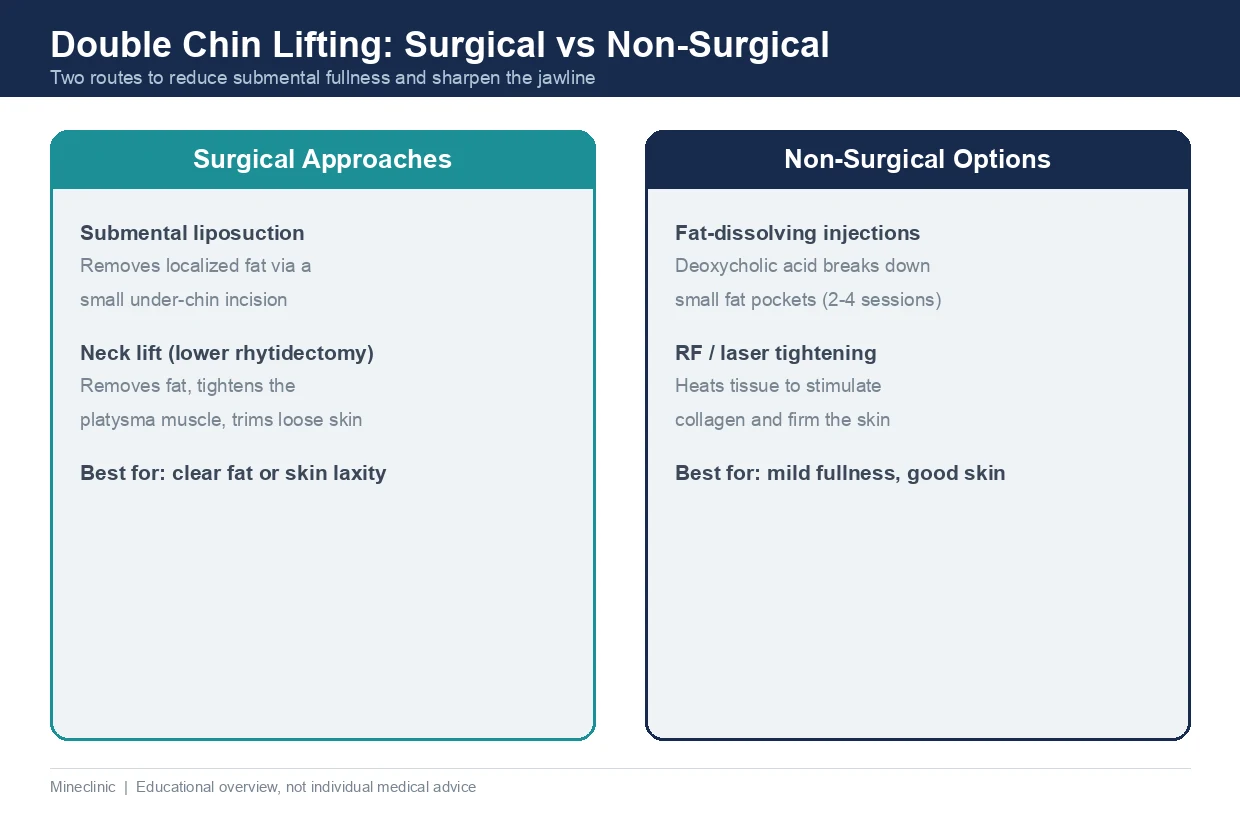
When Non-Surgical Treatments Excel
Fat-dissolving injections, cryolipolysis, Ultherapy, RF and HIFU are usually the right call for patients who:
- Have mild to moderate submental fullness
- Prefer gradual, natural-looking changes
- Cannot accommodate extended downtime
- Are seeking preventative or maintenance treatments
- Have good skin elasticity
When Surgical Options May Be Preferable
Surgical interventions such as submental liposuction or a neck lift may be more appropriate for those with:
- Significant fat deposits under the chin
- Moderate to severe skin laxity
- Desire for immediate, dramatic results
- Ability to accommodate recovery time
- Need for comprehensive correction of neck anatomy
The medical team at mineclinic specializes in both approaches and can provide personalized guidance during consultation.
How to Choose the Right Treatment for Your Jawline Goals
Selecting the optimal treatment involves consideration of multiple factors:
Assessment Criteria
- Anatomical Factors
- Amount of submental fat
- Skin quality and elasticity
- Muscle tone in the neck and jaw
- Overall facial proportions
- Personal Preferences
- Timeline for results
- Tolerance for downtime
- Budget considerations
- Maintenance commitment
- Lifestyle Considerations
- Activity level and recovery requirements
- Public-facing professional demands
- Social events and timeline constraints
- Long-term aesthetic goals
Expert Consultation Process
At mineclinic, the consultation process includes:
- Comprehensive facial analysis using advanced imaging
- Discussion of aesthetic goals and expectations
- Review of treatment options with transparent information
- Personalized treatment planning based on individual needs
- Progressive treatment approach that can be adjusted based on results
Medical professionals at mineclinic emphasize a customized approach rather than a one-size-fits-all package. If you want a neutral overview of what the surgical end of the scale involves before your consultation, WebMD’s patient guide to neck procedures is a reasonable place to start.
Non-Surgical Double Chin Removal: Frequently Asked Questions
How many sessions does non-surgical double chin removal take?
It depends entirely on the tool. Fat-dissolving injections usually take two to four sessions at least four weeks apart; cryolipolysis one or two; microfocused ultrasound is often a single session; radiofrequency is given as a course of three to six. Nobody can promise an exact number in advance, because it depends on how much fat is present, where it sits and how quickly your body clears it.
Is non-surgical double chin removal permanent?
Partly. Fat cells destroyed by injection or by cooling do not grow back, so that part of the change is durable. But the fat cells left behind can still enlarge if you gain weight, and the tightening treatments work on a different clock: they slow the appearance of skin aging rather than stop it, so most people repeat them after a year or two. No non-surgical treatment freezes the jawline in place permanently.
How much downtime should I plan for?
Injections are the one to plan around: visible swelling under the chin for roughly one to two weeks is normal, and it is usually most pronounced after the first session. Cryolipolysis leaves redness and numbness but no real downtime. Ultherapy, HIFU and RF typically leave mild redness for a few hours. None of these require time off work in the way surgery does, but do not book a first injection session the week of a wedding.
How do I know if I need surgery instead?
Three findings push the decision toward surgery: a large volume of fat, fat that sits beneath the platysma muscle, and skin that no longer springs back when pinched. Any of these puts a hard ceiling on what a non-surgical plan can achieve. A specialist can usually tell within minutes of examining you — a photograph cannot, which is why an online opinion on a picture is worth very little here.
Will losing weight remove my double chin?
Sometimes. Weight loss shrinks fat cells throughout the body, and for some people the chin is among the first areas to change. For others the submental pad is largely genetic and remains after the rest of the body has slimmed down. Weight loss also cannot restore elasticity to skin that has already lost it, and a significant loss can make lax neck skin look looser rather than tighter.
Conclusion: Achieving Your Ideal Jawline
Non-surgical double chin removal options have revolutionized facial contouring, offering effective solutions without the recovery time and risks associated with invasive procedures. From fat-dissolving injections and cryolipolysis to tightening technologies such as Ultherapy and HIFU, these options deliver meaningful improvements for the right candidates — and very little for the wrong ones, which is why matching the treatment to the anatomy matters more than the treatment itself.
Understanding that each treatment has specific advantages and limitations helps establish realistic expectations. For most patients with mild to moderate submental fullness, non-surgical approaches offer an excellent balance of results and convenience.
The experts at mineclinic are dedicated to helping you navigate these options to find the perfect solution for your jawline definition goals. With personalized treatment plans and progressive approaches, achieving your ideal profile is more accessible than ever.
Ready to explore your non-surgical double chin removal options? Contact mineclinic for a personalized consultation to discover which treatment best addresses your unique concerns and aesthetic goals.
Want to learn more about facial contouring? Check out our other articles on non-surgical facial rejuvenation techniques on the mineclinic blog. (double chin jawline lifting)
※ This content is for informational purposes only and does not replace professional medical advice, diagnosis, or treatment. Individual results may vary, and side effects may occur. Please consult with a board-certified plastic surgeon for personalized advice.