EN
EN

Salivary gland surgery cost in Korea is not a single fixed price. It is a quote assembled from five separate decisions: how much gland is removed, whether one side or both are treated, what else is combined with it, which type of anesthesia is used, and whether the operation is a first procedure or a revision. Two clinics can quote the same patient very differently and both quotes can be honest, because they are describing two different operations.
Patients who come to us after three or four consultations rarely ask what the number is. They ask why the numbers do not agree. That is the more useful question, and it is the one this article answers.
If you have lost weight everywhere except under your chin, and the fullness there feels deep and firm rather than soft, the tissue involved may not be fat at all. Below the jawline sits the submandibular salivary gland, and when it enlarges or drops it produces exactly the blunt, heavy jawline that liposuction cannot fix. Understanding that first is what makes a quote readable.
Table of Contents
- What salivary gland surgery actually removes
- The 5 variables behind the quote
- How to audit a quote before you sign
- Why the cheapest quote is rarely the cheapest outcome
- The total cost structure of a Korea trip
- How the procedure is performed
- Recovery timeline and included aftercare
- Risks you should be quoted for
- Botox or surgery: two cost structures
- Surgeon credentials
- Frequently asked questions
What Salivary Gland Surgery Actually Removes
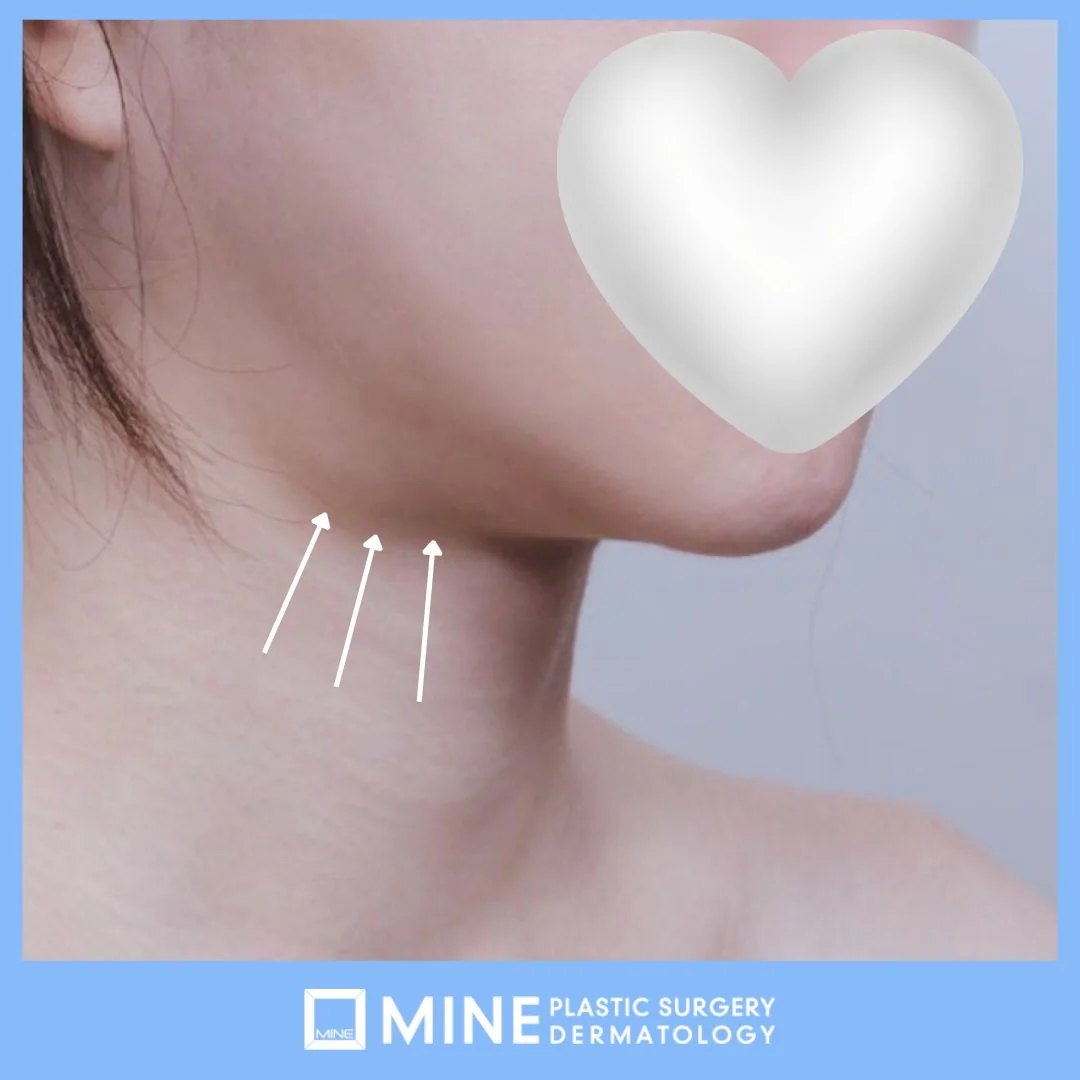
The submandibular glands are a paired set of large salivary glands that sit just beneath the lower jawbone, in a space surgeons call the submandibular triangle. When everything is in its place, they are tucked behind the bone and invisible from the outside. They become visible for three ordinary reasons.
The first is laxity of the platysma, the thin sheet of muscle that covers the front of the neck. As it stretches with age it stops holding the gland in position and the gland slides downward — what we describe as gland prolapse. The second is a constitutional or inherited enlargement, which is why slim patients in their twenties and thirties turn up with a full under-chin and no excess fat anywhere. The third is relative prominence after significant weight loss: the fat around the gland disappears and the outline underneath becomes obvious.
Fat, Muscle, Gland or Skin — the Diagnosis That Sets the Price
A heavy under-chin has four possible sources, and each one has a different operation attached to it.
| Type | Main cause | Appropriate approach |
|---|---|---|
| Fat type | Subcutaneous fat accumulation | Submental liposuction |
| Muscle type | Platysmal bands and laxity | Platysmaplasty, neck lift |
| Gland type | Submandibular gland enlargement or prolapse | Salivary gland reduction |
| Skin type | Loss of skin elasticity | Facelift or neck lift |
In clinic, a single pure type is the exception. Mixed presentations are far more common, and that is the root of quote variation. Palpation alone cannot settle it, so we confirm the size and position of the gland with ultrasound or CT before planning anything. A clinic that prices your surgery before imaging you is pricing a guess. We have covered the anatomy behind that distinction separately, in a fuller look at how salivary gland reduction reshapes the jawline.
Who Is Actually a Candidate
You are likely dealing with gland rather than fat if a firm mass is palpable just outside and below the jawbone when you lift your chin, if the fullness is more obvious sitting or standing than lying down, and if it survived a five-kilogram weight loss unchanged. Deciding whether you actually need gland removal at all comes before any discussion of money, because the wrong operation at a good price is still the wrong operation.
The 5 Variables Behind Salivary Gland Surgery Cost in Korea
These are the five things that genuinely move a quote. Anything else you are told is packaging.
1. Extent of Resection
Removing the entire gland and contouring the portion that hangs below the jaw border are not the same operation. In the surgical literature, complete removal of the submandibular gland is the standard when the gland itself is diseased. Aesthetic contouring has no reason to go that far — the goal is to take the part that has dropped past the jawline and leave the rest, along with its saliva production, intact. A wider resection means longer operating time and a longer, more careful dissection, and the quote follows.
2. One Side or Both
Asymmetry is common, and some patients need only the more prominent side addressed. Bilateral surgery roughly doubles the operative time and the aftercare load. This is one of the simplest reasons two quotes for “the same surgery” differ by a wide margin.
3. Combined Procedures
Gland reduction is often planned alongside submental liposuction, platysmaplasty or a neck lift, because a patient in their forties usually has more than one type of fullness. Combining is efficient — one anesthetic, one recovery, often one incision — but it enlarges the scope, and a combined quote should never be compared with a standalone quote as though they measured the same thing.
4. Type of Anesthesia
Submandibular gland surgery is performed under general anesthesia in the vast majority of cases, with local anesthesia reserved for selected patients. Whether a specialist anesthesiologist is present throughout, and whether monitoring and recovery-room time are billed separately, change the line items considerably. This is a safety question before it is a pricing question.
5. Revision Status
Previous surgery in the same field leaves scar tissue and adhesions. Planes that normally separate cleanly no longer do, dissection slows down, and the risk profile rises. Revision work is quoted higher everywhere in the world for the same reason.
How to Audit a Quote Before You Sign
When patients ask me to compare quotes, the first thing I look at is not the total. It is what is missing from the itemization. Salivary gland surgery cost in Korea becomes comparable only once you know what each clinic has included.
Ask for the following to be written down rather than described verbally:
- Surgical fee, and whether it is per side or bilateral
- Anesthesia fee, and whether an anesthesiologist is present for the whole case
- Recovery room or overnight observation
- Pre-operative ultrasound or CT, and blood work
- Number of included follow-up visits, and what happens after those run out
- Drain removal and suture removal
- Scar management for the incision, and for how many months
- Medication and dressings
- The revision policy in writing — what triggers it, who pays, and what it covers
- Whether VAT is included in the figure you were given
A quote that answers all ten is usually higher than one that answers four, and it is usually the cheaper of the two by the time you fly home. Our own scope and process are set out on the salivary gland reduction procedure page, and a personalized estimate is only possible after an in-person assessment.
Why the Cheapest Quote Is Rarely the Cheapest Outcome
This operation looks small from the outside — a short incision, a piece of tissue removed. The difficulty is entirely in what surrounds the gland.
The Nerves That Make This Operation Difficult
Surgical texts are consistent about where the risk sits. The principal hazards in submandibular gland surgery are injury to the marginal mandibular branch of the facial nerve, which dips below the jawbone and controls the movement of the lower lip; the hypoglossal nerve, which moves the tongue; and the lingual nerve, which carries tongue sensation. The lingual nerve is the one that demands the most attention, because it runs intimately alongside the submandibular duct and the two structures can look strikingly similar in caliber and texture during surgery.
That single fact explains more about pricing than any brochure. Telling those two structures apart in a small, bloody field is a matter of experience, not equipment. Gland tissue is soft and densely supplied with blood vessels, so removing the intended portion in one clean piece through a short incision is technically demanding. Taking it out in fragments increases bleeding and leaves residual tissue behind, which shows up later as a bulge that never fully resolved or a jawline that is uneven from side to side.
Scar Care Is a Cost Line, Not a Courtesy
The under-the-chin (transcervical) approach is a safe and well-established route, but it does leave a skin scar, and in younger patients that scar can thicken or become raised. Published surgical experience treats this as a known trade-off of the approach rather than a rare accident. It is also why scar follow-up belongs inside the quote: sun protection advice, silicone or laser management, and enough scheduled visits over three to six months to catch a scar that is heading the wrong way.
This is where salivary gland surgery cost in Korea stops being a number and starts being a risk calculation. The costs that a low quote does not carry are the ones that appear afterward — management of a complication, additional follow-up visits that were never included, and in some cases corrective surgery. A number that looks economical on day one is not always the economical number by the end of the pathway.
The Total Cost Structure of a Korea Trip
For international patients the surgical fee is only one column. Working out salivary gland surgery cost in Korea realistically means budgeting the whole pathway, and the medical calendar drives most of it.
| Item | Why it belongs in your budget |
|---|---|
| Pre-operative imaging and blood work | Ultrasound or CT determines resection extent; blood work clears you for anesthesia |
| Surgical and anesthesia fees | The quoted core, per side or bilateral |
| Length of stay in Korea | Set by the drain and the sutures, not by preference |
| Drain removal visit | A drain is usually kept for one to two days |
| Suture removal visit | Sutures typically come out on day five to seven |
| Final check before flying | Confirms there is no collection or infection before a long flight |
| Interpreter or coordinator support | Included at some clinics, charged at others |
| Compression garment and aftercare supplies | Worn for weeks, not days |
| Remote follow-up after you return home | Ask who reviews your photographs at three and six months |
The item patients under-budget most often is time rather than money. If drains come out on day one or two and sutures on day five to seven, a same-week flight home is not a realistic plan. Building the trip around that schedule is cheaper than rebooking it.
How the Procedure Is Performed
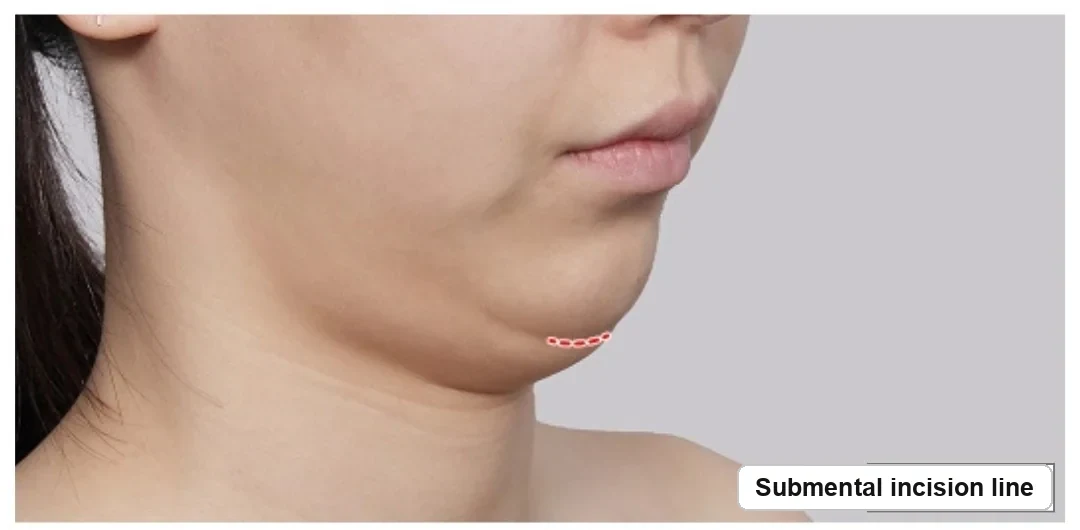
A 2-3 cm Incision in the First Neck Crease
We place the incision along the first crease that appears under the chin when the head is lowered, and keep it to roughly two to three centimeters. It is the same access used for platysma muscle tightening, and it sits where it is not visible unless the head is tilted back. When a neck lift or facelift is planned at the same time, the existing lift incision is used and no additional cut is needed.
Selective Resection of the Portion Below the Jaw Line
Think of the jawbone edge as a reference line. What creates the heavy contour is the part of the gland that has slipped below it. We remove that portion and leave the remainder in place, so saliva production continues while the jawline is restored. In medical terms this is a partial or contouring resection, as distinct from the complete gland removal performed for disease.
Where the gland is substantially enlarged, the resection has to extend further to produce a clean jawline. How far is decided from the pre-operative imaging, not in the operating room.
An Approach Route Planned Around the Nerve
The marginal mandibular branch travels upward and outward along the jaw border. Approaching from the midline, below the chin, and working toward the lower prominence of the gland keeps the dissection at a distance from its path. Limiting the resection to the portion outside the jawline also means there is no reason to enter the deeper plane where the lingual and hypoglossal nerves run.
Safety in this operation is largely designed before the first incision, in the choice of route. Nerve courses and gland positions vary between individuals, so no surgeon can describe any procedure as free of risk — which is precisely why imaging comes before the plan and the plan comes before the quote. Surgery takes roughly one to one and a half hours per side, and a drain is usually kept for one to two days.
Recovery Timeline and the Aftercare That Belongs in Your Quote
| Time after surgery | What to expect |
|---|---|
| Day 0-2 | Drain in place, compression band worn, swelling at its peak |
| Day 3-5 | Bruising and swelling most visible; soft foods |
| Day 5-7 | Sutures removed; presentable outdoors with a mask |
| Week 2-3 | Most swelling settled; back to daily routine |
| Month 1-3 | Internal tightness and firmness gradually release |
| Month 3-6 | Final jawline definition; scar maturation |
A compression garment is worn for two to four weeks, and early compression is the single most important factor in controlling both swelling and salivary leak. Sleep with the upper body raised around thirty degrees and avoid keeping the head bent forward for long periods. Stay on soft food for three to five days and go easy on strongly sour foods early on, since they drive saliva production hard.
Alcohol is best avoided for two to three weeks, strenuous exercise for three to four weeks, and saunas or hot baths for four weeks. Because scar tissue is vulnerable to ultraviolet light, sun protection matters for three to six months after the sutures come out. Every one of those items is aftercare that a complete quote already accounts for.
Risks You Should Be Quoted For
I would rather set out what can go wrong than describe only the outcome patients hope for.
- Swelling and bruising — expected in virtually every patient and part of normal healing.
- Hematoma or bleeding — early compression and drainage are the reason this is uncommon; rarely, a further procedure is needed.
- Temporary weakness of the marginal mandibular branch — most often seen as one corner of the lower lip moving less. It usually reflects retraction of the nerve and recovers over several months, though permanent injury cannot be entirely excluded.
- Lingual or hypoglossal symptoms — reduced tongue sensation or awkward tongue movement.
- Salivary leak (sialocele) — saliva collecting at the resection surface, managed with compression, drainage and aspiration if required.
- Infection, thickened scar, asymmetry — uncommon but real, and all of them cost money to manage if your quote makes no provision for them.
“Will My Mouth Go Dry?”
This is the question I am asked most. The submandibular glands do produce the majority of saliva at rest, but the parotid gland, the sublingual gland and several hundred minor salivary glands share the workload. After a partial or one-sided resection, persistent dry mouth is uncommon. A wide bilateral resection can leave a temporary dry sensation, and anyone with existing dry mouth or Sjögren’s syndrome needs their candidacy reassessed from the beginning rather than at the end. We have addressed the functional questions after gland removal in more detail elsewhere.
Botox or Surgery: Two Different Cost Structures
Injecting botulinum toxin into the gland is the non-surgical alternative, and comparing it with surgery on entry price alone is misleading.
| Salivary gland Botox | Gland reduction surgery | |
|---|---|---|
| Entry cost | Lower | Higher |
| Repeat interval | Every 3-6 months, indefinitely | One procedure |
| Duration of effect | Temporary | The removed portion does not regrow |
| Degree of change | Moderate reduction | Substantial contour change |
| Downtime | 1-2 days | 2-4 weeks |
The honest comparison is cost per year of result rather than cost per session. Botox is a reasonable way to test the direction of change with little commitment; over a long horizon the repeat schedule accumulates. It also has limits, and knowing when salivary gland Botox stops working is often what brings patients to a surgical consultation in the first place.
Surgeon Credentials — the Variable Patients Check Last
Given how close this dissection runs to three named nerves, the operator’s training is not a soft factor. In Korea, a board-certified plastic surgeon completes a one-year internship and a four-year residency — at least five years of structured training after medical licensure — and then passes a board examination. Certification can be verified through the Korean Society of Plastic and Reconstructive Surgeons.
Three questions are worth asking directly: whether the surgeon who will operate is board-certified in plastic surgery, how many of these specific gland procedures they perform each year, and whether pre-operative ultrasound or CT is included as standard rather than offered as an extra. Clinics that answer all three clearly tend to produce quotes that hold.
Frequently Asked Questions
Why does salivary gland surgery cost in Korea vary so much between clinics?
Because it is not one standardized operation. Resection extent, one side versus both, combined procedures, anesthesia type and revision status each change the scope of what is being performed. A quote is a description of an operative plan, so different plans produce different numbers — which is why comparing totals without comparing plans is not a comparison at all.
What should be included in a salivary gland surgery quote?
At minimum: the surgical fee with the number of sides specified, anesthesia with the anesthesiologist’s involvement, recovery room time, pre-operative imaging and blood work, a stated number of follow-up visits, drain and suture removal, scar management, medication, the revision policy and whether VAT is included. Ask for it in writing before you commit to travel dates.
How long do I need to stay in Korea for this surgery?
The schedule is set by the drain and the sutures. Drains typically come out one to two days after surgery and sutures on day five to seven, followed by a final check before a long flight. Plan the trip around that sequence rather than around the cheapest available return fare.
Does a cheaper quote mean a riskier operation?
Not by itself. The risk lies in what has been left out — a narrower resection than your anatomy needs, anesthesia billed separately later, no scar follow-up, or no written revision policy. Compare inclusions line by line before you compare totals, and ask what happens if a complication needs extra visits.
Is salivary gland reduction covered by insurance?
Contouring performed for aesthetic reasons is treated as an elective procedure and is not a covered medical treatment. Where there is an underlying disease indication such as stones or chronic inflammation, that is assessed separately at consultation and follows a different pathway entirely.
How much of the gland is removed, and does the improvement last?
Only the portion that has dropped below the jawbone border is removed, and the resected tissue does not grow back, so that part of the change is lasting. Natural aging and weight change still affect the overall neckline over time, which is why skin and muscle laxity are assessed alongside the gland rather than after it.
Get a Quote You Can Actually Read
Gland size, degree of descent, and the condition of the skin and platysma differ in every patient, so photographs and phone calls cannot produce an accurate plan — and without an accurate plan there is no accurate quote. That is the short answer to what determines salivary gland surgery cost in Korea: the diagnosis does. At MINE Plastic Surgery & Dermatology in Gangnam, Seoul, Dr. Lee Sung-wook assesses the gland with ultrasound in person and explains the resection extent and the inclusions before any figure is discussed.
International patients can start with an online consultation to establish whether the gland is the source of the problem at all, then plan travel around the follow-up schedule rather than the other way around. Book a consultation at MINE Plastic Surgery & Dermatology, 813 Nonhyeon-ro, Gangnam-gu, Seoul, or call +82-2-516-1175.
Written and medically reviewed by Dr. Lee Sung-wook, board-certified plastic surgeon, MINE Plastic Surgery & Dermatology.
※ This content is for informational purposes only and does not replace professional medical advice, diagnosis, or treatment. Individual results may vary, and side effects may occur. Please consult with a board-certified plastic surgeon for personalized advice.