EN
EN

Once your nose surgery is over, the first questions usually arrive within hours: “Is this much swelling normal?” “When can I wash my face?” “Can I wear my glasses?” How smoothly you recover depends heavily on how you manage the first few days.
Rhinoplasty surgery precautions are the aftercare rules you follow from the day of surgery until about six months later to reduce swelling, bruising and bleeding and to let your new nose settle into a stable final shape. This guide sets out the rhinoplasty surgery precautions that Mine Plastic Surgery actually gives its patients, step by step, and explains the textbook reasoning behind the most important ones.
Table of Contents
Why Rhinoplasty Surgery Precautions Matter
Standard plastic surgery textbooks divide postoperative rhinoplasty care into five connected parts: dressings and wound care, medications, activity restrictions, general instructions, and management of complications. When all five work together, swelling and bruising settle faster and the nose is protected while it heals.
The first 48 hours matter most. Keeping your head elevated (textbooks recommend more than 30 degrees) and gently applying cold compresses helps reduce edema (swelling) and ecchymosis (bruising caused by blood under the skin). The reason is simple: when your head is raised, less blood and tissue fluid pool around the nose.
No operation is completely free of risk. The complications listed most often after rhinoplasty are bleeding (nosebleeds, bruising or a hematoma), infection and prolonged swelling. Serious bleeding is uncommon: plastic surgery textbooks report that fewer than 1% of patients have a major nosebleed that needs treatment in the operating room. Even so, MINE treats aftercare as seriously as the surgery itself. Following these rhinoplasty surgery precautions carefully lowers those risks. In rare cases, poor aftercare can lead to a second operation; our revision rhinoplasty page explains when one is needed. For independent background on the procedure, see the American Society of Plastic Surgeons rhinoplasty overview.
Rhinoplasty Surgery Precautions: Step-by-Step Aftercare
The rhinoplasty surgery precautions below follow the written instructions MINE hands to every patient. Exact timings can differ slightly depending on the surgical method, so always follow what your surgeon tells you at discharge.
After-Surgery Position
- For the first week, sleep with your upper body raised so that your head stays higher than your heart, and avoid bending your neck sharply. This helps swelling go down faster.
- Sleep facing the ceiling. Do not lie on your side or on your stomach.
Keep this raised position until you no longer wake up with morning swelling, which is typically around 7–10 days after surgery.
Post-Surgery Diet
- You can eat a normal diet, but irritating foods can make your nose run and feel uncomfortable. Please avoid spicy food and very hot dishes.
Swelling Care
- For the first 2–3 days, swelling and bruising gradually get worse. After that they slowly subside over 2–4 weeks, although this varies from person to person.
- Apply cold compresses from the day of surgery through day 3, then switch to warm compresses. Use the compress pack provided by the clinic.
- Cold compress: keep the pack in the freezer and wrap it gently before applying.
- Warm compress: heat the pack in the microwave for about 15 seconds, or use a heated eye mask instead. Do not overheat the pack, as it can burst.
- The treated area can be temporarily numb, so you may not feel heat properly and could burn your skin. Always check the temperature with your hand first.
- About 2 weeks after surgery the nose may feel firm. It softens gradually as part of normal healing, so please give it time.
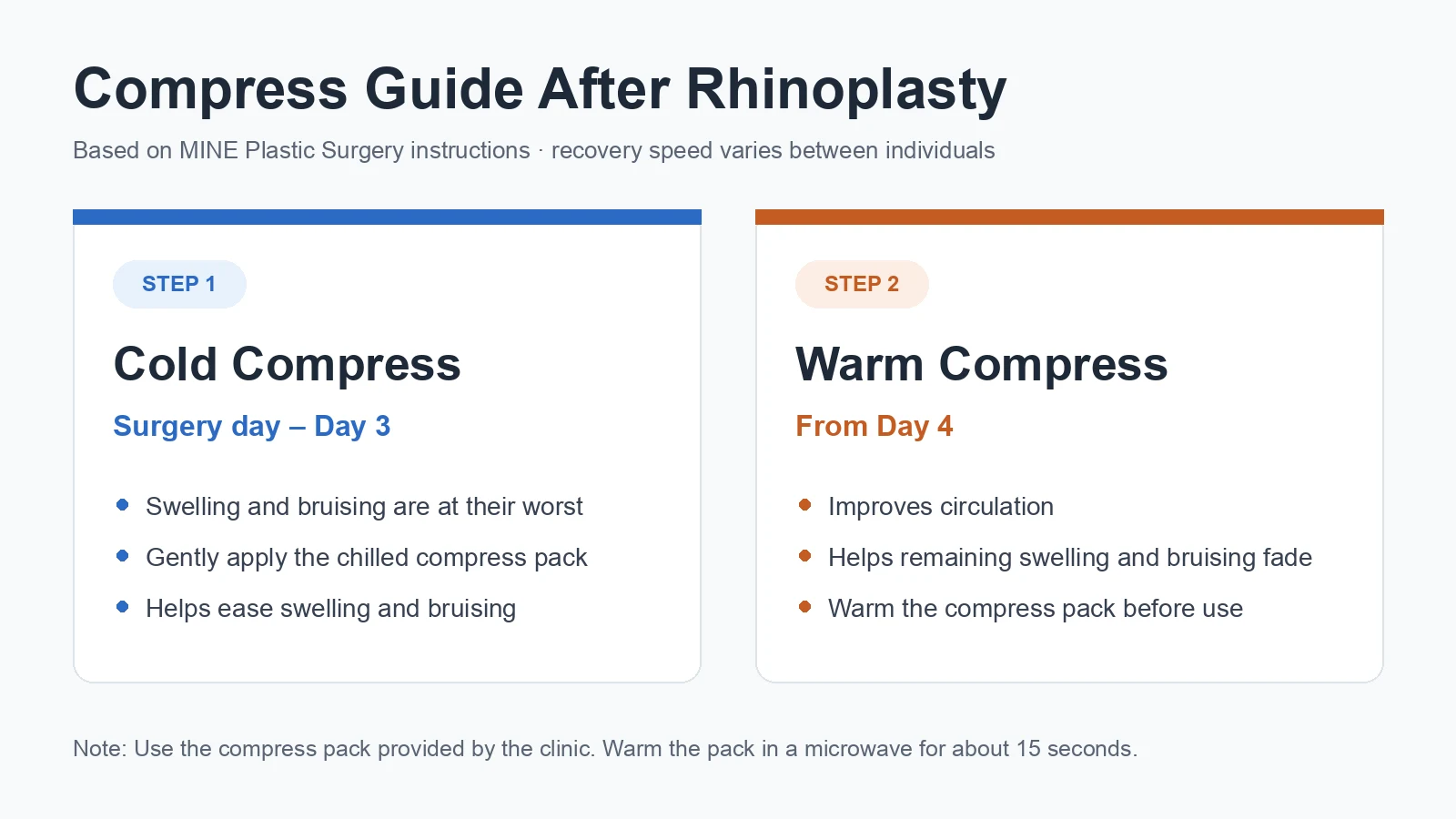
Of all the rhinoplasty surgery precautions, compresses and head position do the most for swelling, and most rhinoplasty swelling eases considerably within about 4 weeks. Textbooks name three basics for limiting early swelling: head elevation, taping and cold compresses. In other words, simply using the compress pack and following the position rules can make a real difference to how quickly the swelling settles.
Wound, Splint and Stitch Care
- Do not remove the tape or splint on your nose yourself. This is one of the most important rhinoplasty surgery precautions, because the splint holds the reshaped structures in place.
- The cotton packing inside the nose is removed after 1–2 days. If septal extension surgery (a cartilage graft attached to the septum to support and reshape the tip) was performed, Merocel packing (a soft, expandable sponge pack) stays in for 3–4 days.
- Stitch removal depends on the surgical method. Usually, stitches at the nasal tip are removed on day 7, and stitches from alar (nostril) reduction are removed on day 5.
- Do not pick at scabs or wounds inside the nose, and avoid touching them with your hands.
- Disinfect the inside of the nose twice a day with Betadine or another povidone-iodine antiseptic.
- If ear cartilage was used, the ear tape is removed when you visit on day 3 or 4, and the ear stitches are removed on day 7.
- If ear cartilage was used, you will also receive an ear molding splint on day 7. Wear it while sleeping for one month so the ear is not pressed out of shape.
- If an osteotomy (reshaping of the nasal bones) was performed, an aqua splint (a firm, molded external splint that protects the nasal bones) is applied and removed on day 7.
- For standard nose surgery, a gauze splint is applied after surgery and removed on day 3–4.
Showering and Washing the Face
- Until the splint, tape and stitches are removed, keep the surgical area dry. Clean the rest of your face with a damp towel or wet wipes.
- You can wash your face and apply makeup to your nose from the day after the stitches in your columella (the strip of skin between the nostrils) are removed. Do not rub the nose hard, and avoid pressing on it while washing.
- Avoid saunas for 1 month after surgery because of the risk of infection.
Exercise
- Most daily activities can be resumed right after surgery. Light exercise is possible from 2–3 weeks, and strenuous exercise from 1 month after surgery.
- For about 3 months, take care that no physical force or impact is applied to your nose.
Medication Use
- Take the medication prescribed at discharge 30 minutes after your first meal following surgery, then continue at the scheduled times. If you develop diarrhea or an allergic reaction, please contact the clinic.
- Do not take aspirin or vitamin E for 1 week after surgery, as they can cause bleeding.
There is a clear medical reason behind these medication rules. Aspirin, vitamin E and any anti-inflammatory painkillers (NSAIDs) your surgeon has not prescribed are avoided because they weaken platelets, the blood cells that help blood clot, and so raise the risk of bleeding. Some painkillers can also cause constipation, and straining on the toilet can trigger bleeding at the surgical site, so drink plenty of water and eat vegetables to prevent constipation.
Alcohol and Smoking
Avoid alcohol and smoking for 1 month after surgery. This is one of the rhinoplasty surgery precautions that directly affects healing: both can worsen bleeding, slow wound healing and increase the risk of infection.
Progress
- Do not blow your nose until 1 month after surgery.
- Swelling and recovery differ from person to person, and the two sides may swell differently, so right after surgery the nose can look upturned or asymmetrical.
- Under MINE’s protocol, you can wear glasses right after surgery. For about 3 months, though, take care not to bump or knock your nose.
- Swelling between the eyebrows, along the bridge and at the tip goes down more slowly than elsewhere. The final shape usually settles after about 6 months, although plastic surgery textbooks note that the last traces of swelling can take around 12 months to fade completely, and even longer in thick skin.
- Because the inside of the nose is irritated after surgery, you may have a runny or blocked nose or slight bleeding. These symptoms improve over time.
Scar Ointment Usage Guide
How to use the ointment
- Use either Dermatix Ultra Gel or Contractubex (choose one of the two).
- Start 3 weeks after suture removal and continue consistently for at least 6 months.
- Use it only after the wound has completely healed. Do not apply it to an open wound.
- Clean the scar, pat it dry, then spread a pea-sized amount thinly and massage it in gently.
- Let it dry for 1–2 minutes. Apply twice a day, morning and evening.
Ointment precautions
- After applying, avoid touching or scratching the scar.
- UV exposure can darken scars, so use sunscreen when you go outside.
- If irritation or an allergic reaction occurs, stop using the ointment immediately and contact the clinic.
Rhinoplasty Recovery Timeline at a Glance
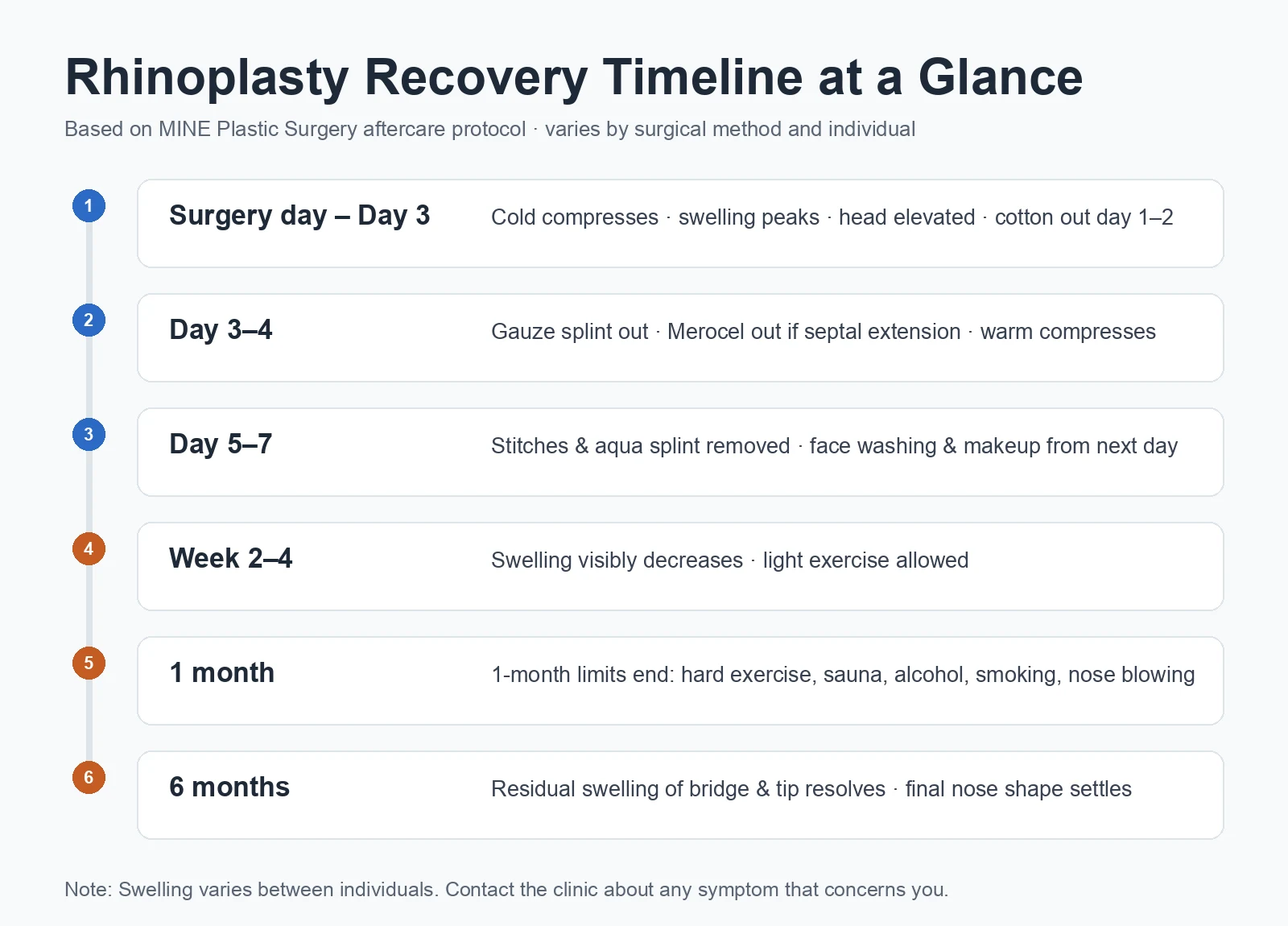
The table below puts the rhinoplasty surgery precautions above on a single timeline. The timings come directly from MINE’s aftercare instructions; actual recovery speed depends on the surgical method and your own healing.
| Period | What happens and what to do |
|---|---|
| Surgery day – day 3 | Cold compress period. Swelling and bruising peak around this time. Keep your head elevated and rest. The cotton packing inside the nose is removed after 1–2 days. |
| Day 3–4 | Gauze splint removed (standard nose surgery). After septal extension, the Merocel packing is removed at this stage. Switch to warm compresses. |
| Day 5–7 | Alar reduction stitches out on day 5; nasal tip stitches, aqua splint and ear stitches out on day 7. Face washing and makeup from the day after columella stitch removal. |
| Week 2–4 | Swelling decreases noticeably. Light exercise from 2–3 weeks. |
| 1 month | The 1-month restrictions on strenuous exercise, saunas, alcohol, smoking and nose blowing end. The risk of infection and bleeding is much lower. |
| 6 months | Most of the residual swelling between the eyebrows, on the bridge and at the tip has resolved, and the final nose shape settles. |
Dr. Lee Sung-wook’s key point: when it comes to rhinoplasty surgery precautions, taking it easy matters more than trying to recover fast. Faithfully keeping up cold compresses for the first three days and head elevation for the first week makes a visible difference to swelling and bruising. Rushing tends to slow recovery down rather than speed it up.
When to Contact the Clinic Right Away
Rhinoplasty surgery precautions also include knowing when not to wait. Some discomfort is expected, but plastic surgery textbooks advise calling your surgeon promptly if your fever rises above 38.5°C (101.3°F) or if either of the following occurs:
- Pain that is not controlled by your prescribed medication
- Persistent bright red bleeding from the nose
If you have already flown home after surgery in Korea, contact MINE by phone or through a messaging app, and if symptoms are severe, see a local doctor or emergency department without delay.
Frequently Asked Questions
How long do I need to follow rhinoplasty surgery precautions?
Most rhinoplasty surgery precautions apply for the first month: no saunas, alcohol, smoking, strenuous exercise or nose blowing until then. Avoid physical force or impact on the nose for about 3 months, and expect the final shape to settle at around 6 months.
When does swelling go down after rhinoplasty?
Swelling is worst 2–3 days after surgery and then subsides gradually over 2–4 weeks. Residual swelling on the bridge and tip takes longer, and the final shape settles at around 6 months. Use cold compresses through day 3 and warm compresses after that.
When can I wash my face and wear makeup after nose surgery?
You can wash your face and wear makeup from the day after the columella stitches are removed. Before then, clean only the areas outside the surgical site with a damp towel or wet wipes, and never rub the nose hard. Avoid saunas for 1 month because of the risk of infection.
When can I wear glasses after rhinoplasty?
Under MINE’s protocol, you can wear glasses right after surgery. For about 3 months, though, take care not to bump or knock your nose.
When can I exercise after rhinoplasty?
Daily activities are possible right after surgery, light exercise from 2–3 weeks, and strenuous exercise from 1 month. Straining or vigorous activity earlier than this raises the risk of bleeding, so please keep to these timings.
Related Rhinoplasty Guides
- Rhinoplasty in Korea by nose type – which technique suits which nose
- Autologous rhinoplasty with cartilage – using your own septal, ear or rib cartilage
- Alar reduction guide – narrowing wide nostrils
- Dorsal hump rhinoplasty – causes, methods and recovery
Following these rhinoplasty surgery precautions is part of your result. Postoperative care is just as important as the surgery itself, so we kindly ask you to follow these instructions closely. Recovery varies with the surgical method and your individual condition. If anything is unclear, or a symptom is not what you expected, please do not try to work it out on your own. Contact the clinic so we can check it, in person if possible. You can read more about rhinoplasty at MINE on our main procedure page.
Mine Plastic Surgery · 4th floor, 813 Nonhyeon-ro, Gangnam-gu, Seoul, South Korea
T. +82 10 3476 1175 · Clinic hours: weekdays 10 AM–7 PM, Saturdays 10 AM–4 PM
Written and medically reviewed by Dr. Lee Sung-wook, Korean Board-Certified Plastic Surgeon and Head Doctor at Mine Plastic Surgery in Seoul (member, Korean Society of Plastic and Reconstructive Surgeons and the International Society of Aesthetic Plastic Surgery, ISAPS). Last reviewed: October 2026.
※ This content is for informational purposes only and does not replace professional medical advice, diagnosis, or treatment. Individual results may vary, and side effects may occur. Please consult with a board-certified plastic surgeon for personalized advice.