EN
EN


Table of Contents
Dorsal hump rhinoplasty is nose surgery that lowers the ridge of bone and cartilage sitting on the bridge of the nose, so the profile reads as a smooth, straight line. The surgeon either reduces the hump in controlled layers and then rebuilds the dorsal lines to protect breathing, or leaves the hump intact and settles the whole bridge onto a lower foundation.
This article is written around the clinical term rather than the everyday one. If you are looking for a plain-language overview of the same concern, our hump nose rhinoplasty overview covers it, and our guide to rhinoplasty in Korea by nose type places dorsal hump rhinoplasty within the wider map of nasal shapes. Here we stay with the anatomy, the two surgical routes, the specific risks, and the recovery calendar.
What Is a Dorsal Hump? Definition, Anatomy and Causes
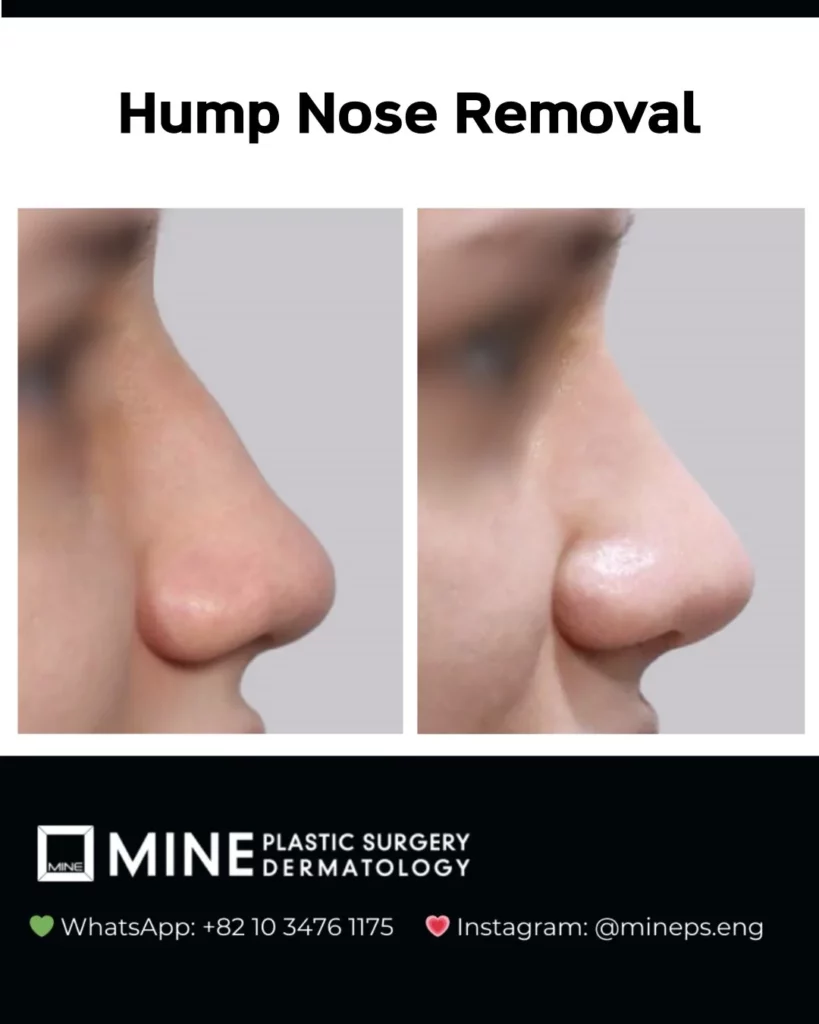
A dorsal hump is a raised, irregular projection along the bridge of the nose, typically composed of excess bone, cartilage, or a combination of both. When viewed in profile, it creates a convex shape — sometimes described as a “bump,” “hook,” or “eagle nose” — that many individuals find disrupts the harmony of their facial features.
Anatomically, the bridge is not one solid piece. The upper third is bone (the bony vault). Below it sits the middle third, built from the septum in the center and the two upper lateral cartilages — thin cartilage “wings” that also form the inner breathing channel. A hump is usually a mix of both zones, which is exactly why dorsal hump rhinoplasty is a structural operation rather than simple filing.
Dorsal humps are among the most common aesthetic concerns addressed by rhinoplasty surgeons worldwide. According to data from the American Society of Plastic Surgeons (ASPS), rhinoplasty consistently ranks within the top five most performed cosmetic procedures globally, with nasal profile refinement — including hump reduction — being one of the primary motivations.
What Causes a Dorsal Hump?
Dorsal humps can form due to several factors:
- Genetics: The most common cause. If a parent or grandparent has a pronounced nasal bridge, you may inherit the same structural trait.
- Ethnicity: Certain ethnic groups — including Middle Eastern, South Asian, Southern European, and some East Asian populations — tend to have a higher prevalence of dorsal humps.
- Trauma or Injury: A nasal fracture that heals improperly can result in a traumatic hump forming over the bone or cartilage.
- Developmental Changes: In some cases, the nose continues to grow during adolescence, causing a hump to develop or become more pronounced over time.
Because most humps are inherited or developmental rather than acquired, they rarely resolve on their own — and no exercise, taping, or topical product changes the underlying bone. That is the honest starting point of every dorsal hump rhinoplasty consultation.
Mild vs. Large Dorsal Hump: Why Size Changes the Plan
The height of the hump changes the surgical plan more than almost any other factor, so dorsal hump rhinoplasty is planned differently at each end of the range:
- Mild dorsal hump: A few millimeters of excess. Lowering is small, the bones often need little or no repositioning, and the main risk is over-correction rather than under-correction.
- Moderate dorsal hump: Both bone and cartilage are clearly involved. Lowering the bridge usually opens the roof of the nose, so the nasal bones are repositioned in the same operation.
- Large dorsal hump: A tall hump often hides a nose that is also long or droopy at the tip. Reducing the bridge alone can unmask those features, so tip and septum work is frequently planned alongside it.
Skin thickness matters just as much as height. Thicker skin drapes less tightly over a newly lowered bridge and holds swelling longer, while very thin skin shows every small contour irregularity — one reason your surgeon assesses your skin before deciding how much to remove.
Who Is a Candidate for Dorsal Hump Rhinoplasty?
People seek dorsal hump rhinoplasty for a range of deeply personal reasons:
- To achieve a smoother, straighter profile that feels more proportionate to their face
- To address self-consciousness or a lack of confidence caused by the hump’s appearance in photos or in social settings
- To correct post-traumatic nasal deformity
- To improve breathing, when the hump is associated with a deviated septum or internal structural irregularity
Suitable candidates are in good general health, have finished facial growth (generally from the late teens onward), do not smoke around the time of surgery, and have expectations that match their anatomy. At Mine Clinic in Seoul, we see international patients from across Southeast Asia, the Middle East, Europe, and the Americas — all seeking rhinoplasty results that look natural, balanced, and specifically suited to their facial anatomy.
Dorsal Hump Rhinoplasty: The Procedure at Mine Clinic
How Is a Dorsal Hump Removed?
Dorsal hump rhinoplasty involves carefully reducing the excess bone and cartilage that create the visible bump on the nasal bridge. At Mine Clinic, our board-certified surgeons approach every nose as unique — there is no one-size-fits-all technique.
The procedure generally follows these steps:
1. Consultation & Digital Simulation Before any surgery, your surgeon will conduct an in-depth consultation to analyze your nasal structure, skin thickness, facial proportions, and your aesthetic goals. Digital imaging may be used to simulate potential outcomes, giving you a realistic preview of results.
2. Anesthesia Dorsal hump rhinoplasty is performed under general anesthesia, ensuring you are comfortable and completely unaware during the procedure. The typical operating time is 2 to 3 hours.
3. The Approach: Open vs. Closed Rhinoplasty
- Open Rhinoplasty: A small incision is made across the columella (the thin strip of tissue between the nostrils), allowing the surgeon to lift the nasal skin and have full, direct access to the underlying structures. This is preferred for more complex humps or when simultaneous tip refinement is needed.
- Closed Rhinoplasty: All incisions are made inside the nostrils, leaving no visible external scarring. This approach suits patients with smaller humps and less structural complexity.
At Mine Clinic, the choice between open and closed rhinoplasty is determined entirely by your individual anatomy and goals — not by a standardized protocol.
4. Hump Reduction
The surgeon carefully removes or reshapes the excess bone and cartilage forming the dorsal hump using precise instruments including osteotomes (bone chisels) and rasps. The key skill lies in one word: balance — removing too little leaves the hump visible; removing too much creates a “scooped” or “ski-slope” appearance. Our surgeons are trained to deliver a naturally straight or softly refined profile.
5. Osteotomy (if required)
In many cases, once the hump is removed, the nasal bones may appear too wide, creating an “open roof deformity.” To correct this, controlled fractures of the nasal bones (osteotomies) are made to narrow and realign the bridge. Surgical texts describe a second purpose that patients rarely hear about: these controlled cuts also give the bony vault back its stability, so the newly narrowed bridge stays where the surgeon placed it while the bone heals. Osteotomy is therefore part of the architecture of dorsal hump rhinoplasty, not an optional extra.
6. Tip & Structural Refinement (if combined)
Many patients choose to combine hump reduction with tip refinement, alarplasty, or septal correction for a fully harmonized result. At Mine Clinic, this is seamlessly integrated into a single surgical session where appropriate. You can explore Mine Clinic’s full range of Hump Nose surgery options, our detailed guide to alarplasty (nostril reduction), and our comprehensive MINE Rhinoplasty approach for more details.
7. Closing & Dressings
Incisions are meticulously closed with fine sutures. A splint or cast is applied to the bridge to support healing and maintain the new nasal shape.
Inside Dorsal Hump Rhinoplasty: Component Reduction and Dorsal Reconstitution
Modern surgical textbooks no longer describe hump removal as cutting the bump off in one block. The current standard in dorsal hump rhinoplasty is component dorsal hump reduction: the surgeon separates the hump into its parts — the bony roof, the septum in the middle, and the two upper lateral cartilages on either side — and lowers each one in small, graduated steps.
The reason is not neatness. Those upper lateral cartilages are also the outer wall of the internal nasal valve, the narrowest part of your airway. Cutting them away with the bone in a single sweep is what historically produced a pinched middle third and noisy, restricted breathing. Keeping them intact during dorsal hump rhinoplasty means the surgeon can lower the bridge without routinely needing to rebuild the airway with cartilage grafts afterwards.
The second half of the operation is the part most articles skip. Once the bridge has been lowered, the dorsum has to be put back together — a step surgeons call dorsal reconstitution. The upper lateral cartilages are drawn back up to the septum with fine spanning sutures, and where extra support is needed, small strips of the patient’s own cartilage (autologous cartilage grafts) are placed to hold the width open.
What this rebuilding produces is the pair of soft highlights that run from the eyebrows to the tip, known as the dorsal aesthetic lines. When they are straight, even, and gently divergent, a nose reads as “natural” from the front. Removal alone never delivers that — which is why, at Mine Clinic, reduction and reconstitution are treated as one continuous stage of dorsal hump rhinoplasty rather than two optional ones.
Dorsal Preservation (Push-Down) vs. Hump Reduction
There is a second route that has grown quickly in the last decade, and most patients have never heard of it. In dorsal preservation rhinoplasty — often called the push-down or let-down technique — the hump is not shaved off at all. Instead the surgeon removes a strip of bone and cartilage from underneath the bridge, then lowers the entire intact roof onto that new foundation. It is the same goal as classic dorsal hump rhinoplasty reached from the opposite direction.
The two approaches answer the same complaint in opposite ways, so your consultation should cover both:
| Aspect | Reduction (component) | Preservation (push-down) |
|---|---|---|
| What happens to the hump | Lowered in layers and removed | Kept intact and settled downward |
| Dorsal lines | Rebuilt by the surgeon | Your original lines are retained |
| Best suited to | Irregular, asymmetric or very large humps | Straight, smooth humps with good underlying lines |
| Main drawback | Contour irregularity if reduction is uneven | The hump can gradually return |
Preservation is appealing because nothing has to be reconstructed: if your dorsal lines were pleasing above the hump, they stay yours. The trade-off is documented candidly in the surgical literature. Hump recurrence is the most frequently reported complication of every dorsal preservation method, although published accounts note that what comes back is usually a small bump rather than the original full hump, and that prevention depends on how carefully the keystone area — the junction where the nasal bones overlap the upper lateral cartilages — is weakened before the bridge is lowered.
Neither route is universally superior. A crooked bridge, a hump with dips and ridges along it, or a nose that also needs significant tip work usually points toward component reduction; a smooth, regular hump on an otherwise well-shaped nose is where preservation shines. A good consultation names both options and explains why one suits your anatomy better than the other.
Can Dorsal Hump Rhinoplasty Be Non-Surgical?
For patients with very mild humps, non-surgical rhinoplasty using dermal fillers can sometimes camouflage the appearance of a bump by adding volume above and below it to create the illusion of a straighter profile. However, this is a temporary measure — duration varies considerably by product and injection depth, commonly in the region of 9–18 months — and it does not reduce the actual hump the way dorsal hump rhinoplasty does.
As a side effect, the bridge can look wider over time, since filler may spread beyond where it was placed.
Filler on the bridge can also make future rhinoplasty more difficult.
For a structurally lasting correction, surgical dorsal hump rhinoplasty remains the reference standard. Our Filler and non-surgical consultation team can help you determine which approach is appropriate during your initial consultation.
Why Choose Korea — and Mine Clinic — for Dorsal Hump Rhinoplasty
Korea’s Unique Position in Rhinoplasty Excellence
South Korea has become one of the world’s most active hubs for rhinoplasty — and not by accident. Korean plastic surgeons perform rhinoplasty at volumes rarely seen elsewhere, developing precision, speed, and artistry that comes only from deep surgical experience. Korean aesthetic philosophy emphasizes subtle, natural-looking refinement that respects the individual’s ethnic identity while enhancing harmony — a philosophy that resonates strongly with international patients who fear looking “operated on.” That restraint matters in dorsal hump rhinoplasty, where the difference between a refined profile and an over-reduced one is measured in millimeters.
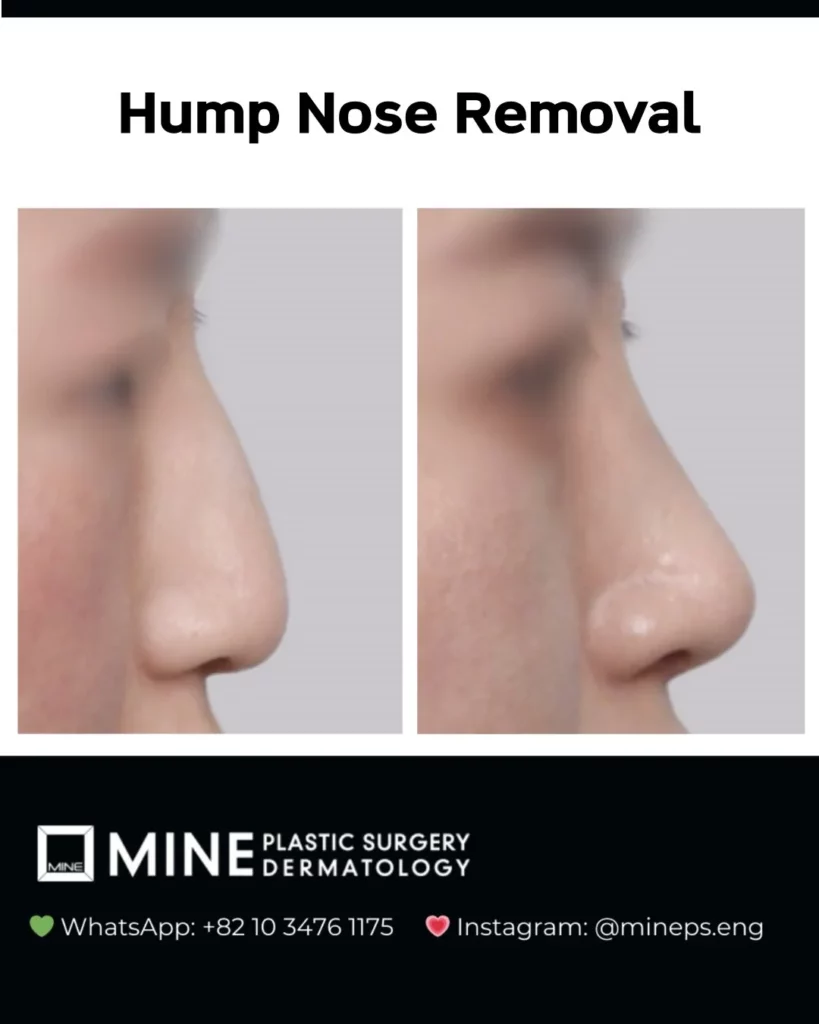
If you would like to see how that philosophy translates into finished profiles, our article on dorsal hump removal before and after results shows the change in profile line that this style of surgery aims for.
Dorsal Hump Rhinoplasty Risks, Side Effects & Safety
We believe that well-informed patients make the best surgical decisions. Dorsal hump rhinoplasty is a well-established procedure — but like all surgeries, it carries potential risks that must be discussed openly.
Common & Expected Side Effects
These are normal parts of the healing process and resolve over time:
| Side Effect | Typical Duration |
|---|---|
| Swelling of the nose and surrounding area | 2–4 weeks (significant), up to 12 months (residual) |
| Bruising around the eyes (“raccoon eyes”) | 1–2 weeks |
| Nasal congestion / reduced airflow | 2–4 weeks |
| Temporary numbness of the nasal tip | 3–6 months |
| Mild discomfort or pressure | 3–5 days post-op |
Less Common Risks
Surgical texts group the specific complications of hump surgery around one theme: what happens to the middle third of the nose once the roof has been opened. These are the risks your surgeon should name during the consultation.
- Dorsal irregularity: Uneven, excessive, or insufficient reduction of the bone-and-cartilage hump can leave visible ridges, a residual bump, or a shallow area along the bridge.
- Inverted-V deformity: A visible upside-down “V” shadow across the middle of the nose. It appears when the upper lateral cartilages drop away from the nasal bones after the roof is opened, leaving the bone edges outlined under the skin.
- Midvault narrowing: The middle third becomes too narrow relative to the bridge above and the tip below, producing a pinched look in front view.
- Internal nasal valve collapse: The functional counterpart of the same problem — the narrowest part of the airway loses its support, and breathing becomes harder, particularly during exercise or sleep. Preserving and then re-suspending the upper lateral cartilages is the main defense against it.
- Hump recurrence (preservation techniques): The most frequently reported complication of dorsal preservation, described in the section above.
- Over-reduction / “scooped” profile: Removing too much dorsal tissue leaves a ski-slope or saddle shape. Correcting it means adding structure back, so the second operation has more in common with low nose rhinoplasty than with a simple revision.
- Asymmetry: Minor irregularities in healing can occasionally cause subtle asymmetry; secondary refinement may be considered after full healing.
- Infection: Uncommon, managed with prescribed antibiotics.
- Poor scarring (open rhinoplasty): The columellar scar is typically inconspicuous once healed, but individual healing varies.
- Revision surgery: Some patients later request refinement. Published revision rates vary widely between surgeons and techniques, and no single global figure applies. One rhinoplasty surgeon, for example, reported about 4% in his own series over a two-year period. Mine Clinic provides dedicated revision consultations through our nose surgery center.
Breathing changes: Any rhinoplasty can affect nasal airflow. Mine Clinic surgeons assess the internal nasal structure — including the septum and the internal valve — before surgery, so that the surgery protects or improves airflow rather than compromising it.
Dorsal Hump Rhinoplasty Recovery in Korea: Week by Week
One of the most frequent questions we receive from international patients is: “How long do I need to stay in Korea after dorsal hump rhinoplasty?” Here is a realistic, week-by-week guide to what you can expect.
Day 1–2: Surgery & Immediate Post-Op
- Surgery is performed and you recover in Mine Clinic’s post-op suite.
- You will experience significant swelling and bruising around the nose and eye area — this is completely normal.
- A nasal splint/cast and internal silicone splints are in place.
- Mild pain is managed with prescribed oral medication.
- You are advised to sleep with your head elevated (at a 30–45-degree angle) to reduce swelling.
Day 3–5: Early Recovery
- Swelling and bruising reach their peak around Day 3, then begin to gradually subside.
- Most patients describe this stage as uncomfortable rather than painful.
- You can walk gently and perform light daily activities indoors.
- Avoid blowing your nose; use saline spray as directed.
Day 7: Stitch Removal ✓
- External sutures are removed at the Mine Clinic follow-up appointment on Day 7.
- Many patients notice a visible improvement in nasal shape even at this early stage, though significant swelling remains.
- The nasal splint is also typically removed at this visit, which is the first clear look at the new bridge line after dorsal hump rhinoplasty.
- After this appointment, most international patients are cleared to fly home — provided their recovery is progressing normally and no complications are present. We recommend a minimum 7–10 day stay in Korea for all rhinoplasty patients.
Week 2–4: Visible Progress
- The majority of visible bruising resolves by the end of Week 2.
- Swelling decreases noticeably; friends and colleagues will begin to see your new profile.
- You may return to light desk work and low-intensity activities.
- Avoid wearing glasses resting on the nasal bridge for at least 6 weeks — after dorsal hump rhinoplasty the bone underneath is still knitting together.
- Avoid strenuous exercise, contact sports, or any activity risking nasal impact for 6–8 weeks.
Month 1–3: Settling Into Results
- At the 1-month mark, roughly 60–70% of swelling has resolved.
- The nasal profile looks significantly more refined, but the tip may still appear slightly fuller than the final result.
- Sun exposure should be minimized, and SPF 50+ applied to the nose area daily.
Month 6–12: Final Results
- By 6 months, 90% of swelling has resolved and the dorsal line is clearly visible.
- Final rhinoplasty results are typically considered complete at the 12-month mark, when all residual swelling and internal scar tissue have fully settled.
- Most patients experience their “reveal moment” — the point where they see the nose they envisioned — between months 4 and 6.
Our comprehensive Post-Op Care guide provides detailed instructions for every stage of recovery, including guidance for patients managing recovery from abroad after returning home.
Frequently Asked Questions
How long does dorsal hump rhinoplasty surgery take?
The surgery itself typically takes 2 to 3 hours, depending on the extent of hump reduction and whether additional procedures (such as tip refinement or septal correction) are performed simultaneously. You should plan for a full day at the clinic including pre-operative preparation and post-anesthesia recovery time.
What is the difference between dorsal preservation and hump reduction?
Hump reduction lowers the bridge by removing bone and cartilage from the top, then rebuilding the dorsal lines. Dorsal preservation leaves the hump intact and lowers the whole bridge from underneath, so your original dorsal lines are kept. Both are recognized forms of dorsal hump rhinoplasty: reduction handles irregular or very large humps more predictably, while preservation suits smooth, regular humps. Your surgeon should explain which one your anatomy favors.
Can a dorsal hump come back after rhinoplasty?
It can, and the surgical literature is open about it. Recurrence is reported most often after dorsal preservation techniques, where the hump is settled rather than removed, and it usually returns as a small bump rather than the original contour. After component reduction, a residual bump is more often the result of under-correction or of swelling that has not fully resolved. The 12-month mark is the fair point at which to judge the outcome of any hump surgery.
Will my dorsal hump removal results look natural?
That is the goal when the procedure is performed by an experienced specialist. At Mine Clinic, we aim for a natural, harmonious profile rather than a dramatic or “over-operated” appearance. Our surgeons analyze your full facial structure and ethnic anatomy before deciding exactly how much tissue to reduce, and rebuild the dorsal lines so the front view stays smooth. We also show patients digital simulations of likely outcomes during the consultation phase. You can review authentic patient results in our before and after gallery.
Can I combine dorsal hump rhinoplasty with other nose surgeries?
Yes — and it is often recommended. Many patients combine hump reduction with nasal tip refinement, alarplasty (nostril reduction), or septal correction during the same operation. Combining procedures means a single anesthesia event and a unified recovery period. Mine Clinic offers a full spectrum of nose surgeries, from Tip Rhinoplasty to Alarplasty, all of which can be discussed during your personalized consultation.
How do I prepare for a rhinoplasty consultation at Mine Clinic as an international patient?
Mine Clinic offers a convenient Online Consultation service specifically designed for international patients. Before your online appointment, it helps to prepare clear photos of your nose from the front, profile (both sides), and a 45-degree angle. You can also share reference images of the type of nasal profile you are hoping to achieve. Our International Service team will guide you through all logistics including travel, accommodation, and timing your trip around the 7–10 day minimum recovery stay (WhatsApp: +82 10 3476 1175).
Is dorsal hump rhinoplasty permanent?
Surgical dorsal hump rhinoplasty produces structural changes to the bone and cartilage of the nose that are intended to last. Once the excess tissue is reduced and the bones are repositioned and healed, the corrected profile does not simply revert. Natural aging causes very gradual changes to the surrounding soft tissue over decades, and preservation techniques carry the recurrence risk described above. Non-surgical filler alternatives, by contrast, are temporary and require ongoing maintenance treatments.
A Final Note on Dorsal Hump Rhinoplasty for International Patients
We understand that choosing to undergo surgery abroad is a significant decision — one that involves trust, planning, and a leap of faith. At Mine Clinic, we have supported thousands of international patients through exactly this journey, and we are proud of the relationships we build along the way. Dorsal hump rhinoplasty is a structural operation, and the surgeon you choose to perform it matters more than any other single decision.
For more information and resources on nose surgery in Korea, visit our Nose Surgery Blog for expert articles, or Book a Consultation when you are ready to take the next step.
Interested in this procedure? Contact Mine Clinic today for a personalized online consultation. We are ready to assist you on WhatsApp and guide you through your K-Beauty journey in Seoul.
👉 Start Your Online Consultation | 📍 Get Directions to Mine Clinic, Gangnam, Seoul
※ This content is for informational purposes only and does not replace professional medical advice, diagnosis, or treatment. Individual results may vary, and side effects may occur. Please consult with a board-certified plastic surgeon for personalized advice.
Reviewed by Dr. Lee Sung-wook, Board Certified Plastic Surgeon at Mine Clinic, Seoul, Korea.