EN
EN

Table of Contents
Breast reduction revision surgery is a second operation performed after a breast reduction to correct what the first one left behind: breasts still too large or now too small, asymmetry after breast reduction, thickened or widened scars, or a nipple sitting too high or too low. It is not the same operation repeated — the surgeon works through scar tissue and a blood supply already re-routed once, so a breast reduction revision has to be planned differently from the original.
A peer-reviewed 2013 study of 134 revisionary breast surgery patients (Grewal & Fisher, Aesthetic Surgery Journal) included 15 whose original operation was a breast reduction. Those 15 came back for volume loss from over-resection (40%), nipple-areola loss (27%), and asymmetry (27%). With only 15 cases, this is one clinic’s experience rather than a population rate; surgical textbooks point instead to weight gain and under-resection as the everyday reasons a second reduction becomes necessary.
When Breast Reduction Revision Surgery is Needed
Understanding when breast reduction revision surgery becomes necessary is crucial for achieving your desired aesthetic and functional outcomes. Accurate identification of the underlying cause serves as the foundation for successful revision surgery.

Insufficient Size Reduction
One of the most common reasons for secondary breast reduction occurs when the initial surgery doesn’t achieve adequate size reduction. Patients may find their breasts remain larger than desired or disproportionate to their body frame. It is also possible that your breasts were reduced too much or too little, or that you are dissatisfied with their firmness or the degree of scarring. This situation often requires additional tissue removal through carefully planned revision surgery.
Breast Asymmetry Issues
Breast asymmetry after reduction represents a significant concern that may necessitate revision surgery. Uneven breast size, shape, or positioning can result from various factors including:
- Differential healing patterns between left and right breasts
- Variations in tissue response during the recovery process
- Pre-existing asymmetries not adequately addressed in the initial surgery
- Surgical technique limitations or execution variations
Scarring Complications
Breast reduction surgery inevitably results in scarring, but problematic scar formation may require revision. Excessive scarring, keloid formation, or hypertrophic scars can significantly impact aesthetic outcomes. Excessive scarring may also occur: the scars from your operation are far more visible than expected or than was indicated during the planning stages. Additionally, poorly positioned scars that compromise cosmetic appearance may benefit from revision techniques.
Nipple-Areola Complex Problems
Issues affecting the nipple-areola complex positioning, shape, or sensation significantly impact quality of life and aesthetic satisfaction. Problems may include:
- Asymmetric nipple positioning or height discrepancies
- Compromised nipple sensation affecting intimate experiences
- Abnormal nipple projection or contour irregularities
- Areola size or shape concerns following initial surgery
Breast Tissue Regrowth
Hormonal changes, weight fluctuations, pregnancy, or aging can all cause breast tissue regrowth after an initial reduction. Surgical textbooks are blunt about which dominates in practice: a repeat reduction is most often needed because of weight gain, not because the first operation was poorly done. Recurrent symptomatic enlargement — the return of the back, neck, and shoulder pain that prompted the original surgery — is a recognized reason to operate again.
The practical consequence is that weight has to be stable before anything is scheduled; operating on a breast that is still changing size means aiming at a moving target. Reading up on how weight changes affect breast reduction results is worth doing before a breast reduction revision is planned rather than after it.
Medical Complications
Long-term complications such as chronic pain, persistent inflammation, infection, or healing problems may require surgical intervention to resolve underlying issues and restore normal breast function.
Important Considerations Before Revision Surgery
Several critical factors require careful evaluation before proceeding with breast reduction revision surgery.
Adequate Recovery Time
Sufficient healing time following initial surgery is essential before considering revision. It is advisable to wait at least six months after your original breast reduction before considering a revision, as this will be time enough to see if any post-surgical issues disappear on their own. Most plastic surgeons recommend waiting 6-12 months to allow complete tissue stabilization and final result evaluation.
In practice the interval is usually far longer. The same 2013 study put the average gap between a first reduction and a revision at 2.9 years: most people live with the result first, watching swelling settle and scars fade, before concluding that something still needs to change.
Setting Realistic Expectations
Understanding that revision surgery aims for improvement rather than perfection helps establish appropriate expectations. While significant improvements are achievable, complete elimination of all concerns may not always be possible. However, when a patient is a good candidate for revision and is fully informed about what to expect, including the recovery period and the results she can reasonably anticipate, meaningful improvement is usually achievable.
Expert Consultation Importance
Breast reduction revision surgery requires greater technical judgment than a first procedure: the anatomy has been altered, the blood supply is uncertain, and there is less tissue to work with. Choosing a board-certified plastic surgeon with substantial breast reduction revision experience does not guarantee a particular result, but it does more than anything else to improve the odds, and it is the one variable still fully under a patient’s control. Ask how many secondary reductions the surgeon performs, and how they would approach yours if the original operative report cannot be found.
At MINE Plastic Surgery in Seoul, Dr. Lee Sung-wook, a board-certified plastic surgeon, plans a breast reduction revision around the one thing the first operation left uncertain: where the blood is still flowing.
Understanding Revision Risks: Nipple and Fat Necrosis
The most serious risk of a second reduction has a name. Surgical textbooks identify nipple-areola necrosis — the nipple and surrounding skin losing their blood supply and dying — and fat necrosis, where pockets of breast fat harden into firm, sometimes tender lumps, as the primary concerns of secondary reduction.
Three things stack the odds against you: scar tissue from the first operation does not carry blood the way healthy tissue does; the blood supply has already been cut and re-routed once; and unless the original operative report is available, nobody knows which pedicle — the strip of tissue left attached to feed the nipple — was used.
What lowers the risk is unglamorous: good general health, no smoking, thick lateral flaps, and a broad-based pedicle. Surgical textbooks describe a window of roughly 12 hours in which a nipple whose blood supply has clearly failed can still be converted to a free nipple graft. This is not a reason to avoid a breast reduction revision, but it is a reason to choose your surgeon carefully and to bring the record of your first operation.
Breast Reduction Revision Techniques and Methods
Breast reduction revision surgery employs various specialized techniques tailored to address specific patient concerns and anatomical considerations.
Choosing a Technique: Liposuction, Wedge Excision, or a Full Re-do
Technique choice in a breast reduction revision is governed by one constraint: the surgeon cannot be certain where the blood is flowing. Options are ranked by how little they disturb circulation, not by how much tissue they remove. Liposuction sits at the top of that ranking, because volume can be removed safely without detailed knowledge of the vascular anatomy the first operation left behind.
Its limits matter just as much: the skin envelope barely shrinks, and although some tightening follows, how much is unpredictable. The next option is a wedge excision through the existing scars, removing skin and the tissue directly beneath without widely undermining the breast, sparing circulation and reusing the old incision lines rather than adding new ones. Comparing the different breast reduction techniques explains why the first operation shapes what the second can do.
| Approach | What it does | Why it is chosen | Trade-off |
|---|---|---|---|
| Liposuction | Removes volume through small ports | Safe without knowing the old blood supply | Skin envelope barely changes |
| Wedge excision through the old scar | Removes skin and the tissue under it | Avoids undermining the breast | Limited reshaping |
| Full re-do with a new pedicle | Redesigns breast and nipple blood supply | Needed when position and shape both change | Most invasive, least predictable |
Fat Grafting for Asymmetry Correction
Autologous fat transfer techniques effectively address volume asymmetries by harvesting fat from other body areas and carefully injecting it into deficient breast regions. This method provides natural-feeling results while improving the overall breast contour.
Breast Reduction Scar Revision: Advanced Techniques
A breast reduction scar revision may take several forms, depending on how the scar has behaved:
- Scar excision and re-closure using advanced suturing techniques
- Z-plasty or W-plasty methods to redirect scar orientation
- Laser treatments and steroid injections for scar maturation
- Dermabrasion or chemical peeling for surface texture improvement
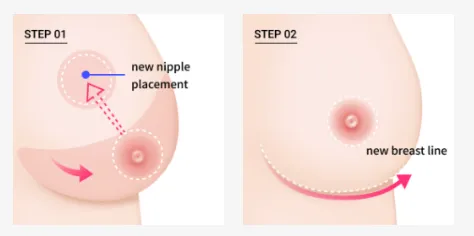
Nipple Revision After Breast Reduction: Repositioning the Areola
A nipple revision after breast reduction corrects a nipple that has ended up too high, too low, or off the midline of the breast. Nipple and areola repositioning runs on its own timetable: scar tissue is given time to mature and settle first, because early contracture can still shift the nipple on its own.
The two directions are not equally fixable. Raising a nipple that sits too low usually means repeating a circumvertical skin resection and closure, which is well established and reasonably predictable. Lowering an areola is harder: a transverse strip of skin is taken from the lower breast near the fold, and if more descent is needed, tissue expansion or nipple transposition may be required, leaving scars on the upper breast that are difficult to accept. That is why surgeons prefer to err on the low side in a first reduction, and why the direction yours must move largely sets how much improvement is realistic.
Internal Support Structure Enhancement
Some surgeons add internal tissue suspension or mesh support systems to hold breast shape over the longer term. Treat this as an option a surgeon may propose rather than a settled part of revision reduction: published evidence for these techniques in the specific setting of a second breast reduction remains limited, so whether the added material is worth it is a judgment to make case by case.
Why Does Asymmetry Occur After Breast Reduction?
Breast asymmetry following reduction surgery represents one of the most common revision indications, arising from multiple potential causes.
Pre-existing Natural Asymmetry
Most women possess inherent breast asymmetries that, if inadequately addressed during initial surgery, may persist or become more apparent post-operatively. Thorough pre-surgical planning must account for these natural variations.
Differential Healing Responses
Varied healing patterns between left and right breasts can create asymmetries even when surgical technique remains consistent. Factors influencing healing include swelling duration, scar contracture patterns, and tissue remodeling responses.
Surgical Technique Limitations
Technique selection may not optimally address specific anatomical features, or lifestyle changes such as weight fluctuations or pregnancy may differentially affect breast appearance over time.
Vascular and Neural Changes
Surgery-induced alterations in blood supply and nerve function may affect healing patterns and final breast shape differently on each side, contributing to asymmetric outcomes.
Recovery Process and Aftercare Management
Breast reduction revision recovery follows similar patterns to initial surgery but may require extended healing time due to previous tissue alterations.
Initial Recovery Phase (1-2 weeks)
Post-surgical symptoms include pain, swelling, and bruising managed through prescribed medications and compression garments. Adequate rest and activity restriction remain essential during this critical healing period. Your downtime after breast reduction revision should be approximately equal to the timeline of your original breast reduction recovery.
Intermediate Recovery Phase (2-6 weeks)
Gradual swelling reduction and early scar formation characterize this period. Patients may resume light daily activities while avoiding heavy lifting and vigorous exercise. Compression bra wear continues, and scar management protocols begin.
Long-term Recovery Phase (6 weeks – 6 months)
Progressive return to normal activities occurs during this phase. Scar maturation continues with color fading and texture smoothing. Breast and nipple sensation may gradually improve over time. Scheduled follow-up visits are how a surgeon catches a problem while it is still small.
Effective Scar Management
Post-revision scar care proves crucial for optimal aesthetic outcomes. Strategies include:
- Silicone gel sheets or tapes for scar texture improvement
- Compression therapy to minimize scar prominence
- Sun protection to prevent hyperpigmentation
- Gentle massage techniques to soften scar tissue
Nutrition and Lifestyle Factors
Recovery optimization benefits from protein-rich balanced nutrition, adequate hydration, and smoking cessation. Sufficient sleep and stress management further support healing processes.

Expected Results After Revision Surgery
Breast reduction revision surgery can achieve significant improvements across multiple aspects of breast appearance and function.
Aesthetic Improvements
Revision surgery addresses asymmetry correction, size optimization, shape enhancement, and scar reduction. Previous surgical limitations can often be overcome through advanced revision techniques and careful planning.
Functional Benefits
Reduced neck, shoulder, and back pain, improved posture, and enhanced activity freedom represent significant functional improvements many patients experience following successful revision.
Psychological Satisfaction
Increased self-confidence and improved body image frequently result from revision surgery, contributing to enhanced quality of life and emotional well-being.
Result Longevity
Proper surgical technique combined with appropriate aftercare produces long-lasting results. However, weight changes, pregnancy, and aging may continue influencing breast appearance over time.
Result Stabilization Timeline
Final results become apparent 6-12 months post-surgery once swelling completely resolves, tissues stabilize, and scars mature. You will be able to fully appreciate the final results of your breast reduction revision after 6–12 months. This is the time you can expect inflammation to have completely subsided and scars to have fully healed.
Frequently Asked Questions
Does breast reduction revision surgery take longer to heal than the initial procedure?
Revision surgery recovery generally parallels initial surgery timelines, though previous scar tissue and altered blood flow may extend healing slightly. Individual variation exists, and recovery duration depends on revision complexity and scope. Most patients can resume light daily activities within 2-3 weeks.
Can sensation loss from initial surgery improve after revision?
Complete sensation restoration may not occur through revision surgery. However, some patients experience partial sensation improvement over time. Revision surgery primarily addresses aesthetic and functional concerns rather than nerve damage repair from previous procedures.
Can I become pregnant and breastfeed after breast reduction revision?
Pregnancy remains possible after revision surgery, but breastfeeding ability depends on surgical techniques used in both initial and revision procedures. Nipple-areola repositioning methods and milk duct preservation affect nursing capacity. Discuss breastfeeding plans with your surgeon before surgery.
How painful is breast reduction revision surgery?
Discomfort is broadly comparable to the first operation, but its character differs. Because the surgeon works through scar tissue, some areas feel tighter or achier for longer than patients remember from the original reduction. Prescribed pain medication and a compression garment manage most of it; the sharpest phase is the first one to two weeks, with light daily activity usually resumed within two to three weeks.
Will insurance cover a breast reduction revision?
It depends on why the breast reduction revision is being done and where you are treated. Coverage usually turns on whether functional symptoms have returned and been documented: back, neck, and shoulder pain, bra strap grooving, intertrigo (skin irritation in the fold under the breast), or numbness and tingling in the arm and fingers. Where the aim is correcting appearance — asymmetry, scars, nipple position — the procedure is generally self-funded. Rules differ by country and insurer, so settle this in consultation.
Achieving Optimal Breast Reduction Revision Results
Breast reduction revision surgery is a real second chance to address what the first operation left unresolved, whether that is size, symmetry, scars, or nipple position. None of what makes it work is dramatic: enough healing time before deciding, expectations shaped by what a revision can realistically improve rather than by perfection, a clear-eyed view of the necrosis risk, and a surgeon who does this often.
For a personalized assessment of breast reduction revision surgery, bring the record of your first procedure and we at MINE will go through what is realistically correctable and what is not — see our breast reduction program for how a first operation is planned.
Ready to explore your breast reduction revision options? Contact us for a consultation to talk through what a second procedure could — and could not — change for you.
※ This content is for informational purposes only and does not replace professional medical advice, diagnosis, or treatment. Individual results may vary, and side effects may occur. Please consult with a board-certified plastic surgeon for personalized advice.