EN



Deep forehead lines, frown lines between the eyebrows, and heavy upper eyelids are often linked: the brow sits lower with age, and the muscles that lift or pull it work overtime. This guide explains which forehead wrinkles an endoscopic brow lift can soften, which ones it cannot, and how MINE Plastic Surgery in Seoul performs the procedure.
Table of Contents
- What Is an Endoscopic Brow Lift?
- 5 Essential Facts at a Glance
- Why a Sagging Brow Causes Forehead Wrinkles
- Which Wrinkles a Brow Lift Can and Cannot Fix
- Brow Lift vs Botox for Forehead Wrinkles
- Who Is an Ideal Candidate?
- How MINE Performs an Endoscopic Brow Lift
- What Is an Endotine Forehead Lift and How Does It Work?
- Risks and Side Effects
- Recovery Timeline
- Combining a Brow Lift with Other Procedures
- Frequently Asked Questions
- Planning Your Consultation
What Is an Endoscopic Brow Lift?
An endoscopic brow lift is a surgical procedure that raises sagging eyebrows and smooths forehead and frown lines. Working through a few short incisions hidden in the scalp, the surgeon uses a thin camera (endoscope) to release and reposition the forehead tissues. It treats the upper third of the face: the forehead, the eyebrows, and the space between the brows.
Older brow lift techniques used a long incision running across the top of the head from ear to ear. The endoscopic approach replaces that with several small openings behind the hairline. Through them, the surgeon frees the forehead tissue from the bone, lifts the brow to a more natural height, and secures it there while it heals.
You may also see this operation called an endoscopic forehead lift. Both names describe the same idea. For a broader overview of the procedure, including travel planning and a day-by-day recovery plan in Korea, see our complete guide to the endoscopic forehead lift in Korea. This article focuses on one question: what an endoscopic brow lift does for forehead wrinkles.
5 Essential Facts at a Glance
- It treats the cause, not just the crease. The surgery raises a low brow so the forehead muscle can relax, and the frown muscles can be weakened in the same operation.
- It works best on lines driven by brow position and muscle activity. Fine lines etched by sun damage usually need skin treatments as well.
- It is not the same as Botox. Injections relax muscles for about 3 to 4 months, while surgery repositions tissue; if your brows already sit low, Botox alone can make them feel heavier.
- Endotine holds the lift while you heal. At MINE, the new brow position is secured within 1 to 2 months, and the small absorbable devices disappear after about 12 months.
- Recovery is measured in weeks. Most swelling and bruising settle within 1 to 2 weeks, and the final brow position becomes clear over 1 to 3 months.
Why a Sagging Brow Causes Forehead Wrinkles
Many people assume forehead lines are only a skin problem. In practice, muscles and brow position play a large part.
Horizontal forehead lines
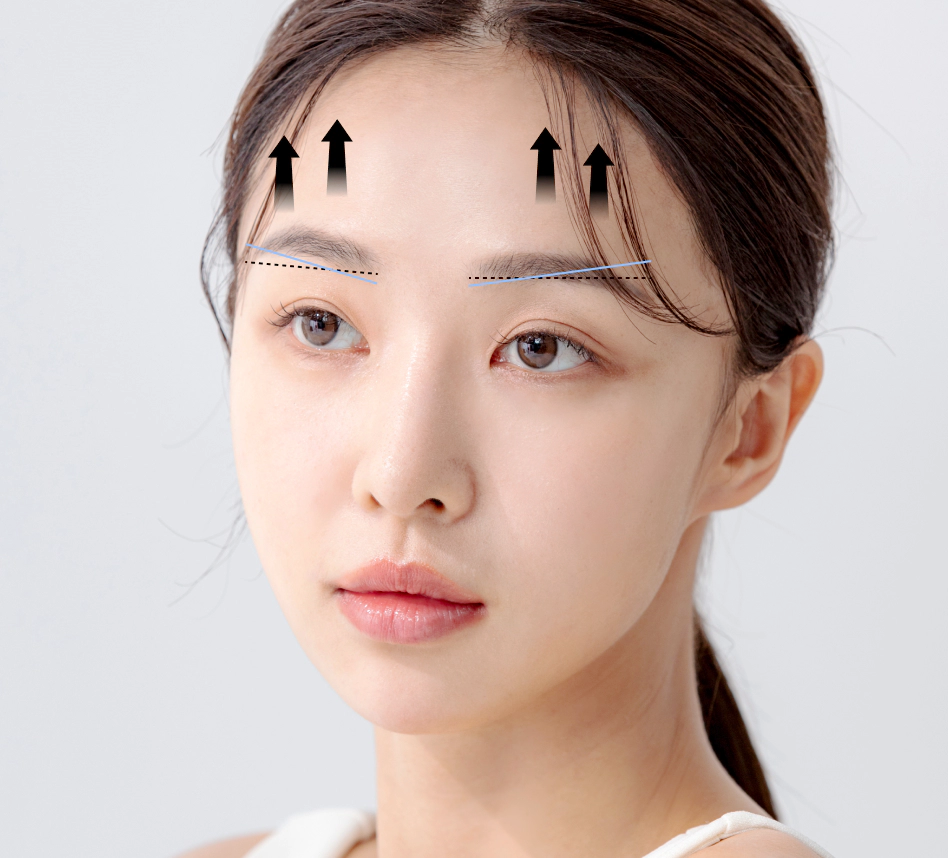
When the eyebrows drop with age, the upper eyelids feel heavier and the field of vision can narrow. To compensate, the frontalis muscle in the forehead contracts all day to hold the brows up. Years of this constant lifting fold the skin into deep horizontal lines. Many patients notice that they raise their eyebrows without realizing it, especially when tired.
Frown lines between the eyebrows
The vertical “11” lines between the brows come from two small muscles, the corrugator and the procerus, which pull the brows down and together. Strong, habitual frowning creates a tense or angry look even when you feel relaxed.
Heavy upper eyelids and a tired look
As the outer part of the brow descends, skin gathers over the upper eyelid. The eyes look hooded and smaller, and the face can look tired or sad at rest.
Plastic surgery textbooks describe the endoscopic approach as a way to treat all three of these problems at once. It addresses both of their underlying causes: overactive forehead and frown muscles, and a low or uneven brow that weighs on the eyelids. That is why an endoscopic brow lift can improve forehead wrinkles in a way that skin treatments alone often cannot.
Which Wrinkles a Brow Lift Can and Cannot Fix
An endoscopic brow lift is most useful when wrinkles are driven by brow position and muscle activity. It is less useful for lines that are etched into thin, sun-damaged skin. The table below gives a general picture; your surgeon will confirm what applies to your face.
| Concern | How a brow lift helps | What may still be needed |
|---|---|---|
| Horizontal forehead lines | Once the brow sits higher, the frontalis no longer has to work constantly, so lines usually soften | Deeply etched lines may stay faintly visible; skin resurfacing or fillers can help |
| Frown lines (“11” lines) | The corrugator and procerus muscles can be weakened under the endoscope, reducing frowning | Fine residual creases may need injectables |
| Low or drooping eyebrows | Directly repositions the brow to a more natural height | Usually no additional treatment |
| Uneven eyebrows | Each side can be lifted by a different amount | Asymmetry caused by eyelid ptosis needs eyelid correction |
| Hooded upper eyelids | Lifting the outer brow reduces skin folded over the lid | Excess eyelid skin itself may need blepharoplasty |
| Crow’s feet | Lifting the outer brow can modestly improve the area | Often best treated with injectables or laser |
| Fine lines from sun damage | Little direct effect | Skin treatments are more suitable |
In short, an endoscopic brow lift corrects the cause of many forehead wrinkles, but it does not resurface the skin. Setting this expectation early helps patients judge results realistically.
Brow Lift vs Botox for Forehead Wrinkles
Botulinum toxin (Botox and similar products) is the most common non-surgical option for forehead lines. It relaxes the muscles that create wrinkles, but the effect of Botox on forehead lines typically lasts about 3 to 4 months, so treatment has to be repeated. You can read more about where these injections are used in our guide to Xeomin and Botox treatment areas.
The key difference is that injections relax muscles, while surgery moves tissue. If your brows are already low, relaxing the frontalis can even make them sit lower and the eyelids feel heavier, because that muscle was holding them up. An endoscopic brow lift corrects the low brow itself, so the forehead no longer needs to strain.
- Injectables may suit you if your brows sit at a good height, your lines are mainly caused by expression, and you prefer no downtime.
- An endoscopic brow lift may suit you if your brows have dropped, your eyelids look hooded, or injections no longer give the result you want.
- Many patients use both. Injections after surgery can fine-tune residual lines.
Who Is an Ideal Candidate?
You may be a good candidate for an endoscopic brow lift if you:
- Have deep horizontal forehead lines or frown lines that are visible even at rest
- Have eyebrows that sit low, or one brow lower than the other
- Have a short distance between the eyes and the eyebrows
- Notice heavy upper eyelids, sometimes enough to limit vision
- Are often told you look tired, angry, or sad when you are not
- Are in good general health and do not smoke, or can stop before and after surgery
- Have realistic expectations about what surgery can change
Forehead shape and hairline height also matter. Surgical textbooks note that the best results with the endoscopic technique are seen in patients with a relatively flat forehead and a hairline that is not already high. Because lifting the forehead tends to move the hairline up slightly, people with a naturally high, stable hairline may be better served by a different approach, such as forehead reduction (hairline lowering). If you are unsure whether you truly need surgery, our guide to the forehead lift in Korea walks through the signs, what affects the cost, and recovery week by week.
The American Society of Plastic Surgeons advises discussing your goals, complete medical history, and current medications with your surgeon at a brow lift consultation. A face-to-face assessment is the only reliable way to decide.
How MINE Performs an Endoscopic Brow Lift
At MINE Plastic Surgery, the plan is tailored to each patient. The degree and direction of sagging vary with age, skin type, and facial structure, so the surgeon decides case by case how much tissue to release and how high to lift the brow.
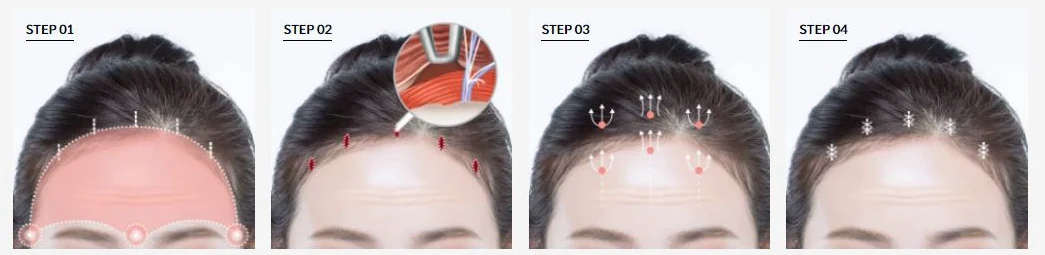
- Small incisions in the scalp. About three to five incisions of roughly 1 cm are made behind the hairline, where hair covers them.
- Endoscopic release. Using a high-definition endoscope, the surgeon locates and protects the nerves and blood vessels while carefully freeing the forehead tissue. This release includes the tight attachments along the side of the forehead and near the outer end of the eyebrow, which hold the brow down. Frown muscles can be weakened at this stage if needed.
- Lifting and fixation. The forehead is lifted as a whole and fixed to the bone with sutures or with Endotine fixation devices, so the new brow position holds while the tissue reattaches.
- Closure. The small incisions are closed with fine sutures.
At MINE, the operation typically takes about 1 hour under sleep (IV) sedation, and patients usually go home the same day. Before finishing, surgeons check brow height and symmetry, because small differences between the two sides are easier to correct during surgery than afterwards.
Compared with the traditional open technique, the endoscopic method generally means shorter scars, less scalp numbness, and a lower risk of hair loss along the incision line. It is, however, technically demanding, which is one reason surgeon experience matters.
A 2026 systematic review in Plastic and Reconstructive Surgery Global Open compared traditional and endoscopic brow lift techniques across 15 studies and found that endoscopic approaches showed comparable aesthetic outcomes with fewer complications and shorter recovery, although differences between the studies limit how firm that conclusion can be.
What Is an Endotine Forehead Lift and How Does It Work?
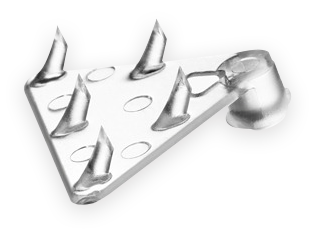
An Endotine forehead lift is a brow or forehead lift, such as an endoscopic brow lift, in which the lifted tissue is held in place with Endotine, a small, bioabsorbable fixation implant. It has a tiny post that sits in a shallow socket made in the skull, and a platform with small tines that grip the underside of the scalp. Once the surgeon lifts the forehead, the tines hold the tissue at its new height, much like a tent peg, while the forehead heals and reattaches to the bone.
Holding the lift securely during this early healing period is important. Plastic surgery literature reports that relapse of the brow has become less common as fixation methods have improved. In one published series of 128 endoscopic forehead lifts, Sozer and Biggs found that hair loss near the incisions became less frequent once they began fixing the lift with titanium microscrews. A 2025 scoping review of 2,519 patients identified 11 different fixation methods, with Endotine among them.
The device is made of absorbable material. According to MINE’s procedure information, the new brow position is secured within 1 to 2 months, and the device is fully absorbed after about 12 months, so nothing is left in place permanently. MINE uses genuine Endotine devices with regulatory clearance from the U.S. FDA and Korea’s Ministry of Food and Drug Safety. For the first several months, patients may feel small bumps under the scalp where the devices sit; these fade as the material is absorbed.
Risks and Side Effects
Like any surgery, an endoscopic brow lift carries risks. Most are uncommon, and many are temporary, but they should be part of your decision:
- Bleeding or a collection of blood under the skin
- Infection at the incision sites
- Numbness or tingling in the forehead and scalp, caused by stretching of the sensory nerves above the eyes; this usually improves over weeks to months
- Hair thinning or hair loss around the incisions
- Asymmetry between the two brows
- A “surprised” look if the inner brows are lifted too much; careful planning of how far each part of the brow is raised helps avoid this
- Relapse, meaning the brow drops again over time
- Visible scars or delayed wound healing
- Temporary weakness in raising the eyebrows, from irritation of a nerve branch
- Reactions to anesthesia
Occasionally, a second procedure is needed to correct asymmetry or relapse. Following pre- and post-operative instructions, avoiding smoking, and choosing an experienced surgeon all help lower these risks. Our guide to forehead lift and temporal lift precautions lists what to do before and after surgery.
Recovery Timeline
Recovery after an endoscopic brow lift varies from person to person. The general pattern looks like this:
| Time after surgery | What to expect |
|---|---|
| Days 1 to 7 | Swelling and bruising around the forehead and eyes; mild to moderate discomfort controlled with medication; sleep with the head raised and use cool compresses |
| Weeks 1 to 2 | Stitches are removed; swelling and bruising fade noticeably; light daily activities and desk work can often resume |
| Weeks 3 to 4 | Most visible swelling has settled; avoid strenuous exercise and heavy activity for about a month |
| Months 1 to 3 | Remaining swelling resolves and the final brow position becomes clearer |
Most swelling and bruising after an endoscopic brow lift settle within 1 to 2 weeks, and strenuous exercise usually waits about 4 weeks.
During recovery, avoid smoking and alcohol, protect the incision sites from the sun, take medication exactly as prescribed, and attend every follow-up visit. Contact your surgeon promptly if you notice increasing pain, fever, or one-sided swelling.
Results are long-lasting because the surgery changes the position of the tissues rather than only relaxing muscles. Natural aging continues, however, so the forehead will still change slowly over the years.
Combining a Brow Lift with Other Procedures
Forehead aging rarely happens alone. An endoscopic brow lift is often combined with:
- Upper or lower blepharoplasty to remove excess eyelid skin and fat
- A facelift or mini facelift to address the cheeks and jawline
- A neck lift for loose skin and bands in the neck
- Fat grafting to restore lost volume
- Skin resurfacing or injectables for fine lines the lift does not reach
Brow position should usually be assessed before eyelid surgery. If the brow is low, removing eyelid skin alone can pull the brow down further, so planning both areas together tends to give a more balanced result.
Frequently Asked Questions
Will an endoscopic brow lift get rid of my forehead wrinkles completely?
It usually softens horizontal forehead lines and frown lines noticeably, because the forehead muscles no longer have to strain and the frown muscles can be weakened. Very deep or sun-etched lines may remain faintly visible and can be refined with skin treatments or injectables.
Is a brow lift better than Botox for forehead lines?
They do different jobs. Botox relaxes muscles for a few months and suits people whose brows sit at a good height. An endoscopic brow lift repositions a low brow and gives a longer-lasting change. If your eyebrows have dropped, Botox alone may make heaviness worse.
What is Endotine, and does it stay in my body permanently?
Endotine is a small absorbable implant that holds the lifted forehead in place while it reattaches to the bone. It is gradually absorbed by the body, usually within about 12 months, so it does not stay permanently.
Will a brow lift raise my hairline?
Lifting the forehead can move the hairline up slightly. For people who already have a high forehead, a hairline approach or forehead reduction may be more suitable, which is why hairline height is checked at consultation.
How long is recovery after an endoscopic brow lift?
Most swelling and bruising settle within one to two weeks, and many people return to desk work in that time. Strenuous exercise should wait about a month, and the final result is usually clear within one to three months.
Planning Your Consultation
If forehead lines, frown lines, or a heavy brow are bothering you, a consultation is the best place to start. The surgeon will check your brow height, eyelids, hairline, and skin quality, and explain whether an endoscopic brow lift, a less invasive option, or a combination suits you. Have questions? You can book a consultation with MINE Plastic Surgery for a personalized assessment.
Medically reviewed by Dr. Lee Sung-wook, board-certified plastic surgeon and director of MINE Plastic Surgery in Gangnam, Seoul. Last reviewed: October 8, 2026.
※ This content is for informational purposes only and does not replace professional medical advice, diagnosis, or treatment. Individual results may vary, and side effects may occur. Please consult with a board-certified plastic surgeon for personalized advice.