EN


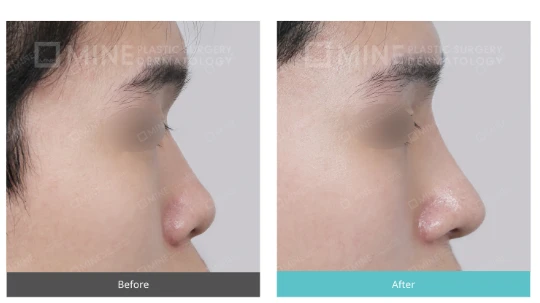
A pseudo hump nose is a nose that looks humped in profile mainly because the tip droops or lacks projection, not because the bony or cartilage bridge is truly oversized. Because the real problem sits at the tip, a pseudo hump nose is often corrected by supporting and lifting the tip rather than by shaving or cutting bone.
Do you avoid side-on photos because of a bump on your bridge? Many people who come to see me assume the answer is to file the bone down and add an implant. In my clinical experience, that assumption is often wrong. The first and most important step is working out whether you have a true hump or a pseudo hump nose, because the two call for very different operations.
I’m Dr. Lee Sung-wook, a board-certified plastic surgeon at MINE Plastic Surgery & Dermatology in Seoul. This guide is a diagnosis-and-decision guide: how to tell a pseudo hump nose from a true hump, when the nasal bones actually need to be cut, and which grafting material suits which nose. If you would like a general overview of causes and techniques first, read how dorsal hump surgery works in Korea.
Dr. Lee’s key point: Mistaking a pseudo hump nose for a true hump can lead to bone cutting and implants you never needed. An accurate diagnosis comes before any decision about technique.
What Is a Pseudo Hump Nose — and How Is It Different from a True Hump?
A dorsal hump is a bump that rises from the middle of the nasal bridge and is easiest to see from the side. It can be inherited, follow an old nasal fracture, or develop alongside a deviated septum (a bent inner wall between the nostrils). A true hump is extra bone and cartilage that genuinely sticks out. A pseudo hump nose, by contrast, has a bridge of reasonable height that only looks prominent because the tip below it has dropped.
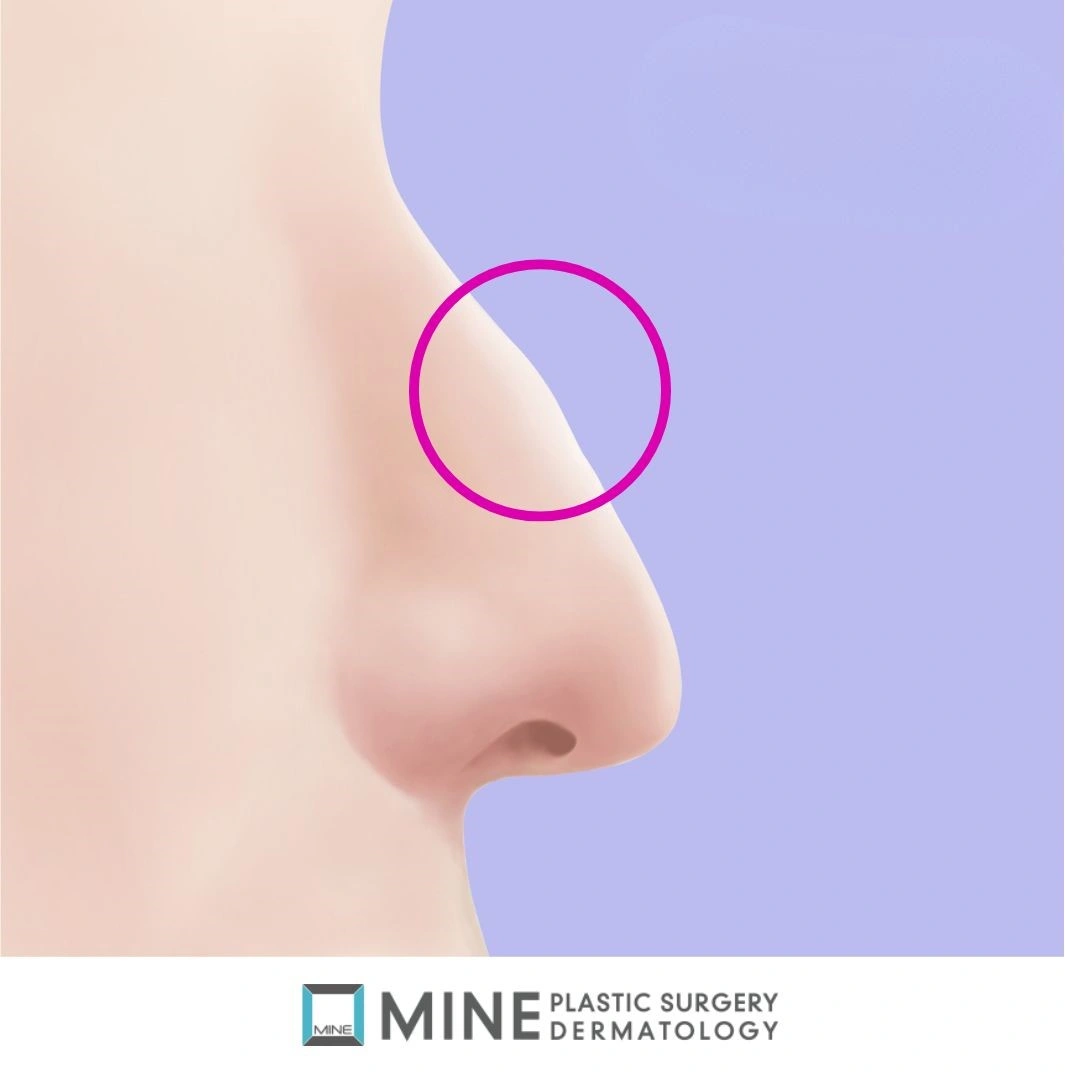
Where a Hump Actually Sits: The Three Thirds of the Nose
Rhinoplasty textbooks divide the nose into 3 zones, and knowing them makes the rest of this guide much easier to follow.
| Zone | What it is made of | How it feels |
|---|---|---|
| Upper third | Nasal bones | Hard when you press it |
| Middle third | The septum and the upper lateral cartilages (two cartilage plates that continue the bridge below the bone) | Firm but slightly springy; this bone-to-cartilage junction is where most humps form |
| Lower third | The lower lateral cartilages that shape the tip | Soft and mobile |
Plastic surgery textbooks note that a dorsal hump is often made more of cartilage than of bone. That is why good hump surgery always deals with the cartilage, not just the nasal bone. The literature also describes small humps as the most common kind, which matters because a small cartilage hump rarely calls for the larger operations described later, and a pseudo hump nose often needs no bone work at all.
True Hump vs Pseudo Hump at a Glance
| True hump | Pseudo hump nose | |
|---|---|---|
| What sticks out | Excess bone and cartilage on the bridge | A normal bridge that looks high because the tip sits low |
| Front view | The nose may look wide or large | The nose often looks fairly normal |
| Profile view | A clear, hard bump | A gentle bump plus a drooping or under-projected tip |
| Typical fix | Hump reduction, sometimes with osteotomy | Tip support and lift using your own cartilage, with little or no hump trimming |
Patients often arrive believing that every hump means bone shaving and an implant. Yet humps show different patterns in different faces. A typical Western hump tends to come with a large, high bridge, so the whole nose may need to be made smaller. In my clinical experience, many Korean and East Asian patients who ask about a hump actually have a pseudo hump nose: the bridge is not too high at all, but the tip has lost support. This is a difference in anatomy, not a judgement about which nose is more attractive.
Pseudo Hump Nose Self-Check: The 35-Degree Line and the Tip-Lift Test
The two checks below are rough at-home guides I share with patients so they can think about their own nose before a consultation. They are not textbook standards and they are not a diagnosis. A proper diagnosis needs an in-person examination and, at our clinic, a 3D-CT scan.
How to Do the 35-Degree Profile Check
The 35-degree check uses one profile photo and two lines; if the bridge stays behind the 35-degree line, the hump is likely a pseudo hump.
- Take a straight side-on photo of your face at 90 degrees, with your head level.
- Find the radix (the deepest point of the bridge, between your eyes) and mark it as your reference point.
- Draw a vertical line straight down from that point.
- From the same point, draw a second line angled 35 degrees forward from the vertical.
- Look at your bridge. If it does not cross the 35-degree line, you probably have a pseudo hump nose that could improve with tip work alone.
The Fingertip Tip-Lift Test
Stand side-on to a mirror and gently push the tip of your nose upward with one fingertip. If the bump suddenly looks much smaller, the tip is likely the main problem. That pattern points towards a pseudo hump nose. Other clues are a bridge that seems the right height when you ignore the tip, and a nose that looks unremarkable from the front.
Signs It Is Probably a True Hump
- You can feel a hard ridge at bone level when you run a finger down the bridge.
- The bump stays obvious even when you lift the tip.
- The nasal bones look wide from the front, or the whole nose looks large for your face.
Plenty of noses show a mix of both patterns, for example a small true hump combined with the drooping tip of a pseudo hump nose. That is exactly why the final decision is made in the clinic, not in the mirror.
From Diagnosis to Surgery: 4 Paths and When Osteotomy Is Needed
No single technique fixes every hump. At MINE, we choose the operation by looking at four things: how high the radix starts, how far the hump sticks out, whether the tip droops, and how wide the nasal bones are. A pseudo hump nose is one of these four paths, not a separate category. Below is our clinical decision flow: if your diagnosis looks like X, this is usually the path.
Low Radix with a Mild Hump: Smooth the Hump, Build the Upper Line
When the bridge starts low between the eyes, even a modest hump looks bigger than it is, and the line from forehead to nose appears broken. We smooth the small hump and raise the upper part of the bridge with your own cartilage, or an implant where needed. The aim is one continuous, gently rising line rather than a deep dip followed by a bump.
High Radix with a Prominent Hump: Resect Bone and Cartilage Together
Here the starting point is already high, and the hump clearly stands out. We remove the bony and cartilage parts of the hump together, then smooth the surface so the bridge feels even. An implant is usually not needed, because adding height to an already high bridge tends to look unnatural. Taking too much is just as much a problem as taking too little, so the goal is a continuous line, not a flat one.
Large Hump with Wide Nasal Bones: Osteotomy to Close the Open Roof
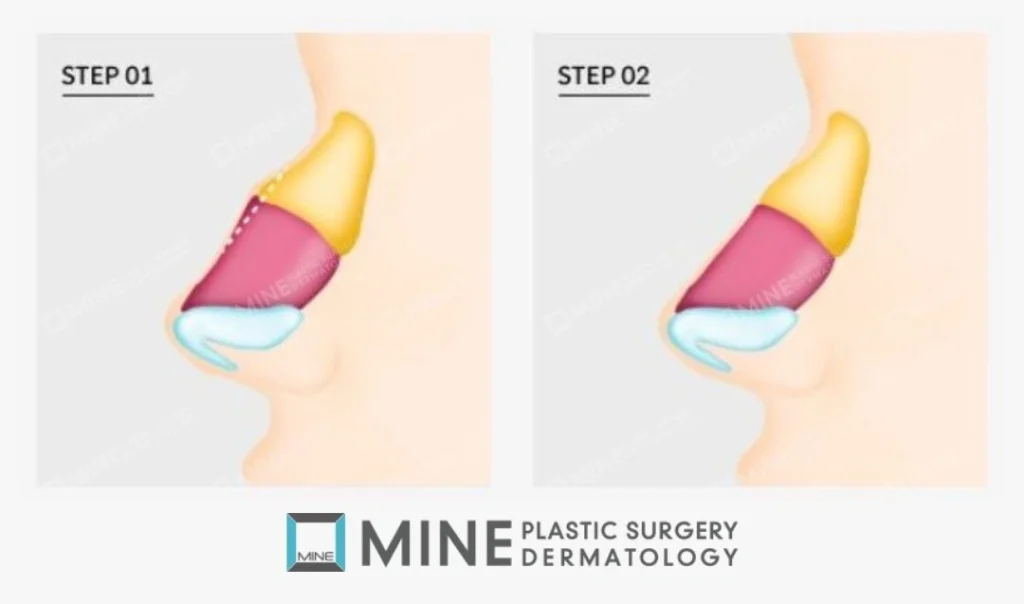
When a large bony hump is removed, it leaves a flat gap on top of the nose. Surgeons call this an “open roof,” because the two nasal bones are left standing apart like the walls of a house with no ridge beam. If the bones are also wide, the bridge can end up looking broad or unstable. In this group, an osteotomy (a controlled cut of the nasal bones) lets us move the bones inward, narrow the bridge and close the roof.
High Radix with a Droopy Tip (Pseudo Hump): Lift the Tip First
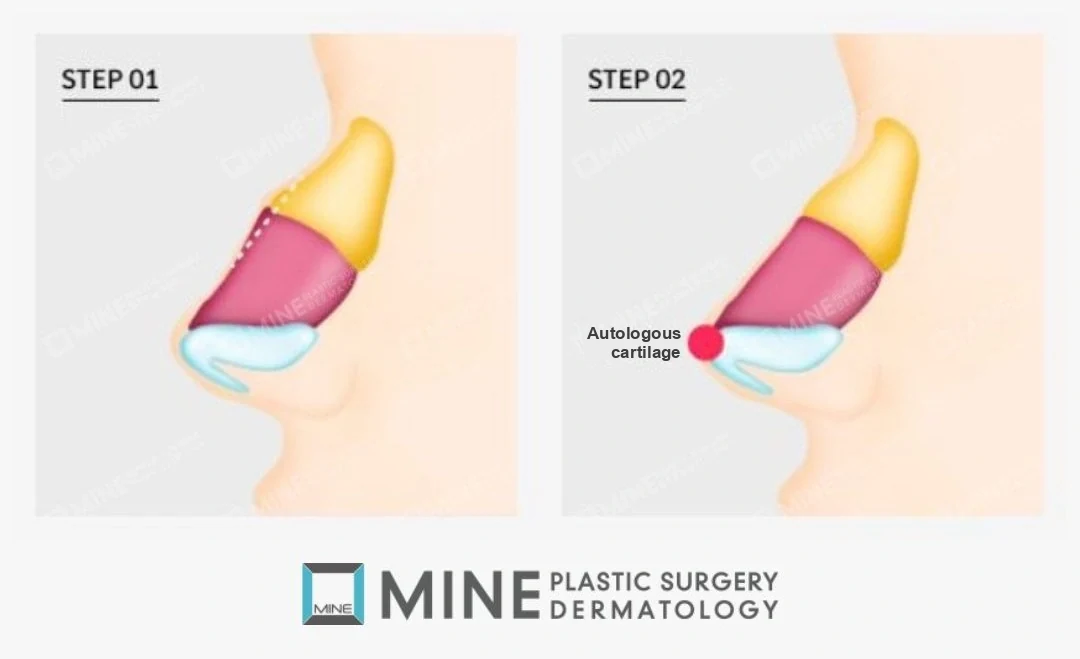
This is the classic pseudo hump nose. The radix and bridge are already high enough; the tip has dropped, so the middle of the bridge looks prominent by comparison. We trim only what genuinely sticks out and use your own cartilage to lift and support the tip, restoring its angle and strength. For many patients with a pseudo hump nose, the tip work is what changes the profile most. Our droopy nose tip correction page explains this type of tip surgery in more detail.
Do I Need Osteotomy for a Hump Nose?
Often, no. A pseudo hump nose and a small cartilage hump usually do not need the bones cut at all. Osteotomy becomes necessary when a larger, clearly bony hump is removed and leaves an open roof, or when the nasal bones are wide to begin with. Some surgeons also use preservation techniques such as push-down or let-down, where the bony bridge is lowered as a single unit after controlled bone cuts instead of being shaved.
Technique matters just as much as the decision to cut. Rhinoplasty textbooks list 5 problems that careless hump reduction can cause: an irregular bridge, too much or too little removal, an inverted-V deformity (a visible upside-down V shadow where the bone meets the cartilage), a pinched middle section of the nose, and collapse of the internal nasal valve (the narrowest part of the airway inside your nose). The same literature explains that keeping the upper lateral cartilages intact and then rebuilding a smooth bridge helps prevent these problems, both for appearance and for breathing.
Choosing Materials: Septal, Ear or Rib Cartilage vs Implants
Whether you have a true hump or a pseudo hump nose, the surgeon may need material to support the tip or rebuild the line of the bridge. The choice is between your own tissue and a manufactured implant. Neither is automatically better; each has a job it suits.
Your Own Cartilage: Septum, Ear and Rib Compared
| Source | Strengths | Limits | Best use |
|---|---|---|---|
| Septal cartilage (the inner wall of the nose) | Taken from inside the nose, so no extra incision; firm and supportive | Only a limited amount; less available if the septum is badly bent or was used in an earlier surgery | Tip support, bridge reinforcement, spreader grafts for crooked noses |
| Ear (conchal) cartilage | Soft and naturally curved; harvesting does not change how the ear looks | Too soft for heavy structural support | Shaping a refined tip; topping up when septal cartilage runs short; thin-skinned tips |
| Rib cartilage | The largest amount of graft material; strong | Separate chest incision, early chest pain and a risk of warping (the graft slowly bending) | Lengthening a short nose, revision surgery, large reconstructions |
Rib cartilage provides the largest amount of graft material but adds a chest incision and a risk of warping, according to rhinoplasty literature. For a pseudo hump nose, septal or ear cartilage is usually enough, because the job is tip support rather than major rebuilding. You can learn more in our guide to rhinoplasty with your own cartilage.
Silicone, Gore-Tex and 3D Custom Implants: When They Make Sense
- Silicone has the longest track record, keeps its shape well and can be removed easily. In thin skin it may show through, so it is best kept to the bridge rather than the tip.
- Gore-Tex bonds well with surrounding tissue and feels soft, but that same bonding can make it harder to remove if an infection develops.
- 3D-printed custom implants are made to fit an individual nose closely. They are a newer option with a shorter track record.
Can a Hump Nose Be Fixed Without an Implant?
In many cases, yes. A pseudo hump nose can usually be corrected with your own cartilage alone. Even in moderate true humps, septal and ear cartilage can rebuild the bridge and support the tip. In my view, implants are often unnecessary in Korean hump and pseudo-hump noses, and I use them only when the height or shape you want genuinely cannot be built with cartilage. Every unnecessary implant is one more long-term risk.
Recovery With vs Without Osteotomy
General week-by-week recovery is covered in our full dorsal hump guide. Here we focus on the one factor that changes the timeline most: whether the nasal bones were cut.
Timeline Table: Splint, Bruising, Swelling, Glasses
| Milestone | Without osteotomy | With osteotomy |
|---|---|---|
| Splint and stitches removed | Day 5 to 7 | Day 5 to 7 |
| Bruising mostly gone | About 1 to 2 weeks | Often 1 to 2 weeks longer, especially around the eyes |
| Most visible swelling down | About 3 to 4 weeks | Slightly later |
| Glasses resting on the nose | About 4 weeks | About 6 weeks |
| Final profile | 6 to 12 months | 6 to 12 months |
Splints and stitches typically come off on day 5 to 7, and the final profile settles over 6 to 12 months. Glasses can usually be worn about 4 weeks after hump correction without osteotomy, versus about 6 weeks when the nasal bones are cut. Contact lenses are a good stand-in during that time.
Why Osteotomy Adds One to Two Weeks
If you have a pseudo hump nose treated with tip work alone, there are usually no bone cuts, so this extra time does not apply. Cutting and moving the nasal bones causes more bruising and swelling around the eyes, and that simply takes longer to clear. If you are flying in from abroad, plan to stay in Seoul at least until your splint comes off, usually about a week. Your own schedule may be shorter or longer depending on your surgery, so confirm it with your surgeon before you book flights.
Risks and Precautions to Discuss Before Correction
Every operation carries risk, and honest information is part of good care. The American Society of Plastic Surgeons rhinoplasty overview is a useful general reference before your consultation.
Risks Specific to Hump and Tip Work
- An uneven or irregular bridge
- Over-resection (a scooped bridge) or under-resection (a hump that remains)
- Inverted-V deformity
- Open-roof deformity if the bones are not properly closed after a large hump is removed
- Breathing changes from narrowing of the internal nasal valve
- Asymmetry that becomes visible once swelling settles
- Persistent bump after surgery, which can happen if a pseudo hump nose is treated as a true hump without fixing the tip
- With implants: shifting, show-through and contracture (scar tissue tightening around the implant, which can make the skin feel hard or pull the tip upward)
Temporary effects such as bruising, a stuffy nose from internal swelling and numbness at the tip usually fade over weeks to months. If you have already had surgery and something does not look right, read about the warning signs that may need revision.
Before and After Surgery: Key Do’s and Don’ts
- About 2 weeks before: stop aspirin, vitamin E, omega-3 and ginkgo supplements under your doctor’s guidance, as they can increase bleeding. Stop smoking, which slows healing and raises infection risk.
- First week after: sleep with your head raised above your heart, use cold compresses around the eyes (over gauze) for 2 to 3 days, do not blow your nose, and sneeze with your mouth open.
- Weeks 2 to 4: light daily activity is fine; avoid hard exercise, saunas and alcohol.
- Months 1 to 3: protect your nose from knocks and avoid contact or ball sports.
Pseudo Hump Nose FAQ
How do I know if I have a pseudo hump nose or a real hump?
Try the tip-lift test and the 35-degree profile check. If lifting your tip shrinks the bump and your bridge stays behind the 35-degree line, a pseudo hump nose is likely. Treat both as rough guides only; a real diagnosis needs an examination and imaging such as 3D-CT.
Do all hump noses need the bone shaved or broken?
No. A pseudo hump nose or a small cartilage hump often needs no osteotomy at all. Bone cuts are reserved for larger, clearly bony humps that leave an open roof once removed, or for noses with wide nasal bones.
Can a hump nose be corrected without an implant?
Often, yes, and especially with a pseudo hump nose. Your own septal or ear cartilage can support the tip and smooth the bridge. Implants are used only when the height or shape you need cannot be built with cartilage alone.
Will the hump grow back after surgery?
The bone itself does not regrow. When a hump seems to return, the usual cause is cartilage that was not trimmed precisely enough and springs back toward its old position. Careful shaping of both bone and cartilage helps prevent this.
When can I wear glasses after hump correction?
Usually about 4 weeks after surgery without osteotomy, which covers most pseudo hump nose corrections, and about 6 weeks when the nasal bones were cut. Contact lenses are a practical alternative in the meantime.
Can a crooked nose and a hump be fixed in the same surgery?
Yes, they are usually corrected together, which helps balance both appearance and function. Recovery may be slightly longer, and breathing problems such as a deviated septum or narrow valve can be treated at the same time. See our page on crooked nose correction.
Getting an Accurate Hump Diagnosis at MINE Plastic Surgery
At MINE, we measure before we decide. A 3D-CT scan shows how much of your hump is bone, how much is cartilage and how wide your nasal bones are. We try to preserve as much of your own bone and cartilage as possible, and we look at breathing, including a deviated septum or narrow valve, alongside appearance.
We also aim to be honest. Some patients with a pseudo hump nose need only tip work, and a few mild cases may not need surgery at all. If you suspect a pseudo hump nose, start with our droopy nose tip correction page, then send us clear front and side photos for an online consultation, or call +82-2-516-1175.
※ This content is for informational purposes only and does not replace professional medical advice, diagnosis, or treatment. Individual results may vary, and side effects may occur. Please consult with a board-certified plastic surgeon for personalized advice.