EN


Facial nerve weakness after facelift is reduced movement in part of the face, such as a brow that won’t lift, an uneven smile or a lower lip that won’t pull down. It is caused by temporary stretching, swelling or, rarely, injury to a facial nerve branch during surgery. A numb earlobe is different: it involves a sensory (feeling) nerve, not a movement nerve.
The short answer most patients want first: in the large majority of cases, facial nerve weakness after facelift is temporary. Weakness that appears in the first few hours is usually caused by the numbing medicine. Weakness that lasts longer is most often a stretched or “stunned” nerve branch that recovers over days to weeks, and an intact nerve usually recovers within about 6 months.
Noticing that one side of your face moves differently a few days after surgery is frightening, especially if you are recovering far from the clinic that operated on you. This guide, written by Dr. Lee Sung-wook, a board-certified plastic surgeon at MINE Plastic Surgery in Seoul, explains which nerve matches which symptom, how long to wait, what a surgeon checks, and when you should not wait at all.
What Is Facial Nerve Weakness After Facelift?
Facial nerve weakness after facelift is a loss of strength in one or more facial muscles because the nerve signal to those muscles is temporarily blocked or, less often, interrupted. The facial nerve is the “movement nerve” of the face. It comes out just in front of the ear and fans forward into five main branches, like the fingers of a hand.
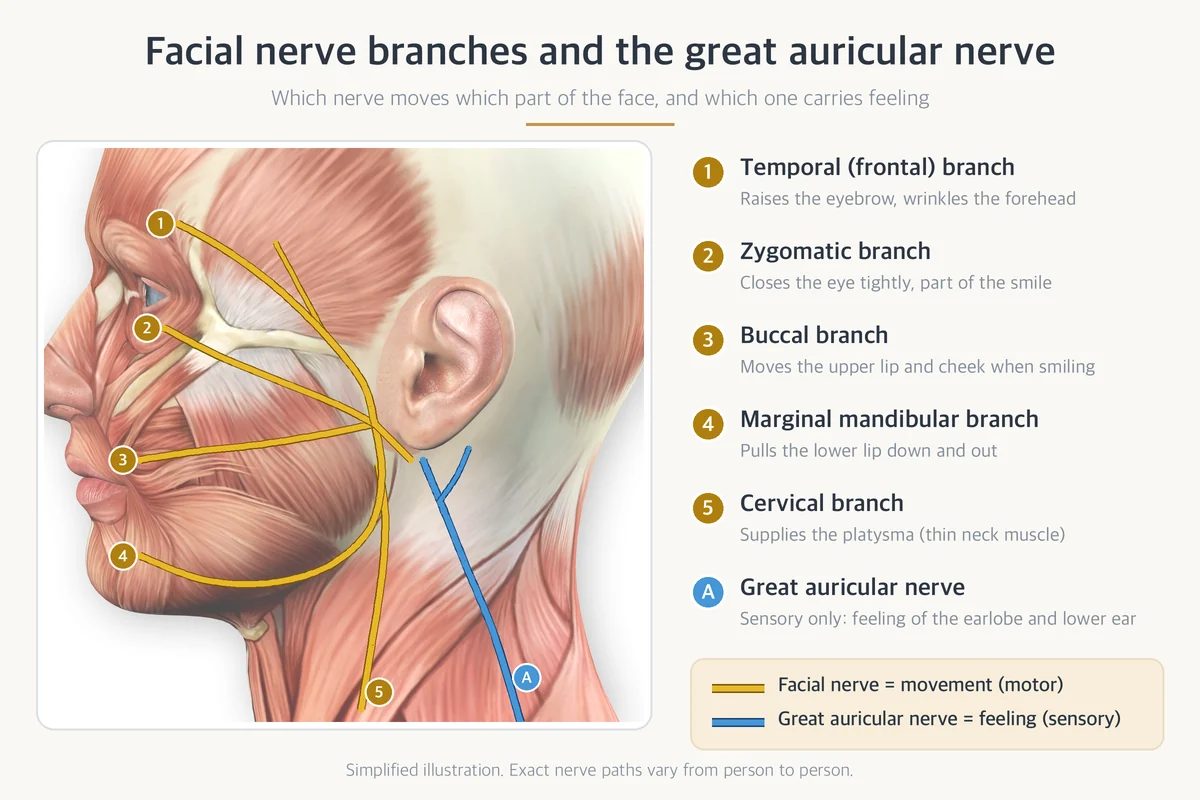
Each branch controls a different region:
- Temporal (frontal) branch: raising the eyebrow and wrinkling the forehead
- Zygomatic branch: closing the eye tightly and part of the smile
- Buccal branch: the upper lip and cheek during smiling
- Marginal mandibular branch: pulling the lower lip down and out
- Cervical branch: the platysma (a thin sheet of neck muscle)
Plastic surgery textbooks describe facial nerve injury during facelift as rare, usually temporary and, in most cases, limited to small segmental branches rather than the main nerve trunk. That is the single most useful fact to hold on to in the first anxious days.
Motor Branches vs. Sensory Nerves: Why a Numb Earlobe Is a Different Problem
Two kinds of nerves run through the area a facelift works on. Motor nerves make muscles move. Sensory nerves carry feeling from the skin. When patients say “my face feels weird,” it helps to separate the two.
If you can move a part of your face normally but it feels numb, that is a sensory issue. If you can feel your skin but a part of your face won’t move, that is a motor issue. The great auricular nerve, which supplies feeling to the earlobe and lower ear, is purely sensory. A numb earlobe after facelift therefore never causes a crooked smile or a stuck brow.
Anesthetic, Swelling or True Nerve Injury: Three Common Causes
Surgical textbooks group early facial nerve weakness after facelift into three broad causes:
- Local anesthetic still working. Long-acting local anesthetic can keep part of the face weak for about 12 hours after surgery. Weakness noticed in the recovery room is usually this.
- Neurapraxia. This is a “stunned” nerve: the branch is intact, but stretching, pressure from swelling or heat from the cautery (the tool used to stop bleeding) has temporarily switched off its signal. It typically resolves over days to weeks.
- True injury. Rarely, a branch is partly or fully cut. This is the uncommon scenario, and how it is managed is covered further down.
For other problems after surgery, such as bruising, swelling or hematoma, see our guide to managing other facelift complications. This article focuses only on nerves.
Brow, Smile, Lower Lip or Earlobe: Matching the Symptom to the Nerve
The symptom-to-nerve map is a simple way to link what you see in the mirror to the nerve branch most likely involved. Your symptom points to the branch, and the branch says a lot about how quickly things usually recover.
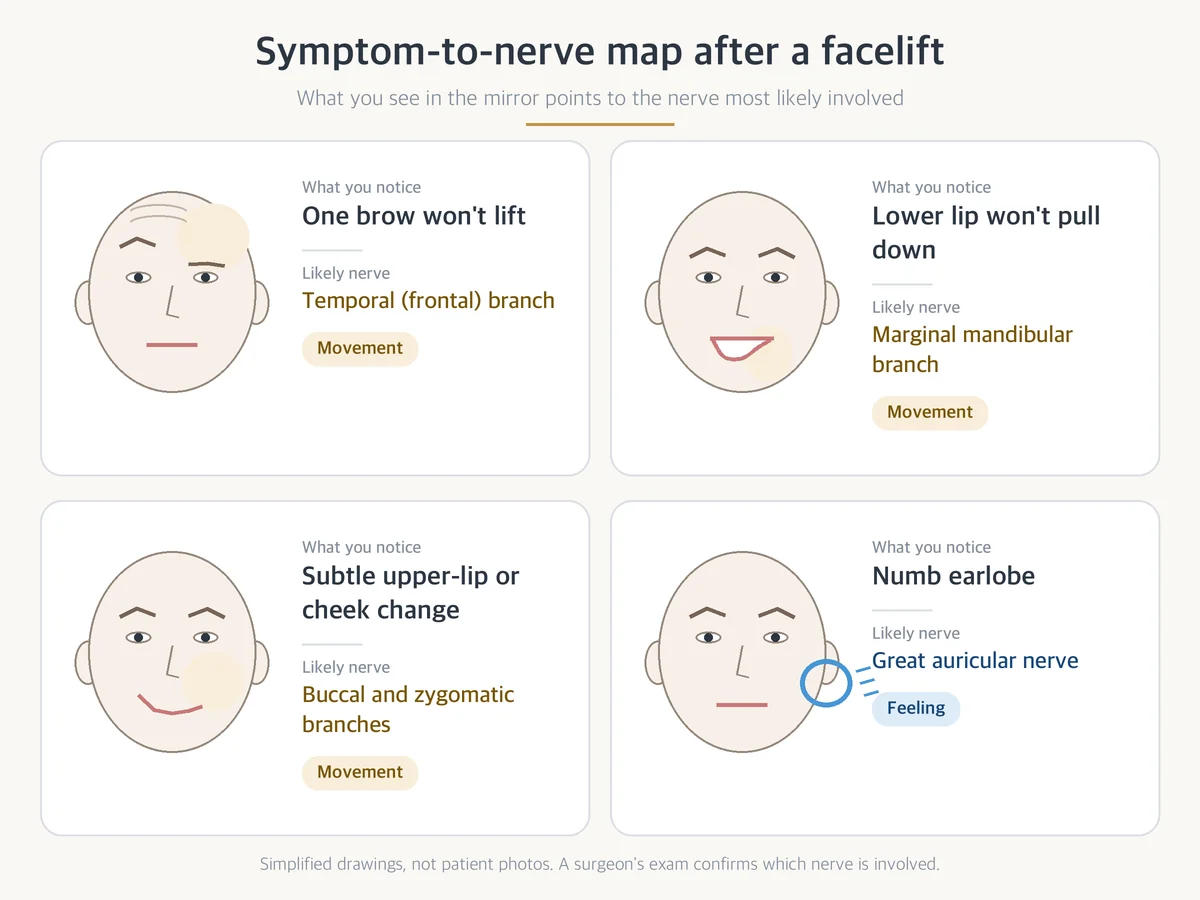
| What you notice | Likely nerve | Movement or feeling? | Typical outlook |
|---|---|---|---|
| One brow won’t lift; forehead won’t wrinkle on one side | Temporal (frontal) branch | Movement | Usually temporary; can be slower because this branch has little backup |
| Lower lip won’t pull down; uneven smile when showing lower teeth | Marginal mandibular branch (or platysma pseudoparalysis) | Movement | Usually temporary; more noticeable, as this end branch has few cross-connections |
| Subtle change in upper lip or cheek when smiling | Buccal and zygomatic branches | Movement | Rarely lasting, because these branches cross-connect |
| Numb earlobe, lower ear and skin around the ear | Great auricular nerve | Feeling | Usually improves over months; a painful lump needs a check |
| Numbness on the outer cheek | Zygomaticofacial sensory branch | Feeling | Part of expected flap numbness that usually recovers |
Brow Won’t Lift on One Side: Temporal (Frontal) Branch
An eyebrow not moving after a facelift usually points to the temporal branch. This branch crosses the temple over the cheekbone arch, where it lies fairly close to the surface. When it is stunned, the forehead on that side stays smooth and the brow may sit a little lower.
Brow-lift literature describes temporary weakness of this branch as relatively common and permanent damage as rare, with watchful waiting as the standard approach. If you are researching upper-face surgery, our guide to the endoscopic forehead lift explains how this same branch is protected there.
Uneven Smile or Lower Lip Won’t Pull Down: Marginal Mandibular Branch
An injury to the marginal mandibular nerve after a facelift shows up as an asymmetrical smile, most clearly when you show your lower teeth. On the weak side, the lower lip doesn’t pull down and out, so the smile looks lopsided. This is particularly obvious in people with a wide, “full denture” smile.
The marginal mandibular branch runs along the jawline. During facelift flap dissection it tends to take more stress than the temporal branch. Before assuming it is the nerve, though, a surgeon will also consider platysma pseudoparalysis, explained in the next section.
Subtle Upper-Lip or Cheek Smile Change: Buccal and Zygomatic Branches
Published facelift series name the buccal branch as the one injured most often during a facelift. The good news is that it rarely leaves a lasting problem. Buccal and zygomatic branches form a network of cross-connections, so when one small twig is stunned, neighboring twigs can take over. Many minor changes here are so subtle that patients never notice them.
By contrast, the temporal and marginal mandibular branches are “end” branches with very few connections to the rest of the nerve. That is why weakness in the brow or lower lip is more noticeable and can be slower to recover.
Numb Earlobe After Facelift: Great Auricular Nerve
Plastic surgery textbooks identify the great auricular nerve as the nerve most commonly injured in facelift and neck lift surgery. It sits just under the skin about 6.5 cm below the ear canal, running over the large neck muscle that turns the head. Injury causes numbness of the earlobe, the lower ear and the skin in front of and behind the ear.
Because this nerve only carries feeling, a numb earlobe after a facelift does not affect your expression. If the nerve was cut, a small, tender lump called a neuroma (a tangle of regrowing nerve fibers) can occasionally form and cause pain. That is a reason to see your surgeon, not a reason to panic.
Uneven Smile After Facelift and Neck Lift: When It Is Not the Facial Nerve
Platysma pseudoparalysis is a lower-lip weakness that looks like a nerve injury but is caused by surgery on the neck muscle itself, with the marginal mandibular nerve still working. It matters because it changes the outlook and the explanation you should expect.
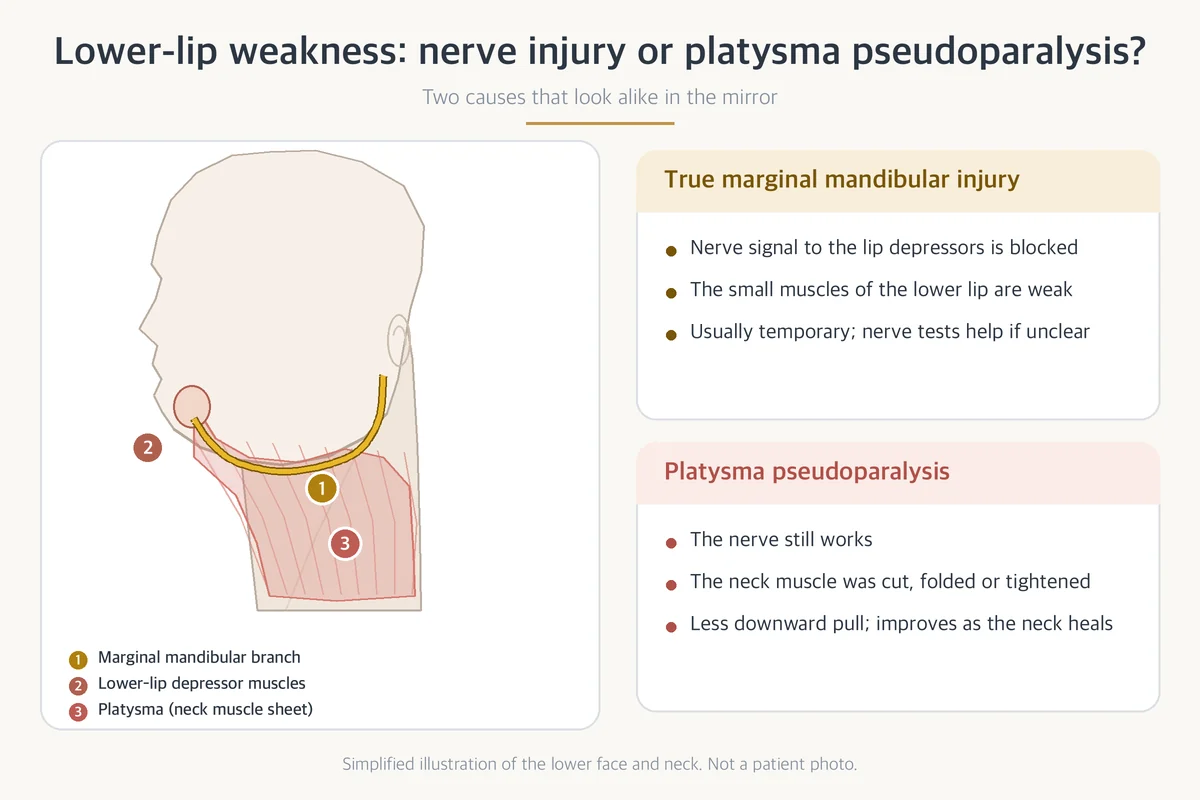
Platysma Pseudoparalysis: Why Neck Muscle Surgery Can Mimic a Nerve Injury
The platysma is a thin sheet of muscle that runs from the collarbone up over the jawline. It helps pull the corner of the mouth and lower lip downward. In a neck lift or a facelift with neck tightening, surgeons often cut, fold or tighten this muscle to sharpen the jawline.
When that happens, the lower lip can lose some of its downward pull even though the nerve is fine. The result looks very similar to a marginal mandibular injury. To give a sense of scale, one long-running clinical series of 1,499 facelifts reported pseudoparalysis in 16.5% of patients during a specific period when the surgeons were removing a large part of the platysma, and permanent lower-lip dysfunction in 0.9%. That figure reflects one technique in one period, not a general rate.
For a wider view of neck surgery risks, see our article on neck lift side effects.
How Doctors Tell the Two Apart
A surgeon looks at the specific muscles that move the lower lip and at how the neck muscle behaves when you tense it. With a true marginal mandibular injury, the small depressor muscles of the lower lip itself are weak. With pseudoparalysis, those lip muscles work but the platysma’s contribution is reduced. In unclear cases, nerve testing can help.
Pseudoparalysis usually improves as the neck heals and the tissues soften. Knowing which of the two you have helps set realistic expectations for the weeks ahead.
How Long Does Facial Nerve Weakness After Facelift Last? Recovery Timeline
The recovery timeline for facial nerve weakness after facelift depends mainly on the cause: hours for anesthetic, days to weeks for a stunned branch, and up to about 6 months for slower recovery of an intact nerve. Numbness follows its own, longer clock.
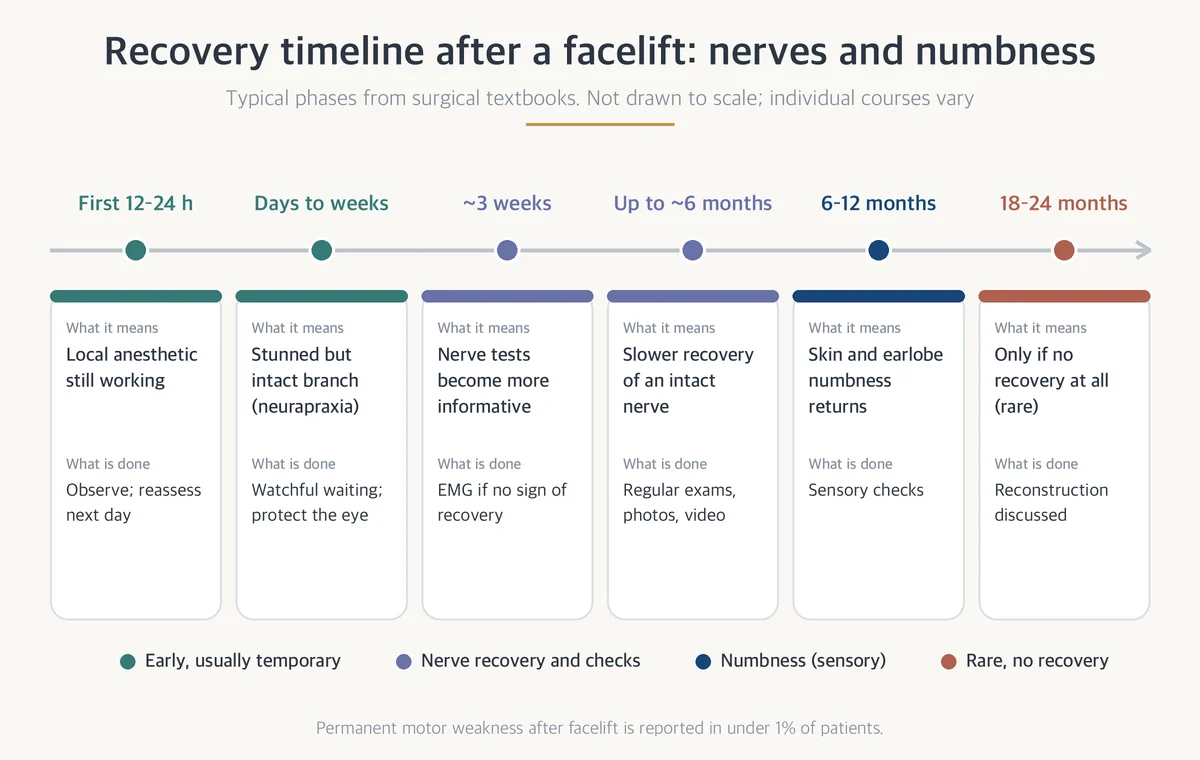
| Time after surgery | What it usually means | What is usually done |
|---|---|---|
| First 12–24 hours | Local anesthetic still working | Observe; reassess the next day |
| Days to weeks | Neurapraxia (stunned but intact branch) | Watchful waiting; protect the eye if closure is weak |
| Around 3 weeks | Nerve tests become more informative | EMG if there is no sign of recovery |
| Up to about 6 months | Slower recovery of an intact nerve | Regular exams with photos and video |
| 6–12 months | Skin and earlobe numbness gradually returns to normal | Sensory checks; look for a painful lump |
| 18–24 months | Relevant only in the rare case with no recovery | Reconstructive options are discussed |
First 12–24 Hours: Anesthetic Effect
Surgical textbooks note that long-acting local anesthetic can last about 12 hours. Weakness on the evening of surgery, therefore, says very little about the nerve itself. The useful assessment comes the next day, once the numbing medicine has worn off.
Days to Weeks: Stretched or “Stunned” Branches (Neurapraxia)
Weakness that persists after the anesthetic wears off is most often neurapraxia. Think of it like a garden hose that has been kinked: nothing is broken, but the flow is blocked until the kink relaxes. In my clinical experience, this type of weakness typically resolves over days to several weeks.
Up to About 6 Months: Slower Recovery of an Intact Nerve
According to surgical textbooks, postoperative paralysis with a known intact nerve usually recovers within about 6 months. The end branches, temporal and marginal mandibular, may take longer than the cross-connected buccal branches. Plastic surgery textbooks report permanent motor paralysis of any degree after a facelift in under 1% of patients.
Earlobe and Skin Numbness: 6–12 Months
Plastic surgery textbooks state that numbness from divided small skin nerves usually recovers completely within 6 to 12 months. Some numbness of the lifted skin is expected after every facelift, because tiny sensory branches are divided when the skin is raised. You can read more about how long numbness lasts after plastic surgery in our general guide.
When 18–24 Months Matters
Textbooks note that reconstructive options differ for paralysis lasting less than versus more than 18–24 months, because muscles that have gone without a nerve signal for a long time respond differently to repair. This only concerns the rare patient whose facial nerve weakness after facelift shows no recovery at all, but it is why regular follow-up, rather than waiting indefinitely, is important.
What Gets Checked: Exam, Grading Scales and Nerve Tests
Checking facial nerve function after surgery means a structured, branch-by-branch examination of the face at rest and in motion, a grading scale to track change, and, only when needed, electrical nerve tests. Here is what that looks like in practice.
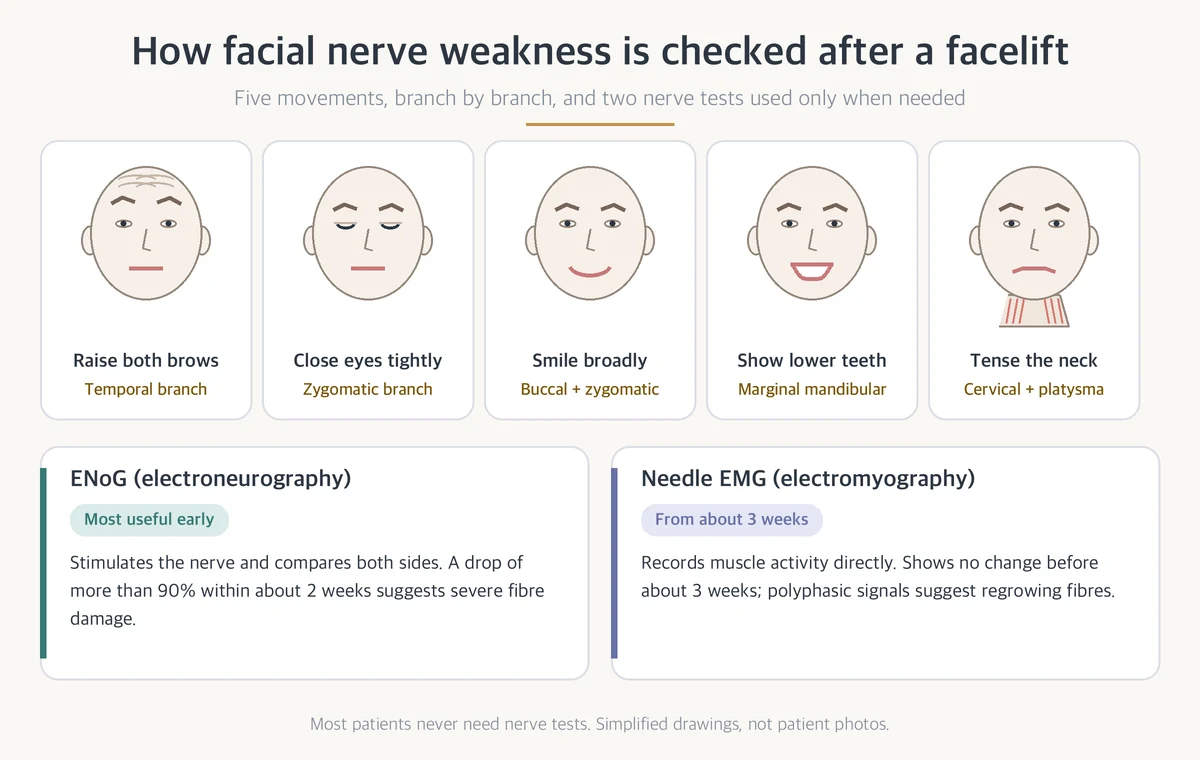
Branch-by-Branch Exam at Rest and in Motion
At follow-up, what I check first is how each region moves from top to bottom. I ask patients to:
- Raise both eyebrows (temporal branch)
- Close the eyes tightly (zygomatic branch)
- Smile broadly (buccal and zygomatic branches)
- Show the lower teeth or pull the lower lip down (marginal mandibular branch)
- Tense the neck as if grimacing (cervical branch and platysma)
If you are recovering abroad, you can do the same five movements at home. Film a short, front-facing video in good, even light every week or two. Side-by-side clips are often more reliable than memory for spotting gradual improvement, and they make a remote review far more useful.
Grading Scales: House-Brackmann vs. Sunnybrook and eFACE
The House-Brackmann scale grades facial movement from I (normal) to VI (no movement), but it rates the whole side of the face. It was not designed for single-branch weakness, though, which is the usual pattern after a facelift. The Sunnybrook and eFACE scales score each region separately and capture this kind of segmental weakness better.
ENoG and EMG: What Nerve Tests Show and When
Most patients with facial nerve weakness after facelift never need nerve tests. When they are used, timing matters:
- ENoG (electroneurography) stimulates the nerve and compares the muscle response on both sides. It is most useful early. Textbooks describe a drop of more than 90% within about 2 weeks as a sign of severe nerve fiber damage.
- Needle EMG (electromyography) records muscle activity directly. Textbooks note it shows no change until about 3 weeks after a nerve injury, so it is used only when there is no recovery by then.
EMG can also bring good news. Small, complex signals called polyphasic potentials suggest that nerve fibers are regrowing into the muscle, sometimes before any movement is visible. One caution: recovery figures from Bell’s palsy studies are often quoted online, but Bell’s palsy is a different condition and its numbers should not be applied to facelift patients.
Sensory Mapping for the Ear and Cheek
For numbness, the surgeon lightly touches the earlobe, the skin around the ear and the cheek, and marks where feeling is reduced. Repeating this at each visit shows whether the numb area is shrinking, which is the usual pattern.
Treatment Options and When to Contact Your Surgeon Right Away
Treatment of facial nerve weakness after facelift is, in most cases, careful observation with supportive care, because the large majority of stunned branches recover on their own. Surgery is reserved for the uncommon situation in which a branch is known to be cut.
Watchful Waiting and Supportive Care
For most patients, the plan is simple: regular follow-up exams, photos and video to track change, and time. If the eye does not close fully, protecting it matters, for example with lubricating drops during the day and taping or an ointment at night as advised by your doctor. Supportive care does not speed up nerve healing itself, but it protects the face while the nerve recovers.
If a Branch Was Known to Be Cut: Immediate Repair
Surgical textbooks advise that if a branch is knowingly divided during a facelift, it should be repaired immediately, during the same operation. Injuries to the temporal and marginal mandibular branches are repaired whenever possible, because loss of these branches is so noticeable. The same principle applies to the great auricular nerve: if it is cut during surgery, repair at that time is recommended.
Contact Your Surgeon Promptly If…
Do not wait for a scheduled visit if you notice any of the following:
- You cannot close your eye fully, or the eye becomes red, dry or painful
- Weakness is getting worse rather than better, or a new area becomes weak
- A new, painful lump appears near the ear or along the neck (possible neuroma)
- Swelling on one side is rapidly increasing or feels tight and painful
- Weakness appears suddenly days after surgery when movement had been normal
If you are back home after surgery abroad, see a local doctor in person for any of these signs, and send your surgeon your videos at the same time. The American Society of Plastic Surgeons’ facelift safety guide is also a useful reference while you recover.
Lowering the Risk: Anatomy, Dissection Plane and Surgeon Experience
Lowering the risk of facial nerve weakness after facelift comes down to precise anatomical knowledge: knowing exactly where each branch runs and at what depth, and adjusting the dissection around those areas. No technique removes the risk entirely, but careful planning keeps it low.
Danger Zones Surgeons Map Before Operating
Plastic surgery literature describes facial “danger zones,” the spots where nerve branches run close to the surface and are most exposed. Three matter most in a facelift:
- The temple over the cheekbone arch, where the temporal branch crosses
- The jawline, where the marginal mandibular branch runs
- The side of the neck below the ear, where the great auricular nerve lies just under the skin
Deeper dissection planes can carry more risk of temporary neurapraxia because the surgeon works closer to the nerve branches. In practice, though, how well the surgeon knows the anatomy matters more than the name of the technique. One surgeon’s early series with an extended deep technique reported temporary lower-lip weakness that recovered fully and stopped after the dissection over the jaw was changed. That single experience shows how technique details, not labels, drive risk.
Questions to Ask Before a Facelift
- How do you protect the facial nerve branches in the areas you will be working on?
- What layer of tissue will you be lifting, and why for my face?
- Will my neck muscle be tightened or cut, and what could that mean for my lower lip?
- How is follow-up handled, and who do I contact if I notice weakness after I return home?
- Can I send photos and videos for remote review during recovery?
Clear answers to these questions are a good sign of a careful surgical plan. You can learn how we approach this on our face and neck lift page.
Frequently Asked Questions About Facial Nerve Weakness After Facelift
How long does facial nerve weakness after facelift last?
It depends on the cause. Anesthetic weakness wears off within about 12 hours. A stunned branch usually recovers over days to weeks, and textbooks note that an intact nerve usually recovers within about 6 months. Permanent motor paralysis of any degree is reported in under 1% of patients.
Why can’t I raise one eyebrow after my facelift?
This usually involves the temporal (frontal) branch of the facial nerve, which crosses the temple. In most cases the branch has been stretched rather than cut, and watchful waiting is the standard approach. Because it is an end branch with little backup, recovery can be slower than elsewhere in the face.
Why is my smile uneven after a facelift or neck lift?
A lower lip that won’t pull down usually points to the marginal mandibular branch or to platysma pseudoparalysis, where neck muscle surgery reduces the lip’s downward pull without nerve damage. Subtle upper-lip changes come from buccal branches, which are well cross-connected and rarely leave a lasting problem.
Is a numb earlobe after a facelift permanent?
Usually not. It comes from the great auricular nerve, which carries feeling only, so it does not affect your expression. General skin numbness after a facelift usually recovers within 6 to 12 months. A painful lump near the ear should be checked by your surgeon.
When should nerve tests like EMG be done after a facelift?
Most patients never need them. Needle EMG shows no change until about 3 weeks after a nerve injury, so it is used only if there is no recovery by then. ENoG, which compares both sides, is more useful early when weakness is severe.
What is the difference between nerve weakness and normal numbness after a facelift?
Facial nerve weakness after facelift means a part of your face doesn’t move properly; it involves the facial nerve. Numbness means reduced feeling in the skin and involves sensory nerves. Some numbness is expected after every facelift, while weakness is uncommon. They also recover on different timelines.
Facial nerve weakness after facelift is unsettling, but it is usually temporary, and a clear symptom-to-nerve picture, a realistic timeline and structured checks make the waiting period far easier to manage.
Had a facelift elsewhere and noticing weakness or numbness, or planning a facelift and want to understand the risks? You can book an online consultation with Dr. Lee Sung-wook, board-certified plastic surgeon, through WhatsApp or our website form. Short videos of the five movements described above make a remote review much more useful.
Written and medically reviewed by Dr. Lee Sung-wook, board-certified plastic surgeon, MINE Plastic Surgery, Seoul.
※ This content is for informational purposes only and does not replace professional medical advice, diagnosis, or treatment. Individual results may vary, and side effects may occur. Please consult with a board-certified plastic surgeon for personalized advice.