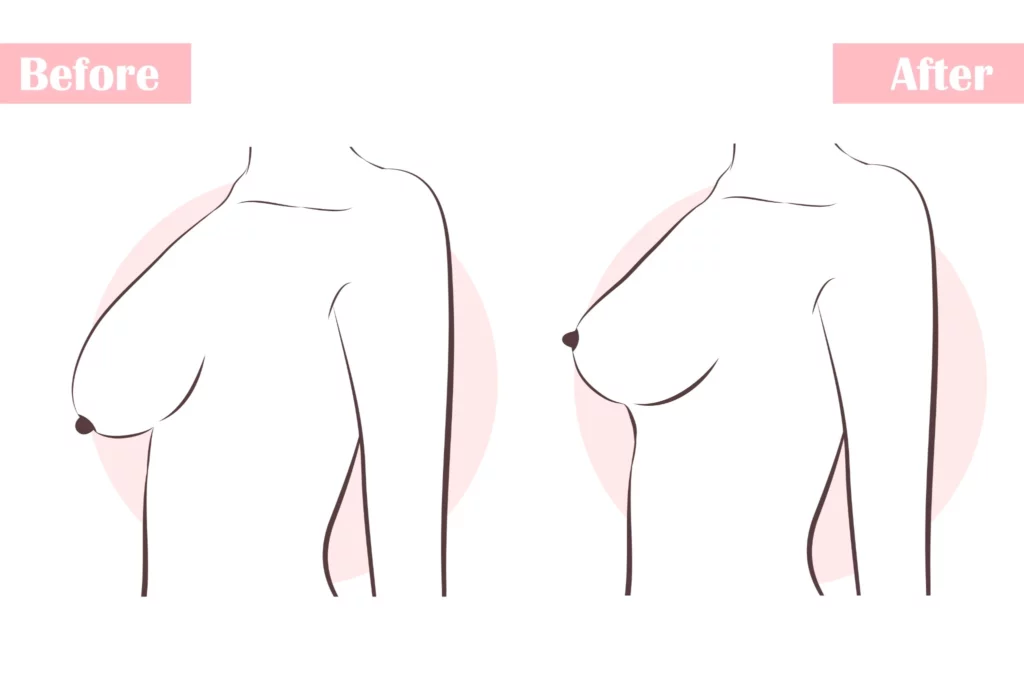
EN
EN

Breast implant replacement is a revision operation in which an existing breast implant is taken out and a new implant is placed, usually in the same procedure and through the original incision. Breast implant removal, or explantation, means the implant is taken out and nothing is put back in. The two decisions are often made together, which is why they are covered side by side here.
Are you considering breast implant replacement or removal? Years after an initial augmentation, the implant, your body, or simply what you want from your result can all change, and any of those can put revision surgery back on the table. Implant lifespan, pregnancy or weight shifts, complications, and a preference for a different size or shape are the usual triggers.
In this comprehensive guide, we’ll explore everything from when breast implant replacement becomes necessary to surgical methods, recovery processes, and important considerations. Everything below is grounded in current surgical practice and imaging guidance, so you can weigh replacement against removal with real numbers rather than impressions.
Table of contents
When and Why You Need Breast Implant Replacement
Breast implants are not lifetime devices. Over the years, several things can make replacement or removal necessary. Let’s look at the main reasons, and at when patients usually start to consider a revision.
Lifespan of Breast Implants and Replacement Timeline
The average lifespan of breast implants is approximately 10-20 years, though this can vary significantly between individuals and implant types. Implants are medical devices rather than permanent body parts, so what matters is periodic monitoring rather than a fixed expiry date. Patient education material from organizations such as the American Society of Plastic Surgeons is a useful starting point, but the follow-up interval that applies to you should be set by the surgeon who knows your implant type, placement, and surgical history.
While implant manufacturers typically recommend replacement every 10 years, it’s not mandatory to replace them at this specific interval. If there are no issues, the replacement timeline can be extended, and regular consultations with your plastic surgeon are crucial to determine the appropriate timing.
Personal Preference Changes for Implant Exchange
Many women consider breast implant replacement due to changing preferences as they age or experience life changes such as pregnancy, breastfeeding, or weight fluctuations. Common reasons include:
- Size modification: Desiring larger or smaller implants
- Shape changes: Switching to a different profile (high profile, moderate profile, etc.)
- More natural appearance: Preferring a more natural look with age
Medical Reasons for Breast Implant Replacement
Medical circumstances that may necessitate breast implant replacement include:
- Capsular contracture: Hardening of tissue around the implant
- Implant rupture or leakage: Detected through MRI or ultrasound
- Implant displacement: Migration or bottoming out of implants
- Asymmetry development: Gradual asymmetry between the breasts
- Pain or discomfort: Ongoing pain or tenderness
Complications and Side Effects of Breast Implants
Breast implant-related complications can be primary reasons for replacement surgery. Let’s explore the main complications and how to recognize them.
Capsular Contracture: The Most Common Breast Implant Complication
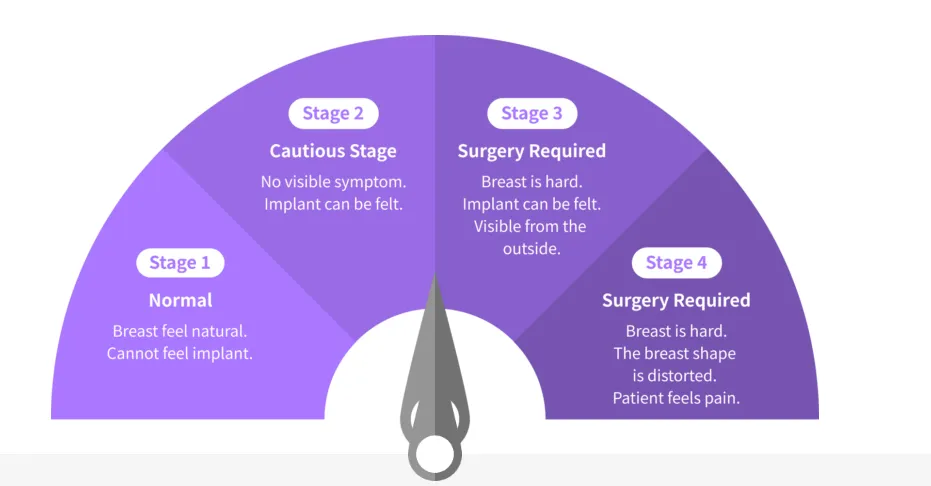
Capsular contracture is one of the most common breast implant complications, occurring when the body recognizes the implant as a foreign object and forms a fibrous capsule around it. When this capsule contracts, symptoms may include:
- Firmness in the breast
- Distortion of breast shape
- Pain or discomfort
- The implant feeling firm or rounded to the touch
Capsular contracture is classified according to the Baker Grade (I-IV), with grades III-IV typically requiring surgical correction.
Implant Rupture and Leakage: Signs and Detection
Symptoms of implant rupture vary depending on the type:
- Silicone implants:
- Often called a “silent rupture”
- Gel may remain within the capsule with minimal symptoms
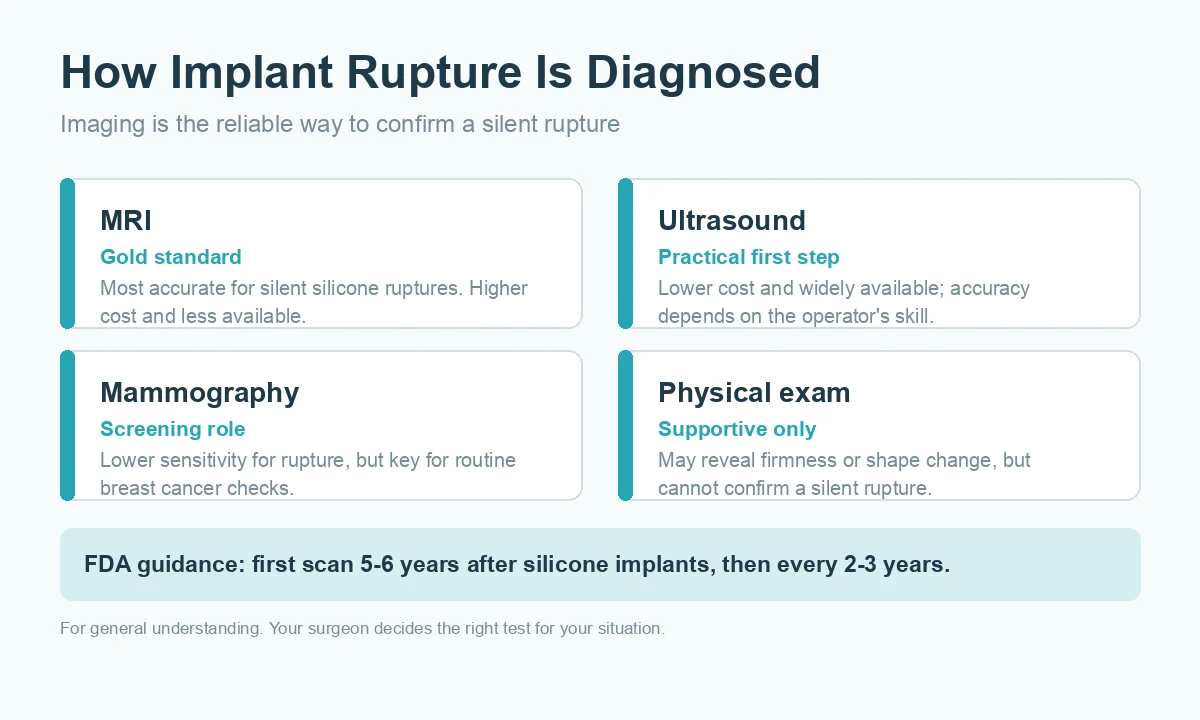
- Requires MRI or ultrasound for detection
- Saline implants:
- When ruptured, saline is absorbed by the body, causing the breast to rapidly decrease in size
- Asymmetry becomes clearly noticeable
- Easier to identify visually
Because a silicone rupture is often silent, imaging is the only reliable way to confirm it. Under current U.S. FDA labeling guidance for silicone gel implants, the first ultrasound or MRI screening is advised 5 to 6 years after surgery, with repeat imaging every 2 to 3 years after that. Screening practice differs between countries, and general patient resources such as the American Society of Plastic Surgeons site are only a starting point, so confirm the schedule that applies to you with your own surgeon.
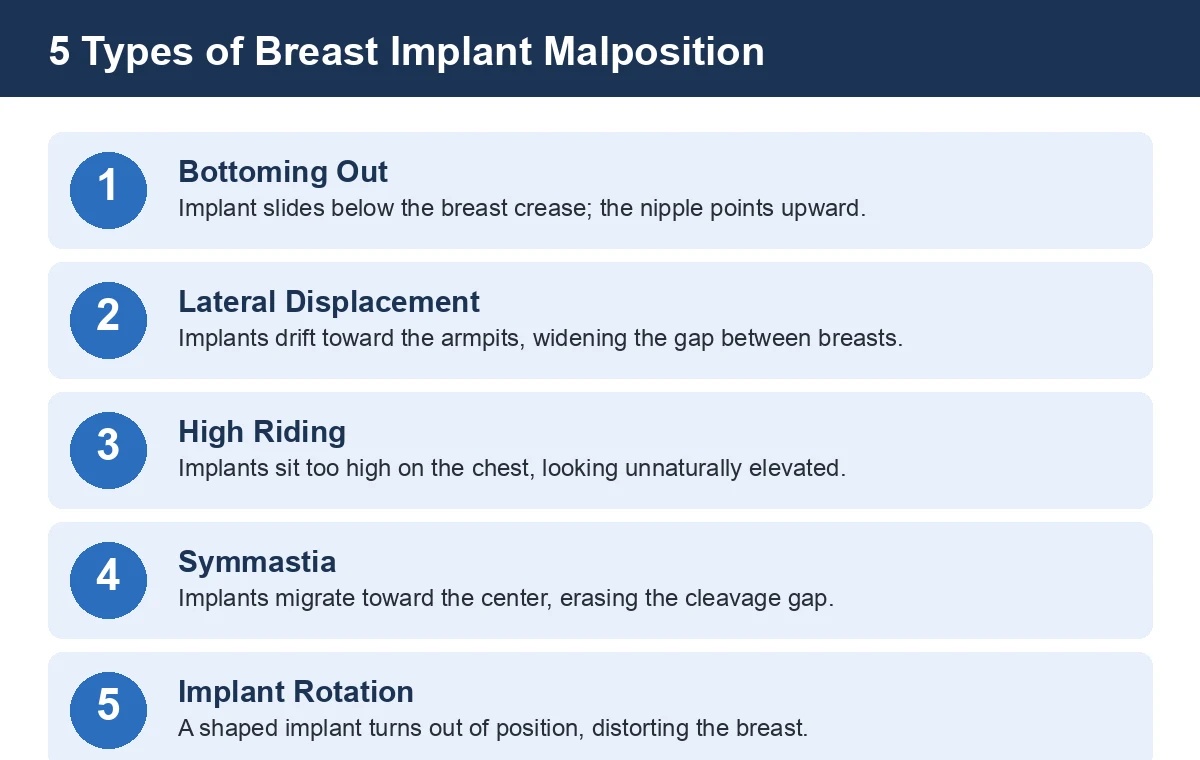
Implant Malposition and Displacement
Over time, the following position abnormalities may occur:
- Bottoming out: Downward displacement of the implant
- Lateral displacement: Movement toward the armpit
- Superior displacement: Upward movement of the implant
- Symmastia: Implants moving toward the center of the chest
These positional changes can result from implant size, tissue characteristics, surgical technique, and other factors.
Breast Implant Replacement Surgery: Process and Methods
Breast implant replacement surgery is similar to the original breast augmentation but with some important differences. Let’s examine the process step by step.
Pre-Surgery Consultation and Planning
The first step for breast implant replacement is consultation with a board-certified plastic surgeon. During this consultation:
- Current implant condition assessment (MRI, ultrasound, etc.)
- Selection of new implant size, shape, and material
- Discussion of surgical approach
- Explanation of expected results and risks
- Review of medical history
Roughly two weeks before surgery, your surgical team will review any medications or supplements that can increase bleeding, such as aspirin, ibuprofen, vitamin E, and some herbal products. Never stop a prescribed medicine on your own – particularly a blood thinner such as warfarin, clopidogrel or a direct oral anticoagulant. Stopping one abruptly carries its own risk, so any change has to be agreed with the doctor who prescribed it and with your surgeon.
Surgical Approaches for Implant Exchange
Breast implant replacement surgery is typically performed through the original incision lines. These original incisions may be:
- Periareolar (around the areola)
- Inframammary fold (under the breast)
- Transaxillary (through the armpit)
Using existing incision lines avoids additional scarring. If your case is a straightforward like-for-like swap rather than a removal decision, our dedicated guide to breast implant exchange surgery goes through implant selection and cost factors in more detail.
The Replacement Surgery Process
Breast implant replacement surgery typically proceeds through these steps:
- Anesthesia: Usually general anesthesia
- Incision: Access through existing incision lines
- Removal of existing implants: Removal of implants and possibly the capsule
- Pocket adjustment: Adjustment of the implant pocket (space) if necessary
- New implant insertion: Placement of the selected new implants
- Closure: Multi-layer tissue closure
- Dressing: Application of compressive dressing
Surgery typically takes 1-3 hours, and many patients can return home the same day.
Capsulectomy Procedures During Replacement
If capsular contracture is present, capsulectomy may be necessary alongside implant replacement. Types of capsulectomy include:
- Partial Capsulectomy: Removal of problematic portions of the capsule
- Total Capsulectomy: Removal of the entire capsule
- Intracapsular Removal: Removal of the implant within the capsule
- Extracapsular Removal: Removal of both capsule and implant together
The extent of capsulectomy depends on the patient’s condition and the surgeon’s assessment.
Aesthetic breast surgery textbooks describe the capsule as living scar tissue rather than an inert lining. That is why the amount removed is a surgical judgment call rather than a fixed rule. A thin, soft capsule is often left alone, because removing it adds operating time, bleeding and tissue trauma without a clear gain. A thick, calcified or contracted capsule is usually taken out, since hardened tissue left behind makes recurrent contracture more likely.
So-called en bloc removal – lifting the implant out while it is still sealed inside its capsule – is normally reserved for cases where an intact silicone rupture or a suspected implant-associated lymphoma makes containment important, and it calls for a longer incision than a routine implant exchange.
Options After Breast Implant Removal
After implant removal, there are three main options: replacement with new implants, reconstruction using your own tissue, or simple removal. Let’s explore each option in detail.
New Implant Selection for Replacement
Many women choose to replace their existing implants with new ones after removal. Key considerations include:
- Implant type: Silicone gel, cohesive gel (“gummy bear”), saline, etc.
- Shape: Round or anatomical (teardrop) shape
- Size: Larger, smaller, or the same size as before
- Surface: Smooth or textured surface
- Position: Subglandular (above the muscle) or submuscular/dual-plane (under the muscle)
When selecting new implants, thorough consultation with your surgeon is essential to choose the optimal option based on your body type, skin elasticity, lifestyle, and goals.
Using Your Own Tissue for Reconstruction
Some women opt for reconstruction using their own tissue instead of artificial implants. Main methods include:
- Fat Transfer:
- Reconstruction using your own fat
- Fat harvested from abdomen, thighs, or other areas through liposuction
- Purified and injected into the breasts
- Provides natural results
- Typically allows up to one cup size increase
- May require multiple procedures
- Flap Surgery:
- Technique primarily used in breast reconstruction
- Uses skin, fat, and muscle from abdomen, back, or buttocks
- Can restore larger volume
- More complex surgery with longer recovery period
Advantages of autologous reconstruction:
- Natural feel and appearance
- No complications associated with artificial materials
- Natural adaptation to weight changes over time
Disadvantages:
- Donor site scarring
- Unpredictable fat survival rate
- Limited increase in volume
Explant Surgery – Simple Removal Without Replacement
Some women choose to return to their natural state after implant removal without replacement. This is called “explantation.”
Post-explantation breast appearance is influenced by:
- Duration of implant use
- Implant size
- Skin elasticity
- Amount of breast tissue
- Age
- Pregnancy/breastfeeding experience
Additional procedures that can be performed with explantation:
- Mastopexy (breast lift): tightens loose skin and repositions the breast
- Skin-tightening treatment: helps firm skin that has lost elasticity
- Internal support techniques: added support to help hold the breast shape
At MINE Plastic Surgery & Dermatology, the consultation is built around each patient’s anatomy, situation, and goals before any option after implant removal is recommended.
Recovery After Breast Implant Replacement or Removal
Recovery after breast implant replacement or removal is generally faster than after initial breast augmentation. However, recovery may be longer if capsulectomy or additional corrective procedures are performed.
Stage-by-Stage Recovery Timeline
Immediately post-surgery to 48 hours:
- Compression dressing or surgical bra worn
- Moderate pain and discomfort (manageable with prescribed pain medication)
- Swelling and bruising may occur
- Only light activities permitted
3 days to 1 week:
- Reduced pain and discomfort
- Dressing replacement or removal
- Showering permitted (following physician’s instructions)
- Return to light daily activities
- Heavy activities and lifting still restricted
2 to 4 weeks:
- Most swelling and bruising reduced
- Keep wearing the compression bra around the clock, unless your surgeon says otherwise
- Return to office work possible
- Light aerobic exercise permitted (walking, etc.)
- Restriction on raising arms above shoulder height
4 to 6 weeks:
- Most daily activities resumed
- Light strength training can begin
- Scars enter maturation phase
- Results begin to stabilize
After 6 weeks:
- Most activity restrictions lifted
- Gradual increase in exercise intensity
- Final results visible after 3-6 months
Tips for Faster Recovery After Implant Exchange
Tips for quick recovery and optimal results:
- Follow your surgeon’s instructions carefully: Recovery guidelines, medication use, activity restrictions
- Sufficient rest: Especially important during the first week
- Proper nutrition: Protein-rich diet, vitamin C and zinc supplements
- Hydration: At least 8 glasses of water daily
- Compression bra wear: For the duration recommended by your surgeon
- No smoking: Avoid smoking at least 2 weeks before and after surgery (to prevent delayed healing)
- Avoid excessive activity: No heavy lifting or strenuous exercise
- Regular check-ups: Attend all follow-up appointments with your surgeon
Warning Signs to Watch For
Contact your doctor immediately if you experience:
- Fever above 38°C (100.4°F)
- Abnormal increase in pain
- Redness with warmth
- Increased drainage or color changes from incisions
- Abnormal swelling or deformation of the breast
- Shortness of breath
These symptoms may indicate infection or other complications requiring immediate medical attention.
Frequently Asked Questions About Breast Implant Replacement
How often should breast implants be replaced?
If there are no issues with your implants, there’s no mandatory timeframe for replacement. While implants typically last 10-20 years, regular check-ups are recommended to monitor their condition. Implants can be maintained as long as no problems arise, based on your surgeon’s assessment.
Is implant rupture dangerous to my health?
Modern silicone implant ruptures generally don’t pose immediate health risks. Cohesive gel implants often contain the gel within the capsule even after rupture. However, if a rupture is detected, you should consult with your surgeon about removal or replacement. Saline implant ruptures result in the saline being absorbed by your body with minimal health risks.
What will my breasts look like after implant removal?
Post-removal breast appearance varies based on several factors:
- Duration of implant use
- Original breast size and skin elasticity
- Age and pregnancy/breastfeeding history
- Weight changes
Typically, skin stretching, sagging, and volume loss may occur. Breast lift surgery or fat grafting can be considered to improve these changes.
Can capsular contracture be prevented?
While capsular contracture cannot be completely prevented, there are ways to reduce the risk:
- Preventive antibiotics given around the time of surgery
- Strict adherence to sterile techniques
- Appropriate surgical techniques (dual-plane, no-touch)
- Post-surgical massage (as directed by your surgeon)
- No smoking
- Following post-operative instructions
Can implants be replaced without capsulectomy?
If the capsule is thin and problem-free, it’s possible to replace implants without capsulectomy. However, capsulectomy is recommended if capsular contracture is present, the capsule is thick, or BIA-ALCL is suspected. The optimal approach should be determined in consultation with your surgeon based on your individual condition.
BIA-ALCL stands for breast implant-associated anaplastic large cell lymphoma. It is a rare lymphoma of the immune system that has been linked mainly to textured-surface implants rather than smooth ones, and it is not breast cancer. It typically appears years after surgery as persistent one-sided swelling or a fluid collection around the implant, and it is generally treatable when it is found early and the implant is removed together with its capsule. Any swelling on one side that does not settle should be examined rather than watched.
Is recovery from replacement surgery faster than the initial surgery?
Generally, recovery from breast implant replacement surgery is often faster than the initial surgery. This is because the pocket has already been formed and the tissues have already stretched. However, recovery may be longer if capsulectomy or additional corrective procedures are performed.
Is fat transfer a good alternative to implants?
Fat transfer can be a good alternative for women seeking a small volume increase or who prefer a natural feel. Advantages include natural feel, no complications related to artificial materials, and using your own tissue. However, there are limitations to the volume increase possible, unpredictable fat survival rates, and multiple procedures may be required.
Breast Implant Replacement: A Decision That Requires Careful Consideration
Breast implant replacement or removal is an important decision that affects your health, appearance, and confidence. As we’ve explored in this guide, there are many factors to consider, including timing, methods, options, and recovery process.
A good outcome usually comes down to three things: doing your research, consulting an experienced specialist, and being clear about what you want. Our complete guide to breast implants goes into implant types, longevity, and safety data in more depth.
At MINE Plastic Surgery & Dermatology, consultations for breast implant replacement and removal are built around your anatomy and your goals. Our board-certified plastic surgeons will also tell you honestly when replacement, explantation, or simply continued monitoring is the more sensible option for you.
If you’re considering breast implant replacement or removal, consult with a specialist at mineclinic for accurate diagnosis and a tailored treatment plan. We’re here to help you make the best choice for your health and beauty.
This article was prepared with reference to standard aesthetic breast surgery texts and to the clinical experience of the board-certified plastic surgeons at MINE Plastic Surgery & Dermatology, Seoul. It describes general patterns, not a treatment plan for any individual.
※ This content is for informational purposes only and does not replace professional medical advice, diagnosis, or treatment. Individual results may vary, and side effects may occur. Please consult with a board-certified plastic surgeon for personalized advice.