EN
EN

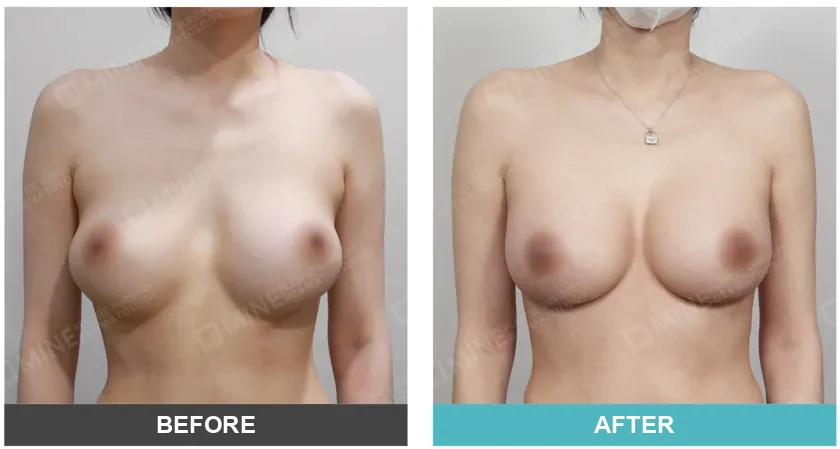
Capsular contracture refers to the hardening and shrinkage of the fibrous capsule that your body builds around a breast implant. Every implant forms a capsule; capsular contracture is what happens when that capsule thickens and squeezes the implant, so the breast feels firm, rides high, changes shape, or aches.
This guide is written for the moment before you have an appointment: you have noticed that something about one breast feels different, and you want a structured way to check it. Below you will find what to look for, a step-by-step self-check you can do at home in about five minutes, how often to repeat it, and the point at which a self-check should become a clinic visit. For the background on why the condition develops and how it is prevented, our complete guide to capsular contracture causes and prevention covers that ground in depth.
Table of Contents
What Capsular Contracture Is, and Why the Signs Appear
When you undergo breast augmentation surgery, your body wraps the implant in a thin layer of scar tissue called a capsule. This is a normal biological response to any foreign object placed in the body, and in most women that capsule stays soft, thin, and completely unnoticeable. Capsular contracture begins when the same capsule lays down excess collagen, thickens, and starts to shrink around the implant.
That shrinking is what produces every sign you can detect yourself. Surgical textbooks describe a clinically significant contracture as excessive scar formation with shrinkage and thickening of the capsule, leading to firmness, distortion, and displacement of the implant — which is exactly the trio you can feel and see at home: hardness, a change in shape, and an implant that has moved. Studies of augmentation patients report capsular contracture rates ranging from roughly 3% to 19% — the range given in Augmentation Mastopexy: Mastering the Art in the Management of the Ptotic Breast is 2.8% to 18.9% — and that is why surgeons ask you to keep checking long after your scars have faded.
There is a second reason self-checking works. Capsular contracture is progressive rather than sudden. The literature separates early capsular contracture — contracture appearing within 1 year of implant placement — from later cases, and early presentations are treated more aggressively. Catching the first change while the breast is only slightly firmer leaves you and your surgeon with more options than waiting until the shape has visibly distorted.
Capsular Contracture Signs to Check For
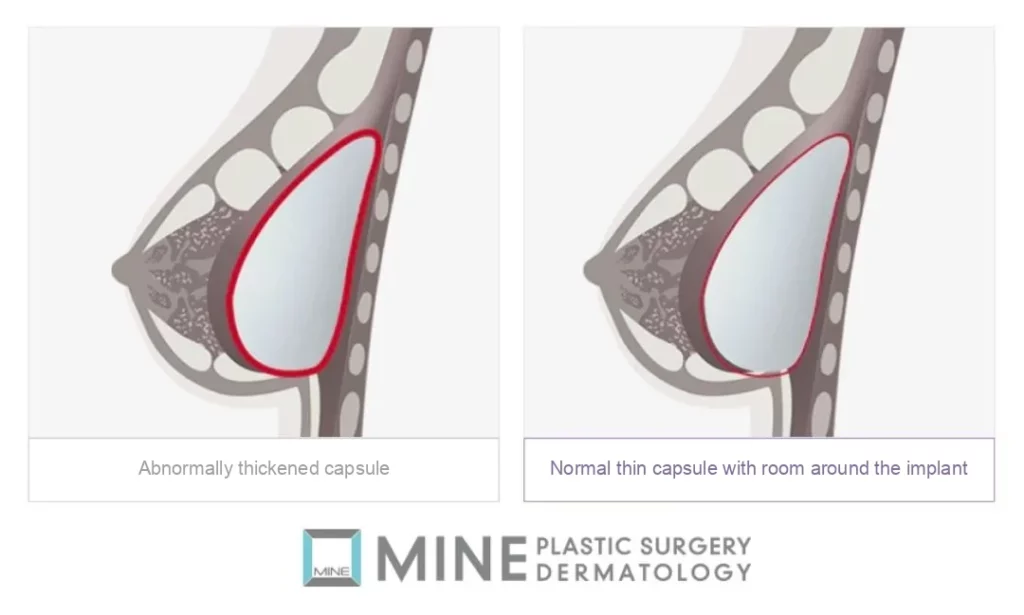
Before you touch anything, know what you are looking for. The signs below are the ones that appear again and again in surgical texts and in our revision consultations, ordered roughly from earliest to latest.
- A firmer feel on one side. The earliest sign of capsular contracture is usually one-sided — one breast is noticeably less soft than the other when you press gently, with nothing visible yet.
- The implant sits higher. A contracting capsule pulls the implant upward, so the lower pole flattens while the upper pole looks fuller. Patients often describe this as the implant “riding high.”
- A rounder, more spherical shape. The capsule squeezes the implant into a ball rather than a teardrop, and the breast can look narrower from the front.
- Visible rippling or distortion. Edges, ridges, or a contour that clearly differs from the other side.
- A change you can see in the mirror, not only feel. Textbook grading treats visible distortion as the line between mild and moderate disease.
- Tightness, discomfort, or pain. Aching that persists, worsens over weeks, or disturbs your sleep. Pain together with visible distortion is the most advanced pattern in the Baker system.
- Loss of natural movement. A soft breast shifts when you lie down or lean forward; a contracted one tends to stay where it is.
No single item on that list confirms capsular contracture. Implant rupture, malposition, and ordinary post-operative swelling can each mimic one of them. What raises genuine suspicion is a pattern that appears on one side and does not resolve over several weeks.
How to Self-Check for Capsular Contracture at Home
A self-check takes about five minutes and needs nothing but a mirror and good light. Do it in the same order every time, because consistency is what lets you notice a small change. Treat it as a screening habit rather than a diagnosis — only an examination by your surgeon can confirm capsular contracture.
- Stand in front of a mirror with your arms at your sides. Look at both breasts together. Note where each nipple sits relative to the fold under the breast, and whether one implant looks higher than the other.
- Raise your arms overhead. Both breasts should move and lengthen. A capsule that has contracted holds its shape and may pull the breast upward with the muscle.
- Compare the side profile. Use a second mirror or a photograph. You are looking for a lower pole that has flattened, or an upper pole that has become unusually full.
- Press gently with the flat of your fingers. Start at the upper inner quadrant and work around the breast, immediately comparing the same spot on the other side. You are judging softness here, not screening for lumps — if you do feel a new lump or an area of thickening, have it examined on its own account rather than filing it under capsular contracture.
- Cup and lift each breast. A soft breast yields and reshapes in your hand. A firm one feels like a single unit that moves as a block.
- Lie down flat and look again. A normal implant flattens and drifts slightly toward the side of the chest. An implant held by a tight capsule stays high and central.
- Record any pain and its pattern. Write down where it is, how strong it is out of ten, and whether it is worse than last month.
- Photograph yourself in the same pose and lighting. Front and both sides, arms down and arms up. Monthly photographs are far more reliable than memory, and they are the single most useful thing you can bring to a consultation.
If one step gives a different answer from last month, repeat the whole check a week later before you worry — unless the change came on suddenly or brings pain, redness, or fever, in which case call your surgeon now rather than waiting. Swelling, hormonal changes, and the normal settling of implants all produce week-to-week variation. A true sign of capsular contracture, by contrast, stays put or slowly worsens.
When to Check: A Month-by-Month Schedule
Timing matters as much as technique, because the risk is not spread evenly across the years after surgery.
| Period after augmentation | How often to self-check | What you are mainly looking for |
|---|---|---|
| Weeks 0–8 | Weekly, gently | Your baseline. Firmness and tightness at this stage are usually normal healing, not capsular contracture. |
| Months 2–6 | Monthly, with photographs | Implants should be softening and settling into the lower pole. Increasing firmness is what to report. |
| Months 6–12 | Monthly | The window textbooks call early capsular contracture. One-sided hardening or a high-riding implant belongs in front of a surgeon. |
| Year 2 onward | Every 2–3 months | Late contracture, rupture-related change, and slow drift in shape. |
Do not wait for the next scheduled check if firmness appears suddenly, if one breast changes shape within days, if pain is new and escalating, or if you develop redness or fever. Those patterns can point to bleeding or infection rather than capsular contracture, and both are time-sensitive.
Baker Grades: Matching What You Feel to a Grade
Surgeons describe capsular contracture with the Baker grading system, first set out in the surgical literature in 1977 and still the common language of a revision consultation. It has four grades, and it is built almost entirely from what a clinician feels and sees — which means you can place yourself on it, at least approximately.
| Baker grade | What a surgeon records | What you are likely to notice |
|---|---|---|
| Grade I | Soft capsule, no visible distortion | Nothing at all. The breast feels as soft as one that has never been operated on. |
| Grade II | Firm on palpation, no visible distortion | The implant can be felt and the breast is less soft than the other side, but it still looks normal in the mirror. |
| Grade III | Firm on palpation with visible distortion | Firmness you cannot ignore, plus a rounder, higher, or narrower shape that other people may notice. |
| Grade IV | Firm and visibly distorted, with discomfort | All of the above, together with pain that persists. |
Two cautions come with that table. First, grading is a clinical judgment: a published analysis in the plastic surgery literature concluded that the Baker classification is unreliable as a standalone diagnostic tool, because different examiners grade the same breast differently. Use it to organize what you noticed, not to decide your own treatment. Second, the treatment threshold for capsular contracture generally sits at Grades III and IV; textbooks describe those grades as the ones for which surgical treatment is indicated, while Grades I and II are usually monitored.
Signs That Are Not Capsular Contracture
Half the value of a structured self-check is ruling things out. Several situations produce one or two of these signs without being capsular contracture at all.
Implants that have not finished settling. For the first three to six months, implants sit high and feel tight while the tissues relax around them — the process patients call drop and fluff. Our drop and fluff timeline sets out what normal settling looks like month by month, which is the comparison most people are missing.
Implant rupture. A silicone rupture can change the shape of a breast and occasionally its firmness, but the accompanying signs differ and imaging usually settles the question. Our guide to breast implant rupture symptoms lists the features that separate the two.
Malposition. An implant that sits too high, too low, or too far to the side may point to a pocket problem rather than a capsule problem, and the correction is different. See our guide to breast implant malposition for how those cases present.
If your findings match one of these instead, the next step changes completely. That is precisely why a self-check should end with a consultation rather than with a conclusion.
When Capsular Contracture Signs Mean You Need Capsule Removal
Most capsular contracture that is caught early is monitored rather than operated on. Capsule removal enters the conversation once the signs reach a threshold, and there are a few clear scenarios. Whether the capsule itself has to come out during surgery is a separate decision with its own trade-offs, which we cover in detail in our article on whether the capsule needs to be removed during revision surgery.
Advanced capsular contracture (Baker Grade III–IV). When the capsule has become thick and hard enough to cause pain or visible distortion, complete removal — a capsulectomy — is typically recommended. Textbooks note that capsulectomy is often effective in advanced Grade IV disease, particularly when the implant is exchanged at the same time. At Mine Clinic we grade contracture severity at consultation before proposing an approach.
Rupture, chronic inflammation, or infection. If a silicone implant has ruptured, removing the whole capsule helps clear residual gel from the surrounding tissue. Persistent inflammation or infection inside the capsule calls for the same thorough approach, because leaving affected tissue behind compromises healing around a new implant. For early capsular contracture within the first year, the literature recommends managing the problem much like a low-grade implant infection: total capsulectomy, systemic antibiotics, a freshly created pocket, and a new device.
Pocket change and aesthetic distortion. Moving from a subglandular to a submuscular position, or correcting the rippling, asymmetry, and unnatural shape caused by a distorted capsule, may call for partial removal or release rather than complete capsulectomy. Reviews of revision breast surgery describe careful capsule management as a significant contributor to long-term satisfaction, and a 2021 article in Aesthetic Plastic Surgery sets out where prevention and treatment of capsular contracture currently stand. For a plain-language overview, the American Society of Plastic Surgeons publishes a patient page on breast implant revision.
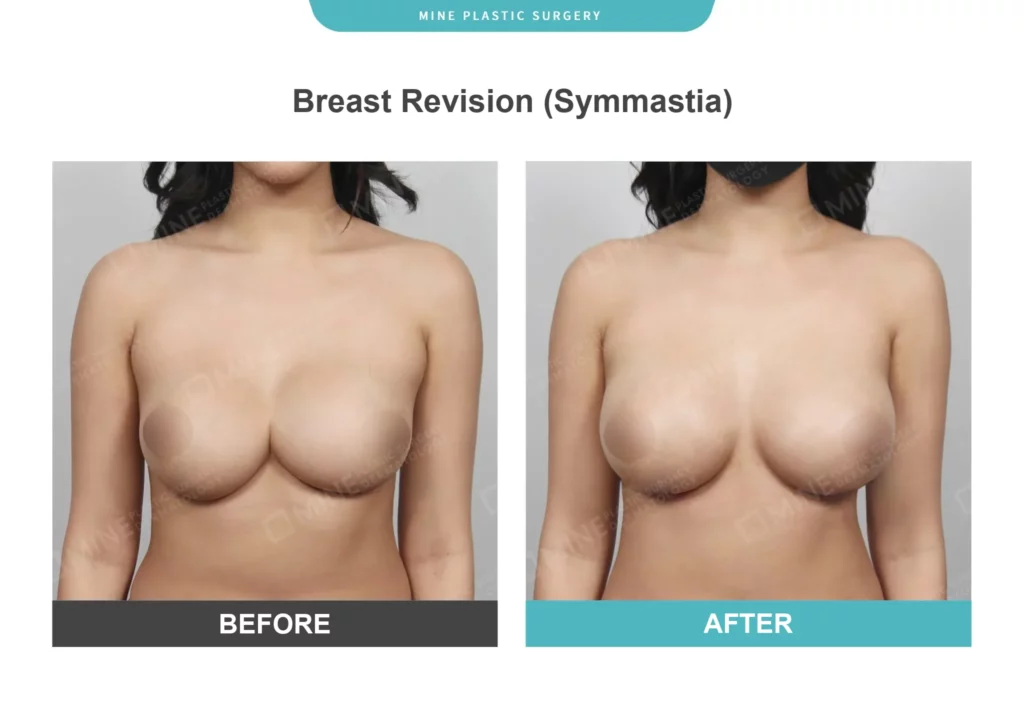
The Capsule Removal Procedure at Mine Clinic
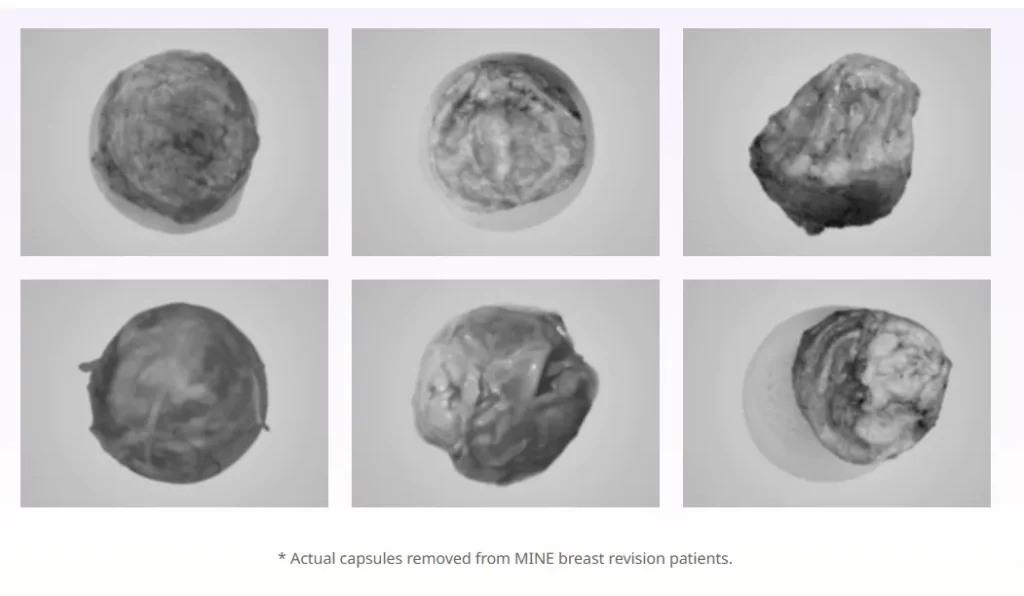
Mine Clinic uses Korean revision techniques built around precision and tissue preservation. Before surgery, Dr. Lee Sung-wook reviews imaging — ultrasound or MRI — to assess capsule thickness, implant integrity, and tissue quality, and the operative plan follows from that assessment rather than from the grade alone.
| Technique | What is done | Typically chosen for |
|---|---|---|
| Complete capsulectomy | The entire capsule is removed along with the implant | Severe capsular contracture, implant rupture, or infection |
| Partial capsulectomy | Only the problematic portions are removed; supportive areas are preserved | Localized thickening with an otherwise healthy capsule |
| Capsulotomy | The capsule is scored or released without being removed | Milder contracture where capsule quality is good |
| En bloc removal | Implant and capsule are taken out together as one unit | Ruptured silicone implants or suspected contamination |
HD endoscopic visualization lets the surgeon work inside a confined pocket with less tissue trauma and less bleeding. The procedure usually takes two to three hours depending on complexity, and our international service team builds the surgical schedule around your stay in Seoul.
Why Choose Korea for Breast Revision Surgery
A large share of Korea’s revision breast surgery is concentrated in Seoul’s Gangnam district, and case volume is what builds judgment about difficult capsules. At Mine Clinic, our surgeons work routinely with the full range of implant types, capsule conditions, and previous-surgery histories that international patients arrive with. HD endoscopy and modern imaging are standard rather than optional here, and Korean aftercare culture adds daily post-operative support, professional wound care, and lymphatic massage for the days you are in the city.
Cost is usually lower than it is for comparable revision surgery in Western countries, and Seoul’s medical tourism infrastructure — translation, accommodation, transport — is mature. Our international service team handles the logistics so that your attention stays on recovery.
Risks, Side Effects & Safety Considerations
Swelling and bruising peak in the first week and settle over three to four weeks. Tightness and mild discomfort are expected while tissue heals around a new implant, and temporary changes in nipple sensitivity usually resolve over several months as nerves recover.
The complications worth knowing about are bleeding or hematoma, infection, implant malposition once supportive capsule tissue has been removed, asymmetry that becomes more visible after removal, and recurrent capsular contracture — because a new capsule always forms and can harden again. Careful pocket creation, compression garments, internal suturing, and a closely monitored early recovery are what keep those risks down. Our safety standards include board-certified anesthesiologists, real-time monitoring, and accredited surgical facilities.
Breast revision with capsule removal is a significant operation, and Dr. Lee Sung-wook uses the consultation to assess candidacy, set realistic expectations, and screen for contraindications before anything is scheduled.
Recovery Timeline in Seoul
Plan on 10 to 14 days in Seoul. Days 1–3 are spent at our partnered recovery facility with 24-hour nursing care, and drainage tubes, if they were placed, come out within two to three days. Daily check-ups continue through the first week, non-dissolvable sutures are removed around day seven, and clearance for the flight home is usually given between days 7 and 10.
Swelling continues to subside through weeks 2–4 as the breast shape settles, and most patients return to full activity, including exercise, during months 2–3. Final shape and scar maturation take 6 to 12 months, and follow-up imaging may be recommended to confirm implant position and healthy capsule formation. Remote follow-up continues by video consultation, and our location in Gangnam keeps accommodation and transport straightforward.
Frequently Asked Questions
How Do I Know If I Have Capsular Contracture?
You cannot confirm it on your own, but you can build a strong case for the consultation. Compare both breasts for firmness, position, and shape, repeat the same check monthly with photographs, and look for a one-sided change that lasts more than a few weeks. Firmness alone suggests an early grade; firmness with visible distortion, or firmness with pain, is what moves capsular contracture into the grades that are usually treated.
How Early Can Capsular Contracture Signs Appear?
It varies from patient to patient. Surgical texts define early capsular contracture as contracture occurring within 1 year of implant placement, and that first year is when most reported cases declare themselves — which is why monthly self-checks matter most between month two and month twelve. Contracture can still develop years later, so a check every two to three months after the first year is sensible.
Can You See Capsular Contracture on an Ultrasound?
Partly. Ultrasound can measure how thick the capsule is, and researchers have looked at whether that thickness predicts how severe a contracture is — a 2022 study in Aesthetic Plastic Surgery compared capsule thickness on breast ultrasound with the Baker grade. It is also the first-line test when rupture is suspected. Treat it as a supporting tool rather than the diagnosis itself, since the grade is still assigned by physical examination; MRI is added when rupture, or a more complicated capsule problem, needs to be ruled out.
How Do I Tell Normal Healing Firmness from Capsular Contracture?
By direction and by timing. Firmness in the first six to eight weeks is ordinary healing, and it should ease month by month as the implants settle into the lower pole. Contracture moves the other way: a breast that had already softened becomes firmer, higher, or rounder over weeks or months, and the change is usually on one side only. A reversal like that — softer, then firmer again — is the pattern worth reporting, which is why the monthly photographs matter more than any single examination.
What Does It Mean If Only One Breast Feels Firm?
It is the most useful single finding a self-check can produce. Both breasts heal in the same body, under the same hormones and the same aftercare, so a difference between them usually has a local cause. That cause is not always a contracting capsule: a hematoma, an implant that has shifted within its pocket, or a rupture can each affect one side alone. Note the date you first felt it and whether it is still changing, and take that to your surgeon instead of waiting for the other side to catch up.
How Should I Take Self-Check Photos, and What Do I Compare?
Use the same four frames every month: front with your arms down, left profile, right profile, and front with your arms raised. Stand in the same place, at the same distance, in the same light, without a bra, and put the date in the file name. What you compare between months is where each nipple sits relative to the fold under the breast, how full the upper pole looks, and how wide each breast is at its base. Two photographs a month apart show slow changes that a mirror hides, and they give your surgeon a dated record to work from.
Can I Keep My Capsule If It Looks Healthy?
In some cases, yes. If your capsule is thin and soft and you are simply changing implant size or type without complications, your surgeon may preserve it for the structural support it provides. Partial scoring or release may still be needed so that the new implant sits correctly. Dr. Lee Sung-wook makes that determination during surgery, based on how the capsule actually looks and feels.
How Does Capsule Removal Affect Recovery Time?
Complete capsule removal typically adds one to two weeks to recovery compared with a straightforward implant exchange. The extra dissection means more tissue to heal, so swelling and discomfort are greater at first. In cases where the capsule is genuinely the problem, though, removing it thoroughly tends to produce better long-term comfort and a better shape.
Questions that sit on the other side of that decision — whether the capsule itself has to come out, what removing it adds to the cost, and whether fat grafting can take the place of an implant afterward — are answered in our guide to whether the capsule needs to be removed during revision surgery.
Conclusion
Checking for capsular contracture is a habit rather than an event. Five minutes in front of a mirror once a month, in the same order every time, with a photograph to compare against — that is the entire protocol, and it is what turns a vague sense that something feels different into a specific, dated observation your surgeon can act on.
If your self-checks keep pointing the same way, bring the photographs and your notes to a consultation rather than waiting for the shape to change further. Mine Clinic’s experience with complex revision, together with Korea’s surgical technology and structured aftercare, makes Seoul a practical choice for patients who need capsule management handled thoroughly. For more on related procedures, explore our breast surgery blog.
Concerned about capsular contracture after your augmentation? Contact Mine Clinic today for a personalized online consultation. We are ready to assist you on WhatsApp and to guide you through your K-Beauty journey in Seoul. Visit our online consultation page or book your appointment to begin.
※ This content is for informational purposes only and does not replace professional medical advice, diagnosis, or treatment. Individual results may vary, and side effects may occur. Please consult with a board-certified plastic surgeon for personalized advice.
Reviewed by Dr. Lee Sung-wook, Board-Certified Plastic Surgeon at Mine Clinic