EN
EN


Drop and fluff is the name patients give to the settling process that follows breast augmentation: implants that sit high and firm in the first days gradually descend into the lower breast, while the tissue above them relaxes and softens. Surgeons describe the same events in clinical language — implant settling, soft tissue relaxation, and capsule maturation — but the patient phrase captures it well, because the breast really does drop into position and then fluff out along the bottom.
Table of Contents
What Is Drop and Fluff in Breast Augmentation?
If you have just had breast implants, or you are still researching the procedure, you have probably come across the phrase drop and fluff. It sounds informal, and that is exactly what it is: a term coined by patients rather than by surgeons. It describes one of the most important and, once you understand it, most reassuring parts of your recovery.
In the first days after surgery, your new breasts sit high and tight on the chest. They may look firmer, rounder, and more “stuck on” than you expected. This is normal. Swelling from the operation and the natural tension in your chest muscles hold the implants in an elevated position. According to the American Society of Plastic Surgeons, implants gradually settle and soften as the muscles relax and swelling subsides over the following weeks and months.
The Two Phases: Drop, Then Fluff
- Drop: The implant gradually descends into the lower part of the breast pocket. Gravity and muscle relaxation allow it to settle into a more natural position at the bottom of the breast.
- Fluff: The breast tissue and skin over the implant relax and expand, filling out the lower pole. The breast becomes softer, the upper area looks less tight, and the overall shape rounds out into a gentle teardrop.
Key Takeaway: A high, tight, firm chest right after surgery is the starting point of drop and fluff, not a complication. Your final shape reveals itself as your body heals, not on the day you leave the operating room.
Why Patients Search for This Phrase
Most people look up drop and fluff because they feel uneasy in the early weeks. The breasts can look too high, slightly uneven, or simply not the shape they hoped for. Knowing that this is an expected phase, and that one side often settles ahead of the other, removes a great deal of anxiety. For the full picture of what happens in the months around it, our complete breast augmentation recovery guide covers the whole journey.
The Science Behind Drop and Fluff
You will not find drop and fluff in a surgical textbook. What you will find are three well-documented processes that, together, produce exactly what patients describe: release and relaxation of the chest muscle, relaxation of the soft tissue pocket, and maturation of the capsule that forms around every implant. Understanding these three makes the waiting far easier.
Muscle Release: Why Implants Start High and Tight
When an implant is placed under the pectoralis major (the large chest muscle that sits over the ribs), the surgeon releases the lower edge of that muscle along the breast crease so the implant has room to sit low enough. Surgical texts describe using trial implants, called sizers, during the operation specifically to confirm that the muscle has been released adequately before the real implant goes in.
Even with a perfect release, a muscle that has just been lifted and stretched does not relax on command. For the first weeks it acts like a firm hand pressing the implant upward. As that tension fades, the implant is free to move down. This is why implants placed under the muscle almost always take longer to settle than implants placed above it.
Soft Tissue Relaxation: What Dropping Really Means
Here is a detail that surprises many patients: the implant is not really traveling anywhere. Breast surgery literature describes the pocket and the surrounding soft tissue as needing to relax before an implant can assume a natural, gently descending shape. The drop half of drop and fluff is your own tissue letting go, not the device sliding down.
The fluff half works the same way. Textbooks on breast reshaping note that breast tissue has to be freed properly from the front surface of the chest muscle so it can re-drape over the implant afterwards. That re-draping is the anatomical reality behind the softer, fuller lower breast you notice around the second and third month.
Capsule Maturation: Why Three Months Keeps Coming Up
Every implant, in every patient, is surrounded by a thin layer of scar tissue called a capsule. This is normal and expected. Plastic surgery texts describe collagen (the structural protein of scar tissue) being laid down progressively over about three months, after which it is organized into stable, well-formed bundles.
That timescale is the real reason the three-month mark appears in almost every drop and fluff discussion online. It is not folklore. It reflects how long the tissue envelope around an implant takes to finish forming, and once it has, the shape it holds is largely the shape you keep.
Key Takeaway: Three separate processes must finish on their own schedule: swelling resolves, muscle and pocket relax, and the capsule matures over roughly three months. None can be safely accelerated, which is why patience genuinely produces the better result.
Drop and Fluff Timeline: 5 Stages, Week by Week
Below is a realistic stage-by-stage guide to drop and fluff. Everyone heals at their own pace, and these are general ranges rather than promises. Implant position, implant size, skin elasticity, and body type all shift the timing.
Stage 1 — Days 1 to 7: High and tight. Your breasts sit high on the chest and feel firm. Swelling and tightness peak in the first few days, then begin to ease. You wear a supportive surgical bra around the clock. Stitch removal usually happens around day 7, which is why international patients plan their stay in Korea accordingly.
Stage 2 — Weeks 2 to 6: The drop begins. As swelling recedes and the muscle relaxes, the implants start to descend. Most international patients are cleared to fly home around 7 to 10 days after surgery, once initial healing and the stitch check are complete. Always confirm your own clearance with your surgeon before booking flights.
Stage 3 — Weeks 6 to 12: Noticeable fluffing. This is where the most visible change happens. The lower breast fills out, the upper pole softens, and the shape starts to look and feel like your own. Many surgeons clear patients for more vigorous exercise around the three-month mark, which lines up with capsule maturation.
Stage 4 — Months 3 to 6: Settling into the final shape. For most patients the implants reach their near-final position somewhere between three and six months, and the visible work of drop and fluff is largely done. Small side-to-side differences that worried you early on have usually evened out by this point.
Stage 5 — Up to 12 months: Full maturity. Complete softening, scar maturation, and the last refinements of shape can continue for up to a year. This final stage is subtle; most people stop noticing changes long before it ends.
Drop and Fluff Before and After: What the Photos Actually Show
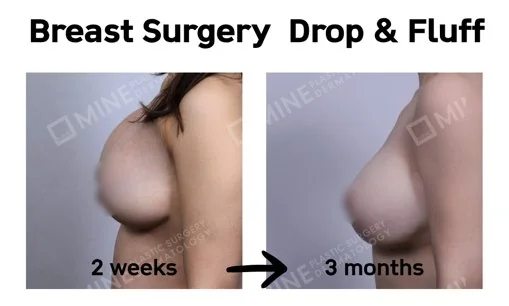
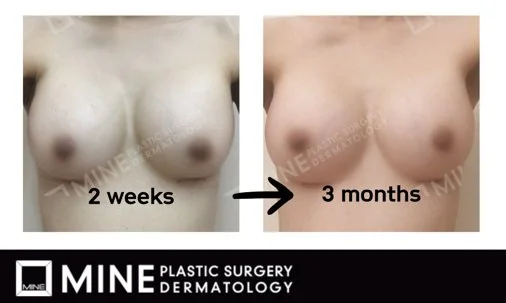
Search for drop and fluff before and after photos and you will find thousands of them. It helps to know what you are looking at, because most are not pre-surgery versus post-surgery comparisons. They set an early post-operative photo against a later one, typically week one or two against month three or six. Both frames show the same breasts after the same operation.
Between those two frames, three things change: the implant sits lower on the chest wall, the lower breast fills out so the curve beneath the nipple deepens, and the upper pole loses its shelf-like fullness as swelling and muscle tension resolve.
To track your own progression reliably, keep the conditions identical: same room and lighting, same distance, same posture with arms relaxed, and front, side, and three-quarter views every time. Weekly photos for the first two months, then monthly, are enough. Comparing before and after shots taken under different lighting is how patients talk themselves into believing nothing is changing when it is.
What you wear matters more than most patients expect during these stages. Our guide to bra choices for each recovery stage explains what supports the breast at each point, and our breast augmentation pain guide sets out what discomfort is typical while the muscle is still tight. If you are also considering a lift, our breast lift recovery guide walks through that separate timeline.
How Your Surgery Shapes the Settling Process
Drop and fluff belongs to recovery, but it is set in motion during the operation itself. Technique, implant choice, and pocket placement all influence how your breasts will settle. At Mine Clinic in Seoul, breast augmentation is planned around your anatomy and your goals rather than a standard template.
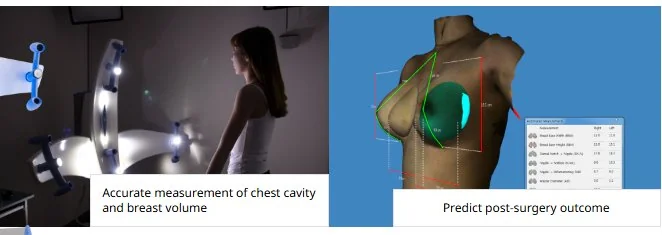
- Consultation and 3D planning. Your surgeon assesses chest width, skin elasticity, and existing breast tissue to recommend an implant type, size, and placement.
- Implant selection. Mine Clinic works with implants including Motiva implants and Mentor Xtra, chosen to suit your body and lifestyle. Profile and shell type both affect settling speed, as our implant types and profiles guide explains.
- Endoscopic, precision technique. Our surgeons use a minimally invasive HD endoscopic approach to create a precise pocket while protecting surrounding tissue. You can read more on our breast augmentation procedure page.
- Pocket placement. The implant may be placed under the muscle or in another plane depending on your tissue. Placement directly affects your timeline.
Why does placement matter? Implants under the muscle generally take longer to settle, because the muscle holds them more firmly at first. Smooth, round implants tend to descend more readily than textured ones. Your surgeon will explain what to expect for your specific plan, and what to prepare before you travel is worth reading in advance.
Supporting the Process Safely, and What to Avoid
Patients frequently ask how to make drop and fluff happen faster. The honest answer is that you cannot force it, but you can avoid slowing it down. What helps is unglamorous and consistent:
- Wear exactly the support garment your surgeon prescribes, for as long as prescribed.
- Rest properly in the first two weeks, and return to activity in the order your surgeon sets out.
- Avoid strenuous chest exercise until you are cleared, since repeated muscle contraction works against the relaxation you are waiting for.
- Stay hydrated, eat well, and avoid smoking, all of which support healing tissue.
A word of caution about the shortcuts circulating in online forums. Aggressive massage and tight compression bands, used without medical supervision, are really attempts to force the pocket open. Surgical texts are blunt about the trade-off: over-expanding the breast thins the tissue covering the implant, raises the risk of the implant working its way through it, and can leave the pocket too stretched to hold the implant in position. Follow your own surgeon’s instructions on massage and banding, and no one else’s.
Detailed aftercare instructions are set out in our post-operative care plan, and further recovery reading is collected on our breast surgery blog.
When It Is Not Drop and Fluff: Warning Signs to Know
Normal settling is slow, but it does move. If your breasts are still noticeably high and hard well past the three-month mark, that is worth a consultation rather than more waiting. Surgical literature separates ordinary settling from several distinct conditions:
- Late capsular contracture. The capsule tightens rather than staying supple, and the breast feels firm and sits high. Texts note that late contracture relates more to the long-term behavior of an implant than to events around surgery. Our guide to capsular contracture covers the symptoms in detail.
- Implant malposition. The implant sits too high, too low, too far to the side, or asymmetrically for structural reasons. This is a pocket problem, not a patience problem. See our breast implant malposition guide.
- Lower pole stretch deformity. The opposite problem: the lower breast stretches too far rather than too little. Textbooks classify this as a separate condition requiring a lift or a smaller device, not as an extreme form of normal settling.
Contact your surgeon promptly for unusual pain, worsening swelling, redness, heat, or bleeding at any stage. These are signs that need evaluation, not signs to wait out.
Risks, Side Effects and Safety
Breast augmentation is surgery, and being straightforward about risk is part of helping you decide well. Most side effects are temporary and part of normal healing, but you should know them before you commit.
- Swelling and bruising. Most initial swelling settles within one to two weeks, though some can linger and affect how settled your breasts look for several months.
- Tightness and a high, firm position. The expected starting point, not an abnormality.
- Temporary changes in sensation. Numbness or heightened sensitivity around the nipple is common and usually improves with time.
- Asymmetry during healing. One breast frequently settles ahead of the other, and this typically evens out.
- Less common risks. Infection, bleeding, fluid collection, capsular contracture, implant malposition, or the need for revision surgery in some cases.
Mine Clinic follows strict surgical and sterilization standards, uses certified implants, and monitors recovery closely through scheduled follow-up.
Why Patients Choose Korea and Mine Clinic
Korea has become a significant center for plastic surgery, and Seoul’s Gangnam district sits at the heart of it. International patients come for the surgical technique, but they stay in touch because of the care that surrounds it, including the months of drop and fluff that follow.
- A natural aesthetic philosophy. Korean breast augmentation emphasizes proportion and a soft result rather than an obviously operated look.
- Endoscopic precision. Accurate pocket creation supports smoother, more predictable settling.
- Dedicated international support. Our International Service team coordinates interpretation, scheduling, and aftercare, so distance never means being left without answers.
Frequently Asked Questions About Drop and Fluff
How long does drop and fluff take?
For most patients, implants reach their settled position between three and six months after surgery, with subtle refinement continuing to around twelve months. Implants placed under the muscle usually take longer than those placed above it.
Is it normal for one breast to drop faster than the other?
Yes. Uneven drop and fluff in the early weeks is very common and usually evens out. Breasts are rarely perfectly symmetrical to begin with, and each side heals at its own rate. If a marked difference persists past several months, raise it with your surgeon.
Can I speed up drop and fluff?
Not safely. You can support the process by following your surgeon’s bra and activity instructions, resting well, and eating properly. Attempts to force settling through aggressive massage or tight banding risk over-stretching the pocket and compromising the result.
Do implants get bigger after drop and fluff?
The implant volume never changes. What changes is distribution: as the lower breast fills out, the same volume reads as fuller and more rounded from the front, which many patients interpret as a size increase.
How long should I stay in Korea after breast augmentation?
Many international patients plan a stay of around 7 to 10 days, which covers surgery, initial healing, and the stitch check. Your surgeon confirms flight clearance individually.
What if my implants do not seem to be dropping?
Some patients simply take longer, particularly with submuscular placement or textured implants. If nothing has changed by around three months, or if you have unusual pain, swelling, or firmness, see your surgeon so capsular contracture and malposition can be ruled out.
Considering breast augmentation, or already in the middle of drop and fluff and unsure what you are seeing? Contact Mine Clinic for a personalized online consultation. Our team is available on WhatsApp to guide you through your K-Beauty journey in Seoul.
Book your online consultation here.
Pricing is tailored to each patient, so a consultation is required for personalized pricing.
Reviewed by Dr. Lee Sung-wook, Board Certified Plastic Surgeon at Mine Clinic.
※ This content is for informational purposes only and does not replace professional medical advice, diagnosis, or treatment. Individual results may vary, and side effects may occur. Please consult with a board-certified plastic surgeon for personalized advice.