EN
EN

Table of contents
Types of Rhinoplasty
Customized rhinoplasty is the practice of tailoring nose surgery to each patient’s anatomy. Each individual has a unique facial structure and nose shape, so personalized rhinoplasty is essential for a natural, balanced face. Rather than simply aiming for a higher nose bridge, a well-performed rhinoplasty should take into account factors such as skin thickness, nasal tip shape, and overall facial harmony. A customized surgery enhances natural beauty, complements other facial features, and fulfills the patient’s specific aesthetic goals. By tailoring the procedure, surgeons can achieve a well-balanced appearance that aligns with the patient’s ethnicity and personal preferences, leading to more natural and satisfying results.
Personalized rhinoplasty is a surgical approach designed to suit the unique facial features and aesthetic desires of each patient. Through this method, individuals can enhance their appearance while maintaining their natural beauty, achieving the best harmony and balance in their overall look.
1. Low Nose Rhinoplasty
Low nose rhinoplasty is a procedure designed to enhance and define a flat or low nasal bridge, creating a sharper and more structured appearance. At MINE Plastic Surgery, our approach carefully considers the starting point, height, and shape of the implant to ensure a seamless and natural result. By inserting the implant with precision and a snug fit, we achieve a smooth, natural-looking nose that feels like your own.
Benefits of Low Nose Rhinoplasty at MINE Plastic Surgery
✔ Prevention of Contracture – Reduces the risk of implant-related complications
✔ Minimized Side Effects – Advanced techniques to lower post-surgical risks
✔ Simultaneous Functional Correction – Enhances both aesthetics and nasal function
✔ Natural Appearance – A seamlessly integrated, non-artificial look
✔ Defined & Elevated Nasal Tip – Creates a refined, elegant contour
✔ Harmonious Facial Balance – Ensures the nose complements the overall facial structure
Features of Low Nose Rhinoplasty
Prevention of Contracture or Hardening – Cartilage is carefully sculpted based on individual conditions to prevent hardening or contraction.
Soft and Natural Feel – The cartilage is precisely fitted and secured, ensuring a seamless and natural-looking outcome.
Defined & Sharp Nasal Tip – Creates an elegant, refined contour without an artificial appearance.
No Risk of Redness or Implant Visibility – Ensures that the tip does not turn red, and the implanted cartilage remains discreet.
Harmonized with Facial Proportions – The nose is designed to match the overall facial balance, enhancing natural beauty.
Step-by-Step Surgical Process
Step 01 – Incision (Closed or Open Approach)
Depending on the patient’s condition, either a closed (non-visible incision) or open (greater precision) rhinoplasty technique is selected.
Step 02 – Creating Space for the Implant
A precise pocket is formed above the nasal bone, passing through the alar cartilage and upper lateral cartilage, ensuring the implant fits securely.
Step 03 – Implant or Autologous Tissue Placement
The implant or autologous tissue (such as cartilage) is carefully sculpted, considering the forehead projection and nasal bridge height to achieve a harmonious and natural result.
The structure is then securely placed and fitted, ensuring smooth integration with surrounding tissues.
2. Deviated Nose Rhinoplasty
A deviated nose, which curves to one side, not only affects facial aesthetics but can also cause nasal congestion, chronic headaches, and other nasal issues. Therefore, correcting a deviated nose through rhinoplasty can significantly improve both appearance and function.
At MINE Plastic Surgery, we address both the cosmetic concerns and functional issues by correcting septal deviation (deviated septum). By carefully dissecting the periosteum (the membrane covering the nasal bone) to precisely match the implant size, we ensure that the implant is securely fixed, preventing any movement or further deviation. This technique allows for a straight, natural-looking nasal bridge without instability or unnatural shifting.
Benefits of Deviated Nose Rhinoplasty
✔ Simultaneous Improvement of Aesthetic and Functional Aspects – Enhances both appearance and breathing function
✔ Straight and Symmetrical Nasal Line – Achieves a properly aligned, balanced nasal bridge
✔ Correction of Septal Deviation – Addresses both functional and cosmetic concerns to improve nasal airflow and symmetry
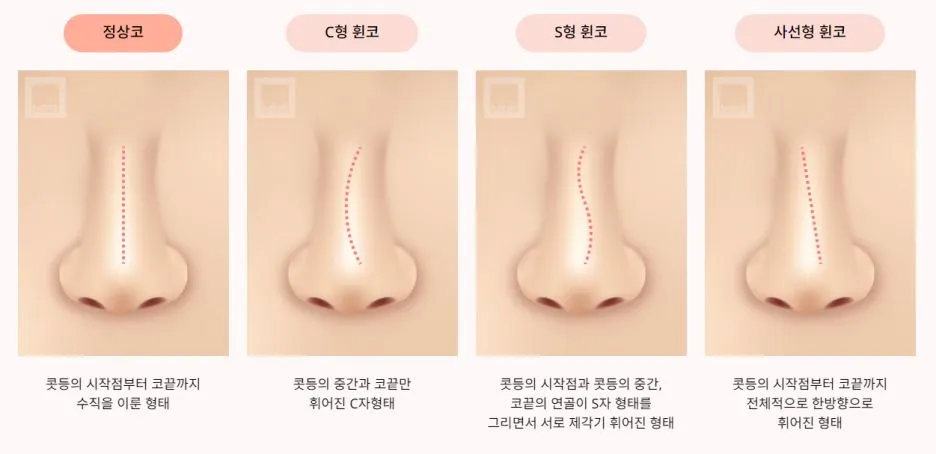
Key Features
✔ Prevention of Recurrence – Minimizes the risk of the nose becoming crooked again after surgery.
✔ Ideal Angle & Height – Tailors the nose shape to match the patient’s facial proportions for the most natural and balanced result.
✔ Simultaneous Aesthetic & Functional Correction – Corrects septal deviation (deviated septum) while improving both appearance and breathing function.
When Deviated Nose Rhinoplasty Is Needed
Facial asymmetry caused by a crooked nose – When a deviated nose disrupts facial harmony.
Frequent nasal congestion or related health issues – If a deviated septum leads to breathing difficulties or chronic nasal conditions.
Asymmetrical nostrils – When one nostril appears higher or lower than the other.
Implant deviation – If a previous nose job resulted in an implant shifting or bending, causing an unnatural look.
Deviated Nose Rhinoplasty: Surgical Methods
01. Mild Deviation
For slightly crooked noses, cartilage or dermis is strategically placed in the curved area of the nasal bridge to create a visually straighter appearance.
This method provides a minimally invasive correction, ensuring a smooth and balanced nasal line.
02. Severe Deviation
In cases of significant nasal deviation, a septoplasty (deviated septum correction) is performed alongside osteotomy (bone-cutting procedure).
The crooked nasal bone and cartilage are carefully repositioned to align the nose properly.
3. Hump Nose Rhinoplasty
A hump nose refers to a nose with a noticeable bump in the middle of the nasal bridge. Through hump nose correction surgery, it is possible to achieve a smoother and more refined nasal profile.
For individuals with both a low nasal bridge and a hump, the procedure involves removing the hump and then augmenting the bridge using ear cartilage, silicone, or Gore-Tex. This creates a more defined and three-dimensional appearance.
Benefits
✔ Smooth and Secure Bone Fixation – Ensures a stable and natural-looking correction.
✔ Simultaneous Correction of a Low Nose – The procedure enhances both the nasal bridge height and shape.
✔ Balanced and Harmonious Results – The nose is customized to match the patient’s facial proportions.
Features of Hump Nose Rhinoplasty
Precise and Smooth Fixation of Bone & Cartilage – The hump is carefully removed, and the nasal structure is securely refined.
Correction of Both a Hump Nose and a Low Nose – The bridge can be reshaped and elevated at the same time.
Customized to Enhance Facial Harmony – The final nose shape is tailored to complement the patient’s unique features.
When Is Hump Nose Rhinoplasty Needed?
Hump nose correction is recommended in the following cases:
Irregular nasal bridge – When the middle part of the nose bridge protrudes, causing a bump.
Desire for a sleek nasal contour – For those who want a more refined and even nose bridge.
High nasal bridge but irregular shape – When the nose is already high but appears unbalanced or asymmetrical.
Hump Nose Rhinoplasty: Surgical Methods
The approach to correcting a hump nose varies depending on the individual’s facial structure and the severity of the condition.
1. Low Glabella with a Hump Nose
The hump is removed, and the nasal bridge is reshaped using autologous cartilage and an implant to achieve an elevated and smooth line.
2. High Glabella with a Severe Hump
The hump and excess cartilage are carefully excised, and the surface of the bone is smoothed out to create an even transition.
3. Severe Hump with Wide Nasal Bone
In cases where the nasal bone is broad, the procedure includes both hump removal and osteotomy (bone-cutting) to refine and narrow the nasal bridge.
4. High Glabella with a Drooping Nasal Tip
After removing the hump, autologous cartilage is used to elevate and refine the nasal tip, creating a balanced and natural profile.
4. Long Nose / Droopy Nose Rhinoplasty
A long nose or droopy nose (arrow-shaped nose) occurs when the nasal tip droops excessively, making the nose appear too long in proportion to the face. This surgery lifts the alar cartilage, reduces the septum, and refines the nasal tip to create a softer and more youthful appearance.
Benefits
✔ Reduction of Overall Nasal Length – Adjusts the nose’s proportions for a balanced look.
✔ Well-Balanced Nasal Tip Angle – Lifts the drooping tip to enhance facial harmony.
✔ Correction of Nasal Tip Cartilage – Strengthens and repositions the alar cartilage for long-lasting results.
Features of Long Nose / Droopy Nose Correction
Balanced Facial Proportions – The nose is adjusted to match the overall face length, enhancing harmony.
More Youthful Appearance – A lifted nasal tip creates a softer, younger-looking face.
Ideal Nose Width for a Harmonious Look – The nose shape is refined to blend naturally with the facial structure.
Precise Septum & Alar Cartilage Repositioning – The nasal septum is trimmed, and the alar cartilage is repositioned upward to reduce the nose’s length.
Prevention of Recurrence – If the muscle that pulls the nasal tip downwards is overly developed, it is partially removed to prevent the nose from drooping again.
Optimal Nasal Tip Angle for Facial Balance – The angle of the nasal tip is carefully adjusted to enhance overall symmetry.
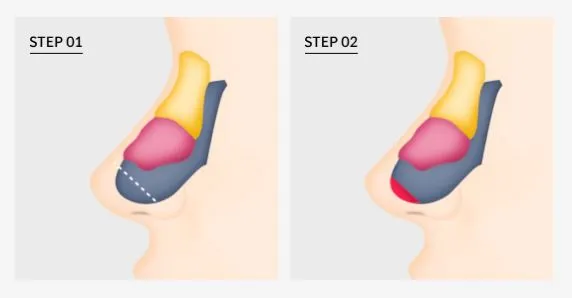
Surgical method for long nose/ droopy nose
A portion of the lower end of the septal cartilage is trimmed and reconnected to reduce the length of the nasal septum.
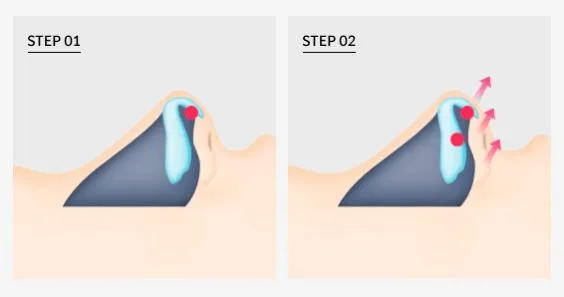
Alar Cartilage Tip Surgery
The drooping nasal tip cartilage is rotated upward, reducing the overall nasal length. If necessary, ear cartilage or septal cartilage is grafted to adjust the nasal tip height.
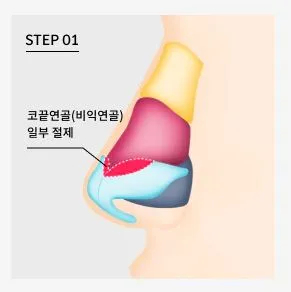
When the Alar Cartilage Protrudes Toward the Upper Lip
When the alar cartilage extends excessively toward the upper lip, trimming a portion of it and reconnecting it lifts the elongated nasal tip.
Since the nasal septum length is normal, it is not cut, and only the alar cartilage is adjusted to match the new nasal tip height.
5. Short Nose / Upturned Nose Rhinoplasty
A short nose or upturned nose occurs when the nasal tip is excessively lifted, making the nostrils overly visible, often referred to as a “piggy nose.” This condition may result from a naturally short nasal structure or previous surgery.
At MINE Plastic Surgery, we carefully analyze nasal length, nostril exposure, and nasolabial angle to systematically design a natural and harmonious nose shape.
Key Benefits
✔ Ideal Nasal Angle & Height – Achieves a balanced and three-dimensional nasal profile.
✔ Naturally Proportioned Nasal Tip Angle – Adjusts the nasal tip to create a smooth, natural aesthetic.
✔ Correction for Excessively Visible Nostrils – Extends the nose length and refines the nostril exposure.
Features of Short Nose / Upturned Nose Rhinoplasty
Achieves Ideal Facial Proportions by Extending the Nose Length – Enhances facial balance and harmony.
Prevents Recurrence by Adjusting Cartilage Support Thickness – Strengthens nasal structure for long-lasting results.
Uses Autologous Cartilage for Strong Support & Minimal Side Effects – Reduces risks such as infection and implant-related complications.
When Is Short Nose / Upturned Nose Rhinoplasty Needed?
Short nose or upturned nose correction is recommended in the following cases:
Overly lifted nasal tip – When the nose appears over-rotated and nostrils are excessively visible.
Nasal bridge appears too short – The nose lacks sufficient length, making facial proportions unbalanced.
Nasal contracture – When scarring or previous surgery has caused the nose to shrink.
Excessive nostril exposure – When the nostrils are more visible than normal.
Desire to minimize nostril exposure – For those who prefer a more refined and elongated nasal tip.
Surgical Methods for Short Nose / Upturned Nose Correction
01. Cartilage Reshaping Surgery
The upper portion of the alar cartilage is trimmed, allowing the lifted nasal tip to be pulled downward.
This elongates the nasal appearance, creating a more proportionate nose length.
02. Ear Cartilage Grafting
The lifted nasal tip is repositioned downward, and ear cartilage is used to create a longer support structure for stability.
The graft is secured in place to prevent recurrence.
03. Septal Cartilage Grafting
Harvested septal cartilage is placed between the septum and alar cartilage to extend the nasal tip length.
This method provides strong support while ensuring a natural extension.
04. Rib Cartilage Grafting
In cases where the nose is extremely short, rib cartilage (costal cartilage) is used to significantly increase nasal length.
The graft is inserted between the septal and alar cartilage, allowing for a more dramatic elongation of the nasal tip.
6. Bulbous Nose Rhinoplasty
A bulbous nose refers to a nasal tip that appears round, wide, and flat. In such cases, bulbous nose correction surgery refines the nasal structure by reshaping the cartilage and reducing the fat layer beneath the skin. This procedure enhances nasal definition, creating a slimmer and more refined appearance.
Benefits
✔ Slimmer and More Sophisticated Nasal Shape – Reduces the bulkiness of the nasal tip for a sharper, more elegant look.
✔ Refined & Harmonized Facial Appearance – Enhances the overall facial balance.
✔ Ideal Nasal Width for Facial Proportion – Achieves a proportional and natural-looking nose.
Features of Bulbous Nose Rhinoplasty
Customized Nose Shape to Match Facial Proportions – The nasal structure is tailored to complement the patient’s overall facial features.
Smooth & Natural Curvature – A refined nasal tip that retains a natural, soft aesthetic.
Ideal Nasal Width for Facial Harmony – The procedure narrows the bulbous nasal tip for a balanced look.
When Is Bulbous Nose Rhinoplasty Needed?
Excessively large and rounded nasal tip – When the tip appears too wide or undefined.
Wide nostrils with a flat nasal tip – When the nasal wings and tip are broad and spread out.
Thick nasal skin with excess fat tissue – When dense skin and fat contribute to the bulky appearance.
Bulbous Nose Surgery Method
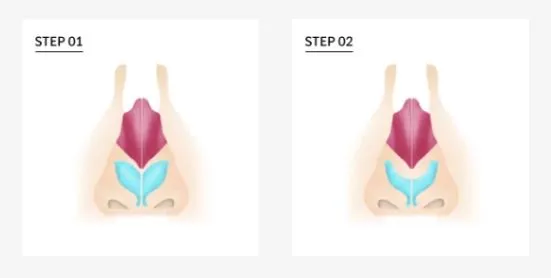
Wide Alar Cartilage
The alar cartilage is trimmed and sutured to bring the nasal wings closer together, reducing width.
To provide additional support and create a sharper, more defined nasal tip, ear cartilage or septal cartilage is inserted between the spread-out alar cartilages.
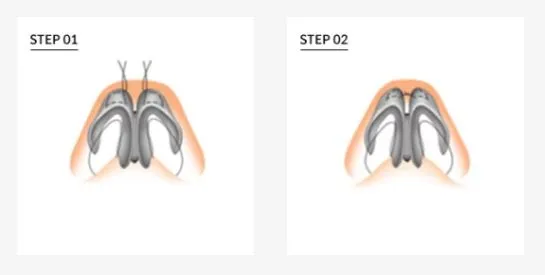
Flared, Spread Apart Nasal Tip Cartilage
The nasal tip cartilage is trimmed, and the two sides are sutured together to refine and shape the tip.
This naturally lifts the connected septal cartilage, creating a more projected and defined nasal tip.
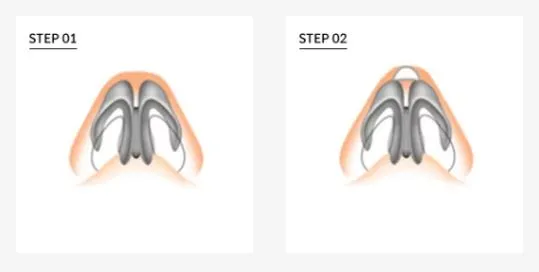
Thick Skin with Excess Fat Tissue
Excess subcutaneous fat and tissue are removed to slim down the nasal tip.
If nasal bridge augmentation is also performed, ear cartilage or septal cartilage is used to further elevate and refine the nasal tip, ensuring a sharp and elegant result.
Customized Rhinoplasty
Customized rhinoplasty focuses on creating a balanced and naturally fitting nose that complements an individual’s facial structure and ethnic background. Rather than a one-size-fits-all approach, patients should seek a tailored procedure that refines their unique features, enhances facial harmony, and preserves nasal function.
The ultimate goal is to achieve subtle yet effective improvements that enhance natural beauty while boosting self-confidence. A well-performed rhinoplasty should appear effortlessly natural, blending seamlessly with the patient’s existing facial characteristics.
For a detailed consultation on personalized rhinoplasty solutions based on different nose types, visit MINE Plastic Surgery for expert guidance. 😊 Thank you
Medical Disclaimer
This article is for general informational and educational purposes only and does not substitute professional medical advice, diagnosis, or treatment. Individual results from plastic surgery vary and depend on anatomy, age, and lifestyle. Always consult a board-certified plastic surgeon before making any decision about a surgical procedure. For a personalized consultation, contact MINE Plastic Surgery directly.