EN
EN


Table of Contents
What Is Salivary Gland Reduction?
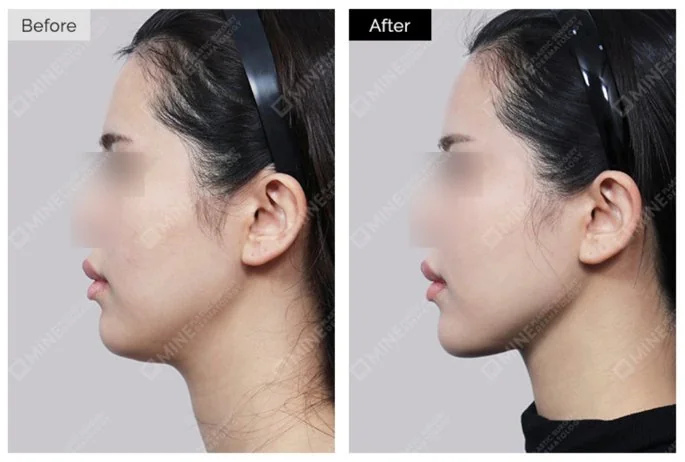
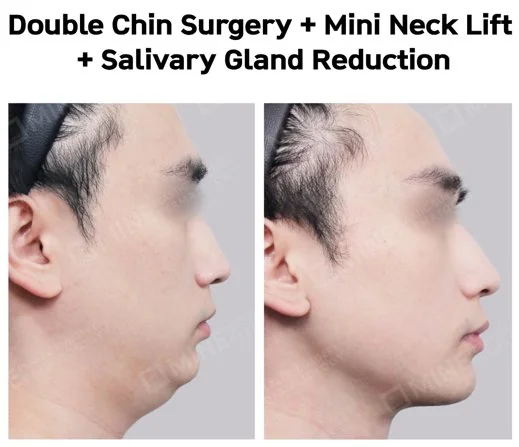
Salivary gland reduction is a procedure designed to slim the lower face by reducing the volume of the submandibular salivary glands. These glands sit just beneath the jawline, and when they are enlarged or hypertrophic, they can create a bulky, drooping, or “double jawline” appearance — even in patients who are slim or who have already undergone V-line surgery, jaw contouring, or facelifts.
Salivary gland reduction must be performed together with double chin surgery. It is not possible to access the submandibular gland without removing the submuscular fat pad that sits in front of it.
In Korea, where a sharp, defined jawline is a cornerstone of K-Beauty aesthetics, this procedure has become a popular option for patients who notice no change in the double chin volume even after liposuction or double chin surgery.
Why Do People Seek Salivary Gland Reduction?
Many international patients arrive at Mine Clinic in Seoul with the same frustration: their face looks “puffy” below the ear, the jawline lacks definition, or their lower face still appears wide despite previous procedures. Common reasons patients consider salivary gland reduction include:
- A persistent rounded or “bulging” lower jawline
- A blurred boundary between the chin, jaw, and neck
- Asymmetric jawline shape
- Residual fullness after V-line surgery or facial liposuction
- Aging-related shifts that emphasize the gland area
Key Takeaway: Enlarged salivary glands are a structural cause of a wide lower face that diet, exercise, and even surgery cannot fully address. Reducing them produces a slimmer, sharper jawline contour.
How Salivary Gland Reduction Is Diagnosed at Mine Clinic
Step-by-Step Process
- Detailed Consultation & Imaging Assessment The board-certified physician evaluates the patient’s facial structure, palpates the submandibular gland area, and checks for asymmetry. Ultrasound may be used to confirm gland size and depth.
- Customized Planning Because every patient’s anatomy is different, Mine Clinic does not use a “one-size-fits-all” protocol.

For an in-depth overview of how this treatment fits into a broader anti-aging strategy, you can also explore our Salivary Gland Reduction service page.
Why Choose Korea & Mine Clinic for This Procedure
Korea is widely recognized as a global leader in aesthetic and anti-aging medicine, and salivary gland reduction is a treatment Korean clinics have refined over many years. Here’s why international patients consistently choose Mine Clinic in Seoul:
1. Expertise in the Submandibular Anatomy
The submandibular gland is surrounded by sensitive structures — the marginal mandibular nerve, lymph nodes, blood vessels, and swallowing muscles. Dr. Lee Sung-wook, our board-certified plastic surgeon, has extensive experience in lower facial contouring, including Mini Neck Lift (Jawline) and V-line Surgery. Dr. Lee determines whether salivary gland reduction is needed after a thorough ultrasound check during an in-person consultation. Only patients with protruding oversized salivary glands need salivary gland reduction.
2. International Patient Support
Mine Clinic offers a dedicated International Service team with English communication, airport pickup coordination, and personalized aftercare. Our Online Consultation lets patients prepare their treatment plan before flying to Seoul.
3. Authentic, Medical-Grade Products
Korea has strict regulations on botulinum toxin and aesthetic injectables. Mine Clinic uses only authenticated medical-grade products with traceable lot numbers — an important safety standard supported by the American Society of Plastic Surgeons (ASPS).
Important: Risks, Side Effects & Safety
As with any medical procedure, salivary gland reduction has potential risks. Mine Clinic believes in fully informing patients so that they can make confident, educated decisions.
Possible Side Effects
- Mild swelling or tenderness (1-2 weeks)
- Temporary bruising
- Dry mouth sensation (typically mild and transient)
- Slight asymmetry due to differences in gland size and facial bone structure.
- Difficulty swallowing dry foods in rare cases — usually short-lived (1 month)
Who Should Avoid This Procedure
Salivary gland reduction is not recommended for patients who are:
- Pregnant or breastfeeding
- Diagnosed with neuromuscular disorders (e.g., myasthenia gravis)
- Currently experiencing salivary gland infection or inflammation
Recovery Timeline in Korea
| Timeframe | What to Expect |
|---|---|
| Day of Treatment | Mild redness or tenderness; can return to your hotel immediately |
| Day 1–2 | Possible swelling or bruising; cold compresses help. Compression Needed |
| Day 3–7 | Day 3 check-up. Day 7 stitch removal |
| Week 2–3 | Initial slimming begins to appear |
| Week 4–8 | Visible jawline contour improvement |
| Month 2–3 | Firm tissue begins to soften. Final results at 6 months. |
Practical Travel Tips
- Minimum stay in Korea: 7-10 days
- When can I fly home? We recommend flying home after 7 days, stitches are removed on the 7th day after surgery
- Avoid: Smoking, alcohol, and saunas for 1 month. No heavy exercise for 3 months.
- Maintenance: 1st week compression band 24/7. 2nd-3rd week compression band minimum 10 hours a day. The more the better.
Common Concerns & Patient Questions
International patients often have specific worries before traveling for treatment. Here are the most frequent concerns we address at Mine Clinic.
“Will my face look unnatural or ‘frozen’?”
No. Salivary gland reduction targets a gland — not facial expression muscles. Your smile, speech, and emotional expression are not affected. Patients describe results as “slimmer but still me.”
“Is this painful?”
Patients often describe the pain as similar to a sore throat. We prescribe pain killers after surgery to help with the pain.
“Will I produce less saliva permanently?”
No. The submandibular glands are only one of three pairs of major salivary glands (along with the parotid and sublingual glands). Saliva production continues normally from the others, and the treated glands’ function usually returns gradually within 1 month.
“Can I combine this with other procedures during my Seoul trip?”
Yes — and many international patients do. Common pairings include SMAS Facelift, Mini Neck Lift, or Chin Implant Surgery for a fully harmonized lower-face transformation.
“What if I’m not a good candidate?”
Some patients arrive thinking they need salivary gland reduction when, in fact, their lower-face fullness is caused by fat, masseter muscle, or skin laxity. Mine Clinic conducts a thorough diagnostic evaluation to recommend the right approach.
FAQs
How long do salivary gland reduction results last?
Once salivary gland reduction surgery is performed, the removed part of salivary gland does not grow back.
Can salivary gland reduction replace V-line surgery?
No. V-line surgery reshapes the jawbone, while salivary gland reduction reduces gland-related fullness below the jaw. They address different anatomical structures and are often complementary, not substitutes.
How much does salivary gland reduction cost at Mine Clinic?
Pricing depends on the patient’s anatomy, dosage required, and any combined treatments. A personalized consultation is required for accurate pricing, which we provide through our Online Consultation form.
How do I book a consultation as an international patient?
You can use our Online Reservation system or reach out via WhatsApp through our International Service page. We will guide you through pre-arrival paperwork, treatment planning, and post-care.
Interested in this procedure? Contact Mine Clinic today for a personalized online consultation. We are ready to assist you on WhatsApp and guide you through your K-Beauty journey in Seoul.
This content is for informational purposes only and does not substitute professional medical advice.
Reviewed by Dr. Lee Sung-wook, Board Certified Plastic Surgeon at Mine Clinic.