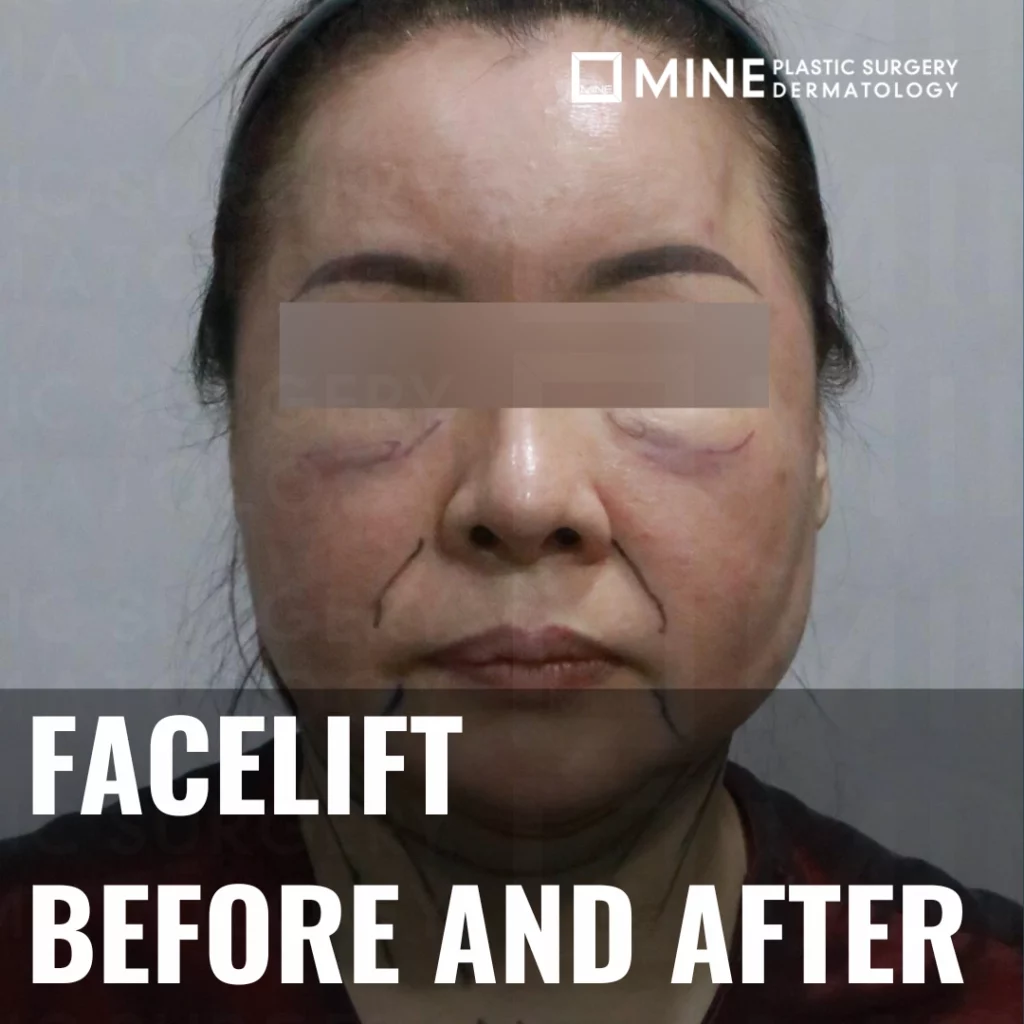
EN
EN

Table of contents
Korean jawline lifting (performed at MINE as a mini neck lift) is surgery that re-tensions the platysma (the thin sheet of neck muscle that runs from the chest up to the jawline and slackens with age), so that the border between the chin and the neck becomes clear again. Surgeons also call the operation a platysmaplasty, or a lower rhytidectomy. Because the muscle itself is re-tensioned rather than the skin alone, the change holds without the downtime of a full facelift.
What is Mini Neck Lift?
Mini neck lift (Korean jawline lifting) encompasses advanced surgical techniques specifically designed to enhance facial contours while maintaining natural-looking results. Korean Jawline Lifting (mini neck lift) is highly recommended for those who lack a clear separation between the chin and neck, addressing one of the most common aesthetic concerns in facial aging. Where the concern is submental fullness rather than a loose muscle layer, our comparison of double chin vs mini neck lift is the better starting point.
Key Benefits of Korean Jawline Lifting (Mini Neck Lift)
- Minimal Scarring: Korean surgeons place incision lines where they can be covered, typically within natural facial contours and hairlines, although no incision heals invisibly.
- Natural Results: The philosophy behind Korean facial surgery prioritizes subtle enhancement rather than dramatic alteration, ensuring patients maintain their unique facial characteristics.
- Faster Recovery: Innovative surgical methods significantly reduce swelling, bruising, and downtime compared to conventional approaches.
- Comprehensive Approach: Korean jawline lifting simultaneously addresses multiple aging factors including skin laxity, muscle banding, and fat accumulation.
Understanding the MINE Mini Neck Lift
The MINE mini neck lift represents a groundbreaking advancement in Korean aesthetic surgery. This procedure specifically targets the delicate area where the chin meets the neck, creating a more defined jawline and eliminating the appearance of a double chin or “turkey neck.”
The Mini neck lift precisely targets areas that need wrinkle correction and skin tightening, effectively lifting sagging areas. With minimal incisions under the chin and behind the ear, this procedure reduces concerns about scarring while powerfully tightening both the skin and the underlying platysma muscle.
What Makes MINE Different?
The MINE technique distinguishes itself through several innovative approaches:
- Strategic Incision Placement: Incisions are meticulously planned to follow natural facial contours, ensuring optimal healing and minimal visible scarring.
- Muscle Manipulation: The procedure addresses the sagging platysma muscle underneath, the fundamental structural layer responsible for neck sagging or double chins.
- Customized Treatment: Each MINE procedure is tailored to the patient’s specific anatomy and aesthetic goals, ensuring personalized results.
- Advanced Suturing Techniques: Korean surgeons utilize sophisticated suturing methods that promote faster healing and longer-lasting results.
Why Is Neck Muscle Surgery Different From a Facelift?
Neck muscle surgery and a facelift work on two different layers, and the reason is anatomical rather than commercial. In the face, a thin fibrous sheet called the SMAS sits between the fat and the muscle, and a facelift re-tensions that sheet. Below the jawbone the sheet does not continue; it becomes the platysma, the flat muscle of the neck. Textbooks note that the platysma has only minimal bony attachment to the jaw, which is why the neck slackens along its own plane and why a jaw lift surgery aimed at the neck cannot simply be a facelift extended downward.
That is why MINE treats Korean jawline lifting as a muscle operation first and a skin operation second. Tightening the SMAS above the jawbone does pull on the platysma below it, but only a direct repair of the muscle changes the line under the chin. For the facelift counterpart, see our explanation of the deep plane facelift.
What Is Platysmaplasty?
Platysmaplasty is the surgical step that draws the two halves of the platysma together and re-tensions them. It is the part of Korean jawline lifting that actually builds a jawline, rather than simply removing skin, and it is the reason the operation is sometimes listed as a lower rhytidectomy. Textbook techniques in the same family include a submental approach with medial platysmal plication and the corset platysmaplasty, both of which work through a small incision under the chin.
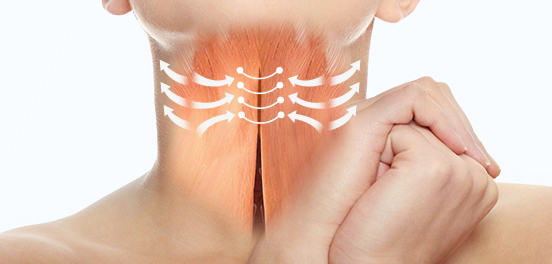
There is one piece of counter-intuitive geometry worth knowing before consultation: opening out a blunted cervicomental angle needs more neck skin, not less, because the straight line across a triangle is shorter than the two sides it replaces. That is why Korean jawline lifting is not simply a matter of cutting skin away. The vocabulary below is the vocabulary your surgeon will use:
- Platysma: a broad, thin sheet of muscle running from the chest up to the jawline. Because it barely attaches to the jawbone, it slides and slackens with age and creates the vertical neck bands people notice in the mirror.
- Platysmaplasty: the step that draws the two halves of the platysma together and re-tensions them. This, and not the skin trimming, is what actually creates a jawline.
- Cervicomental angle: the angle where the underside of the chin meets the front of the neck. A crisp jawline is really a sharp cervicomental angle; an open or blunted one is what people mean when they say they have no jawline.
- Gonial angle: the corner of the jaw below and in front of the ear. Losing its definition is part of why the lower face looks softer with age.
- SMAS: a thin fibrous sheet lying between the fat and the muscle of the face. It does not continue into the neck: below the jaw it becomes the platysma muscle instead, which is exactly why a facelift and a mini neck lift are different operations.
How Does Korean Jawline Lifting Work?
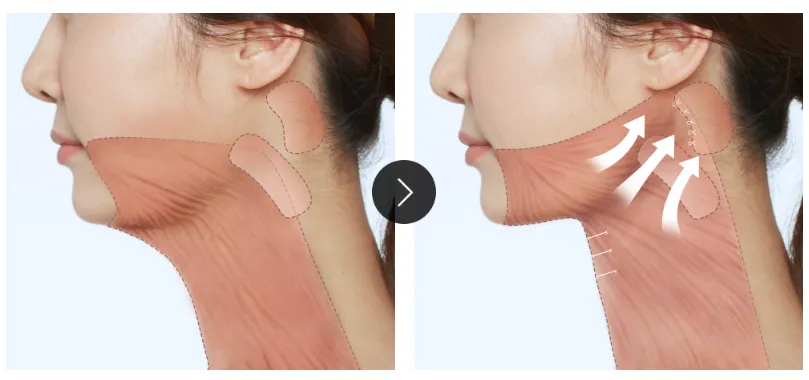
Korean jawline lifting works by addressing the multiple anatomical factors that contribute to an undefined or sagging jawline. According to the American Society of Plastic Surgeons, a neck lift, or lower rhytidectomy, is a surgical procedure that improves visible signs of aging in the jawline and neck.
The Science Behind Jawline Definition
As we age, several changes occur that affect jawline appearance:
- Skin Elasticity Loss: Decreased collagen production leads to skin laxity and sagging.
- Fat Redistribution: Fat deposits accumulate under the chin while facial volume decreases in other areas.
- Muscle Weakening: The platysma muscle, which extends from the chest to the jawline, becomes loose and creates vertical banding.
- Bone Remodeling: Subtle changes in facial bone structure can affect overall contour definition.
Korean jawline lifting comprehensively addresses these issues through targeted surgical intervention, creating a more youthful and defined facial appearance.
What Should You Know Before Mini Neck Lift?
Before considering mini neck lift, understanding the procedure’s scope and limitations is crucial. A neck lift, also known as a platysmaplasty or lower rhytidectomy, restores youthful contours to the jawline and neck area to reverse the signs of aging.
Realistic Expectations: While Korean jawline lifting produces remarkable results, it’s important to have realistic expectations about the outcome. The procedure enhances your natural features rather than completely changing your appearance.
Degree of Sagging, Not Age: Suitability for Korean jawline lifting is decided by how much the neck and jawline have actually loosened, not by a birth year. The mini neck lift is intended for a moderate amount of sagging; the section below explains where that limit sits.
Health Requirements: Good overall health is essential for optimal healing and results.
Commitment to Aftercare: Following post-operative instructions is crucial for achieving the best possible outcome.
Why Liposuction Alone Cannot Build a Jawline
One of the most common questions at consultation is whether liposuction on its own will do what Korean jawline lifting does. At MINE the answer is usually no, and the reason lies in what the tissue there is actually made of. This is genuinely a contested point rather than a marketing position: textbook data show that liposuction alone was used in 54 of 92 necks in one published series (Berry & Davies, J Plast Reconstr Aesthet Surg 2010), so it remains the single most common way surgeons manage the neck.
- Along the jawline there is little fat to begin with, and the tissue is fibrous rather than soft.
- What fat is there sits attached to the platysma, so a cannula cannot draw it out cleanly.
- Removing fat re-tensions nothing: suction on its own cannot rebuild the structure that gives a jawline its edge.
- MINE therefore releases that fibrous-bound fat piece by piece through the ear-crease incision, and only then tightens the muscle.
This is also the honest answer to the question behind a lot of searches: if the problem is a loose muscle layer, no amount of fat removal will fix it, and Korean jawline lifting is the operation that addresses the layer underneath.
Who Is an Ideal Candidate?
MINE mini neck lift is particularly effective for individuals experiencing specific aesthetic concerns. Many of the people who come to MINE are not looking for a full facelift at all; the upper face still looks the way they want it to. What they notice is lower down: the line between the chin and the neck has blurred, the skin under the jaw has gone slack, and fine creases have appeared across the neck. Those are precisely the concerns Korean jawline lifting is built around.
You May Be a Candidate If:
- The border between the chin and the neck is no longer clear.
- The jawline has sagged after facial bone contouring or double-jaw surgery; we cover that pattern in jawline sagging after facial contouring surgery and in what a mini neck lift does after contouring surgery.
- The skin under the jaw has lost its tension and no longer follows the jawline.
- Wrinkles have formed across the neck.
- Lasers or thread lifts were tried and the result was not satisfying; Korean jawline lifting is often the next step once energy devices have reached their limit.
How Much Sagging Is Too Much for a Mini Neck Lift?
This is the selection limit that matters most, and it is the one most articles leave out. Korean jawline lifting through a mini neck lift is designed for a moderate amount of sagging. MINE’s mini neck lift page puts it the same way: the operation is for people with a moderate amount of sagging on the jawline.
Textbooks draw the same line from the other direction. Where neck laxity is minor a shorter technique is enough, and where it is significant a standard incision in front of and behind the ear is needed instead. If the neck skin hangs well below the jaw, or if the muscle bands run the full length of the neck, a full neck lift surgery is the more honest recommendation, because Korean jawline lifting through a mini approach would under-treat the problem and leave you disappointed at three months.
How Long Does Recovery Take?
Recovery time is one of the most significant advantages of Korean jawline lifting techniques. Most patients are comfortable with light everyday activity around day 5 and back to their normal routine within about two weeks.
| Timeframe | What happens | Activity level |
|---|---|---|
| Day of surgery | Outpatient procedure; you are discharged the same day | Rest |
| Days 1–3 | Swelling and bruising peak, then begin to subside | Rest at home |
| Day 5 | Comfortable with light everyday activity | Light activity, daily life |
| Week 2 | Marked improvement in swelling and bruising | Most patients return to work and social activity |
| Month 1 | Remaining swelling resolves and the tissues settle | Normal |
| Months 3–6 | The final jawline contour becomes apparent as healing completes | Normal |
Both incisions are placed where they can be covered (under the chin and inside the ear crease), but no incision heals invisibly, and how a scar matures after Korean jawline lifting depends as much on aftercare as on technique. For what to expect month by month, see our guide to how facelift and neck lift scars are managed.
Which Korean Jawline Surgery Do You Need?
Korean jawline surgery is not one operation but a short menu, and the right choice depends on how much the neck and jawline have actually loosened rather than on age. Korean jawline lifting through a mini neck lift sits in the middle of that menu. If you are weighing the two operations against each other, our guide to full neck lift vs mini neck lift goes into more detail.
| Option | How it works | Recovery | How long it lasts |
|---|---|---|---|
| MINE mini neck lift (platysmaplasty) | An incision of about 1.5 cm under the chin plus one behind the ear; the platysma muscle is tightened and sutured and the skin is redraped | Light activity around day 5; normal routine within about 2 weeks | A structural correction of the muscle layer, so it is long-lasting; how long varies from person to person |
| Lower facelift | Works on the lower third of the face: excess skin is removed, the underlying tissue is tightened and fat is redistributed | Swelling and bruising generally settle in 2–3 weeks; full recovery takes months | Longer-lasting than a mini neck lift because more of the deeper tissue is repositioned; textbooks do not attach a fixed number of years |
| Full neck lift | Incisions behind the ear and, where needed, under the chin; excess fat is removed, the muscle tightened and excess skin excised | Most patients return to normal activity within about 2 weeks | Long-lasting |
| Masseter botulinum toxin | Relaxes a bulky masseter muscle so the lower face looks slimmer | No downtime | Up to about 6 months |
| Thread lift | Absorbable threads are placed under the skin and gently drawn upward | Mild swelling or bruising; most people are back to normal within a few days | Up to about 18 months, with some collagen stimulation along the way |
| Ultherapy (micro-focused ultrasound) | Focused ultrasound energy reaches the deeper layers and stimulates collagen | No downtime | Appears gradually over 2–3 months and can last a year or more |
Patients researching jawline surgery in Korea often assume the largest operation gives the best result. In practice the opposite tends to be true: choosing a procedure heavier than your degree of sagging adds recovery time without adding definition, while choosing one that is too light leaves the muscle layer untouched. That is why the assessment matters more than the menu, and why Korean jawline lifting is only the right answer for some of the people who ask about it.
The MINE Procedure: Step-by-Step
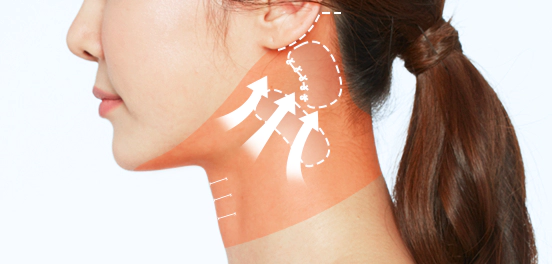
Understanding how Korean jawline lifting is actually carried out helps patients prepare mentally and physically for their surgery. The MINE mini neck lift begins with an incision of about 1.5 cm under the chin, followed by a second incision behind the earlobe that runs up the ear crease and ends in the posterior hairline.
| Item | Detail |
|---|---|
| Surgery time | About 2 hours |
| Anesthesia | Sedation (sleep) anesthesia |
| Incisions | About 1.5 cm under the chin, plus an incision behind the earlobe following the ear crease into the posterior hairline |
| Hospital stay | None; discharged the day of surgery |
| Return to daily life | Around day 5 |
Pre-Operative Planning
Comprehensive Consultation: Detailed discussion of patient goals, medical history, and aesthetic expectations.
Custom Surgical Plan: Development of a personalized surgical strategy based on individual anatomy and desired outcomes.
Surgical Technique
- Sedation anesthesia. Korean jawline lifting is carried out under sedation (a sleep anesthesia rather than a general one) and takes about 2 hours, with discharge the same day.
- Submental incision and platysmaplasty. An incision of about 1.5 cm is made under the chin, and the two halves of the platysma are drawn together and sutured, which moves the crease of the neck up to the chin–neck border.
- Release through the incision behind the ear. The platysma is separated from the skin and fat layer lying over it.
- Upward-and-backward fixation. The muscle is pulled up and back and fixed in its new position: this is the step that sets the new jawline.
- Release of fibrous-bound fat. The fat along the jawline is bound into fibrous tissue and attached to the platysma, so it is released and contoured by hand rather than suctioned out.
- Redraping and fine closure. Excess skin is trimmed, the remaining skin is redraped without tension, and the incisions are closed with fine sutures.
What Results Can You Expect?
Korean jawline lifting produces transformative yet natural-looking results. Patients typically experience significant improvement in facial definition and overall aesthetic appeal.
Immediate Improvements
- Enhanced Jawline Definition: Immediately visible improvement in jawline contour and neck angle.
- Reduced Double Chin: Elimination or significant reduction of submental fullness.
- Smoother Neck Profile: Improved transition between the chin and neck areas.
- Lifted Neck Contours: Overall neck rejuvenation and more youthful appearance.
Long-Term Benefits
Sustained Results: Proper surgical technique ensures long-lasting improvements that age naturally.
Enhanced Self-Confidence: Improved facial aesthetics often boost personal confidence and social comfort.
Professional Advantages: Enhanced appearance can provide benefits in professional and social settings.
Aging Gracefully: The procedure helps patients age more gracefully by addressing fundamental structural issues.
Risks and Considerations
Like any surgical procedure, Korean jawline lifting carries certain risks and considerations that patients should understand before proceeding.
One of the two most common complications of Korean jawline lifting is bleeding under the skin rather than anything dramatic. In a published study of 117 platysma-SMAS plication patients, hematoma occurred in 3.4% (4 patients), and every one of them was drained under local anesthesia with no apparent effect on the final result (Berry & Davies, J Plast Reconstr Aesthet Surg 2010). Some degree of nerve dysfunction was recorded in 5 patients in the same series. That is a broad count that takes in any change in sensation; the study’s separate 3.4% figure for nerve problems counts only temporary muscle weakness, so the two numbers are measuring different things.
Where a submandibular gland reduction is carried out at the same time, the risk profile widens a little. Research on 112 consecutive necks reported minor complications in 10.8% of cases, with submandibular sialocele and marginal mandibular neurapraxia each at 4.5%; all of them had fully resolved by three months and no patient reported permanent dry mouth (Plast Reconstr Surg 2015;136:463-471). That is a separate operation from Korean jawline lifting: read more about salivary gland reduction for the jawline before deciding to combine the two.
Potential Risks
| Risk | What the literature reports | Notes |
|---|---|---|
| Hematoma (blood collecting under the skin) | 4 of 117 patients (3.4%) after platysma-SMAS plication; one of the two most common complications of this operation | All were drained under local anesthesia with no apparent effect on the final result (Berry & Davies, J Plast Reconstr Aesthet Surg 2010) |
| Temporary nerve dysfunction | Some degree of nerve dysfunction in 5 of the same 117 patients | Usually temporary; in that series one patient with one-sided altered sensation was referred to a chronic-pain clinic |
| Infection | Uncommon where sterile technique and aftercare are sound | Report redness, heat or discharge early rather than waiting for the next scheduled visit |
| Scarring | Individual healing varies and no incision heals invisibly | The incisions sit under the chin and in the ear crease: see how facelift and neck lift scars are managed |
| Asymmetry | Minor asymmetry can occur as swelling resolves unevenly | Significant asymmetry can usually be addressed with a revision once the tissues have settled |
| If submandibular gland reduction is combined | Minor complications 10.8%, sialocele 4.5% and marginal mandibular neurapraxia 4.5% in 112 consecutive necks | All resolved by three months and no patient reported permanent dry mouth (Plast Reconstr Surg 2015;136:463-471). The same series also reported major complications in 1.8% of patients, one of which was potentially life-threatening, so the two operations are not combined lightly. This is a separate operation: see salivary gland reduction for the jawline |
Factors Affecting Results
Individual Healing: Personal healing responses affect final results and recovery time.
Surgeon Expertise: Board-certified plastic surgeons with extensive experience provide optimal outcomes.
Patient Compliance: Following post-operative instructions significantly impacts results.
Realistic Expectations: Understanding procedure limitations ensures patient satisfaction.
Frequently Asked Questions
Is Korean Jawline Lifting Painful?
Pain after Korean jawline lifting is usually described as manageable and is controlled with prescribed medication, but discomfort is not the only thing to plan for. Swelling, bruising and a tight feeling across the neck are common through the first two weeks, and for most patients those matter more than pain does. Altered sensation or firmness around the incisions can also occur, and the risks section above sets out the complication rates reported in the literature. Report anything unexpected to your surgeon rather than waiting it out.
How Long Do Results Last?
Korean jawline lifting results are long-lasting, because the operation re-tensions the platysma itself rather than only tightening skin. Textbook descriptions of submental platysmaplasty report excellent long-term results, but the literature does not attach a fixed number of years to the operation. The longevity of results depends on individual factors including skin quality, lifestyle choices, and natural aging processes. Many patients find that the procedure helps them age more gracefully by addressing fundamental structural issues.
Can Korean Jawline Lifting Be Combined with Other Procedures?
Yes, Korean jawline lifting can be safely combined with complementary procedures such as facial fat grafting, brow lifts, or non-surgical treatments like dermal fillers. Combining procedures often provides more comprehensive facial rejuvenation while minimizing overall recovery time.
How Long Does a Mini Neck Lift Take?
Korean jawline lifting through the MINE mini neck lift takes about 2 hours and is carried out under sedation anesthesia, so there is no general anesthetic and no hospital stay; patients are discharged the same day. Most people are comfortable with light everyday activity around day 5 and back to their normal routine within about two weeks.
What Are the Most Common Complications?
Bleeding under the skin is the one to know about. A published study of 117 platysma-SMAS plication patients found hematoma in 3.4% (4 patients), making it one of the two most common complications of this operation. If one side of your neck swells or becomes painful much faster than the other in the first two days, contact the clinic the same day rather than waiting for your next appointment. In that series all of them were drained under local anesthesia without affecting the result. Some degree of nerve dysfunction was recorded in 5 patients in the same series. Infection, visible scarring and minor asymmetry are less common but possible after Korean jawline lifting, which is why the follow-up schedule matters.
Conclusion
Korean jawline lifting at MINE, carried out as a mini neck lift, offers an exceptional solution for individuals seeking enhanced facial definition with minimal invasiveness and rapid recovery. This innovative approach combines Korean surgical precision with advanced techniques to create natural-looking, long-lasting results.
The procedure’s emphasis on subtle enhancement, minimal scarring, and comprehensive aftercare makes it an ideal choice for patients who want to address early signs of aging or improve naturally weak jawline definition. With proper patient selection and expert surgical technique, Korean jawline lifting can provide transformative results that enhance confidence and overall aesthetic appeal.
If you’re considering jawline enhancement and want to explore whether the MINE mini neck lift is right for you, consulting an experienced board-certified plastic surgeon is essential. MINE Plastic Surgery specializes in advanced facial rejuvenation techniques and provides comprehensive consultations to help you achieve your aesthetic goals safely and effectively.
※ This content is for informational purposes only and does not replace professional medical advice, diagnosis, or treatment. Individual results may vary, and side effects may occur. Please consult with a board-certified plastic surgeon for personalized advice.