EN
EN


Table of contents
Neck lift recovery is the staged healing process that follows a full neck lift, the operation that tightens the sagging platysma muscle of the neck (a step surgeons call platysmaplasty) and redrapes loose skin. At MINE Plastic Surgery in Seoul, neck lift recovery runs on a fixed schedule: drain out on day 3, sutures out on day 7, compression band worn 24 hours a day for 1 to 2 weeks, and no massage, sauna, alcohol or smoking for a full month.
Understanding the Basics of Neck Lift Recovery
Neck lift recovery varies with age, skin quality and how much tissue was released, but it follows a predictable sequence. Platysmaplasty is the muscle-tightening step inside neck lift surgery at MINE, not a lighter alternative to it. A mini neck lift has its own aftercare schedule — every timing here is for a full neck lift.
Full recovery from neck lift surgery typically takes 1 to 6 months, and every phase has its own care rules. Following them is what protects the result and lowers the risk of complications.
The healing journey after a neck lift is progressive, with the most visible improvements becoming apparent after the initial swelling subsides. Proper management during each recovery phase not only enhances aesthetic outcomes but also helps prevent complications that could compromise your results.
Dr. Lee Sung-wook, MINE’s head doctor and a board-certified plastic surgeon, gives every full neck lift patient the same neck lift recovery schedule. Here it is in one view; the restrictions that go with it are in the activity table further down.
| Milestone | When (MINE full neck lift protocol) |
|---|---|
| Drain and hemostatic suture (bleeding-control stitch) removed | Day 3, at the clinic |
| Cold compress, then switch to warm | Cold through day 3; warm from day 4 |
| Sutures removed | Day 7 |
| White steri-strips removed | 2–3 days after suture removal |
| Skin-tone 3M tape under the chin | 2 weeks (not needed behind the ears) |
| Compression band worn 24 hours a day | 1–2 weeks |
| Compression band worn 8+ hours a day | Through the first month |
| Radiofrequency aftercare at the clinic | 2 sessions, after suture removal |
| Scar ointment | From 3 months after suture removal, for 6+ months |
Immediate Post-Surgery Recovery Phase (Days 1-3)
The first three days are the most demanding part of neck lift recovery: swelling and discomfort peak, and the neck is managed under close supervision.
Key Symptoms During Immediate Recovery
- Swelling and bruising: These get worse for the first 2 to 3 days, then settle over the following 2 to 4 weeks. That curve is normal neck lift recovery, not a sign that something is wrong.
- Pain and discomfort: Most patients experience mild to moderate pain, which can be managed with prescribed pain medication.
- Drain and hemostatic suture: A small drain and a hemostatic suture — a stitch placed to control bleeding — are left in place, and both are removed at your day 3 clinic visit.
- Compression band: Worn 24 hours a day for the first 1 to 2 weeks, off briefly for meals and brushing your teeth. Firm but never tight — if it pinches, leaves deep marks or turns the skin pale or cold, it is too tight. Skin starved of blood flow that way can break down, which is what pressure necrosis means.
Essential Management Techniques
- Head positioning: Always keep your head elevated above your heart to minimize swelling. Using 2-3 pillows while sleeping is recommended.
- Cold compress, then warm: Cold compresses for 20 minutes at a time, never directly on the skin, through day 3. From day 4, switch to warm compresses. Warm the pack in the microwave for no more than 15 to 20 seconds — longer and it can burst — and test it on the back of your hand first. Your hand still has normal sensation; the skin over the operated neck is temporarily numb, so a pack that is too hot can burn it before you feel anything.
- Keep your chin down: No tilting your head fully back for long stretches — hairdresser, dentist — for 3 months, because the dissolving sutures holding the platysma need that long to be replaced by stable tissue (see neck lift anatomy and technique).
- Medication adherence: Take prescribed antibiotics and pain medications exactly as scheduled to prevent infection and manage discomfort.
- Rest and limited activity: Minimize movement and prioritize rest during this critical healing period.
Important Warning: Avoid sudden neck movements, and stay off aspirin, ibuprofen and vitamin E for a full week unless your surgeon says otherwise. Plastic surgery textbooks report that hematomas after facelift-type surgery typically appear within the first 12 hours, with antiplatelet drugs and post-operative high blood pressure among the factors positively associated with them. Call the clinic if the area feels hot, if pain keeps climbing, or if one side swells quickly — neck lift side effects and complications covers how to tell normal healing from a warning sign.
Your first visits are already fixed: drain out on day 3, sutures on day 7, then two radiofrequency aftercare sessions by appointment. Those scheduled visits are what supervised neck lift recovery looks like at MINE.
Early Recovery Stage (Weeks 1-2)
Weeks 1 and 2 are the turning point of neck lift recovery: the drain and sutures come out, and most patients start easing back into normal routines.
Notable Changes During Early Recovery
- Decreasing swelling and bruising: By days 7-10, swelling and bruising begin to noticeably subside.
- Suture removal: At MINE the sutures come out on day 7. The white steri-strips come off 2 to 3 days later, and a skin-tone 3M tape is then worn under the chin for 2 weeks (not needed behind the ears). Published aesthetic surgery literature describes 3M microfoam tape worn for 1 week to reduce under-chin swelling, though that report reflects a single author’s practice; MINE’s own schedule runs 2 weeks.
- Topical antibiotic ointment: After suture removal, apply the prescribed antibiotic ointment behind the ears and under the chin for 2 to 3 days, then lightly once or twice a day until the drain site closes.
- Compression steps down: After 1 to 2 weeks of round-the-clock wear you move to a lighter garment, worn at least 8 hours a day for the rest of the first month.
Recommended Early Recovery Care Practices
- Gradual activity increase: Begin with light walking but continue to avoid strenuous exercise.
- Nutritional support: Eat protein-rich foods, and add foods with anti-inflammatory properties such as oily fish, berries and leafy greens. Vitamin C and zinc-rich foods promote wound healing.
- Hydration: Drink at least 8 to 10 glasses of water a day. Staying well hydrated supports wound healing and helps you feel less drained during the first couple of weeks.
- Hands off the incisions: Do not rub or press the incision lines for 1 month. Taping, not massage, is the support used at this point in neck lift recovery.
Expert Tip: During this period, you can resume social interactions, but scarves or high-necked clothing may help conceal any remaining bruising and swelling as your neck continues to heal.
Mid-Term Recovery Phase (Weeks 3-4)
By weeks 3-4, the neck looks close to normal again — most swelling and bruising have gone — though it still feels firm and numb at this point in neck lift recovery. The one-month restrictions are all still running, and a couple of them run longer; the activity table below has the full list.
Mid-Term Recovery Characteristics
- Significant swelling reduction: After 3 weeks, most swelling has dissipated, making the new neck contour more visible.
- Bruising resolution: The majority of bruising should completely disappear during this period.
- Sensation returns slowly: Numbness and a tight, dull feeling are normal and usually worst in months 1 and 2. If a corner of the mouth is slow to lift, it generally recovers over 2 to 3 months. One study of neck lifts combined with submandibular gland reduction reported marginal mandibular nerve weakness in 4.5% of patients, every case resolving fully by 3 months.
- The neck hardens, then softens: The area keeps firming for about 2 months before softening again, and lumpiness smooths out from around the 3-month mark. This stage of neck lift recovery surprises patients more than any other, and it is not a complication.
Mid-Term Recovery Management Techniques
- Exercise reintroduction: With your surgeon’s approval, you can begin light aerobic exercises. Continue to avoid exercises that place direct pressure on the neck.
- UV protection: Diligently protect incision sites from sun exposure using SPF 30+ sunscreen. Hats and scarves provide additional protection.
- No massage and no pressure, for a full month: Do not book lymphatic drainage, deep-tissue massage or anything that presses on the neck for 1 month. The platysma is still held by dissolving sutures, and pressure now can undo the lift. Warm compresses and the compression band are the swelling tools for weeks 3 and 4 of neck lift recovery.
- Taping continues, ointment waits: Keep the under-chin tape on and the incisions protected. At MINE, scar ointment does not start yet — the schedule is in the scar section below.
The in-clinic aftercare MINE provides in this window is radiofrequency treatment, two sessions, booked once your sutures are out, to help the firmness settle.

Long-Term Recovery Process (Months 1-6)
Months 1 to 6 are the long tail of neck lift recovery, when firmness resolves and the final contour appears.
Key Changes During Long-Term Recovery
- Enhanced skin elasticity: Over time, neck skin elasticity continues to improve, creating more natural contours.
- Progressive scar fading: With proper care, surgical scars gradually become less noticeable and blend with surrounding skin.
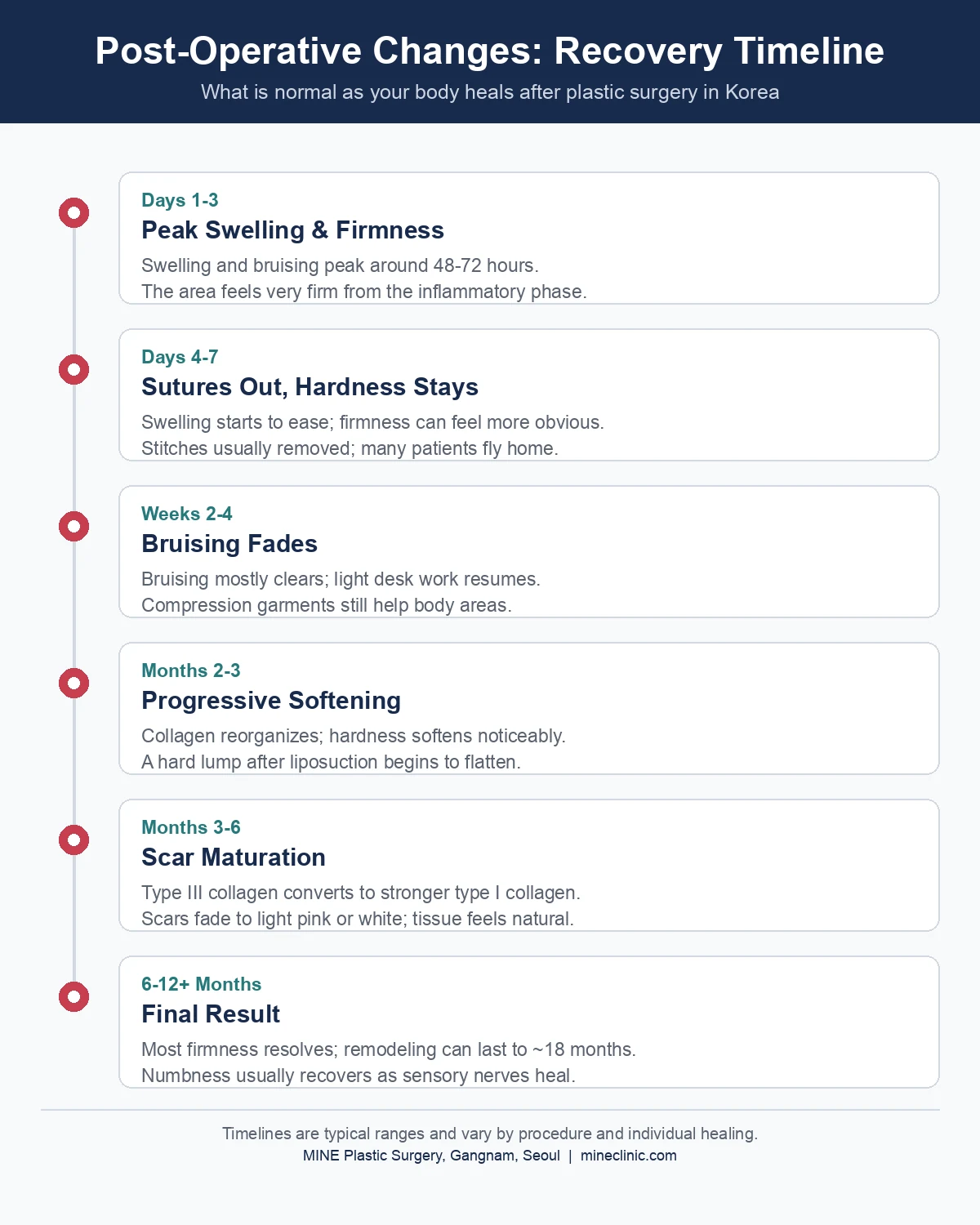
- Result stabilization: Most patients see their final, stable neck contour between 3 and 6 months after surgery. The general timeline chart above runs out to 6 to 12 months because it also tracks scar maturation and the last of the residual firmness, which keep settling after the contour itself is set.
- A dissolving stitch may surface: From about 1 month, an absorbable suture can show through the skin or poke out. The body absorbs it within roughly 3 months. Do not pull or cut it — call the clinic.
Long-Term Recovery Management Strategies
- Regular follow-up appointments: Maintain scheduled check-ups with your surgeon to monitor recovery progress and address any concerns.
- Continued scar care: Once ointment starts, keep it up for at least 6 months, and stay strict with sun protection through the first year.
- Healthy lifestyle maintenance: Not smoking, proper hydration, balanced nutrition and adequate sleep help preserve your surgical result.
- Neck muscle strengthening exercises: With your surgeon’s approval, gentle neck-strengthening exercises can begin during this phase.
Maintaining Long-Term Neck Lift Results
Once neck lift recovery is complete, keeping the result comes down to daily skin care and sun habits. For non-surgical upkeep later on, our comparison of neck wrinkle treatment options sets out what each can and cannot do. Ultrasound-based tightening under the chin waits until 6 months.
Scar Care During Neck Lift Recovery: When to Start and How Long
This section answers one question: when scar care starts in neck lift recovery, and how long it runs. For where the scars sit, why they thicken and the full treatment range, see our guide to managing facelift and neck lift scars.
Where Are Neck Lift Scars Located?
Neck lift scars sit behind the ears and below the earlobes, and there is usually a small one under the chin. All of them are placed inside natural creases or within the hairline. Our scar management guide maps each incision month by month.
Scar Care Schedule During Neck Lift Recovery
- Weeks 1 to 4 — tape, not ointment: Skin-tone 3M tape under the chin for 2 weeks, incisions left alone, no rubbing for 1 month.
- From 3 months after suture removal — ointment: This is the MINE schedule and this guide follows it. Use one product — a silicone-based scar gel or an onion-extract gel, not both — a pea-sized amount twice a day, dried for 1 to 2 minutes, for at least 6 months. Scar-management literature describes silicone being worn 12 to 24 hours a day over 12 to 24 weeks, usually starting about 2 weeks after the wound has fully closed; where the two differ, follow the schedule your MINE surgeon gave you and raise it at your follow-up.
- Start earlier if the scar changes: Cosmetic dermatology textbooks advise starting silicone sheeting at the first sign of redness with firmness or raised texture, and reviewing weekly, because early thickening can often be halted. Tell the clinic if you see that rather than waiting for the 3-month mark.
- Sun protection, every day: Scar tissue darkens easily. Use SPF 30+ on the neck whenever you go outside, through the first year.
- Energy-based devices wait: Ultrasound tightening and similar devices under the chin are off-limits for 6 months. Ask before booking any laser or device treatment over the scars.
Important Note: Your surgeon’s instructions override any general schedule. Published scar-management guidelines recommend silicone gel and sheeting as a first-line option for raised scars and for preventing them. The mechanism is thought to be a normalizing of water loss through the skin — in plain terms, keeping the scar covered and slightly moist so it stops behaving as though the wound were still open and laying down extra collagen.
Lifestyle Management Guidelines After Neck Lift Surgery
Day-to-day habits shape neck lift recovery as much as the surgery itself. Published neck lift recovery guidance covers the general picture; the timings below are MINE’s own protocol.
When Can You Resume Normal Activities After Neck Lift Surgery?
Normal life comes back in three steps. Your everyday routine at home restarts right away: moving around the house and light tasks are fine from day 1, as long as you keep your head elevated and avoid anything that strains the neck.
Through the first 1 to 2 weeks, life fits around the clinic and the band: you can go out and work from home, but you are scheduling around two fixed visits — drain out on day 3, sutures out on day 7 — and wearing the compression band around the clock. Light walking as exercise starts at the end of this stage, at the 1-to-2-week mark.
The last everyday limits come off at the one-month mark: the compression band comes off, and the bans on strenuous exercise, massage, sauna, alcohol and smoking all end with the first month. Two restrictions run longer — no tilting your head fully back for 3 months, and no ultrasound-type devices under the chin for 6 months. The full neck lift recovery table below sets out the rest.
Nutritional Guidelines
- Increase protein intake: Enhance collagen production and tissue regeneration by consuming more protein-rich foods.
- Anti-inflammatory foods: Incorporate omega-3 fatty acids, fruits, and vegetables with anti-inflammatory properties into your diet.
- Sodium limitation: Maintain a low-sodium diet to prevent worsening of swelling.
- No alcohol and no smoking for 1 month: Both worsen bleeding, slow healing and raise infection risk, so MINE asks patients to stop for a full month. Limit caffeine early on too — it can raise blood pressure and is mildly dehydrating, neither of which helps a healing neck.
- No sauna or hot baths for 1 month: Heat and humidity raise infection risk while the incisions mature.
Physical Activity Timeline
| Activity Type | When to Resume | Special Considerations |
|---|---|---|
| Everyday routine at home | Right away | Keep your head elevated and avoid straining |
| Light walking as exercise | 1–2 weeks | Moving around the house is fine from day 1; build structured walks up slowly |
| Strenuous exercise, gym, running | 1 month | Nothing that spikes blood pressure before then |
| Massage or pressure on the neck | Not before 1 month | Includes lymphatic drainage |
| Sauna, hot bath, swimming pool | Not before 1 month | Infection risk |
| Head tilted fully back for long periods | Not before 3 months | Dissolving sutures need time to be replaced |
| Ultrasound or Ulthera-type devices under the chin | Not before 6 months | Ask the clinic before booking |
Sleep Position and Recovery
Keep your head and neck above heart level for at least the first 2 weeks. It is the simplest thing you can do to keep swelling down and circulation moving.
- Recommended sleep position: Sleeping on your back with head and shoulders elevated at a 30-45 degree angle is ideal.
- Positions to avoid: Avoid sleeping on your stomach or side with your neck bent.
- Specialized pillows: Consider using a specialized neck support pillow or wedge pillow during recovery.
Every timing here comes from the written aftercare protocol Dr. Lee Sung-wook gives full neck lift patients at MINE; if your own sheet differs, follow yours. Neck lift recovery after a mini neck lift runs on a different timetable, so do not mix the two.
Frequently Asked Questions (FAQ)
How Long Does Swelling Last After Neck Lift Surgery?
Swelling and bruising build for the first 2 to 3 days, then fade over 2 to 4 weeks. Subtle puffiness can linger up to 3 months, and the neck stays firm for about 2 months before softening. Cold compresses through day 3, warm from day 4, head elevation and the compression band are what shorten this phase of neck lift recovery.
How Painful Is Neck Lift Recovery?
Moderate, and well controlled by the prescribed medication. Pain peaks in the first 3 to 5 days, then eases into a tight, dull feeling that is strongest in months 1 and 2 of neck lift recovery. Pain that climbs instead of fading, or heat over the area, is a different matter — see neck lift side effects and complications, and call the clinic.
How Visible Are Neck Lift Scars?
When performed by a skilled plastic surgeon, neck lift scars are designed to be concealed within natural creases or hairlines. With proper scar management and time, most scars become minimally noticeable. Individual skin type, age, and scar management approach all influence the final appearance.
When Can I Wash My Face and Shower After Neck Lift Surgery?
At MINE, no water reaches the surgical area until the sutures come out on day 7. Until then, wash your face carefully around the wounds and shower from the waist down only. After suture removal, wash and shower normally — keeping direct pressure and very hot water off the neck — and makeup can go back on.
How Long Do Neck Lift Results Last?
Neck lift results are long-lasting, but they do not stop the aging process — the neck goes on aging from its new starting point. Longevity depends on individual skin characteristics, aging rate, lifestyle factors (smoking, sun exposure), and weight fluctuations. Proper skin care and healthy lifestyle practices can help extend the duration of your results.
Achieve Optimal Neck Lift Recovery with Expert Guidance
Neck lift surgery addresses neck wrinkles and sagging caused by aging, but a structured neck lift recovery is what protects the result.
Successful neck lift recovery comes down to following your surgeon’s instructions closely at each stage, and the first month matters most.
At MINE, neck lift recovery is supported by scheduled clinic visits — drain removal on day 3, suture removal on day 7 and two radiofrequency sessions afterwards — plus the written aftercare sheet you take home on the day of surgery.
If you have questions about neck lift surgery or neck lift recovery, book a consultation and we will go through your own timeline with you. You can also browse everything we have published on neck lift surgery.
※ This content is for informational purposes only and does not replace professional medical advice, diagnosis, or treatment. Individual results may vary, and side effects may occur. Please consult with a board-certified plastic surgeon for personalized advice.