EN
EN

Table of contents

What is a Mini Facelift?
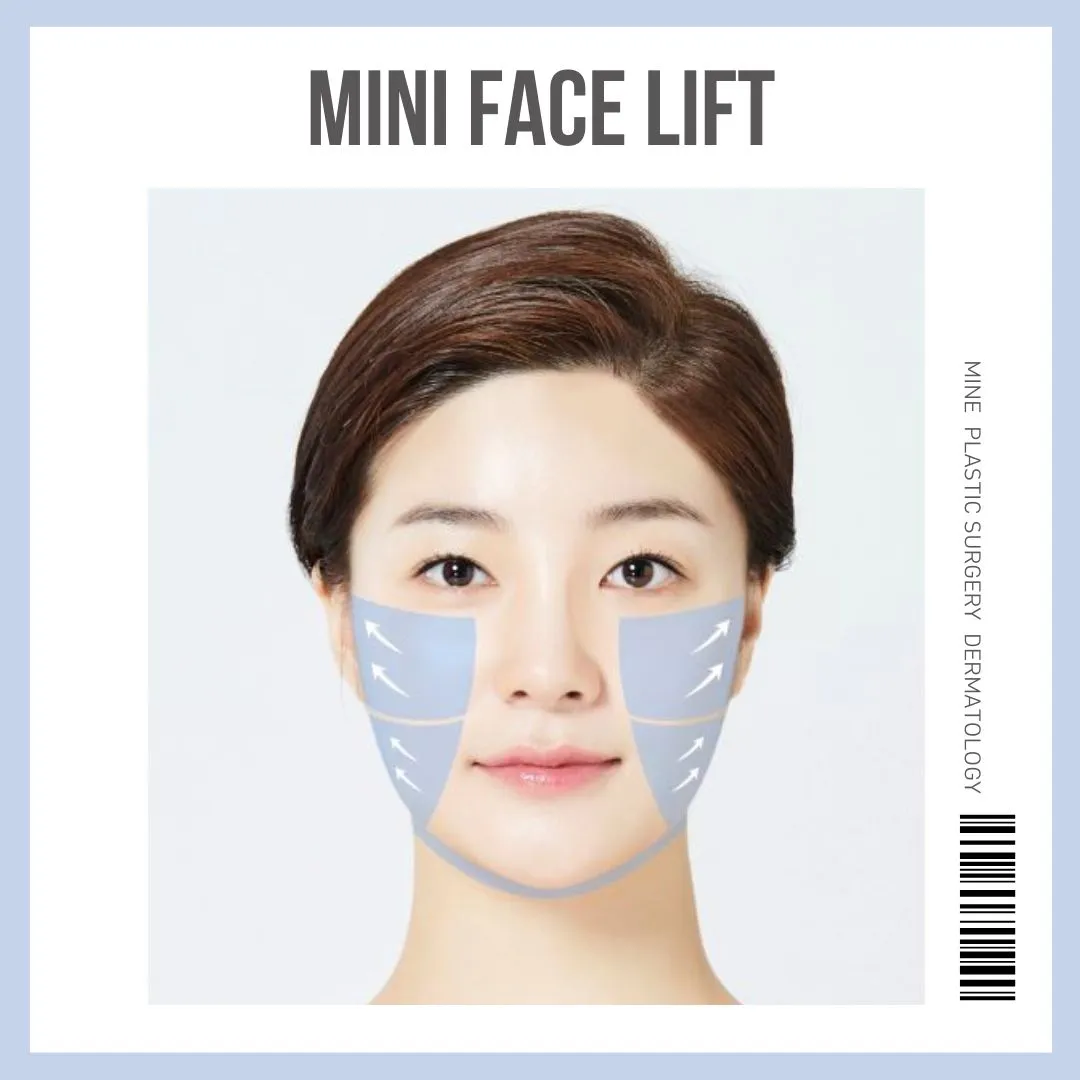
A mini facelift is a facelift performed through a shorter incision, hidden in the temple hairline and the natural creases around the ear. Through that incision the surgeon lifts the deeper supporting layer of the face (the SMAS) and then redrapes the skin. Together, these steps lift sagging cheeks, jowls and a blurred jawline. It suits mild to moderate sagging and usually involves one to two weeks of social downtime.
You will also see it spelled mini face lift, or called a short-scar facelift or a limited-incision facelift. The word “mini” describes the incision, not the depth of the work. It is still surgery on the SMAS (superficial musculoaponeurotic system), the fibrous, muscle-linked layer that holds the cheek fat in place. That is what separates it from a thread lift or an energy-based treatment such as HIFU.
“In my practice, the small part of a mini facelift is the scar, not the lift,” explains Dr. Lee Sung-wook, board-certified plastic surgeon at MINE in Seoul. “Through the shorter incision we still release and lift the SMAS across the cheek, jowl and jawline area, much as we would in a standard facelift. We stop before the smile line and stay away from the lower eyelid and the side of the nose.”
This guide is about one question: what does a mini facelift give you, and what does it trade away? For the operation itself in detail, read our step-by-step guide to the surgery. For a full head-to-head comparison, see our guide to choosing between a mini and a full facelift.
Mini Facelift Pros and Cons at a Glance
| Pros | Cons |
|---|---|
| Shorter incision, with scars hidden in the hairline and around the ear | Limited effect on heavy neck laxity, the forehead and the eye area |
| Lifts the SMAS layer, not just the skin | Results usually last fewer years than a full facelift |
| About 1–2 weeks before most people return to daily life | Still surgery, with real risks such as hematoma and temporary numbness |
| Natural-looking result when lift direction and skin tension are planned well | Outcome depends heavily on technique, and “mini” means different things at different clinics |
| Can address sagging that fillers, threads or devices no longer improve | Not suitable for advanced sagging or poor skin elasticity |
How Does the Mini Facelift Procedure Work?
Knowing the basic sequence makes the pros and cons below easier to judge. At MINE, the operation usually follows these steps:
- Design: the lift is marked while you are upright, so gravity shows where the tissue actually falls.
- Anesthesia: sedation or general anesthesia, chosen according to your health and the planned extent.
- Incision: a short incision runs from inside the temple hairline down along the front of the ear and around the earlobe. It is shorter than a full facelift incision, which continues further behind the ear.
- SMAS lift: the SMAS is released and moved upward and backward, in line with the cheek muscles, then stitched to the firm tissue in front of the ear.
- Skin redraping and closure: the skin is laid back over the lifted layer without being stretched, the excess is trimmed, and the incision is closed in layers.
The surgery typically takes about one to three hours, depending on the extent of the lift and whether other procedures are added. Fine drains, if used, are usually removed within a day or two.
Key Benefits of Mini Facelift Surgery
1. A Shorter Incision and Well-Hidden Scars
The most obvious advantage is the shorter incision. The scar sits inside the temple hairline and along the natural creases around the ear, so once healed it is usually hard to spot in conversation. Every incision leaves a scar, and how it matures depends on your skin type and aftercare. Our guide to minimizing facelift scars covers the details.
2. A True SMAS Lift, Not a Skin Pull
Facial sagging is not just loose skin. With age, the SMAS and the fat attached to it slide downward, deepening the smile lines and forming jowls. Plastic surgery textbooks note that a skin-only facelift has a limited effect on this heavier, deeper tissue. Because a properly performed short-scar lift repositions the SMAS, the lift is carried by the deeper layer and not by tension on the skin.
3. Shorter Downtime
Most patients return to daily life about one to two weeks after the procedure, compared with roughly two to four weeks after a full facelift. That matters for international patients planning a trip to Seoul. Stitches near the ear usually come out around day 5–7, so a stay of about 7–10 days is often enough for the first checks.
4. Natural-Looking Results
A well-planned lift avoids the “pulled” or “wind-swept” look. The SMAS is moved along the natural direction of the cheek muscles, and the skin is closed without tension. The aim is a rested version of your own face rather than a different one. In practice, patients more often hear “you look well” than “did you have surgery?”
5. A Good Fit for Earlier Sagging and Post-Contouring Laxity
The procedure is often considered by people in their late 30s to early 50s who have mild to moderate sagging and good skin elasticity. It is also used when facial contouring, jaw surgery or liposuction has left loose skin, and when fillers, Botox or thread lifts no longer give a visible improvement. It can be combined with fat grafting, double-chin liposuction or a neck lift when the plan calls for it.
Limitations of Mini Facelift Procedures
1. Limited Reach Beyond the Cheek and Jawline
A mini facelift works on the mid-to-lower face: the cheeks, jowls, jawline and the outer part of the smile lines. It does not lift the brow or the eyelids. It also cannot fully correct heavy neck skin or prominent neck bands, because those need the longer incision of a face and neck lift.
2. Results Usually Last Fewer Years
Results commonly last around 5–7 years, while a full facelift is often expected to last 7–10 years or more. Aging continues after any lift. Genetics, sun exposure, smoking and weight changes all affect how long the improvement shows. Textbooks also note that methods relying only on stitching the SMAS in place (plication) can loosen sooner, which is one reason releasing and repositioning the SMAS matters.
3. It Is Still Surgery, With Real Risks
A shorter scar does not make the operation risk-free, because the SMAS is still released and lifted. Possible problems include:
- Bruising and swelling: almost everyone has some, peaking around day 3–4 and settling over 1–2 weeks.
- Temporary numbness or tightness around the ears and cheeks, usually improving within 3–6 months.
- Hematoma (a collection of blood under the skin): most often appears within the first 48 hours and needs prompt treatment.
- Infection: uncommon with proper care.
- Facial nerve weakness: rare and usually temporary.
For context, a plastic surgery textbook reports on 3,500 facelifts performed with lateral SMASectomy, a SMAS technique also used in short-scar facelifts. Hematoma occurred in about 1.5% of women and 4% of men, and infection in about 1% of patients. Facial nerve weakness occurred in 0.1% of patients, and in every case it resolved within six months. The American Society of Plastic Surgeons lists the same kinds of complications for facelift surgery in general.
Smoking, uncontrolled blood pressure and blood-thinning supplements raise these risks, which is why preparation matters.
4. Technique Varies, and So Do Results
“Mini facelift” is not a single standard operation. Some clinics use the name for a skin-only lift or a very short incision that leaves no room to release the SMAS properly. Surgical texts also describe a typical short-scar problem: when skin is pulled straight upward, it can bunch near the ear or shift the temple hairline, because skin and SMAS need to move in different directions. Before booking, ask exactly how the SMAS is handled and where the incision will run. Our 7-point clinic checklist lists the questions to ask.
Useful questions for your consultation:
- Will you release and lift the SMAS, or only tighten the skin?
- Exactly where will the incision run, and will it extend behind the ear?
- Who performs the operation, and who is responsible for the anesthesia?
- If I am traveling home soon after surgery, how will follow-up and any complications be handled?
How a Mini Facelift Compares With a Full Facelift
Here is how the two operations usually compare at MINE:
| Mini facelift | Full facelift | |
|---|---|---|
| Typical sagging | Mild to moderate | Moderate to severe |
| Incision | Temple hairline, front of the ear, around the earlobe | Longer, continuing behind the ear into the hairline |
| Main areas improved | Cheeks, jowls, jawline, outer smile lines | Whole lower face plus neck |
| Anesthesia | Sedation or general | General |
| Return to daily life | About 1–2 weeks | About 2–4 weeks |
| Typical longevity | Around 5–7 years | Around 7–10+ years |

How to Determine the Best Option for You
A mini facelift tends to suit you if:
- Your sagging is mainly in the cheeks, jowls and jawline, not the neck
- Your skin still has good elasticity
- You want a shorter recovery and a smaller scar
- Non-surgical treatments no longer give you a visible change
A full facelift or face and neck lift is usually the better choice if your neck skin is loose, your sagging is advanced, or you want the longest-lasting result from a single operation. Age is only a guide. Our article on the right age for a facelift explains why the degree of sagging matters more than the number.
How to Prepare for a Mini Facelift
Good preparation lowers your risk and shortens recovery:
- Stop smoking at least two weeks before surgery, and stay smoke-free during healing
- Pause aspirin, vitamin E, omega-3 and other blood-thinning supplements two weeks ahead, only after checking with your doctor
- Get blood pressure, diabetes and other conditions under control beforehand
- If you are traveling to Seoul, plan to stay about 7–10 days for stitch removal and the first check-ups
- Follow the fasting instructions you are given for the day of surgery
What is the Recovery Process After a Mini Facelift?
Recovery is quicker than after a full facelift, but it still follows clear stages:
| Time after surgery | What to expect |
|---|---|
| Days 0–3 | Compression dressing; sleep with your head raised; no alcohol or saunas; any drains usually removed after 1–2 days |
| Days 4–7 | Swelling and bruising, which usually peak around day 3–4, begin to ease; stitches near the ear removed around day 5–7 |
| Weeks 1–2 | Most people return to daily life and work, with some swelling still visible |
| Weeks 2–4 | Light makeup is usually fine from about week 2; avoid strenuous exercise for about a month; scar care begins |
| Months 3–6 | Most swelling has gone and the jawline settles into its final shape |
For a week-by-week aftercare plan, see our complete mini facelift guide, which covers everything from how the surgery works to how you recover. You can also read patients’ own accounts of their recovery.
Is a Mini Facelift Worth It?
A mini facelift is usually worth it if you have early to moderate sagging in the lower face, good skin quality, and limited time for recovery. In that case it can give a real structural lift with a smaller scar. It is usually not worth it if your main concern is the neck, your sagging is advanced, or you mainly want the longest-lasting result. For those patients, a full facelift often gives better value over the years.
If your sagging is still very mild, non-surgical options such as thread lifts or HIFU may be enough for now, with the understanding that their effect is shorter-lived and does not reposition the SMAS. Many patients use them first and consider surgery once they stop making a visible difference.
“Rather than deciding that one operation is simply better, look at how much sagging you have, your skin condition, how much recovery time you can take and what result you expect,” advises Dr. Lee Sung-wook. Choosing the procedure that matches the face, not the one with the smallest scar, is what makes the result feel worthwhile.
Frequently Asked Questions About Mini Facelifts
How long do mini facelift results last?
Results commonly last around 5–7 years, though this varies from person to person. Genetics, sun exposure, smoking and weight changes all play a part. Aging continues after surgery, but the face starts from a lifted position. Sun protection and a stable weight help the result last longer.
What age is best for a mini facelift?
Many patients are in their late 30s to early 50s, when sagging has started but skin elasticity is still good. Age alone does not decide candidacy, though. Someone in their 30s with laxity after facial contouring may be a good candidate, while someone in their 50s with heavy neck laxity may need a full facelift instead.
Can a mini facelift be combined with other procedures?
Yes. Common combinations include fat grafting for lost volume, double-chin liposuction for the jawline, a neck lift when the neck is also loose, and eyelid surgery or a brow lift for the upper face. Combining procedures can lengthen the surgery and recovery, so your surgeon will weigh this against your health and schedule.
How visible are mini facelift scars?
The incision is placed inside the temple hairline and along the natural creases around the ear. Once healed, the scar is usually hard to notice at conversational distance. It is often red or slightly raised for the first months and gradually fades over about a year. Scar care and sun protection help it settle.
What’s the difference between a mini facelift and a mid-facelift?
A mini facelift lifts the cheek, jowl and jawline area through a short incision near the ear. A mid-facelift targets the upper cheek and the area under the eyes, often through incisions near the lower eyelid or inside the mouth. They treat different zones and can sometimes be combined.
How much does a mini facelift cost in Korea?
It usually costs less than a full facelift, because the operation is shorter. The final quote depends on the extent of the lift, the anesthesia, and any combined procedures. Our breakdown of facelift cost in Korea explains what drives the price, and an exact quote is given after an in-person or online assessment.
Conclusion
The pros of a mini facelift are a shorter scar, a genuine SMAS lift and a faster return to daily life. The cons are a narrower treatment area, results that usually fade sooner than a full facelift, and the ordinary risks of surgery. If your sagging is mild to moderate and centered on the cheeks and jawline, the trade-off often makes sense. If your neck or advanced sagging is the main concern, a fuller operation is usually the better choice.
To see how MINE approaches the operation, read about our mini facelift in Korea or browse our wider Korean facelift overview. A consultation with a board-certified plastic surgeon is the only reliable way to tell which option fits your face.
References: Plastic Surgery, Volume 2: Aesthetic Surgery (facelift chapters on SMAS techniques, short-scar facelifts, skin–SMAS vectors and lateral SMASectomy complications); Selected Readings in Plastic Surgery — The Aging Face (short-scar facelift with lateral SMASectomy); patient information from the American Society of Plastic Surgeons. Medically reviewed by Dr. Lee Sung-wook, board-certified plastic surgeon at MINE, Seoul. Last reviewed: October 2026.
※ This content is for informational purposes only and does not replace professional medical advice, diagnosis, or treatment. Individual results may vary, and side effects may occur. Please consult with a board-certified plastic surgeon for personalized advice.