EN
EN


Facelift cost in Korea is not a fixed price but a quote assembled from how deep and how wide the surgeon works beneath the skin — how much of the SMAS support layer is lifted, and how many retaining ligaments are released. Two clinics can quote the same face very differently and both quotes can be honest, because they are describing two different operations.
Across the consultation desk, the question I am asked most often is not what the number is. It is why the numbers do not agree. That is the more useful question, and it is the one this article answers.
In my clinical experience, patients who understand one principle read a quote far more calmly: a facelift is not a single operation with a single fee. It is a plan, and the plan is written on your face before it is written on paper. What follows is how that plan is built, and what each decision inside it does to the total.
Table of Contents
- What a facelift quote is actually paying for
- Who is a candidate, and why your face sets the scope
- The 6 essential factors behind facelift cost in Korea
- Why Korean clinics quote a facelift package price
- From consultation to discharge: where the hours go
- Downtime is a cost line, not a footnote
- Why the cheapest quote is rarely the cheapest outcome
- How to audit a facelift quote before you sign
- Frequently asked questions
What a Facelift Quote Is Actually Paying For
Most people picture a facelift as skin being pulled tight and stitched. That description is comfortable, and it is wrong in a way that makes quotes impossible to read. Skin is the last layer the surgeon touches, and it is not where the operating time goes.
The Support Layer Under Your Skin
Beneath the skin of the face sits the SMAS — the superficial musculoaponeurotic system. In plain terms, it is a continuous sheet of muscle and fascia that holds the face up, rather like a hammock stretched across the cheek. Anchoring that hammock to the bone underneath are the retaining ligaments: short, tough fibrous bands that keep the cheek and jawline where they belong.
Medical textbooks treat facial aging largely as a mechanical event. Those ligaments lengthen, the SMAS slides downward, and the soft tissue that used to sit over the cheekbone settles along the jaw. Tightening only the skin leaves both of those changes untouched, which is why a skin-only lift tends to relax again.
Releasing the Retaining Ligaments Is the Real Work
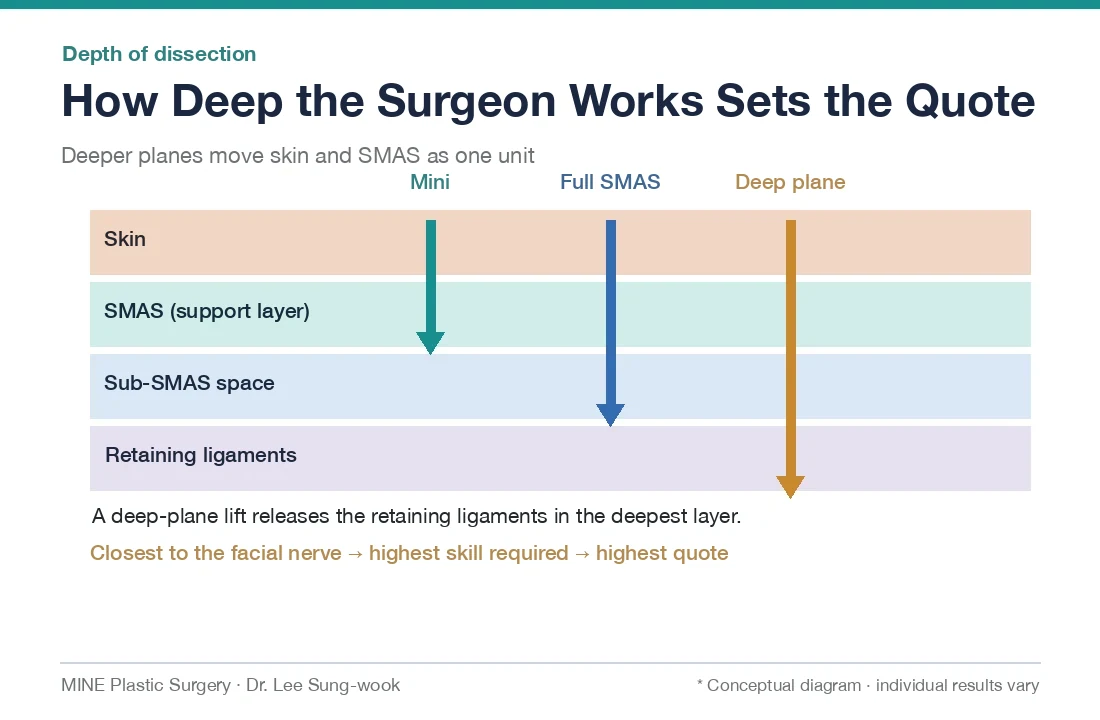
The surgical literature describes the release of these retaining ligaments as fundamental to deep-plane surgery. That single sentence explains most of what a quote is measuring. The hours are spent freeing tissue that is holding the face down, not closing the incision at the end.
There is a second reason that release is demanding. The retaining ligaments double as landmarks for the facial nerve: the zygomatic and buccal branches, which drive the muscles of expression, emerge from the deep fascia and cross beneath the SMAS just inside the cheek ligaments. Working in that layer means working alongside those branches with a clear anatomical map. That is skill and time, and skill and time are what a quote prices.
Depth of Dissection Is the Price Ladder
It helps to stop thinking of facelift techniques as products on a menu and start thinking of depth as a continuous scale. At the shallow end, the surgeon works just under the skin. Further along, the SMAS itself is folded, trimmed, or elevated. At the deep end, the dissection passes beneath the SMAS so that skin and support layer move together as one composite unit. Each step along that scale adds dissection, and dissection adds hours. That ladder, not a brand name, is what moves facelift cost in Korea from one clinic’s quote to another’s.
This article stays on the money question, so the surgical detail is handled elsewhere on this site. If you want the scope of a lighter operation set against a wider one, we cover how the scope of a mini and a full lift differ in a separate article. For the anatomy of the deepest plane, read what the deep plane technique involves.
Who Is a Candidate, and Why Your Face Sets the Scope
Candidacy is usually written as a preamble to pricing. It is not. It is the first cost variable, because the amount of laxity determines the amount of dissection, and the amount of dissection determines how long you are in the operating room.
What the Pattern of Descent Tells the Surgeon
Two faces of the same age can need very different operations. Laxity that is confined to the jawline, with a cheek that still sits high, is a limited problem and often does not call for the deepest plane. Descent through the mid-cheek, with deepening nasolabial folds and volume that has slipped toward the jaw, is where release of the deeper ligaments earns its cost — that tissue cannot be repositioned from a shallow layer.
Why Your Own Anatomy Decides the Extent of Surgery
The surgical literature is explicit on this point: the position and tightness of a patient’s own retaining ligaments dictate how much of the SMAS has to be elevated to free the tissue at all. Some faces release early; others hold on until the dissection is carried well into the cheek.
That is the honest reason an average price found online cannot be applied to a face nobody has examined. Skin thickness, ligament strength, the pattern and degree of descent, and any previous surgery all vary from person to person. There is no universal extent of surgery, so there can be no universal number attached to it.
When a Lighter Operation Is the Honest Answer
Paying for a deeper operation than your anatomy requires is not better value — it buys downtime and risk you did not need. The reverse is equally true. An operation that is lighter than the anatomy requires can leave a result that fades early, and a second procedure is the most expensive line item of all.
Before any figure is discussed, I examine skin quality and thickness, where the tissue sits when the face is upright and again when it is lying flat, the strength of the jawline, the state of the neck, and the medical history. Only then is there a plan worth pricing.
The 6 Essential Factors Behind Facelift Cost in Korea
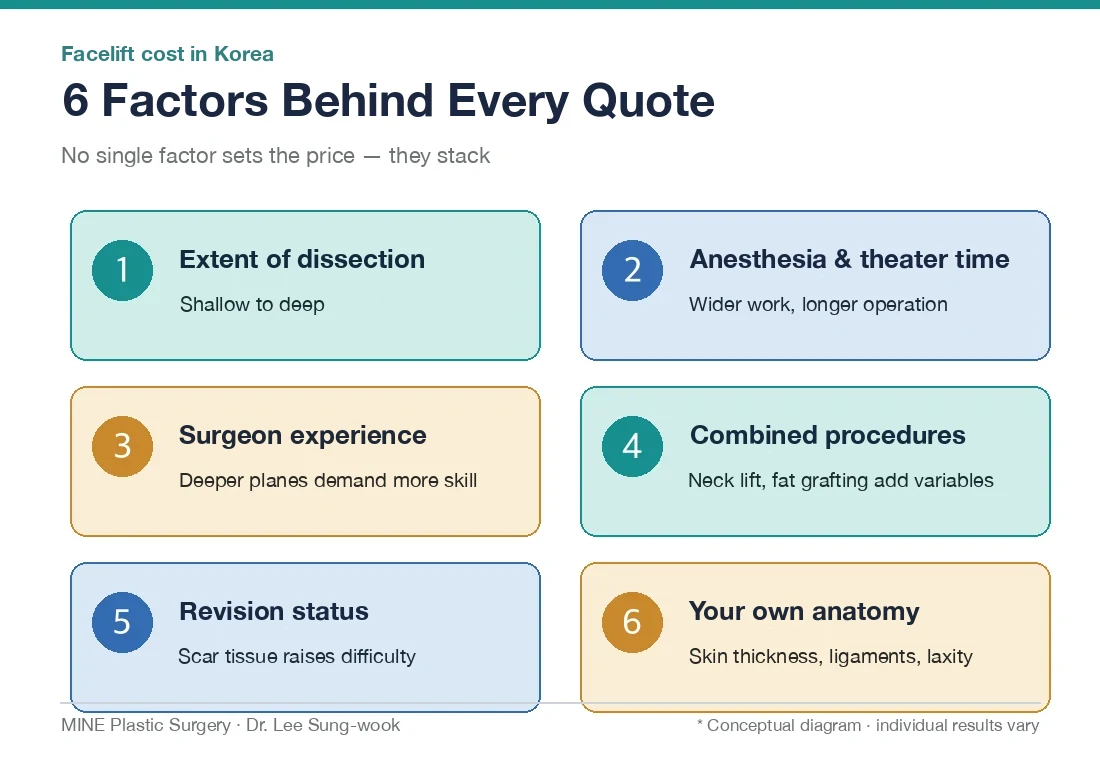
When patients ask why facelift cost in Korea moves so much between clinics, this is the list I work through with them. These six are not independent line items on an invoice — they stack, and each one changes the size of the operation being described.
1. Extent of Dissection
A short-scar procedure that repositions a limited area, a wide elevation of the SMAS, and a release carried beneath the SMAS are three different operations in duration and difficulty, ordered by depth. This is the single largest variable behind any quote, and everything below is downstream of it. For the Korea-specific version of the deepest approach, see our guide to the deep plane facelift in Korea.
2. Anesthesia Type and Operating Room Time
This is the most mechanical of the six. A wider dissection means a longer anesthetic, a longer occupation of the operating room, and more hours from the anesthesiologist, scrub nurse, and recovery staff. Whether the case is done under sedation or general anesthesia, and whether a dedicated anesthesiologist monitors you throughout, are both real cost inputs and both worth asking about by name.
3. Surgeon Experience and Case Volume
In the deep plane, the dissection runs close to the branches of the facial nerve. What you are buying at that point is anatomical judgment — knowing where the plane opens safely, where it does not, and when to stop. Surgeons who perform this operation in volume price that judgment into their fee. Our guide on how to choose a facelift specialist covers the questions that reveal genuine volume.
4. Combined Procedures
A neck lift, eyelid surgery, or fat grafting performed in the same session changes the scope of the operation and therefore the quote. Modern facelifting has moved steadily toward restoring lost volume rather than only tightening what remains, so fat grafting is now a common companion rather than an upsell. Each addition extends the anesthetic and the operating room booking, which is why a combined plan should be quoted as one plan, not assembled at the last minute.
5. Revision Status
Previous surgery leaves scar tissue and distorted tissue planes. Layers that separate cleanly in an untouched face have to be found and freed carefully in a revision, which lengthens the dissection and raises the difficulty. A revision quote that matches a primary quote deserves a question about how the extra time has been accounted for.
6. Your Own Anatomy
Skin thickness, ligament strength, and the degree of descent differ from patient to patient, as described above. This is the factor no price list can carry, and it is the reason the same operation is quoted differently for two people of the same age.
Stack all six and the arithmetic becomes clear. An average figure circulating online is no more than a rough reference, because it is describing an operation that may have almost nothing in common with the one your face needs.
Why Korean Clinics Quote a Facelift Package Price
International patients often notice that Korean clinics quote a bundled figure rather than an itemized list, and assume it is a marketing device. It is usually the opposite: it exists because your care is a schedule, not a single event.
What a Face Lifting Package Cost in Korea Usually Rolls Together
Someone flying in for surgery needs an assessment, the operation itself, an anesthesia team, recovery-room or inpatient time, dressing changes, suture removal, and a final review before a long flight home. Bundling those into one face lifting package is what makes the trip straightforward to plan. A typical package covers:
- the surgical fee
- anesthesia and the anesthesiologist
- operating and recovery room time
- standard post-operative visits
- dressings
- medication
- a starter scar-care regimen
- interpreter or coordinator support
What Commonly Sits Outside the Package
The items most often excluded are predictable, and every one of them is worth confirming in writing:
- pre-operative imaging and blood work
- an extended stay if healing is slower than planned
- procedures added on the day of surgery
- the revision policy
- accommodations and airport transfers
- aftercare products beyond the starter regimen
- how VAT is treated
None of these are hidden charges when they are stated up front. They become a problem only when nobody asks.
The Questions That Reveal the Real Total
Two questions do most of the work. First: what happens to the total if the operation runs longer than planned? Second: what happens if a second procedure is added during surgery? A clinic that answers both without hesitation is quoting a plan it has thought through. A vague answer to either is the clearest early warning you will get.
From Consultation to Discharge: Where the Hours Go
It is easier to judge a quote once you can see what is actually being bought. Almost every element of facelift cost in Korea resolves into two units: hours in the operating room and appointments on the calendar. The incision itself is not one of them.
The Examination That Precedes Any Number
The assessment comes first and it is not a formality. Skin quality and thickness, ligament strength, the degree and pattern of descent, the condition of the neck, previous surgery, medications, and general health all shape the operative plan. A quote issued before that examination is a quote for an operation nobody has planned yet.
Operating Room Time and the Anesthesia Team
Inside the operating room, the slow part is the dissection. Closure is the quick part. A deeper plane adds time because the surgeon is releasing tissue immediately alongside nerve branches rather than lifting skin away from it. That is why operating time, not incision length, is the honest cost driver — a short scar can sit above a long and demanding dissection.
Follow-Up Visits Are Scheduled, Not Optional
After surgery there are dressing checks, suture removal, and a final review before long-haul travel. These are appointments with dates attached, and they are either inside your quote or outside it. Ask how many visits are included and what an additional visit involves, particularly if your flight home is already booked.
Downtime Is a Cost Line, Not a Footnote
For an international patient, the calendar is a real expense. Unpaid leave, changed flights, and extra nights of accommodations belong in the budget alongside the surgical fee, and they are set by the same variable that sets the fee.
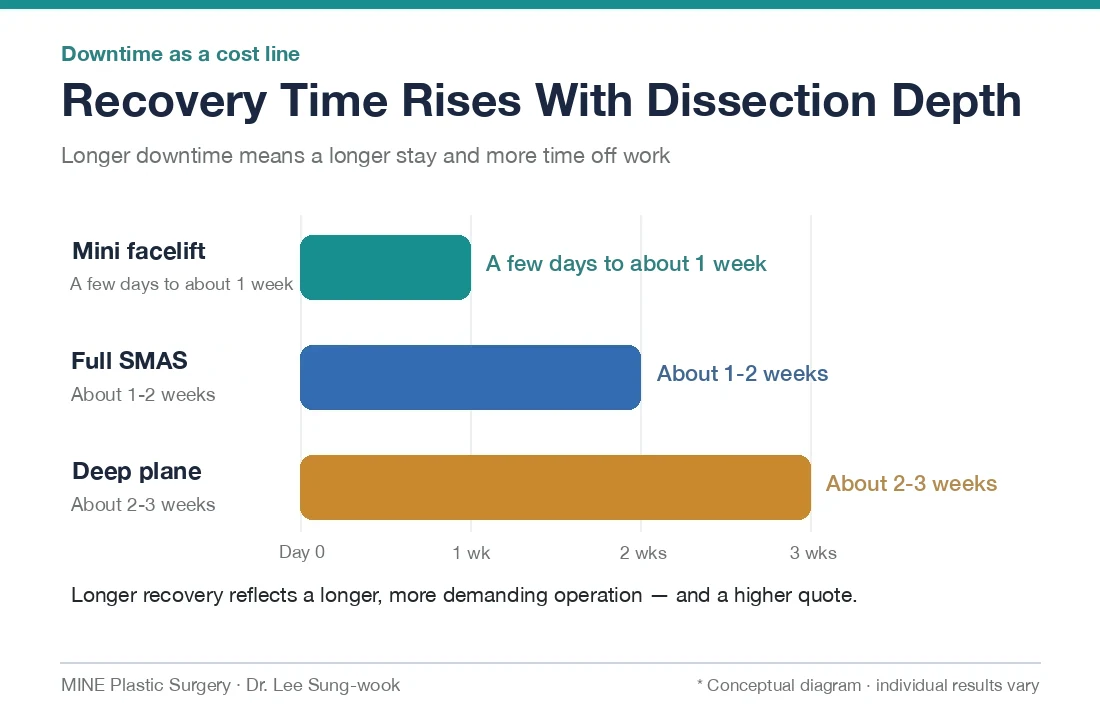
Recovery Time Rises With Dissection Depth
Recovery runs from a few days after the most limited operation to about 2 to 3 weeks after the deepest. The reason is simply how much tissue was released. Bruising, swelling, and temporary altered sensation are expected in the early phase and settle with time in the great majority of patients. For the day-by-day picture, see the full recovery timeline after a deep plane lift rather than trying to plan from a summary.
Time Off Work and Length of Stay in Korea
Budget the weeks, not only the operation. A plan that saves a modest amount on the surgical fee has not saved anything if it costs you an extra ten days in Seoul, or sends you back to camera-facing work before the swelling has settled. Decide first how many days you can realistically be away, then discuss with the surgeon which operation fits inside that window.
Why the Cheapest Quote Is Rarely the Cheapest Outcome
Every operation carries risk, and a quote that leaves out the management of that risk is smaller on paper rather than smaller in reality. Published outcome data is useful here because it puts numbers on what a low quote may be quietly excluding.
What a Published Surgical Series Actually Reports
In a published series of 3,500 lateral SMASectomy facelifts, hematoma — a collection of blood under the skin that has to be drained — occurred in 1.5% of women and 4.0% of men. In the same series, skin slough was reported in 2.0% of cases, scar revision in 2.0%, and infection in 1.0%. These are figures from that published series, not outcome data from our own clinic, and they are quoted here to show the shape of the risk rather than to predict any individual result.
Facial nerve weakness in that same series occurred in 0.1% of cases, and all of those resolved within six months. Nerve dysfunction is described in the surgical literature as the most feared complication of any facelift, and in a separate series of platysma-SMAS plication — a technique that folds the support layer rather than releasing it — none of the nerve complications proved permanent. If a complication does arise, our article on what to do when problems arise after a facelift sets out the practical steps.
A Second Operation Is a Cost the First Quote Did Not Carry
The most striking figure in that series is a different one. Within a year, 2.0% of patients underwent a further limited lift. That is the clearest cost argument available: a second operation carries its own fee, its own anesthesia, its own recovery, and, for an overseas patient, a second flight. No initial quote includes it, and the shallower the first operation relative to what the face needed, the more likely that conversation becomes. How long a result holds is a separate subject, covered in our guide to how long facelift results hold.
Complication Management Belongs in the Budget
Risk is never zero for any surgical procedure. What varies between clinics is whether the follow-up needed to manage a problem is already inside the quote. Ask directly: if bleeding needs to be drained, if healing is slow, or if a scar needs revising, who pays for the extra visits, and is there a written revision policy? A number that excludes all of that is not a lower price. It is a shorter list.
How to Audit a Facelift Quote Before You Sign
Two quotes only mean something side by side once you know they describe the same operation. This is the checklist I would use in your position, and none of it requires knowing any amounts — it is simply how to read what a quote does and does not contain when you are weighing facelift cost in Korea.
The Line Items That Should Already Be in Writing
- Surgical fee, with the planned depth and extent of dissection stated
- Anesthesia, and whether an anesthesiologist monitors the whole case
- Operating room and recovery room time
- Pre-operative imaging and blood work
- The number of follow-up visits included, and suture removal
- Scar-care regimen and post-operative medication
- Pricing for any combined procedure, agreed in advance
- The written revision policy
- How VAT is treated
- Interpreter or patient coordinator support
Questions That Expose an Incomplete Quote
- Ask who administers and monitors the anesthesia.
- Ask how many of these operations the surgeon performs in a typical year.
- Ask which plane is planned for your anatomy and why that plane rather than a shallower or deeper one.
- Ask what is included if you need an extra week in Korea.
- Ask for the revision policy in writing.
That last point is the single most useful action in this article. Request inclusions in writing rather than verbally — a written list can be read side by side with another clinic’s list, and a verbal assurance cannot. Board certification can be verified independently through professional bodies such as the American Society of Plastic Surgeons and ISAPS, which is worth doing before anything else on this list.
Frequently Asked Questions About Facelift Cost in Korea
Why does facelift cost in Korea vary so much between clinics?
Because “facelift” is not one operation. How deep and how wide the surgeon dissects changes the operating time, the anesthetic, and the level of anatomical skill required, and those three drive the quote. Add combined procedures, revision status, and individual anatomy, and two quotes for the same patient can be describing genuinely different operations.
What should a facelift quote in Korea include?
At minimum: the surgical fee with the planned extent stated, anesthesia and the anesthesiologist, operating and recovery room time, pre-operative assessment, a stated number of follow-up visits, suture removal, scar care, medication, and a written revision policy. Ask for those inclusions in writing before you book travel dates.
Why does deeper dissection raise a facelift quote?
Working beneath the SMAS means releasing the retaining ligaments, which serve as landmarks for the zygomatic and buccal branches of the facial nerve. That takes longer and demands more anatomical judgment, and operating time plus expertise is exactly what a quote measures. See what the deep plane technique involves for the surgical detail.
What does a face lifting package cost in Korea usually cover?
A package bundles the whole episode of care rather than a single event: the operation, the anesthesia team, recovery, standard follow-up visits, dressings, medication, and coordinator support. Imaging, an extended stay, procedures added on the day, accommodations, and the revision policy are the items most often outside it, so confirm each one individually.
How long do I need to stay in Korea after a facelift?
Long enough for suture removal and a final review before a long flight, which is precisely why downtime is a budget line rather than a footnote. The deeper the dissection, the longer that window runs. Plan the trip around the recovery schedule rather than around the cheapest available return fare.
Why is the cheapest facelift quote rarely the cheapest outcome?
Because of what has been left out. In a published series of 3,500 lateral SMASectomy facelifts, 2.0% of patients underwent a further limited lift within a year — a second operation the first quote never carried. Complication management, additional follow-up visits, and a missing revision policy are the costs a low number tends to hide.
Your Face Sets Your Quote: Book an In-Person Assessment
The short answer to what determines facelift cost in Korea is this: the quote follows the plan, and the plan follows the examination. Depth of dissection, anesthesia and operating time, surgeon experience, combined procedures, revision status, and your own anatomy stack together into one operation — yours — and that is the only operation worth pricing.
At MINE Plastic Surgery & Dermatology in Gangnam, Seoul, Dr. Lee Sung-wook examines the face in person, explains which plane is appropriate and why, and sets out the inclusions before any figure is discussed. You can review the facelift assessment at MINE beforehand, or browse all lifting procedures at MINE to see where a surgical lift sits among the alternatives.
International patients can begin with an online consultation to establish whether surgery is the right direction at all, then plan travel around the follow-up schedule instead of the other way around. To arrange an assessment, contact MINE Plastic Surgery & Dermatology, 813 Nonhyeon-ro, Gangnam-gu, Seoul, or call +82-2-516-1175.
Written and medically reviewed by Dr. Lee Sung-wook, board-certified plastic surgeon, MINE Plastic Surgery & Dermatology.
※ This content is for informational purposes only and does not replace professional medical advice, diagnosis, or treatment. Individual results may vary, and side effects may occur. Please consult with a board-certified plastic surgeon for personalized advice.